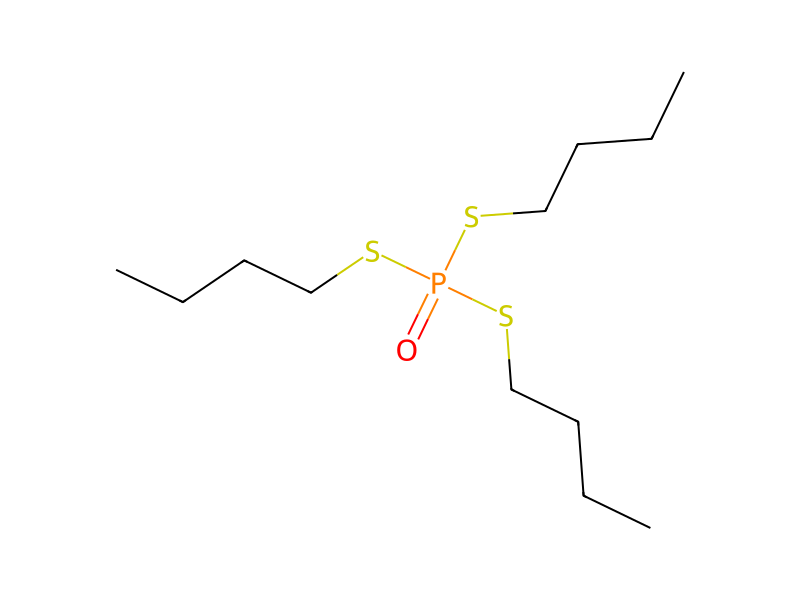
기본 정보
- 표준 SMILES
CCCCSP(=O)(SCCCC)SCCCC- InChIKey
ZOKXUAHZSKEQSS-UHFFFAOYSA-N- 분자식
- C12H27OPS3
- 평균 분자량
- 314.5 g/mol
- 단동위원소 질량
- 314.09616511
개요
Tribufos is a colorless to pale yellow liquid with a skunk-like odor; it is used only as a defoliant (a chemical that removes leaves) for cotton plants. Removing the leaves keeps certain pests that may be found on the leaves from damaging the cotton before it is picked.
이름 및 식별자
- 우선 이름
- Tribufos
- IUPAC
- 1-bis(butylsulfanyl)phosphorylsulfanylbutane
- 현지명
- S,S,S-트리부틸 삼티오인산
- 영어명
- 1,2,4-Tributylphosphorotrithioate
- 분자식
- C12H27OPS3
- 분자량
- 314.51
이름 및 동의어
이름 더 보기
데이터베이스 식별자
- CAS
78-48-8- PubChem CID
- 5125
- DTXSID
DTXSID1024174- ChEMBL
CHEMBL1901047- ChEBI
CHEBI:38737- UNII
- 53075G8GRF
- EC Number
- 201-120-8
- Nikkaji
- J2.827D
물성
구조 계산 물성
- XLogP
- 3.2
- 극성 표면적
- 93 Ų
- 수소 결합 공여자 수
- 0
- 수소 결합 수용자 수
- 4
- 회전 가능 결합 수
- 12
- 무거운 원자 수
- 17
- 형식 전하
- 0
- 복잡도
- 179
실험 및 물리화학적 성질
Pesticides
Pesticide -> EPA IRIS
Plant Growth Regulators
Active substance -> EU Pesticides database: Not approved
Pesticides -> Organophosphate Insecticides
Pesticide (DEF (Tribufos)) -> USDA PDB
Pesticide
LogP
log Kow = 5.7
3.23
Solubility
Soluble in aliphatic, aromatic, and chlorinated hydrocarbons and alcohols. Completely miscible in dichloromethane, n-hexane, 2-propanol, and toluene.
In water, 2.3 mg/L at 20 °C
Vapor Pressure
0.0000053 [mmHg]
5.3X10⁻⁶ mm Hg at 25 °C
물리화학적 성질
- 녹는점
- -25 ° · <-25°
- 끓는 점
- 0.3 · bp0.3 150°; bp4 166.5°
- 밀도
- 204 · d204 1.0552
- 굴절률
- 20 · nD20 1.534
- 저장 조건
- 0 · 0-6°C
- 용해도
- 클로로포름(약간 용해됨), 메탄올(약간 용해됨)
- 물리적 상태
- 기름
- 색상
- 무색
- Henry's Law Constant
- 3.4 · 3.4×101 mol/(m3Pa) at 25℃, Fendinger and Glotfelty (1990)
- NIST
- S,s,s-tributyl phosphorotrithioate(78-48-8)
- EPA
- Tribufos (78-48-8)
화학적 성질
Tribufos is a colorless to yellow liquid. Tribufos is relatively stable to acids and heat and is hydrolyzed slowly under alkaline conditions. Tribufos has a mercaptan or skunk-like odor. Tribufos has a mercaptan or skunk-like odor. Practically insoluble in water (2.3×10⁻⁴ g/ 100 mL); completely miscible in dichloromethane, n-hexane, 2-propanol, toluene.
안전 및 규제
GHS 분류
GHS Classification
Danger
H301 (80.7%): Toxic if swallowed [Danger Acute toxicity, oral]
P262, P264, P270, P273, P280, P301+P316, P301+P317, P302+P352, P316, P321, P330, P361+P364, P391, P405, and P501 (click each P-code to see the statement)
Aggregated GHS information provided per 88 reports by companies from 6 notifications to the ECHA C&L Inventory. Each notification may be associated with multiple companies.
Danger
H301: Toxic if swallowed [Danger Acute toxicity, oral]
유해성 정보
Regulatory Information
Hazard Traits - Carcinogenicity; Neurotoxicity
Phosphorotrithioic acid, S,S,S-tributyl ester is listed on the EPA's Chemical Data Reporting (CDR) system. Manufacturers and importers of Phosphorotrithioic acid, S,S,S-tributyl ester are required to report information about their production and use of this chemical to the EPA under the Toxic Substances Control Act (TSCA). (40 eCFR Part 711)
Tribufos is listed in the dataset of EPA Human Health Benchmarks for Pesticides under the Safe Drinking Water Act (40 eCFR 141)
2002/2076
The New Jersey Worker and Community Right to Know Act requires public and private employers to provide information about hazardous substances at their workplaces. (N.J.S.A. 34:5A-1 et. seq.)
Hazards Summary
Tribufos is a colorless to pale yellow liquid with a skunk-like odor; it is used only as a defoliant (a chemical that removes leaves) for cotton plants. Removing the leaves keeps certain pests that may be found on the leaves from damaging the cotton before it is picked.
Delayed neuropathy has been reported in at least one agricultural worker; Causes moderate skin and minimal eye irritation in rabbits; Anemia observed in females during one year feeding at nominal doses (NOEL for anemia in females = 0.4 mg/kg); Effects in two year feeding study with rats include bilateral retinal and optic nerve atrophy, cataract, corneal opacity, and signs of anemia, but no adverse effects observed for oncogenicity or neurotoxicity; Reproductive toxicity observed at doses maternally toxic; No evidence of teratogenicity in two animal studies; Evidence for delayed neurotoxicity in hens exposed to single dermal dose of 250-1000 mg/kg; No evidence of mutagenicity; [HSDB] The average of two baseline respective cholinesterase activity determinations three days apart, with no exposures to enzyme inhibiting pesticides for at least 30 days, is recommended for each worker prior to exposure to cholinesterase inhibitors because of large inter-individual differences in published baseline values. To be established at least once a year. Removal from workplace exposures is recommended until the cholinesterase activity returns to within 20% of baseline. [TLVs and BEIs]
Special Reports
USEPA/Office of Pesticide Programs; Interim Reregistration Eligibility Decision (IRED) for Tribufos. EPA issues an IRED for a pesticide that is undergoing reregistration, requires a reregistration eligibility decision, and also needs a cumulative assessment under FQPA. The IRED, issued after EPA completes the individual pesticide\'s aggregate risk assessment, may include taking risk reduction measures -- for example, reducing risks to workers or eliminating uses that the registrant no longer wishes to maintain -- to gain the benefits of these changes before the final RED can be issued following the Agency\'s consideration of cumulative risks.[Available from, as of February 7, 2006: http://www.epa.gov/pesticides/reregistration/status.htm]
USEPA, Gulf Breeze Environmental Research Lab. Acephate, Aldicarb, Carbophenthion, DEF, EPN, Ethoprop, Methyl Parathion, & Phorate: Their Acute & Chronic Toxicity, Bioconcentration Potential, & Persistance as Related to Marine Environments. EPA-600/4-81-041. (NTIS PB81-244477). May 1981.
FIFRA Requirements
Tolerances are established for residues of the defoliant tribuphos (S,S,S-tributylphosphorotrithioate) in or on food commodities as follows: Cattle, fat (negligible residue); cattle, meat byproducts (negligible residue); cattle, meat (negligible residue); cotton, undelinted seed; goat, fat (negligible residue); goat, meat byproducts (negligible residue); goat, meat (negligible residue); milk (negligible residue); sheep, fat (negligible residue); sheep, meat byproducts (negligible residue); and sheep, meat (negligible residue).
The Agency has determined that Tribufos is eligible for reregistration provided that: (i) current data gaps and additional data needs are addressed; (ii) the risk mitigation measures outlined in this document are adopted, and label amendments are made to reflect these measures; and (iii) the cumulative risk assessment for the organophosphates support a final reregistration eligibility decision.
As the federal pesticide law FIFRA directs, EPA is conducting a comprehensive review of older pesticides to consider their health and environmental effects and make decisions about their future use. Under this pesticide reregistration program, EPA examines health and safety data for pesticide active ingredients initially registered before November 1, 1984, and determines whether they are eligible for reregistration. In addition, all pesticides must meet the new safety standard of the Food Quality Protection Act of 1996. Pesticides for which EPA had not issued Registration Standards prior to the effective date of FIFRA, as amended in 1988, were divided into three lists based upon their potential for human exposure and other factors, with List B containing pesticides of greater concern and List D pesticides of less concern. S,S,S-tributyl phosphorotrithioate is found on List B. Case No: 2145; Pesticide type: herbicide; Case Status: OPP is reviewing data from the pesticide's producers regarding its human health and/or environmental effects, or OPP is determining the pesticide's eligibility for reregistration and developing the Reregistration Eligibility Decision (RED) document.; Active ingredient (AI): S,S,S-tributyl phosphorotrithioate; Data Call-in (DCI) Date(s): 02/04/91, 10/13/95; AI Status: The producers of the pesticide has made commitments to conduct the studies and pay the fees required for reregistration, and are meeting those commitments in a timely manner.
Reactivity Profile
An organophosphate derivative. Organophosphates are susceptible to formation of highly toxic and flammable phosphine gas in the presence of strong reducing agents such as hydrides. Partial oxidation by oxidizing agents may result in the release of toxic phosphorus oxides.
Hazard Classes and Categories
Acute Tox. 3 (80.7%)
Acute toxicity (Oral) - Category 3
안전 및 보호
Exposure Control and Personal Protection
Biological Exposure Indices (BEI) [ACGIH] - Acetylcholinesterase activity in red blood cells = 70% of individual's baseline; Butylcholinesterase activity in serum or plasma = 60% of individual's baseline; Sample at end of shift; [TLVs and BEIs]
Storage Conditions
Safe Storage of Pesticides. Always store pesticides in their original containers, complete with labels that list ingredients, directions for use, and first aid steps in case of accidental poisoning. Never store pesticides in cabinets with or near food, animal feed, or medical supplies. Do not store pesticides in places where flooding is possible or in places where they might spill or leak into wells, drains, ground water, or surface water.
Cleanup Methods
If a spill occurs, clean it up promptly. Don't wash it away. Instead, sprinkle the spill with sawdust, vermiculite, or kitty litter. Sweep it into a plastic garbage bag, and dispose of it as directed on the pesticide product label.
After Applying a Pesticide, Indoors or Outdoors. To remove pesticide residues, use a bucket to rinse tools or equipment three times, including any containers or utensils that you used when mixing the pesticide. Then pour the rinsewater into the pesticide sprayer and reuse the solution by applying it according to the pesticide product label directions. After applying any pesticide wash your hands and any other parts of your body that may have come in contact with the pesticide..To prevent tracking pesticides inside, remove or rinse your boots or shoes before entering your home. Wash any clothes that have been exposed to a lot of pesticide separately from your regular wash.
Disposal Methods
SRP: The most favorable course of action is to use an alternative chemical product with less inherent propensity for occupational exposure or environmental contamination. Recycle any unused portion of the material for its approved use or return it to the manufacturer or supplier. Ultimate disposal of the chemical must consider: the material's impact on air quality; potential migration in soil or water; effects on animal, aquatic, and plant life; and conformance with environmental and public health regulations.
Safe Disposal of Pesticides. The best way to dispose of small amounts of excess pesticides is to use them - apply them - according to the directions on the label. If you cannot use them, ask your neighbors whether they have a similar pest control problem and can use them. If all of the remaining pesticide cannot be properly used, check with your local solid waste management authority, environmental agency, or health department to find out whether your community has a household hazardous waste collection program or a similar program for getting rid of unwanted, leftover pesticides. These authorities can also inform you of any local requirements for pesticide waste disposal.
Safe Disposal of Pesticides. An empty pesticide container can be as hazardous as a full one because of residues left inside. Never reuse such a container. When empty, a pesticide container should be rinsed carefully three times and the rinsewater thoroughly drained back onto the sprayer or the container previously used to mix the pesticide. Use the rinsewater as a pesticide, following label directions. Replace the cap or closure securely. Dispose of the container according to label instructions. Do not puncture or burn a pressurized container like an aerosol - it could explode. Do cut or puncture other empty pesticide containers made of metal or plastic to prevent someone from reusing them. Wrap the empty container and put it in the trash after you have rinsed it.
Preventive Measures
Wear the items of protective clothing the label requires: for example, non-absorbent gloves (not leather or fabric), rubber footwear (not canvas or leather), a hat, goggles, or a dust-mist filter. If no specific clothing is listed, gloves, long-sleeved shirts and long pants, and closed shoes are recommended. You can buy protective clothing and equipment at hardware stores or building supply stores.
Indoor Applications. If the label directions permit, leave all windows open and fans operating after the application is completed. If the pesticide product is only effective in an unventilated (sealed) room or house, do not stay there. Put all pets outdoors, and take yourself any your family away from treated areas for at least the length of time prescribed on the label. Apply most surface sprays only to limited areas such as cracks; don't treat entire floors, walls, or ceilings. Don't let pesticides get on any surfaces that are used for food preparation. Wash any surfaces that may have pesticide residue before placing food on them.
Indoor Applications. When using total release foggers to control pests, use no more than the amount needed and to keep foggers away from ignition sources (ovens, stoves, air conditioners, space heaters, and water heaters, for example). Foggers should not be used in small, enclosed places such as closets and cabinets or under tables and counters.
Outdoor Applications. Never apply pesticides outdoors on a windy day (winds higher than 10 mph). Position yourself so that a light breeze does not blow pesticide spray or dust into your face.
Allowable Tolerances
Tolerances are established for residues of the defoliant tribuphos (S,S,S-tributylphosphorotrithioate) in or on food commodities as follows: cattle, fat (negligible residue), 0.02 ppm; cattle, meat byproducts (negligible residue), 0.02 ppm; cattle, meat (negligible residue), 0.02 ppm; cotton, undelinted seed, 4 ppm; goat, fat (negligible residue), 0.02 ppm; goat, meat byproducts (negligible residue), 0.02 ppm; goat, meat (negligible residue), 0.02 ppm; milk (negligible residue), 0.002 ppm; sheep, fat (negligible residue), 0.02 ppm; sheep, meat byproducts (negligible residue), 0.02 ppm; and sheep, meat (negligible residue), 0.02 ppm.
독성 정보
Treatment
If the compound has been ingested, rapid gastric lavage should be performed using 5% sodium bicarbonate. For skin contact, the skin should be washed with soap and water. If the compound has entered the eyes, they should be washed with large quantities of isotonic saline or water. In serious cases, atropine and/or pralidoxime should be administered. Anti-cholinergic drugs work to counteract the effects of excess acetylcholine and reactivate AChE. Atropine can be used as an antidote in conjunction with pralidoxime or other pyridinium oximes (such as trimedoxime or obidoxime), though the use of '-oximes' has been found to be of no benefit, or possibly harmful, in at least two meta-analyses. Atropine is a muscarinic antagonist, and thus blocks the action of acetylcholine peripherally.
Interactions
DEF at doses which had little effect on brain acetylcholinesterase, inhibited mouse and rat tissue carboxylesterases and potentiated acute toxic action of organophosphorus insecticides.
Effect of diazinon (0.002%) against female Lucilia cuprina was potentiated by prior treatment with 1% s,s,s-tributyl phosphorotrithioate.
DEF acted as synergist when used with endrin and methomyl against the Egyptian cotton leafworm Spodoptera littorals.
DEF synergized diflubenzuron and Bay Sir 8514 3319- and 45-fold, respectively, in Platynota stultana, but was not synergistic in Spodoptera exiqua.
Target Organs
Gastrointestinal (Stomach and Intestines, part of the digestive system), Hematological (Blood Forming), Neurological (Nervous System)
Nervous
Health Effects
Acute exposure to cholinesterase inhibitors can cause a cholinergic crisis characterized by severe nausea/vomiting, salivation, sweating, bradycardia, hypotension, collapse, and convulsions. Increasing muscle weakness is a possibility and may result in death if respiratory muscles are involved. Accumulation of ACh at motor nerves causes overstimulation of nicotinic expression at the neuromuscular junction. When this occurs symptoms such as muscle weakness, fatigue, muscle cramps, fasciculation, and paralysis can be seen. When there is an accumulation of ACh at autonomic ganglia this causes overstimulation of nicotinic expression in the sympathetic system. Symptoms associated with this are hypertension, and hypoglycemia. Overstimulation of nicotinic acetylcholine receptors in the central nervous system, due to accumulation of ACh, results in anxiety, headache, convulsions, ataxia, depression of respiration and circulation, tremor, general weakness, and potentially coma. When there is expression of muscarinic overstimulation due to excess acetylcholine at muscarinic acetylcholine receptors symptoms of visual disturbances, tightness in chest, wheezing due to bronchoconstriction, increased bronchial secretions, increased salivation, lacrimation, sweating, peristalsis, and urination can occur. Certain reproductive effects in fertility, growth, and development for males and females have been linked specifically to organophosphate pesticide exposure. Most of the research on reproductive effects has been conducted on farmers working with pesticides and insecticdes in rural areas. In females menstrual cycle disturbances, longer pregnancies, spontaneous abortions, stillbirths, and some developmental effects in offspring have been linked to organophosphate pesticide exposure. Prenatal exposure has been linked to impaired fetal growth and development. Neurotoxic effects have also been linked to poisoning with OP pesticides causing four neurotoxic effects in humans: cholinergic syndrome, intermediate syndrome, organophosphate-induced delayed polyneuropathy (OPIDP), and chronic organophosphate-induced neuropsychiatric disorder (COPIND). These syndromes result after acute and chronic exposure to OP pesticides.
Ecotoxicity Values
LC50 Grammarus fasciatus /(Scud)/ 100 ug/L/96 hr at 21 °C (95% confidence interval, 68 to 150 ug/L/96 hr). Static conditions without aeration.
LC50 Pteronarcys 2100 ug/L/96 hr at 15 °C (95% confidence interval, 1500 to 2900 ug/L/96 hr). Static conditions without aeration.
LC50 /Oncorhynchus mykiss/ (Rainbow trout) 660 ug/L/96 hr at 13 °C (95% confidence interval, 560 to 750 ug/L/96 hr). Static conditions without aeration.
LC50 Oncorhynchus mykiss (Rainbow trout, weight 0.91 g) 1700 ppb/96 hr (95% confidence limit: 1300-2300 ppb); flow-through /96.2% AI formulated product/
For more Ecotoxicity Values (Complete) data for TRIBUFOS (19 total), please visit the HSDB record page.
Environmental Fate
TERRESTRIAL FATE: Based on a classification scheme(1), Koc values of 4,870 to 12,684 measured in 4 soils(2),indicate that tribufos is expected to be immobile in soil(SRC). Volatilization of tribufos from moist soil surfaces is not expected to be an important fate process(SRC) given a Henry's Law constant of 2.9X10⁻⁷ atm-cu m/mole(3). Tribufos is not expected to volatilize from dry soil surfaces(SRC) based upon its vapor pressure of 5.3X10⁻⁶ mm Hg(4). Tribufos is very persistent in soils based on an aerobic biodegradation half-life of 745 days in a sandy loam, and an anaerobic biodegradation half-life of 389 days in the same soil(2).
AQUATIC FATE: Based on a classification scheme(1), Koc values of 4,870 to 12,684(2), indicate that tribufos is expected to adsorb to suspended solids and sediment(SRC). Volatilization from water surfaces is not expected(3) based upon a Henry's Law constant of 2.9X10⁻⁷ atm-cu m/mole(4). According to a classification scheme(5), BCF values of 300 to 1,300 measured in fish(2), suggest bioconcentration in aquatic organisms is high to very high(SRC). Tribufos is stable to hydrolysis at pH 5 and 7; however, the half-life at pH 9 was 124 days(2). Photolysis in sunlit surface waters does not appear to be an important environmental fate process(2). Tribufos degrades slowly in aquatic systems, with half-lives of about 120 to 180 days measured in pond sediment(2).
ATMOSPHERIC FATE: According to a model of gas/particle partitioning of semivolatile organic compounds in the atmosphere(1), tribufos, which has a vapor pressure of 5.3X10⁻⁶ mm Hg at 25 °C(2), is expected to exist in both the vapor and particulate phases in the ambient atmosphere. Vapor-phase tribufos is degraded in the atmosphere by reaction with photochemically-produced hydroxyl radicals(SRC); the half-life for this reaction in air is estimated to be 5 hours(SRC), calculated from its rate constant of 7.9X10⁻¹¹ cu cm/molecule-sec at 25 °C(SRC) that was derived using a structure estimation method(3).
Food Survey Values
In the FDA Adult Total Diet studies for Oct 1980 to March 1982, tribufos was detected in 1 sample of an unspecified number of samples of potatoes; no detections were made in (Fiscal Year 1978) nor in any of the foods from the other 12 food groups tested(1). In the FDA study for Oct 1978 to Sept 1979 (Fiscal Year 1979), tribufos was detected in 1 sample of an unspecified number of samples of potatoes at 0.002 ppm; no detections were made in any of the foods from the other 12 food groups tested(2). In FDA studies conducted between Fiscal Years 1982 and 1986, tribufos was detected in 2 of 6,391 samples of U.S. domestic agricultural commodities at a concn of 0.10-0.50 and >2.0 ppm in the 2 samples; it was not detected in 1,239 imported agricultural commodities(3). Tribufos was identified, not quantified, in unspecified food items in the FDA 1999 Pesticide Monitoring program(4). It was not detected in any food items during the 2000 to 2003 monitoring years(4).
Milk Concentrations
The metabolism and residue levels of the defoliant S,S,S-tributyl-phosphorotrithioate (78488) (DEF) were investigated in urine, selected tissue, and milk from a French-Alpine-goat. ... The main route of excretion for the DEF metabolites was the urinary tract, accounting for 52% of the total dose. Fecal excretion accounted for 13% of the total dose. ... The total radioactive residue in fat and milk was composed 31% and 5% respectively of DEF. Less than 1% of the total radioactive residue was contained in the DEF found in the liver, kidney and muscle. The tissue, milk, and urine contained 3-hydroxybutylmethyl-sulfone, a major metabolite. Two minor components of the urine were S,S-dibutyl-phosphorodithioate and S-butyl-phosphorothioate.
Toxicity Summary
S,S,S-Tributyl phosphorotrithioate is a cholinesterase or acetylcholinesterase (AChE) inhibitor. A cholinesterase inhibitor (or 'anticholinesterase') suppresses the action of acetylcholinesterase. Because of its essential function, chemicals that interfere with the action of acetylcholinesterase are potent neurotoxins, causing excessive salivation and eye-watering in low doses, followed by muscle spasms and ultimately death. Nerve gases and many substances used in insecticides have been shown to act by binding a serine in the active site of acetylcholine esterase, inhibiting the enzyme completely. Acetylcholine esterase breaks down the neurotransmitter acetylcholine, which is released at nerve and muscle junctions, in order to allow the muscle or organ to relax. The result of acetylcholine esterase inhibition is that acetylcholine builds up and continues to act so that any nerve impulses are continually transmitted and muscle contractions do not stop. Among the most common acetylcholinesterase inhibitors are phosphorus-based compounds, which are designed to bind to the active site of the enzyme. The structural requirements are a phosphorus atom bearing two lipophilic groups, a leaving group (such as a halide or thiocyanate), and a terminal oxygen.
규제 정보
FIFRA Requirements
Tolerances are established for residues of the defoliant tribuphos (S,S,S-tributylphosphorotrithioate) in or on food commodities as follows: Cattle, fat (negligible residue); cattle, meat byproducts (negligible residue); cattle, meat (negligible residue); cotton, undelinted seed; goat, fat (negligible residue); goat, meat byproducts (negligible residue); goat, meat (negligible residue); milk (negligible residue); sheep, fat (negligible residue); sheep, meat byproducts (negligible residue); and sheep, meat (negligible residue).
The Agency has determined that Tribufos is eligible for reregistration provided that: (i) current data gaps and additional data needs are addressed; (ii) the risk mitigation measures outlined in this document are adopted, and label amendments are made to reflect these measures; and (iii) the cumulative risk assessment for the organophosphates support a final reregistration eligibility decision.
As the federal pesticide law FIFRA directs, EPA is conducting a comprehensive review of older pesticides to consider their health and environmental effects and make decisions about their future use. Under this pesticide reregistration program, EPA examines health and safety data for pesticide active ingredients initially registered before November 1, 1984, and determines whether they are eligible for reregistration. In addition, all pesticides must meet the new safety standard of the Food Quality Protection Act of 1996. Pesticides for which EPA had not issued Registration Standards prior to the effective date of FIFRA, as amended in 1988, were divided into three lists based upon their potential for human exposure and other factors, with List B containing pesticides of greater concern and List D pesticides of less concern. S,S,S-tributyl phosphorotrithioate is found on List B. Case No: 2145; Pesticide type: herbicide; Case Status: OPP is reviewing data from the pesticide's producers regarding its human health and/or environmental effects, or OPP is determining the pesticide's eligibility for reregistration and developing the Reregistration Eligibility Decision (RED) document.; Active ingredient (AI): S,S,S-tributyl phosphorotrithioate; Data Call-in (DCI) Date(s): 02/04/91, 10/13/95; AI Status: The producers of the pesticide has made commitments to conduct the studies and pay the fees required for reregistration, and are meeting those commitments in a timely manner.
안전 데이터
- tsca
- TSCA listed
- rtecs
- TG5425000
- ridadr
- UN 2811
- 독성
- LD50 in male, female rats (mg/kg): 233, 150 orally; 360, 168 dermally (Gaines)
- risk_code
- 24/25-50/53
- hazard_code
- T,N
- safety_code
- 36/37-45-61-60
- 포장분류
- II
- 위험 등급
- 6.1(a)
- 기존화학 물질
- KE-05-1302
- 유해 물질 데이터
- 78-48-8(Hazardous Substances Data)
- 함량 및 규제정보
- 물질구분: 유독물질; 혼합물(제품)함량정보: S,S,S-트리부틸 삼티오인산 및 이를 1% 이상 함유한 혼합물
- 유해화학물질 필터링
- 97-1-462
화학 및 산업
약리 정보
Metabolism/Metabolites
/In animals/ metabolism proceeds by hydrolysis followed by methylation and successive oxidation of butylmercaptan, yielding the main metabolite (3-hydroxy)-butylmethylsulfone.
The data presented here indicate that rodents metabolize and excrete delayed neurotoxic organophosphorus esters with great efficiency. By contrast, the adult chicken seems to have difficulty carrying out these processes. The cat is intermediate between rodents and chickens. Although further studies are needed, these results suggest that the hen model may exaggerate the effect of neurotoxic organophosphorus esters. Extrapolation of findings from the chicken may thus overestimate the risk or hazard of organophosphorus esters to humans. This may explain why no human case of O-ethyl-O-nitrophenyl phenylphosphonothioate induced delayed neurotoxicity has been reported despite the fact that it has been in use for over a quarter of a century. Other neurotoxicity data from our laboratory seem to support the suggestion that the cat may be a better model to extrapolate neurotoxicity results to humans. The data presented in this review suggest that the phrmacokinetics and metabolism of organophosphorus esters may play a prominent role in species and age sensitivities for organophosphorus-induced delayed neurotoxicity. Animals that are sensitive to delayed neurotoxicity have a higher accumulation rate, coupled with slower elimination of the neurotoxic agent. These studies, however, do not rule out the possibility that the target tissue of organophosphorus delayed neurotoxicity itself is species or age specific.
The metabolism and residue levels of the defoliant S,S,S-tributyl-phosphorotrithioate (78488) (DEF) were investigated in urine, selected tissue, and milk from a French-Alpine-goat. ... The main route of excretion for the DEF metabolites was the urinary tract, accounting for 52% of the total dose. Fecal excretion accounted for 13% of the total dose. ... The total radioactive residue in fat and milk was composed 31% and 5% respectively of DEF. Less than 1% of the total radioactive residue was contained in the DEF found in the liver, kidney and muscle. The tissue, milk, and urine contained 3-hydroxybutylmethyl-sulfone, a major metabolite. Two minor components of the urine were S,S-dibutyl-phosphorodithioate and S-butyl-phosphorothioate.
Paraoxonase (PON1) is a key enzyme in the metabolism of organophosphates. PON1 can inactivate some organophosphates through hydrolysis. PON1 hydrolyzes the active metabolites in several organophosphates insecticides as well as, nerve agents such as soman, sarin, and VX. The presence of PON1 polymorphisms causes there to be different enzyme levels and catalytic efficiency of this esterase, which in turn suggests that different individuals may be more susceptible to the toxic effect of OP exposure.
MeSH Pharmacological Classification
Herbicides that remove leaves from trees and growing plants. They may be either organic or inorganic. Several of the more persistent types have been used in military operations and many are toxic. (From Hawley's Condensed Chemical Dictionary, 11th ed)
Compounds or agents that combine with an enzyme in such a manner as to prevent the normal substrate-enzyme combination and the catalytic reaction.
Chemicals that, while not possessing inherent pesticidal activity, nonetheless promote or enhance the effectiveness of other pesticides when combined.
용도 및 제조
Uses
Used as cotton defoliant (for machine harvesting), synergist for insecticides, insecticide, herbicide, and growth regulator; [HSDB] Used in the US strictly for defoliating cotton prior to machine harvesting; General use pesticide; [Reference #1]
Farming (Pesticides) [Category: Industry]
For S,S,S-tributyl phosphorotrithioate (USEPA/OPP Pesticide Code:074801) ACTIVE products with label matches. /SRP: Registered for use in the U.S. but approved pesticide uses may change periodically and so federal, state and local authorities must be consulted for currently approved uses./
Cotton defoliant.
Defoliant /from Table/
... Insecticide, herbicide, growth regulator
U.S. Production
2022: 81,032 lb
(1975) 2.95X10+9 GRAMS (CONSUMPTION)
(1998) 10 thousand-500 thousand pounds
(2002) 10 thousand-500 thousand pounds
Methods of Manufacturing
It is made from butanethiol and phosphorus oxychloride in the presence of a base.
Reaction of butyl mercaptan with phosphorus oxychloride in the presence of a base
Formulations/Preparations
Spray concentrate (700 g active ingredient/L).
Selected products: DEF 6, Folex. Discontinued products: Def, De-Green, E-Z-off D.
There are two technical products of tribufos presently registered. One technical (98.0% ai, liquid) is registered to Bayer (EPA Reg. No. 3125-96) and one to Micro Flo Company (98.1% ai with an EPA Reg. No. 51036-324). There are three liquid end-use products: one registered to Bayer (EPA Reg. No. 3125-282 - 71.5% ai); one registered to Aventis Crop Science (EPA Reg. No. 264-498 - 70.5% ai); and one registered to Micro Flo (EPA Reg. No. 51036-320 -70.5% ai). There was also one Special Local Need (SLN) product registered in Texas, (SLN No. TX810045) which Bayer requested cancellation on July 24, 2000.
Emulsifiable concentrate
For more Formulations/Preparations (Complete) data for TRIBUFOS (8 total), please visit the HSDB record page.
General Manufacturing Information
Phosphorotrithioic acid, S,S,S-tributyl ester: ACTIVE
For complete defoliation 1.25-2.0 kg active ingredient/hectare, for bottom defoliation 1-1.5 kg/hectare
Very phytotoxic.
Application rates vary from 0.50 lbs ai/acre (tank-mixed) to 1.875 lbs ai/acre (tribufos used alone). Tribufos is most typically used in a tank-mix with other defoliants at a rate between 0.50 lbs ai/acre to 0.75 lbs ai/acre.
It was first registered in the United States in 1961.
응용 분야
개요DEF is a cholinesterase-inhibiting organophosphorus pesticide compound used as a cotton defoliant that was registered in 1960.DEF is a colorless to pale-yellow transparent liquid with a skunk-like odor.It is completely miscible with n-hexane, dichloromethane, toluene, and 2-propanol and has an octanol–water partition coefficient of 3.31×10⁵ at 25°C. DEF toxicity is primarily attributed to inhibition of various esterases, including acetylcholinesterase (AChE), butyrylcholinesterase (BuChE), neuropathic target esterase (NTE), and carboxylesterase, resulting in increased accumulation of endogenous acetylcholine (ACh) in cholinergic nerve terminals and related effector organs.
용도1,2,4-Tributylphosphorotrithioate is a defoliant for cotton.
일반 설명Colorless to pale yellow liquid with mercaptan-like odor. Insoluble in water; soluble in aliphatic, aromatic, and chlorinated hydrocarbons.. Used as a growth regulator.
공급사32 곳
관련 반응
현재 필터 조건에 해당하는 반응 기록이 없습니다.
연결된 노트
불러오는 중…