
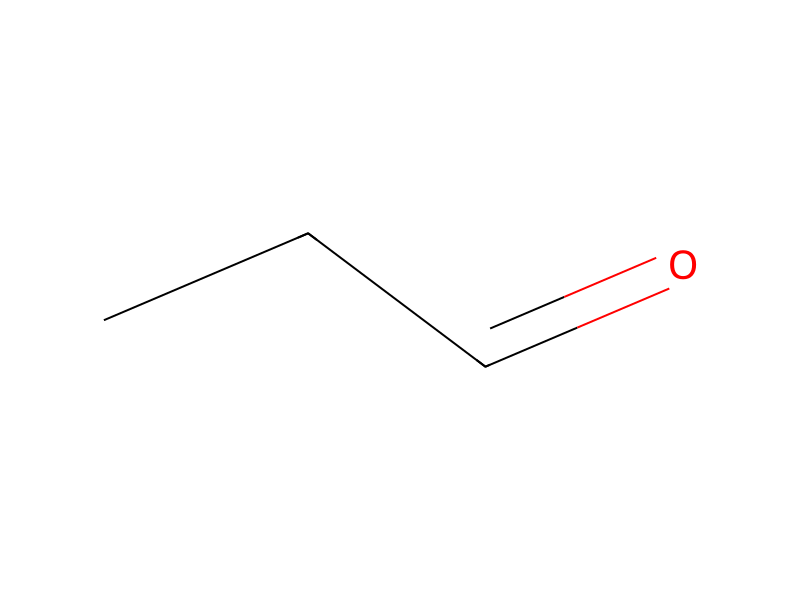
기본 정보
- 표준 SMILES
CCC=O- InChIKey
NBBJYMSMWIIQGU-UHFFFAOYSA-N- 분자식
- C3H6O
- 평균 분자량
- 58.08 g/mol
- 단동위원소 질량
- 58.04186481
개요
Propionaldehyde appears as a clear colorless liquid with an overpowering fruity-like odor. Less dense than water. Flash point 15 °F. Vapors are heavier than air.
이름 및 식별자
- 우선 이름
- Propanal
- IUPAC
- propanal
- 현지명
- 프로피온알데히드
- 영어명
- Propionaldehyde
- 분자식
- C3H6O
- 분자량
- 58.08
이름 및 동의어
Propionaldehydepropanal123-38-6PropanaldehydePropylaldehydePropaldehydeMethylacetaldehyden-PropanalPropionalPropionic aldehyde1-PropanalPropylic aldehyde
이름 더 보기
프로피온알데히드프로피온알데하이드C2H5CHO
n-PropionaldehydePropyl aldehydeAldehyde propionique1-PropanoneFEMA No. 2923FEMA Number 2923DTXSID2021658NCI-C61029
데이터베이스 식별자
- CAS
123-38-6- PubChem CID
- 527
- DTXSID
DTXSID2021658- ChEMBL
CHEMBL275626- ChEBI
CHEBI:17153- UNII
- AMJ2B4M67V
- EC Number
- 204-623-0
- Nikkaji
- J2.497J
물성
구조 계산 물성
- XLogP
- 0.6
- 극성 표면적
- 17.1 Ų
- 수소 결합 공여자 수
- 0
- 수소 결합 수용자 수
- 1
- 회전 가능 결합 수
- 1
- 무거운 원자 수
- 4
- 형식 전하
- 0
- 복잡도
- 17.2
실험 및 물리화학적 성질
Chemical Classes
Hazardous Air Pollutants (HAPs)
Other Classes -> Aldehydes
Flammable agents - 3rd degree
CosmeticsCosmetics ingredient -> Fragrance
SpringerMaterials PropertiesCoriolis coupling
FragrancesFragrance Ingredient (Propionaldehyde) -> IFRA transparency List
PesticidesPesticide -> EPA IRIS
LogP
log Kow = 0.59
0.59
0.59
0.59
Odor
SUFFOCATING, FRUITY
CHARACTERISTIC ODOR SIMILAR TO ACETALDEHYDE
Pungent, unpleasant
Choking odor
Food AdditivesFLAVORING AGENT OR ADJUVANT -> FDA Substance added to food
Density
0.805 at 68 °F (USCG, 1999) - Less dense than water; will float
0.8657 g/cu cm at 25 °C
Relative density (water = 1): 0.8
0.800-0.805
0.805
0.8657 @25 °C
Flavoring AgentsEU Flavoring substances
Viscosity0.3167 cP at 26.7 °C
Color/Form
Liquid
Water-white liquid
물리화학적 성질
- 녹는점
- -81 °C · -81 °C (lit.)
- 끓는 점
- 46 · 46-50 °C (lit.)
- 밀도
- 0.805 g/mL · 0.805 g/mL at 25 °C (lit.)
- 증기 밀도
- 2 · 2 (vs air)
- 증기압
- 18.77 psi · 18.77 psi ( 55 °C)
- 굴절률
- 20 · n20/D 1.362(lit.)
- FEMA
- 2923 · 2923 | PROPIONALDEHYDE
- 인화점
- 16 °F · −16 °F
- 저장 조건
- 20 °C · Store at <= 20°C.
- 용해도
- 클로로포름에 용해됨; 알코올 및 에테르와 섞임
- 물리적 상태
- 액체
- Specific Gravity
- 0.815 · 0.815 (20/4℃)
- 색상
- 하얀색
- 냄새
- 0.1 % · 프로필렌 글리콜 중 0.10%. 흙, 알코올, 와인, 위스키, 코코아, 견과류
- 냄새 유형
- 미묘한
- Odor Threshold
- 0.001 ppm · 0.001ppm
- 생물학적 소스
- synthetic
- 폭발한계
- 2.3 · 2.3-21%(V)
- 수용성
- 540 g/L · 540g/L(20℃)
- 비열
- 1.39 J/ · Cp(gas): 1.39 J/(g·K), at 25℃
- JECFA Number
- 83 · 83
- Merck
- 14 · 14,7823
- BRN
- 506010 · 506010
- Henry's Law Constant
- 9.9 · 9.9×10-2 mol/(m3Pa) at 25℃, Burkholder et al. (2019)
- Dielectric constant
- 18.9 · 18.9(17℃)
- 안정성
- 안정적인. 가연성이 높습니다. 산화제, 강산, 강염기와 호환되지 않습니다.
- 주요 응용
- 향료 및 향
- 화장품 원료 기능
- 향수
- InChI
- 1S/C3H6O/c1-2-3-4/h3H,2H2,1H3
- InChIKey
- NBBJYMSMWIIQGU-UHFFFAOYSA-N
- SMILES
- [H]C(=O)CC
- LogP
- 0.59 at · 0.59 at 25℃
- NIST
- Propanal(123-38-6)
- EPA
- Propionaldehyde (123-38-6)
화학적 성질
Propionaldehyde has a characteristic sharp and pungent odor similar to acetaldehyde.It undergoes reactions typical for the low molecular weight aldehydes, which, because of the terminal carbonyl group, are very reactive. Contamination or the exposure to elevated temperatures may induce a hazardous polymerization. Propionaldehyde is a colorless, flammable liquid with a suffocating fruity odor. It is used as Intermediate for the chemical industry, for example for the manufacture of pharmaceuticals, pesticides, perfumes and plastics.
안전 및 규제
GHS 분류
GHS Classification
Danger
H225: Highly Flammable liquid and vapor [Danger Flammable liquids]
P210, P233, P240, P241, P242, P243, P261, P264, P264+P265, P271, P280, P302+P352, P303+P361+P353, P304+P340, P305+P351+P338, P319, P321, P332+P317, P337+P317, P362+P364, P370+P378, P403+P233, P403+P235, P405, and P501 (click each P-code to see the statement)
Danger
H225 (100%): Highly Flammable liquid and vapor [Danger Flammable liquids]
P210, P233, P240, P241, P242, P243, P261, P264, P264+P265, P270, P271, P280, P301+P317, P302+P352, P303+P361+P353, P304+P340, P305+P351+P338, P317, P319, P321, P330, P332+P317, P337+P317, P362+P364, P370+P378, P403+P233, P403+P235, P405, and P501 (click each P-code to see the statement)
유해성 정보
Regulatory Information
Chemical: Propanal
Hazard Traits - Hepatotoxicity and Digestive System Toxicity; Neurotoxicity
Propanal is listed on the EPA's Chemical Data Reporting (CDR) system. Manufacturers and importers of Propanal are required to report information about their production and use of this chemical to the EPA under the Toxic Substances Control Act (TSCA). (40 eCFR Part 711)
Status: Active Update: 21-10-2022 https://echa.europa.eu/registration-dossier/-/registered-dossier/13148
Propanal: HSNO Approval: HSR001216 Approved with controls
The New Jersey Worker and Community Right to Know Act requires public and private employers to provide information about hazardous substances at their workplaces. (N.J.S.A. 34:5A-1 et. seq.)
DOT LabelFlammable Liquid
Fire Hazards
Behavior in Fire: Vapor is heavier than air and may travel considerable distance to a source of ignition and flash back. (USCG, 1999)
· HIGHLY FLAMMABLE: Will be easily ignited by heat, sparks or flames.
Highly flammable. Vapour/air mixtures are explosive.
Fire Potential
Flammable Liquid.
Dangerous fire hazard when exposed to heat or flame.
Health Hazards
Vapors will irritate nose and throat, and may cause nausea and vomiting. Liquid causes eye irritation. (USCG, 1999)
· May cause toxic effects if inhaled or absorbed through skin.
Hazards Summary
Propionaldehyde is used in the manufacture of plastics, in the synthesis of rubber chemicals, and as a disinfectant and preservative. Limited information is available on the health effects of propionaldehyde. No information is available on the acute (short-term), chronic (long-term), reproductive, developmental or carcinogenic effects of propionaldehyde in humans. Animal studies have reported that exposure to high levels of propionaldehyde, via inhalation, results in anesthesia and liver damage, and intraperitoneal exposure results in increased blood pressure. EPA has not classified propionaldehyde for carcinogenicity.
If left on clothing, can cause reddening of skin; [CHRIS] Propionaldehyde is a skin irritant. [Quick CPC] May form explosive peroxides; Vapor is irritating to eyes and respiratory tract; A severe skin and eye irritant; [ICSC] Causes pulmonary edema in lethal concentration studies in animals; [AIHA] Vapors (and peroxides that may be produced) are explosive; May vigorously polymerize; Vapors cause nose and throat irritation and may cause nausea and vomiting; An eye irritant; [CAMEO] Causes eye and respiratory tract irritation in humans at 14-16 mg/m3; Inhalation of 1,300 ppm for 6 days caused liver damage in rats; [HSDB] Safe when used as a flavoring agent in food; [JECFA] No specific adverse effects observed to reproduction or developing offspring in experimental animals; [OECD SIDS] See ALDEHYDES.
DOT ID and Guide1275 129P
FDA Requirements
Propionaldehyde is a food additive permitted for direct addition to food for human consumption as a synthetic flavoring substance and adjuvant in accordance with the following conditions: a) they are used in the minimum quantity required to produce their intended effect, and otherwise in accordance with all the principles of good manufacturing practice, and 2) they consist of one or more of the following, used alone or in combination with flavoring substances and adjuvants generally recognized as safe in food, prior-sanctioned for such use, or regulated by an appropriate section in this part.
Reactive GroupAldehydes
EC ClassificationSymbol: F, Xi; R: 11-36/37/38; S: (2)-9-16-29
UN ClassificationUN Hazard Class: 3; UN Pack Group: II
TSCA Requirements
Section 8(a) of TSCA requires manufacturers of this chemical substance to report preliminary assessment information concerned with production, exposure, and use to EPA as cited in the preamble in 51 FR 41329. Effective date 9/30/91; Reporting date: 11/2791.
Pursuant to section 8(d) of TSCA, EPA promulgated a model Health and Safety Data Reporting Rule. The section 8(d) model rule requires manufacturers, importers, and processors of listed chemical substances and mixtures to submit to EPA copies and lists of unpublished health and safety studies. Propanal is included on this list. Effective date 9/30/91; Sunset date: 6/30/98.
안전 및 보호
Fire Fighting
Excerpt from ERG Guide 129 [Flammable Liquids (Water-Miscible / Noxious); polymerization hazard]:
Use water spray, powder, alcohol-resistant foam, carbon dioxide. In case of fire: keep drums, etc., cool by spraying with water.
First Aid Measures
Fresh air, rest. Refer for medical attention.
Remove contaminated clothes. Rinse skin with plenty of water or shower.
First rinse with plenty of water for several minutes (remove contact lenses if easily possible), then refer for medical attention.
Rinse mouth. Give one or two glasses of water to drink. Refer for medical attention .
Accidental Release Measures
· CALL 911. Then call emergency response telephone number on shipping paper. If shipping paper not available or no answer, refer to appropriate telephone number listed on the inside back cover.
· ELIMINATE all ignition sources (no smoking, flares, sparks or flames) from immediate area.
First Aid
EYES: First check the victim for contact lenses and remove if present. Flush victim's eyes with water or normal saline solution for 20 to 30 minutes while simultaneously calling a hospital or poison control center. Do not put any ointments, oils, or medication in the victim's eyes without specific instructions from a physician. IMMEDIATELY transport the victim after flushing eyes to a hospital even if no symptoms (such as redness or irritation) develop.
General First Aid:
Safe StorageFireproof. Separated from acids, bases and oxidants. Cool. Keep in the dark. Store only if stabilized.
Firefighting Hazards
Vapor is heavier than air ... & may travel a considerable distance to a source of ignition & flash back.
Can self-ignite if finely dispersed on porous or combustible material such as fabric.
Exposure Control and Personal Protection
· Wear positive pressure self-contained breathing apparatus (SCBA).
2070.0 [ppm]
Fire Fighting Procedures
A water spray may dilute to a point where combustion will not be supported. Water may be ineffective. Use alcohol foam, carbon dioxide, or dry chemical.
If fire becomes uncontrollable or container is exposed to direct flame consider evacuation of one-third (1/3) mile radius.
If material on fire or involved in fire: Do not extinguish fire unless flow can be stopped or safely confined. Use water in flooding quantities as fog. Solid streams of water may be ineffective. Cool all affected containers with flooding quantities of water. Apply water from as far a distance as possible. Use "alcohol" foam, dry chemical or carbon dioxide.
Fight fire from protected location or maximum possible distance. Use water spray to keep fire-exposed containers cool. Use water spray, dry chemical, "alcohol resistant" foam, or carbon dioxide. Water may be ineffective.
Storage Conditions
Store in cool, dry, well-ventilated location. Store away from heat and oxidizers. Outside or detached storage is preferred. Inside storage should be in a standard flammable liquids storage warehouse, room, or cabinet. Separate from oxidizing materials and other reactive hazards.
...Store in cool, well ventilated area away from oxidizers. Where possible, automatically pump liquid from drums or other storage containers to process containers...Metals containers involving the transfer of 5 gallons or more of this chemical should be grounded or bonded. Drums must be equipped with self-closing valves, pressure vacuum bungs, and flame arresters. Use only non-sparking tools and equipment, especially when opening and closing containers of this chemical...
Cleanup Methods
Eliminate all ignition sources. stop or control the leak, if this can be without undue risk. Use water spray to cool and disperse vapors, protect personnel, and dilute spills to form nonflammable mixtures. Control runoff and isolate discharged material for proper disposal.
Absorb the spills with rags or other available absorbing materials. Evaporate in hood and dispose by burning the rag or the absorbing materials.
...Absorb liquids in vermiculite, dry sand, earth, peat, carbon, or a similar material and deposit in sealed containers...
Nonfire Spill ResponseExcerpt from ERG Guide 129 [Flammable Liquids (Water-Miscible / Noxious); polymerization hazard]:
Disposal Methods
SRP: The most favorable course of action is to use an alternative chemical product with less inherent propensity for occupational exposure or environmental contamination. Recycle any unused portion of the material for its approved use or return it to the manufacturer or supplier. Ultimate disposal of the chemical must consider: the material's impact on air quality; potential migration in soil or water; effects on animal, aquatic, and plant life; and conformance with environmental and public health regulations.
Propionaldehyde is a waste chemical stream constituent which may be subjected to ultimate disposal by controlled incineration.
The following wastewater treatment technologies have been investigated for propionaldehyde: Activated carbon.
독성 정보
Interactions
Guanethidine (G) is currently used in the treatment of essential hypertension. Acetaldehyde (A), acrolein (AR), formaldehyde (F) and propionaldehyde (P) are constituents of cigarette smoke and (A) is also an intermediate oxidative metabolite of ethanol. These aldehydes are known to produce sympathomimetic effects by the release of NE from adrenergic neurons and to exert cardioinhibitory effects. The type of predominant effect is dose-dependent. This study was undertaken to determine if these aldehydes result in sympathomimetic effects in the presence of G (15 mg/kg iv) in anesthetized rats. G enhanced the pressor responses to A and P in dose ranges of 5-20 and 5-10 mg/kg respectively. However, AR and F at dose ranges of 0.05-5 and 0.1-10 mg/kg, respectively, elicited only depressor responses after G. Thus, A and P exerted greater sympathomimetic effects through the release of intraneuronal NE in the presence of G. The adrenergic neuronal blocking action of G changes the blood pressure effects of AR and F. When these two compounds are administered in the absence of G, they cause predominant pressor effects, whereas in the presence of G a depressor response is noted. This depressor response is possibly by vagal stimulation and/or direct vasodilation.
Target OrgansNervous
Ecotoxicity Values
EC50; Species: Pseudokirchneriella subcapitata (Green algae, exponential growth phase, 15000 cells/mL, UTEX 1648); Conditions: static, 24 °C, dissolved oxygen 1-2 mg/L; Concentration: 11380 ug/L for 48 hr; Effect: decreased photosynthesis
EC50; Species: Pseudokirchneriella subcapitata (Green algae, exponential growth phase, 15000 cells/mL, UTEX 1648); Conditions: static, 24 °C, dissolved oxygen 1-2 mg/L; Concentration: 24950 ug/L for 48 hr; Effect: decreased population growth rate
LC50; Species: Lepomis macrochirus (Bluegill, length 33-75 mm); Conditions: freshwater, static, 23 °C, pH 7.6-7.9, hardness 55 mg/L CaCO3; Concentration: 130000 ug/L for 96 hr
LC50; Species: Menidia beryllina (Inland silverside, length 40-100 mm); Conditions: saltwater, static, 20 °C, pH 7.6-7.9, hardness 55 mg/L CaCO3; Concentration: 100000 ug/L for 96 hr
Environmental Fate
TERRESTRIAL FATE: Based on a classification scheme(1), an estimated Koc value of 50(SRC), determined from a log Kow of 0.59(2) and a regression-derived equation(3), indicates that propionaldehyde is expected to have very high mobility in soil(SRC). Volatilization of propionaldehyde from moist soil surfaces is expected to be an important fate process(SRC) given a Henry's Law constant of 7.34X10⁻⁵ atm-cu m/mole(4). Propionaldehyde is expected to volatilize from dry soil surfaces(SRC) based upon a vapor pressure of 317 mm Hg(5). Propionaldehyde reached 94% of its theoretical BOD in 4 weeks using an activated sludge inoculum in the Japanese MITI test, suggesting that biodegradation may be an important environmental fate process in soil(SRC). Propionaldehyde degrades by anaerobic biological treatment with 26% utilization being reported in a system with a 20 day hydraulic retention time(7).
AQUATIC FATE: Based on a classification scheme(1), an estimated Koc value of 50(SRC), determined from a log Kow of 0.59(2) and a regression-derived equation(3), indicates that propionaldehyde is not expected to adsorb to suspended solids and sediment(SRC). Volatilization from water surfaces is expected(3) based upon a Henry's Law constant of 7.34X10⁻⁵ atm-cu m/mole(4). Using this Henry's Law constant and an estimation method(3), volatilization half-lives for a model river and model lake are 11 hrs and 5.8 days, respectively(SRC). According to a classification scheme(5), an estimated BCF of 3(SRC), from its log Kow(2) and a regression-derived equation(6), suggests the potential for bioconcentration in aquatic organisms is low(SRC). Propionaldehyde reached 94% of its theoretical BOD in 4 weeks using an activated sludge inoculum in the Japanese MITI test(7), suggesting that biodegradation may be an important environmental fate process in water(SRC).
ATMOSPHERIC FATE: According to a model of gas/particle partitioning of semivolatile organic compounds in the atmosphere(1), propionaldehyde, which has a vapor pressure of 317 mm Hg at 25 °C(2), is expected to exist solely as a vapor in the ambient atmosphere. Vapor-phase propionaldehyde is degraded in the atmosphere by reaction with photochemically-produced hydroxyl radicals(SRC); the half-life for this reaction in air is estimated to be 18 or 20 hrs(SRC), calculated from rate constants of 2.11X10⁻¹¹ cu cm/molecule-sec(3) and 1.96X10⁻¹¹ cu cm/molecule-sec(4), respectively. The rate constant for the vapor-phase reaction of propionaldehyde with nitrate radical has been experimentally determined to be 6.0X10⁻¹³ cu cm/sec(3). This corresponds to an atmospheric half-life of about 1.3 hrs(SRC). The direct photolysis rate constant for propionaldehyde in air is about 4X10⁻⁵ sec-1(5), which corresponds to a half-life of about 4.8 hrs(SRC).
Food Survey ValuesPropionaldehyde was detected as a constituent of coffee aroma(1). Propionaldehyde volatilizes from soybean oil, peanut oil, and lard at rates of 0.01-0.47, 0.02-0.45, and 0.02-0.33 ppm/mg-min, respectively, when heated 150-400 °C(2).
Adverse EffectsOccupational hepatotoxin - Secondary hepatotoxins: the potential for toxic effect in the occupational setting is based on cases of poisoning by human ingestion or animal experimentation.
Exposure RoutesThe substance can be absorbed into the body by inhalation of its vapour and by ingestion.
Plant ConcentrationsPropionaldehyde was emitted from rape during the blooming period at a rate of 0.6-2.69 and 0.22-1.50 ppbv during May 8 and 9, 1998(1).
Signs and Symptoms
Cough. Sore throat.
Redness. Pain.
Redness. Pain.
Burning sensation.
Effluent Concentrations
Propionaldehyde emission rates from dry-process photocopy machines were detected at concns ranging from <100 to 260 ug/hr(1). Propionaldehyde was detected in non-catalyst and catalyst equipped gasoline engine exhaust at 0.10 and 0.06% by weight of total organic gas emissions, respectively(2). Propionaldehyde was detected in commercial jet aircraft exhaust at 1.0% by weight of total organic gas emissions(2). Propionaldehyde concns from automobile exhaust were 3.4-150 ppbv in models from 1971, 1975, and 1977(3). Propionaldehyde emissions from a two stroke engine (chainsaw) using aliphatic gasoline, regular gasoline, and ethanol were 0.039-0.027, 0.062-0.089, and 0.022-0.038 g/kWhr, respectively(4). Using the same two stroke engine, emissions of propionaldehyde from aliphatic gasoline mixed with ethanol at 15, 50, and 85% were 0.039-0.065, 0.036-0.052, and 0.027-0.042 g/kWhr, respectively, and regular gasoline mixed with ethanol at 15, 50, and 85% were 0.067-0.087, 0.053-0.076, and 0.031-0.044 g/kWhr, respectively(4). Propionaldehyde was measured in the emissions of burnt wood at 255, 153, and 155 mg/kg of pine, oak, and eucalyptus, respectively(5). Propionaldehyde emissions from an automobile running on Swedish environmental classified diesel fuel were 3.2 mg/km and the same automobile running on European program emissions fuel were 3.4 mg/km(6).
EPA IRIS Information
Propionaldehyde
Nervous
8 x 10 ^-3 mg/m^3
Medical SurveillanceLung function test. Consider chest x-ray following acute overexposure.
규제 정보
FDA Requirements
Propionaldehyde is a food additive permitted for direct addition to food for human consumption as a synthetic flavoring substance and adjuvant in accordance with the following conditions: a) they are used in the minimum quantity required to produce their intended effect, and otherwise in accordance with all the principles of good manufacturing practice, and 2) they consist of one or more of the following, used alone or in combination with flavoring substances and adjuvants generally recognized as safe in food, prior-sanctioned for such use, or regulated by an appropriate section in this part.
TSCA Requirements
Section 8(a) of TSCA requires manufacturers of this chemical substance to report preliminary assessment information concerned with production, exposure, and use to EPA as cited in the preamble in 51 FR 41329. Effective date 9/30/91; Reporting date: 11/2791.
Pursuant to section 8(d) of TSCA, EPA promulgated a model Health and Safety Data Reporting Rule. The section 8(d) model rule requires manufacturers, importers, and processors of listed chemical substances and mixtures to submit to EPA copies and lists of unpublished health and safety studies. Propanal is included on this list. Effective date 9/30/91; Sunset date: 6/30/98.
Atmospheric Standards
This action promulgates standards of performance for equipment leaks of Volatile Organic Compounds (VOC) in the Synthetic Organic Chemical Manufacturing Industry (SOCMI). The intended effect of these standards is to require all newly constructed, modified, and reconstructed SOCMI process units to use the best demonstrated system of continuous emission reduction for equipment leaks of VOC, considering costs, non air quality health and environmental impact and energy requirements. Propionaldehyde is produced, as an intermediate or a final product, by process units covered under this subpart.
Listed as a hazardous air pollutant (HAP) generally known or suspected to cause serious health problems. The Clean Air Act, as amended in 1990, directs EPA to set standards requiring major sources to sharply reduce routine emissions of toxic pollutants. EPA is required to establish and phase in specific performance based standards for all air emission sources that emit one or more of the listed pollutants. Propionaldehyde is included on this list.
CERCLA Reportable Quantities
Persons in charge of vessels or facilities are required to notify the National Response Center (NRC) immediately, when there is a release of this designated hazardous substance, in an amount equal to or greater than its reportable quantity of 1000 lb or 454 kg. The toll free number of the NRC is (800) 424-8802. The rule for determining when notification is required is stated in 40 CFR 302.4 (section IV. D.3.b).
안전 데이터
- wgk
- 1
- tsca
- TSCA listed
- rtecs
- UE0350000
- ridadr
- UN 1275
- 독성
- LD50 orally in rats: 1.4 g/kg; LC for rats in air: 8000 ppm (Smyth)
- HS 번호
- 29121900
- risk_code
- 11-36/37/38-R36/37/38-R11-41-37/38-20/22
- hazard_code
- F,Xi,Xn
- safety_code
- 9-16-29-S9-S29-S16
- 포장분류
- II
- 위험 등급
- 3
- 기존화학 물질
- KE-29254
- 자연 발화 온도
- 404 °F
- Hazard Classifications
- Acute Tox. 4 InhalationAcute Tox. 4 OralEye Dam. 1Flam. Liq. 2Skin Irrit. 2STOT SE 3
- 스토리지 클래스
- 3 - Flammable liquids
- 유해 물질 데이터
- 123-38-6(Hazardous Substances Data)
화학 및 산업
약리 정보
Mechanism of Action
Inhibition of intercellular communication is an important feature in the tumor promotion phase of a multistage carcinogenesis model. In atherosclerosis inhibition of cell-cell communication by atherogenic compounds, e.g., low density lipoproteins (LDL), also seems to be important. For testing atherogenic compounds we used an atherosclerosis relevant cell type, namely human smooth muscle cells. In order to investigate which part of the LDL particle would be involved in inhibition of metabolic co-operation between human smooth muscle cells in culture ... several fatty acids and their breakdown products /were tested/, namely aldehydes. Unsaturated C-18 fatty acids markedly influenced gap-junctional intercellular communication (GJIC), whereas saturated (C18:0, C16:0) and unsaturated fatty acids with > 20 carbon atoms did not inhibit GJIC. In the case of oleic and elaidic acid, orientation seemed important; however, after exposure to palmitoleic and palmitelaidic acid no differences were found. The most potent inhibitor of GJIC was linoleic acid, which inhibited GJIC by 75%. No correlation was found between degrees of unsaturation and ability to inhibit GJIC. Of the tested aldehydes, hexanal, propanal, butanal and 4-hydroxynonenal did significantly inhibit GJIC, while pentanal had no effect. Since modification of LDL was shown to be important in order for LDL to inhibit GJIC, these results show that fatty acids and their oxidative breakdown products may be of importance for the inhibition of GJIC by LDL.
Metabolism/Metabolites
Detoxification of aldehydes can proceed by oxidation to readily metabolized acids, by reduction to alcohols, and by reaction with sulfhydryl groups, particularly glutathione. Under conditions that deplete glutathione levels or result in an inhibition of aldehyde dehydrogenase (eg, Antabuse treatment), the acute and chronic effects of aldehyde toxicity might be more fully expressed.
Mitochondria oxidize a variety of aldehydes to acids using oxygen as electron acceptor. Relative rates of oxygen consumption promoted by short-chain aldehydes lie in order: propionaldehyde greater than acetaldehyde greater than formaldehyde. ... The NAD-dependent dehydrogenation of aldehydes can also be observed in mitochondria. Rat-liver cytosol contains two aldehyde dehydrogenases (acetaldehyde: NAD oxidoreductases, EC 1.2.1.3) ... the enzymes differ in their substrate specificity to acetaldehyde, propionaldehyde, butyraldehyde, & 3-dimethylamino-2,2-dimethylpropionaldehyde. horse-liver aldehyde dehydrogenase ... is capable of oxidizing ... propionaldehyde ... .
Study of xenobiotic-metabolizing enzymes was undertaken in microsomal and cytosolic fractions of two human livers, 10 individual and several pooled samples of human respiratory nasal mucosa obtained by surgical operation of patients affected by hypertrophy of the inferior turbinates. The activities of glutathione S-transferase, DT-diaphorase, epoxide hydrolase, UDP-glucuronyl-transferase, carbonyl reductase, benzaldehyde and propionaldehyde dehydrogenases were investigated. These activities were similar in nasal and liver tissue, except for UDP-glucuronyl-transferase which was not detected in nasal mucosa.
용도 및 제조
Uses
Propionaldehyde is used in the manufacture of plastics, in the synthesis of rubber chemicals, and as a disinfectant and preservative.
Used to make propionic acid, trimethylolethane, polyvinyl and other plastics, and rubber, medicinal, and agricultural chemicals; Also used as a disinfectant, preservative, and flavoring agent; [HSDB] Used as a chemical intermediate in closed systems and not contained in consumer products; [AIHA] Used almost exclusively (thought to be >99%) as a closed system intermediate and transported by bulk carrier; [OECD SIDS]
Using Disinfectants or Biocides [Category: Clean]
For Propionaldehyde (USEPA/OPP Pesticide Code: 202400) there are 0 labels match. /SRP: Not registered for current use in the U.S., but approved pesticide uses may change periodically and so federal, state and local authorities must be consulted for currently approved uses./
Intermediate in the mfr of trimethylolethane for use in alkyd resin systems and, in certain cases, it is oxidized to propionic acid and reduced to propyl alcohol; in medicinal and agricultural chemical preparations.
Manufacture of propionic acid, polyvinyl and other plastics; synthesis of rubber chemicals; disinfectant; preservative
U.S. Production
2023: 1,000,000,000 - <2,500,000,000 lb
(1972) 5.3X10+10 GRAMS
(1984) 1.02X10+11 g
Propanal is listed as a High Production Volume (HPV) chemical (65FR81686). Chemicals listed as HPV were produced in or imported into the U.S. in >1 million pounds in 1990 and/or 1994. The HPV list is based on the 1990 Inventory Update Rule. (IUR) (40 CFR part 710 subpart B; 51FR21438).
Production volumes for non-confidential chemicals reported under the Inventory Update Rule. [Table#2978]
Consumer UsesNot Known or Reasonably Ascertainable
Industry UsesMonomers
Methods of Manufacturing
Prepared by treating propyl alcohol with a bichromate oxidizing mixture; ... by passing propyl alcohol vapor over copper at high temp.
Synthesis by ... dry distillation of barium propionate with calcium formate.
(A) Oxidation of propyl alcohol with dichromate; (B) By passing alcohol over copper at elevated temperatures.
Ethylene and synthesis gas (hydroformylation)
Formulations/Preparations
USEPA/OPP Pesticide Code 202400; Trade Names: Propanal.
Purity: 97-99+%.
Household ProductsCosmetics product ingredient: Propionaldehyde
Use Classification
Fragrance Ingredients
Flavouring Agent -> FLAVOURING_AGENT -> JECFA Functional Classes
Flavoring Agents -> JECFA Flavorings Index
General Manufacturing Information
Paint and Coating Manufacturing
Propanal: ACTIVE
Synthetic flavoring substances & adjuvants: propionaldehyde
응용 분야
개요Propionaldehyde is a volatile liquid substance which consists of one carbonyl group and its characteristic functional group. The main functional group is an aldehyde which classifies propionaldehyde in the carbonyls. The main trunk of this substance is a short aliphatic chain. The carbonyl group determines, to a large extent, its chemical properties and most importantly its nucleophilic property. Propionaldehyde is readily oxidized if in contact to oxygen and should therefore be stored under inert gases.
출처Reported found in apple aroma and in the essential oils of camphor, Rosa centifolia, clary sage, Pinus excelsa and Pinus silverstris. Also reported found in over 100 natural products including apple, banana, sweet cherry, sour cherry, black currant grapes, melon, pineapple, strawberry, cabbage, carrot, celery, cucumber, garlic, onion, leek, potato, peas, rutabaga, tomato, Scotch spearmint oil, vinegar, bread and bread preferment, blue cheeses, cheddar cheese, Swiss cheese, butter, milk, cream, boiled egg, caviar, fatty fish, cooked turkey, beef, pork and chicken, beer, rum, cognac, whiskies, grape wines, coffee, cocoa, tea, roasted filberts and peanuts, peanut oil, potato chips, pecans, oats, honey, soybeans, Arctic bramble, beans, Bantu beer, plum brandy, cauliflower, Brussels sprouts, rice, prickly pear, peated malt, clary sage, truffle, krill, oysters, loganberry, Chinese quince and maté.
용도Propionaldehyde is produced by the oxo reaction of ethylene with carbon monoxide and hydrogen. n-Propyl alcohol is produced by hydrogenation of propionaldehyde, and propionic acid is made by oxidation of propionaldehyde. n-Propyl alcohol is used as solvent in printing inks and as an intermediate in the preparation of agricultural chemicals. Propionic acid is used as a grain preservative as, for example, in preventing spoilage of wet corn used as animal feed. The use of propionic acid as a grain preservative is an alterna tive to drying by heating, which consumes fuel, and is considered mostly when fuel is expensive.
일반 설명A clear colorless liquid with an overpowering fruity-like odor. Less dense than water. Flash point 15°F. Vapors are heavier than air.
제조 방법
Propionaldehyde is prepared in the usual way by the oxidation of n-propyl alcohol. It can also be prepared by dehydrogenating the alcohol by passing the vapors over a heated copper or brass catalyst. This avoids the danger of further oxidation to propionic acid. The reactions of propionaldehyde are practically like those of acetaldehyde. It must be remembered that only the two alpha hydrogen atoms are active in replacement and condensation reactions.
상·하류 제품 정보
상류 원료
하류 제품
추가 설명
정의ChEBI: An aldehyde that consists of ethane bearing a formyl substituent. The parent of the class of propanals.
관련 반응
866건


연결된 노트
불러오는 중…