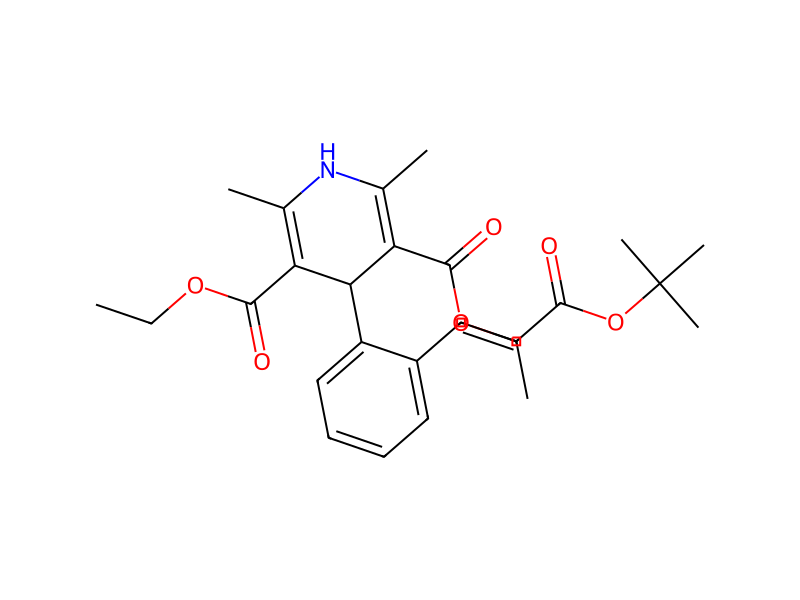
기본 정보
- 표준 SMILES
CCOC(=O)C1=C(C)NC(C)=C(C(=O)OCC)C1c1ccccc1/C=C/C(=O)OC(C)(C)C- InChIKey
GKQPCPXONLDCMU-CCEZHUSRSA-N- 분자식
- C26H33NO6
- 평균 분자량
- 455.5 g/mol
- 단동위원소 질량
- 455.23078778
개요
Lacidipine is a tert-butyl ester and a cinnamate ester.
이름 및 식별자
- 우선 이름
- Lacidipine
- IUPAC
- diethyl 2,6-dimethyl-4-[2-[(E)-3-[(2-methylpropan-2-yl)oxy]-3-oxoprop-1-enyl]phenyl]-1,4-dihydropyridine-3,5-dicarboxylate
- 영어명
- Lacidipine
- 분자식
- C26H33NO6
- 분자량
- 455.54
이름 및 동의어
이름 더 보기
데이터베이스 식별자
- CAS
103890-78-4- PubChem CID
- 5311217
- DTXSID
DTXSID1046429- ChEMBL
CHEMBL1728809、CHEMBL460291- ChEBI
CHEBI:135737- UNII
- 260080034N
- EC Number
- 638-759-0
- Nikkaji
- J325.878E
물성
구조 계산 물성
- XLogP
- 4.5
- 극성 표면적
- 90.9 Ų
- 수소 결합 공여자 수
- 1
- 수소 결합 수용자 수
- 7
- 회전 가능 결합 수
- 11
- 무거운 원자 수
- 33
- 형식 전하
- 0
- 복잡도
- 805
실험 및 물리화학적 성질
물리화학적 성질
- 녹는점
- 174 · 174-175°C
- 끓는 점
- 558.4 · 558.4±50.0 °C(Predicted)
- 밀도
- 1.127 · 1.127±0.06 g/cm3(Predicted)
- 저장 조건
- 2 · 2-8°C
- 용해도
- 20 mg/mL, · DMSO: 용해성20mg/mL, 투명
- 물리적 상태
- 가루
- 산도 계수 (pKa)
- 3 · 3.00±0.70(Predicted)
- 색상
- 흰색에서 베이지색
- Merck
- 14 · 14,5331
- InChI
- InChI=1S/C26H33NO6/c1-8-31-24(29)21-16(3)27-17(4)22(25(30)32-9-2)23(21)19-13-11-10-12-18(19)14-15-20(28)33-26(5,6)7/h10-15,23,27H,8-9H2,1-7H3/b15-14+
- InChIKey
- GKQPCPXONLDCMU-CCEZHUSRSA-N
- SMILES
- C1(C)NC(C)=C(C(OCC)=O)C(C2=CC=CC=C2/C=C/C(OC(C)(C)C)=O)C=1C(OCC)=O
화학적 성질
White-to-Off-White Crystalline Solid
안전 및 규제
GHS 분류
GHS Classification
Warning
H302 (97.9%): Harmful if swallowed [Warning Acute toxicity, oral]
P264, P270, P301+P317, P330, and P501 (click each P-code to see the statement)
Aggregated GHS information provided per 48 reports by companies from 5 notifications to the ECHA C&L Inventory.
유해성 정보
안전 데이터
- wgk
- 3
- rtecs
- US7970200
- 독성
- mouse,LD50,intraperitoneal,80200ug/kg (80.2mg/kg),SKIN AND APPENDAGES (SKIN): HAIR: OTHERSENSE ORGANS AND SPECIAL SENSES: PTOSIS: EYEBEHAVIORAL: SOMNOLENCE (GENERAL DEPRESSED ACTIVITY),Yakuri to Chiryo. Pharmacology and Therapeutics. Vol. 22, Pg. 335, 1994.
- risk_code
- 22
- hazard_code
- Xn
- Hazard Classifications
- Acute Tox. 4 Oral
- 스토리지 클래스
- 11 - Combustible Solids
화학 및 산업
약리 정보
ATC Code
C - Cardiovascular system
QC - Cardiovascular system
Pharmacodynamics
acidipine is a specific and potent calcium antagonist with a predominant selectivity for calcium channels in the vascular smooth muscle. Its main action is to dilate predominantly peripheral and coronary arteries, reducing peripheral vascular resistance and lowering blood pressure. Following the oral administration of 4 mg lacidipine to volunteer subjects, a minimal prolongation of QTc interval has been observed (mean QTcF increase between 3.44 and 9.60 ms in young and elderly volunteers).
Mechanism of Action
By blocking the voltage-dependent L-type calcium channels, it prevents the transmembrane calcium influx. Normally, calcium ions serve as intracellular messengers or activators in exictable cells including vascular smooth muscles. The influx of calcium ultimately causes the excitation and depolarization of the tissues. Lacidipine inhibits the contractile function in the vascular smooth muscle and reduce blood pressure. Due to its high membrane partition coefficient, some studies suggest that lacidipine may reach the receptor via a two-step process; it first binds and accumulates in the membrane lipid bilayer and then diffuses within the membrane to the calcium channel receptor. It is proposed that lacidipine preferentially blocks the inactivated state of the calcium channel. Through its antioxidant properties shared amongst other dihydropyridine calcium channel blockers, lacidipine demonstrates an additional clinical benefit. Its antiatherosclerotic effects are mediated by suppressing the formation of reactive oxygen species (ROS) and subsequent inflammatory actions by chemokines, cytokines and adhesion molecules, thus reducing atherosclerotic lesion formation. Lacidipine may also suppress cell proliferation and migration in smooth muscle cells and suppress the expression of matrix metalloproteinases, which affects the stability of atheromatous plaques.
MeSH Pharmacological Classification
Drugs used in the treatment of acute or chronic vascular HYPERTENSION regardless of pharmacological mechanism. Among the antihypertensive agents are DIURETICS; (especially DIURETICS, THIAZIDE); ADRENERGIC BETA-ANTAGONISTS; ADRENERGIC ALPHA-ANTAGONISTS; ANGIOTENSIN-CONVERTING ENZYME INHIBITORS; CALCIUM CHANNEL BLOCKERS; GANGLIONIC BLOCKERS; and VASODILATOR AGENTS.
A class of drugs that act by selective inhibition of calcium influx through cellular membranes.
Absorption, Distribution and Excretion
Since it is a highly lipophilic compound, lacidpine is rapidly absorbed from the gastrointestinal tract following oral administration with the peak plasma concentrations reached between 30 and 150 minutes of dosing. The peak plasma concentrations display large interindividual variability, with the values ranging from 1.6 to 5.7 μg/L following single-dose oral administration of lacidipine 4mg in healthy young volunteers. Absolute bioavailability is less than 10% due to extensive first-pass metabolism in the liver.
Approximately 70% of the administered dose is eliminated as metabolites in the faeces and the remainder as metabolites in the urine.
응용 분야
개요Lacidipine is a new second-generation dihydropyridine calcium antagonist introduced as a once a day treatment for mild to moderate hypertension. It is reported to have high selectivity for vascular smooth muscle and also a long duration of action. The use of lacidipine as an antiatherosclerotic agent is currently under investigation.
상·하류 제품 정보
상류 원료
공급사50 곳
관련 반응
현재 필터 조건에 해당하는 반응 기록이 없습니다.
연결된 노트
불러오는 중…