
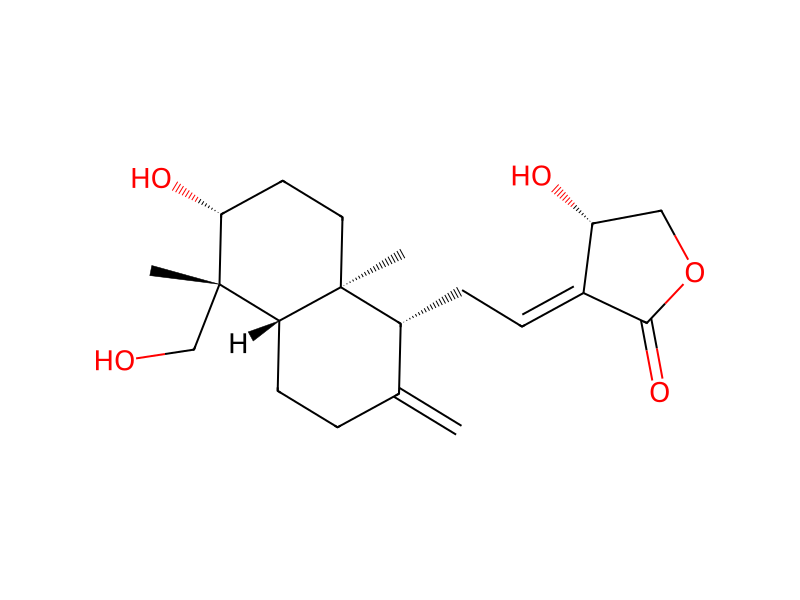
기본 정보
- CAS
5508-58-7- 표준 SMILES
C=C1CC[C@@H]2[C@](C)(CO)[C@H](O)CC[C@@]2(C)[C@@H]1C/C=C1/C(=O)OC[C@H]1O- InChIKey
BOJKULTULYSRAS-OTESTREVSA-N- 분자식
- C20H30O5
- 평균 분자량
- 350.4 g/mol
- 단동위원소 질량
- 350.20932406
개요
Andrographolide is a labdane diterpenoid isolated from the leaves and roots of Andrographis paniculata that exhibits anti-HIV, anti-inflammatory and antineoplastic properties. It has a role as a metabolite, an anti-inflammatory drug, an antineoplastic agent and an anti-HIV agent. It is a primary alcohol, a secondary alcohol, a labdane diterpenoid, a carbobicyclic compound and a gamma-lactone.
이름 및 식별자
- 우선 이름
- Andrographolide
- IUPAC
- (3E,4S)-3-[2-[(1R,4aS,5R,6R,8aS)-6-hydroxy-5-(hydroxymethyl)-5,8a-dimethyl-2-methylidene-3,4,4a,6,7,8-hexahydro-1H-naphthalen-1-yl]ethylidene]-4-hydroxyoxolan-2-one
- 현지명
- 안드로그라폴라이드
- 영어명
- Andrographolide
- 분자식
- C20H30O5
- 분자량
- 350.45
이름 및 동의어
Andrographolide5508-58-7DTXSID3045980HMPL004CHEBI:65408410105JHGRNSC-383468DTXCID10259803alpha,14,15,18-tetrahydroxy-5b,9bH,10a-labda-8(20),12-dien-16-oic acid gamma-Lactone(3E,4S)-3-[2-[(1R,4aS,5R,6R,8aS)-6-hydroxy-5-(hydroxymethyl)-5,8a-dimethyl-2-methylidene-3,4,4a,6,7,8-hexahydro-1H-naphthalen-1-yl]ethylidene]-4-hydroxyoxolan-2-one3-(2-(Decahydro-6-hydroxy-5-(hydroxymethyl)-5,8a-dimethyl-2-methylenenaphthyl)ethylidene)dihydro-4-hydroxyfuran-2(3H)-one(3E,4S)-4-hydroxy-3-{2-[(1R,4aS,5R,6R,8aS)-6-hydroxy-5-(hydroxymethyl)-5,8a-dimethyl-2-methylidenedecahydronaphthalen-1-yl]ethylidene}dihydrofuran-2(3H)-one
이름 더 보기
안드로그라폴라이드ANDROANDROGRAPHISAndrographolid(S,E)-4-Hydroxy-3-(2-((1R,4aS,5R,6R,8aS)-6-hydroxy-5-(hydroxyMethyl)-5,8a-diMethyl-2-Methylenedecahydronaphthalen-1-yl)ethylidene)dihydrofuran-2(3H)-oneAndrographent-(3β,12E,14R)-3,14,19-Trihydroxy-8(17),12-labdadien-16,15-olideAndrographoLNeoandrogrAndrographoL
2(3H)-FURANONE, 3-(2-((1R,4AS,5R,6R,8AS)-DECAHYDRO-6-HYDROXY-5-(HYDROXYMETHYL)-5,8A-DIMETHYL-2-METHYLENE-1-NAPHTHALENYL)ETHYLIDENE)DIHYDRO-4-HYDROXY-, (3E,4S)-2(3H)-Furanone, 3-(2-(decahydro-6-hydroxy-5-(hydroxymethyl)-5,8a-dimethyl-2-methylene-1-naphthalenyl)ethylidene)dihydro-4-hydroxy-, (1R-(1-alpha(E(S*)),4a-beta,5-alpha,6-alpha,8a-alpha))-2(3H)-Furanone, 3-[2-[(1R,4aS,5R,6R,8aS)-decahydro-6-hydroxy-5-(hydroxymethyl)-5,8a-dimethyl-2-methylene-1-naphthalenyl]ethylidene]dihydro-4-hydroxy-, (3E,4S)-(3E,4S)-3-(2-((1R,4aS,5R,6R,8aS)-6-hydroxy-5-(hydroxymethyl)-5,8a-dimethyl-2-methylidene-3,4,4a,6,7,8-hexahydro-1H-naphthalen-1-yl)ethylidene)-4-hydroxyoxolan-2-one(3E,4S)-4-hydroxy-3-(2-((1R,4aS,5R,6R,8aS)-6-hydroxy-5-(hydroxymethyl)-5,8a-dimethyl-2-methylidenedecahydronaphthalen-1-yl)ethylidene)dihydrofuran-2(3H)-oneRefChem:5554(1R-(1-alpha(E(S)),4a-beta,5alpha,6alpha,8a-alpha))-3-(2-(decahydro-6-hydroxy-5-(hydroxymethyl)-5,8a-dimethyl-2-methylene-1-naphthalenyl)ethylidene)dihydro-4-hydroxy-2(3H)-furanone226-852-5
데이터베이스 식별자
- CAS
5508-58-7- PubChem CID
- 5318517
- DTXSID
DTXSID3045980- ChEMBL
CHEMBL186141- ChEBI
CHEBI:65408- UNII
- 410105JHGR
- EC Number
- 226-852-5
- Nikkaji
- J13.236E
물성
구조 계산 물성
- XLogP
- 2.2
- 극성 표면적
- 87 Ų
- 수소 결합 공여자 수
- 3
- 수소 결합 수용자 수
- 5
- 회전 가능 결합 수
- 3
- 무거운 원자 수
- 25
- 형식 전하
- 0
- 복잡도
- 597
실험 및 물리화학적 성질
DrugsPharmaceuticals -> Listed in ZINC15
Dietary IngredientsAndrographis
물리화학적 성질
- 녹는점
- 229 · 229-232 °C (lit.)
- 끓는 점
- 557.3 · 557.3±50.0 °C(Predicted)
- 밀도
- 421 · d421 1.2317
- 저장 조건
- 2 · 2-8°C
- 용해도
- DMSO(최대 25mg/ml) 또는 에탄올(최대 8mg/ml)에 용해됩니다.
- 산도 계수 (pKa)
- 12.36 · 12.36±0.20(Predicted)
- 물리적 상태
- 회백색 고체
- 색상
- 회백색
- Merck
- 14 · 14,633
- BRN
- 42762 · 42762
- 안정성
- 2 · 공급된 대로 구매일로부터 2년 동안 안정적입니다. DMSO 또는 에탄올 용액은 -20°C에서 최대 3개월 동안 보관할 수 있습니다.
- 화장품 원료 기능
- 피부 컨디셔닝
- InChI
- 1S/C20H30O5/c1-12-4-7-16-19(2,9-8-17(23)20(16,3)11-21)14(12)6-5-13-15(22)10-25-18(13)24/h5,14-17,21-23H,1,4,6-11H2,2-3H3/b13-5+/t14-,15-,16+,17-,19+,20+/m1/s1
- InChIKey
- BOJKULTULYSRAS-QPSYGYIJSA-N
- SMILES
- C[C@@]1(CO)[C@H](O)CC[C@@]2(C)[C@H](C\C=C3/[C@H](O)COC3=O)C(=C)CC[C@H]12
- LogP
- 0.424 · 0.424 (est)
화학적 성질
white square prism or flaky crystals (ethanol or methanol) and odorless, with a bitter taste. dissolved in boiling ethanol, slightly soluble in methanol or ethanol, very slightly soluble in chloroform, and almost insoluble in water. Since andrographolide has an ester structure, it is easy to hydrolysis, open loop and isomerization in the aqueous solution to affect the drug stability. At lower temperature, the stability of andrographolide is better; it is unstable in alkaline conditions, and its instability increased with the increase in alkaline strength. The most stable pH value is 3–5. Andrographolide is more stable in chloroform.
안전 및 규제
GHS 분류
GHS Classification
Warning
H315 (100%): Causes skin irritation [Warning Skin corrosion/irritation]
P261, P264, P264+P265, P271, P280, P302+P352, P304+P340, P305+P351+P338, P319, P321, P332+P317, P337+P317, P362+P364, P403+P233, P405, and P501 (click each P-code to see the statement)
Aggregated GHS information provided per 31 reports by companies from 2 notifications to the ECHA C&L Inventory. Each notification may be associated with multiple companies.
유해성 정보
Regulatory Information
2(3H)-Furanone, 3-2-(1R,4aS,5R,6R,8aS)-decahydro-6-hydroxy-5-(hydroxymethyl)-5,8a-dimethyl-2-methylene-1-naphthalenylethylidenedihydro-4-hydroxy-, (3E,4S)-: Does not have an individual approval but may be used as a component in a product covered by a group standard. It is not approved for use as a chemical in its own right.
Hazard Classes and CategoriesSkin Irrit. 2 (100%)
안전 데이터
- wgk
- 3
- rtecs
- LU3490750
- HS 번호
- 29322980
- risk_code
- 20/21/22-36/37/38
- hazard_code
- Xn
- safety_code
- 22-24/25-36-26
- 스토리지 클래스
- 11 - Combustible Solids
화학 및 산업
약리 정보
Mechanism of Action
HMPL-004 acts on multiple cellular targets in the inflammatory signal transduction pathways resulting in suppressed inflammation cytokine expression including TNF-α, IL-1β and IL-6. HMPL-004 was demonstrated to inhibit TNF-α and IL-1β production in cell-based assays. HMPL-004 is also able to inhibit NF-kB activation. NF-kB is a family of transcriptional factors that regulate a wide spectrum of genes critically involved in host defence and inflammation. The mechanism of action of HMPL-004 was further supported in laboratory IBD animal models. Treatment of IBD rats with HMPL-004 caused a significant drop in plasma cytokine concentrations, including TNF-α and IL-1β.
MeSH Pharmacological Classification
Substances that reduce or suppress INFLAMMATION.
Anti-inflammatory agents that are non-steroidal in nature. In addition to anti-inflammatory actions, they have analgesic, antipyretic, and platelet-inhibitory actions. They act by blocking the synthesis of prostaglandins by inhibiting cyclooxygenase, which converts arachidonic acid to cyclic endoperoxides, precursors of prostaglandins. Inhibition of prostaglandin synthesis accounts for their analgesic, antipyretic, and platelet-inhibitory actions; other mechanisms may contribute to their anti-inflammatory effects.
Substances that are destructive to protozoans.
Agents used in the prophylaxis or therapy of VIRUS DISEASES. Some of the ways they may act include preventing viral replication by inhibiting viral DNA polymerase; binding to specific cell-surface receptors and inhibiting viral penetration or uncoating; inhibiting viral protein synthesis; or blocking late stages of virus assembly.
Drugs or agents which antagonize or impair any mechanism leading to blood platelet aggregation, whether during the phases of activation and shape change or following the dense-granule release reaction and stimulation of the prostaglandin-thromboxane system.
용도 및 제조
Household ProductsInformation on 1 consumer products that contain Andrographolide in the following categories is provided:
응용 분야
개요Andrographolide is a diterpene lactone compound extracted from Andrographis. paniculata (Burm. F) Nees. Andrographis paniculata is also known as lanhelian, yijianxi, zhanshecao, kucao, kudancao, etc. Since this product originates in India, it is also known as Indian grass. This product is dry ground part of Jupiteraceae plant Andrographis paniculata (conus) may originate in South Asia. It is commonly cultivated in China such as in Fujian, Guangdong, Hainan, Guangxi, and Yunnan and also in Australia and was also introduced in Jiangsu and Shaanxi.Andrographis paniculata is commonly used in traditional Chinese medicine. Its ability of relieving “snake venom, and internal injuries cough” was recorded in “Lingnan herbal medicine records.” “Quanzhou Materia Medica” described it as “heat-clearing and detoxifying, anti-inflammatory, detumescence and inhibition throat inflammation, dysentery and high fever.”The above ground part of Andrographis paniculata contains andrographolide, neo-andrographolide, 14-deoxygenated andrographolide, etc., and the root contains mainly flavonoids.
출처Andrographis is found growing wild in India and Sri Lanka and is cultivated in many other parts of the world.
역사In 1911, Gorter firstly isolated a crystalline substance from Andrographis paniculata, identified it as a diterpene lactone compound, and named it andrographolide .Andrographolide structure is complex and difficult to artificially synthesize, so it is often extracted from the plant.Andrographolide water solubility is poor and its bioavailability is low; its pharmacological effects are extensive but weak, so the preparation requirements are strict. Therefore, from the 1970s, drugs and organic chemical researchers have done a lot of work in the modification and transformation of andrographolide, mainly concentrated in the α, β-unsaturated lactone double bond Michael addition, redox, selective esterification of hydroxyl groups, oxidation and substitution reactions, intramolecular cyclization, replacement of lactone rings, etc. They had obtained a number of new derivatives. In the research of pharmacological effects, the main study of the andrographolide derivatives focuses on antitumor, antivirus, and other biological activities and has made some progress .
용도Andrographolide is a labdane diterpenoid. Andrographolide is the main bioactive component isolated from the medicinal plant Andrographis paniculata. It has a broad range of therapeutic applications including anti-inflammatory and anti-platelet aggregation activities and potential antineoplastic properties. Andrographolide showed significant antihepatotoxic action in P. berghei K173- induced hepatic damage in M. natalensis. Andrographolide inhibits tumor necrosis factor-α (TNF-α)-induced intercellular adhesion mol.-1 (ICAM-1) expression and adhesion of HL-60 cells onto human umbilical vein endothelial cells (HUVEC), which are associated with inflammatory diseases. These findings suggest that Andrographolide may have potential as a cardiovascular-protective agent.
일반 설명Andrographolide, a bioactive diterpene lactone, is the main constituent of Andrographis paniculata, a plant used in traditional medicines. It is known to have different biological activities such as anti-inflammatory, anti-malarial, anti-cancer and hepatoprotective activity. It also shows potent anti-viral effect against dengue virus.
상·하류 제품 정보
상류 원료
공급사100 곳
国药集团化学试剂有限公司86-21-63210123 · [email protected]
北京华美互利生物化工010-56205725 · [email protected]
梯希爱(上海)化成工业发展有限公司021-67121386 · [email protected]
上海阿拉丁生化科技股份有限公司400-6206333 13167063860 · [email protected]
南通飞宇生物科技有限公司0513-68819626 15152877458 · [email protected]
爱斯特(成都)生物制药股份有限公司+86-28-85122536 85324413 · [email protected]
上海如吉生物科技发展有限公司+86-21-65211385-8001 36031160 · [email protected]
南京丙承生物科技有限公司18805194892
上海迈瑞尔生化科技有限公司4006356688 18621169109 · [email protected]
大连美仑生物技术有限公司0411-62910999 13889544652 · [email protected]
上海德默医药科技有限公司400-021-7337 2355568890 · [email protected]
安耐吉化学&3A(安徽泽升科技股份有限公司)400-0056266 · [email protected]
桂林莱科生物科技有限公司18978670903 18107731009 · [email protected]
上海瀚鸿科技股份有限公司021-54306202 13764082696 · [email protected]
成都普菲德生物技术有限公司028-82610909 13388174823 · [email protected]
上海融禾医药科技发展有限公司17301719108 13341702378 · [email protected]
嘉兴市艾森化工有限公司0573-85285100 18627885956 · [email protected]
Pure Chemistry Scientific Inc.001-857-928-2050 or 1-888-588-9418 · [email protected]
上海泰坦科技股份有限公司400-6009262 15618770481 · [email protected]
深圳虹彩祥根生物科技有限公司+86-0755-89668383 · [email protected]
MedChemexpress LLC021-58955995 · [email protected]
武汉丰泰威远科技有限公司027-87465837 19945049750 · [email protected]
贵州迪大科技有限责任公司0851-8475-2296 18096062265 · [email protected]
杭州东帆化学有限公司86-0571-85151182
孝感深远化工有限公司15527621225; 15527621225 · [email protected]
云南西力生物技术股份有限公司0871-65217109 · [email protected]
山东西亚化学有限公司13355009207 13355009207 · [email protected]
四川库利南科技有限公司400-1166-196 18981987031 · [email protected]
天津希恩思生化科技有限公司400 638 7771 · [email protected]
成都健腾生物技术有限公司86-28-85159085 · [email protected]
上海源叶生物科技有限公司13636370518 · [email protected]
艾科试剂4008-755-333 18080918076 · [email protected]
成都锦然生物科技有限公司028-83311324 1278112614 · [email protected]
上海思域化工科技有限公司86-21-34053660 · [email protected]
西安康培基生物科技有限公司86-029-85456576 · [email protected]
AdooQ BioScience, LLC+1 (866) 930-6790 · [email protected]
上海健超生物科技有限公司150-2103-5486 18017383231 · [email protected]
TCI AMERICA800-4238616 · [email protected]
TOKYO CHEMICAL INDUSTRY CO., LTD.03-36680489 · [email protected]
TCI Europe320-37350700 · [email protected]
深圳康特腾科技有限公司86-0755-86635001 · [email protected]
广州爱纯医药科技有限公司020-39119399 18927568969 · [email protected]
陕西帕尼尔生物科技有限公司13720616393;029-84385017-8003 13720616393 · [email protected]
上海陶素生化科技有限公司021-33632979 · [email protected]
成都瑞芬思德丹生物科技有限公司2355253622; 18981954830 · [email protected]
上海倍卓生物科技有限公司021-61119791,13386096464 · [email protected]
上海将来实业股份有限公司400-0066400 13621662912 · [email protected]
上海将来实业股份有限公司021-61552785 · [email protected]
上海石洋化工有限公司021-56795766 · [email protected]
四川省维克奇生物科技有限公司028-81700200 18116577057 · [email protected]
추가 설명
정의ChEBI: Andrographolide is a labdane diterpenoid isolated from the leaves and roots of Andrographis paniculata that exhibits anti-HIV, anti-inflammatory and antineoplastic properties. It has a role as a metabolite, an anti-inflammatory drug, an anti-HIV agent and an antineoplastic agent. It is a gamma-lactone, a primary alcohol, a secondary alcohol, a labdane diterpenoid and a carbobicyclic compound.
관련 반응
3건

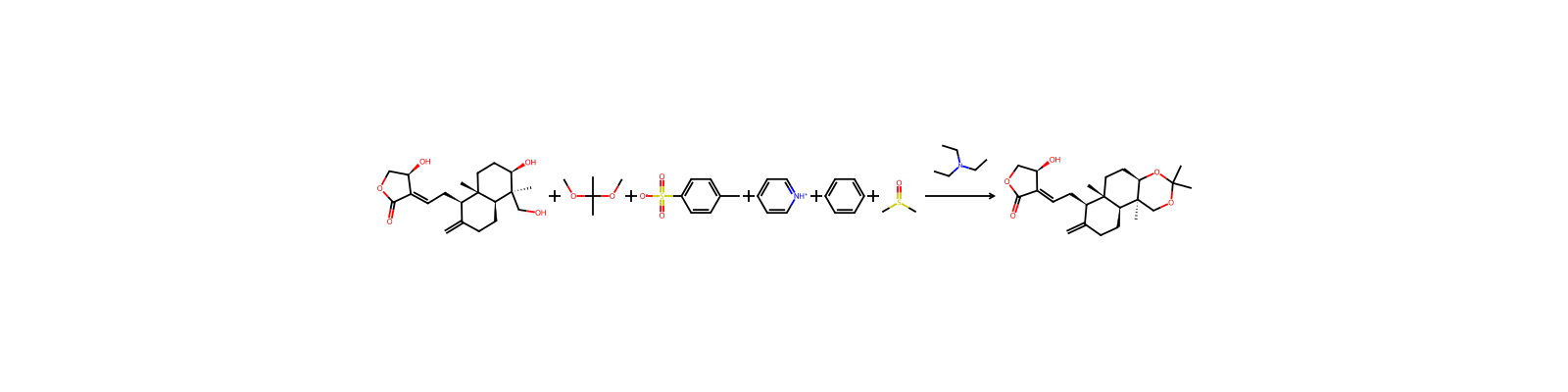
화합물 노트
불러오는 중…