
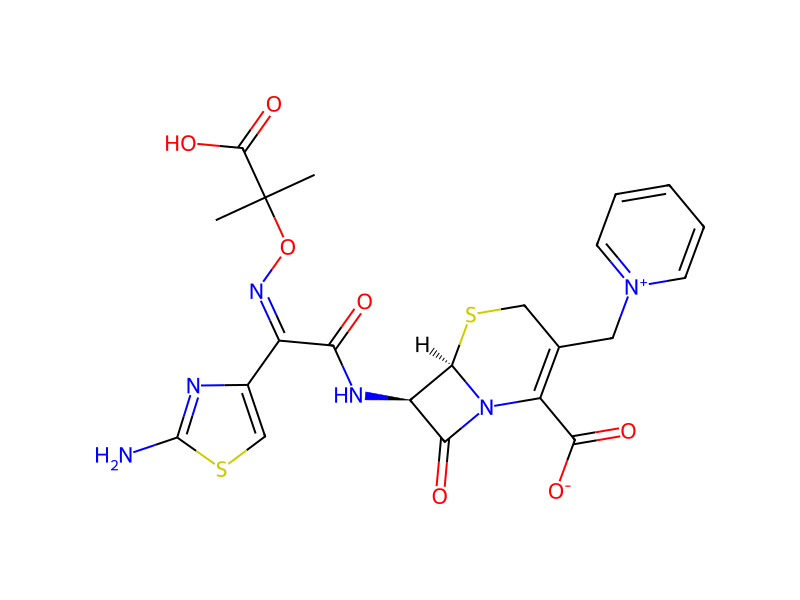
기본 정보
- 표준 SMILES
CC(C)(O/N=C(\C(=O)N[C@@H]1C(=O)N2C(C(=O)[O-])=C(C[n+]3ccccc3)CS[C@H]12)c1csc(N)n1)C(=O)O- InChIKey
ORFOPKXBNMVMKC-DWVKKRMSSA-N- 분자식
- C22H22N6O7S2
- 평균 분자량
- 546.6 g/mol
- 단동위원소 질량
- 546.09913904
개요
Ceftazidime is a third-generation cephalosporin antibiotic bearing pyridinium-1-ylmethyl and {[(2Z)-2-(2-amino-1,3-thiazol-4-yl)-2-{[(2-carboxypropan-2-yl)oxy]imino}acetamido groups at positions 3 and 7, respectively, of the cephem skeleton. It has a role as an antibacterial drug, an EC 2.4.1.129 (peptidoglycan glycosyltransferase) inhibitor and a drug allergen. It is a cephalosporin and an oxime O-ether. It is a conjugate acid of a ceftazidime(1-).
이름 및 식별자
- 우선 이름
- Ceftazidime
- IUPAC
- (6R,7R)-7-[[(2Z)-2-(2-amino-1,3-thiazol-4-yl)-2-(2-carboxypropan-2-yloxyimino)acetyl]amino]-8-oxo-3-(pyridin-1-ium-1-ylmethyl)-5-thia-1-azabicyclo[4.2.0]oct-2-ene-2-carboxylate
이름 및 동의어
ceftazidime72558-82-8FortazceftazidimaTazidimeCeftazidime anhydrousceftazidimumPentacefTazicefFortumCeptazGR 20263
이름 더 보기
CHEBI:3508(6R,7R)-7-[[(2Z)-2-(2-amino-1,3-thiazol-4-yl)-2-(2-carboxypropan-2-yloxyimino)acetyl]amino]-8-oxo-3-(pyridin-1-ium-1-ylmethyl)-5-thia-1-azabicyclo[4.2.0]oct-2-ene-2-carboxylateFortamTazidime In Plastic ContainerNSC-759260DZR1ENT301SN 401 pentahydrateGR-20263
데이터베이스 식별자
- CAS
72558-82-8、78439-06-2- PubChem CID
- 5481173
- DTXSID
DTXSID5022770- ChEMBL
CHEMBL44354- ChEBI
CHEBI:3508- UNII
- DZR1ENT301
- EC Number
- 276-715-9
물성
구조 계산 물성
- XLogP
- 0.4
- 극성 표면적
- 245 Ų
- 수소 결합 공여자 수
- 3
- 수소 결합 수용자 수
- 12
- 회전 가능 결합 수
- 8
- 무거운 원자 수
- 37
- 형식 전하
- 0
- 복잡도
- 1,020
실험 및 물리화학적 성질
Chemical ClassesOther Uses -> Pharmaceuticals
Drugs
Pharmaceuticals -> Antibiotics
Pharmaceuticals -> Antibiotics
LogP-1.60
Solubility5.73e-03 g/L
Human Drugs
Breast Feeding; Lactation; Anti-Infective Agents; Antibacterial Agents; Cephalosporins
Breast Feeding; Lactation; Milk, Human; Anti-Infective Agents; Antibacterial Agents; Cephalosporins
FDA approved drugs -> Active ingredient
FDA approved drugs -> Active ingredient
Watch group antibiotics
Melting Point103-113
Physical DescriptionSolid
안전 및 규제
GHS 분류
GHS Classification
Danger
H300 (17.5%): Fatal if swallowed [Danger Acute toxicity, oral]
P233, P260, P261, P264, P270, P271, P272, P280, P284, P301+P316, P302+P352, P304+P340, P321, P330, P333+P317, P342+P316, P362+P364, P403, P405, and P501 (click each P-code to see the statement)
Aggregated GHS information provided per 80 reports by companies from 5 notifications to the ECHA C&L Inventory. Each notification may be associated with multiple companies.
유해성 정보
Regulatory InformationCeftazidime: Does not have an individual approval but may be used as a component in a product covered by a group standard. It is not approved for use as a chemical in its own right.
Hazards SummaryMay cause allergic skin reaction and asthma; [Pfizer] Occupational asthma confirmed in a pharmaceutical worker; [Malo]
Hazard Classes and CategoriesAcute Tox. 1 (17.5%)
독성 정보
Adverse EffectsAsthma - Reversible bronchoconstriction (narrowing of bronchioles) initiated by the inhalation of irritating or allergenic agents.
Drug Induced Liver Injury
Drug Induced Liver Injury Rank (DILIrank 2.0)
Ceftazidime
vLess-DILI-concern
3
Adverse reactions
DOI:10.1016/j.drudis.2016.02.015
Effects During Pregnancy and Lactation
◉ Summary of Use during Lactation
◉ Summary of Use during Lactation
화학 및 산업
약리 정보
ATC Code
J01DD02
J - Antiinfectives for systemic use
QJ - Antiinfectives for systemic use
J01DD02
Protein BindingCeftazidime plasma protein binding ranges from 5-22.8% (typically less than 10%) and is independent of concentration. Ceftazidime has been shown to bind human serum albumin.
Pharmacodynamics
Ceftazidime is a semisynthetic, broad-spectrum, third-generation cephalosporin antibiotic that is bactericidal through inhibition of enzymes responsible for cell-wall synthesis, primarily penicillin-binding protein 3 (PBP3). Among cephalosporins, ceftazidime is notable for its resistance to numerous β-lactamases and its broad spectrum of activity against Gram-negative bacteria, including _Pseudomonas aeruginosa_. However, it is less active than first- and second-generation cephalosporins against _Staphylococcus aureus_ and other Gram-positive bacteria and also has low activity against anaerobes. Ceftazidime has confirmed activity against clinically relevant Gram-negative bacteria including _Citrobacter_ spp., _Enterobacter_ spp., _Klebsiella_ spp., _Proteus_ spp., _Serratia spp., _Escherichia coli_, _Haemophilus influenzae_, _Neisseria meningitidis_, _Pseudomonas aeruginosa_, and some Gram-positive bacteria including _Staphylococcus_ spp. and _Streptococcus_ spp. There are also _in vitro_ data for ceftazidime efficacy against a wide variety of other bacteria, such as _Acinetobacter baumannii_ and _Neisseria gonorrhoeae_, but no clear clinical studies to support the use of ceftazidime for infections caused by these bacteria. Although β-lactam antibiotics like ceftazidime are generally well tolerated, there remains a risk of serious acute hypersensitivity reactions, which is higher in patients with a known allergy to ceftazidime or any other β-lactam antibiotic. As with all antibiotics, ceftazidime may result in the overgrowth of non-susceptible organisms and potentially serious effects including _Clostridium difficile_-associated diarrhea (CDAD); CDAD should be considered in patients who develop diarrhea and, in confirmed cases, supportive care initiated immediately. Ceftazidime is primarily renally excreted such that high and prolonged serum concentrations can occur in patients with renal insufficiency, leading to seizures, nonconvulsive status epilepticus (NCSE), encephalopathy, coma, asterixis, neuromuscular excitability, and myoclonia. Treatment may lead to the development or induction of resistance with a risk of treatment failure. Periodic susceptibility testing should be considered, and monotherapy failure may necessitate the addition of another antibiotic such as an aminoglycoside. Cephalosporin use may decrease prothrombin activity, which may be improved by exogenous vitamin K. Inadvertent intra-arterial administration of ceftazidime may result in distal necrosis.
Mechanism of Action
The bacterial cell wall, which is located at the periphery of Gram-positive bacteria and within the periplasm of Gram-negative bacteria, comprises a glycopeptide polymer synthesized through cross-linking of glycans to peptide stems on alternating saccharides, which is known commonly as peptidoglycan. Cell wall formation, recycling, and remodelling require numerous enzymes, including a family of enzymes with similar active site character despite distinct and sometimes overlapping roles as carboxypeptidases, endopeptidases, transpeptidases, and transglycosylases, known as "penicillin-binding proteins" (PBPs). The number of PBPs differs between bacteria, in which some are considered essential and others redundant. In general, inhibition of one or more essential PBPs results in impaired cell wall homeostasis, loss of cell integrity, and is ultimately bactericidal. Ceftazidime is a semisynthetic third-generation cephalosporin with broad activity against numerous Gram-negative and some Gram-positive bacteria. Like other β-lactam antibiotics, ceftazidime exhibits its bactericidal effect primarily through direct inhibition of specific PBPs in susceptible bacteria. _In vitro_ experiments in Gram-negative bacteria such as _Escherichia coli_, _Pseudomonas aeruginosa_, _Acinetobacter baumannii_, and _Klebsiella pneumoniae_ suggest that ceftazidime primarily binds to PBP3, with weaker binding to PBP1a/1b and PBP2 as well; although binding to other PBPs, such as PBP4, is detectable, the concentrations required are much greater than those achieved clinically. Similarly, ceftazidime showed binding to _Staphylococcus aureus_ PBP 1, 2, and 3 with a much lower affinity for PBP4. Recent data for _Mycobacterium abcessus_ suggest that ceftazidime can inhibit PonA1, PonA2, and PbpA at intermediate concentrations.
Biological Half-Life
Ceftazidime has an elimination half-life of 1.5-2.8 hours in healthy subjects. As ceftazidime is primarily renally excreted, its half-life is significantly prolonged in patients with renal impairment. In patients with creatinine clearance < 12 mL/min, the half-life is prolonged to between 14 and 30 hours.
Metabolism/MetabolitesCeftazidime is not appreciably metabolized.
FDA Pharmacological Classification
DZR1ENT301
CEFTAZIDIME ANHYDROUS
Established Pharmacologic Class [EPC] - Cephalosporin Antibacterial
Chemical Structure [CS] - Cephalosporins
Ceftazidime anhydrous is a Cephalosporin Antibacterial.
CEFTAZIDIME
MeSH Pharmacological Classification
Agents that are structurally similar to other CEPHALOSPORINS but have a broader spectrum of activity against bacteria than the first and second generation cephalosporins. These agents cover more resistant STREPTOCOCCUS, STAPHYLOCOCCUS, gram-positive anaerobes, and more resistant strains of HAEMOPHILUS, NEISSERIA, PROTEUS, ESCHERICHIA COLI, and KLEBSIELLA (HNPEK).
Absorption, Distribution and Excretion
Ceftazidime administered intravenously in healthy males produced mean Cmax values of between 42 and 170 μg/mL for doses between 500 mg and 2 g, and are reached immediately following the end of the infusion period. The Cmax for 1 g of ceftazidime administered intramuscularly is attained approximately one hour following injection and is between 37 and 43 mg/L. Following intramuscular administration of 500 mg and 1 g of ceftazidime, the serum concentration remained above 4 μg/mL for six and eight hours, respectively. Ceftazidime Cmax and AUC show linear proportionality to the dose over the therapeutic range. In individuals with normal renal function, ceftazidime given intravenously every eight hours for 10 days as either 1 or 2 g doses showed no accumulation.
Approximately 80% to 90% of an intramuscular or intravenous dose of ceftazidime is excreted unchanged by the kidneys over a 24-hour period. When administered intravenously, 50% of the dose appears in the urine within two hours, with another 32% of the dose appearing by eight hours post-administration.
Ceftazidime has a volume of distribution of 15-20 L.
The mean renal clearance of ceftazidime in healthy subjects ranges from 72 to 141 mL/min while the calculated plasma clearance is approximately 115 mL/min.
Cellular LocationsCytoplasm
용도 및 제조
Uses
A cephalosporin antibiotic; [Pfizer]
Use (kg) in Switzerland (2009): >75
관련 반응
3건


연결된 노트
불러오는 중…