
HRID 223766반응물로
Sodium Dimethyldithiocarbamate
데이터를 보충하는 중입니다. 잠시 후 페이지를 새로 고치면 최신 내용을 볼 수 있습니다
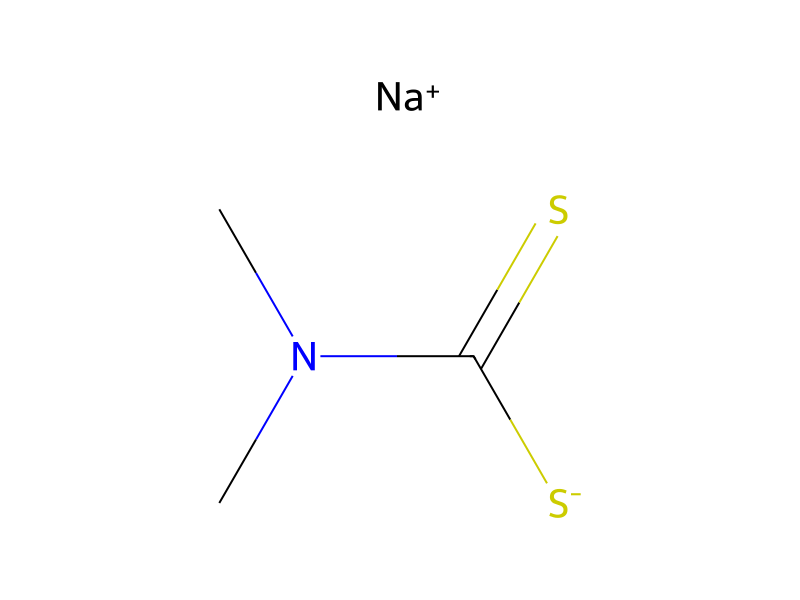
128-04-1CN(C)C(=S)[S-].[Na+]VMSRVIHUFHQIAL-UHFFFAOYSA-MSodium dimethyldithiocarbamate can cause developmental toxicity according to The Environmental Protection Agency (EPA).
Fungicides
Active substance -> EU Pesticides database: Not approved
Pesticides -> Dithiocarbamates (Pesticide)
Crystals or liquid. Becomes anhydrous at 266 °F. (NTP, 1992)
안전 정보는 참고용이며, 공급업체의 물질안전보건자료(SDS), 관련 법규 및 전문가 평가를 대체하지 않습니다.
Warning
H332 (12.2%): Harmful if inhaled [Warning Acute toxicity, inhalation]
P261, P271, P273, P304+P340, P317, P391, and P501 (click each P-code to see the statement)
Aggregated GHS information provided per 450 reports by companies from 17 notifications to the ECHA C&L Inventory. Each notification may be associated with multiple companies.
Warning
H302: Harmful if swallowed [Warning Acute toxicity, oral]
Chemical: Carbamodithioic acid, dimethyl-, sodium salt
Hazard Traits - Developmental Toxicity
Carbamodithioic acid, N,N-dimethyl-, sodium salt (1:1) is listed on the EPA's Chemical Data Reporting (CDR) system. Manufacturers and importers of Carbamodithioic acid, N,N-dimethyl-, sodium salt (1:1) are required to report information about their production and use of this chemical to the EPA under the Toxic Substances Control Act (TSCA). (40 eCFR Part 711)
2002/2076
REACH registered substance: Sodium dimethyldithiocarbamate (EC: 204-876-7)
Sodium dimethyldithiocarbamate: Does not have an individual approval but may be used under an appropriate group standard
...Partition of Mn in the presence of potassium ethylxanthate, sodium diethyldithiophosphate, sodium dimethyldithiocarbamate, and sodium diethyldithiocarbamate between octanol and Tris-HCl buffer showed formation of lipophilic complex with the latter two compounds, but not with the former. However, these four chelating agents all decreased Mn uptake in the /Brown/ trout /(Salmo trutta)/ by 40-45%. ...
Used as a disinfectant, corrosion inhibitor, coagulant, vulcanizing agent, chelating agent, fungicide, and biocide (paints, cutting oils, water treatment, leather tanning, and paper manufacturing); [HSDB]
Metal Machining [Category: Heat or Machine]
For sodium dimethyldithiocarbamate (USEPA/OPP Pesticide Code: 034804) ACTIVE products with label matches. /SRP: Registered for use in the U.S. but approved pesticide uses may change periodically and so federal, state and local authorities must be consulted for currently approved uses./
Disinfectant. Corrosion inhibitor. Coagulant. Vulcanizing agent. Chelating agent. Fungicide.
Used as a vulcanization ultra-accelerator for mixes based on synthetic and natural rubbers (for example butadiene rubber) and natural and synthetic latex. A fungicide.
In water treatment, the rubber industry and is a registered biocide for cutting oils and aqueous systems in industries such as leather tanning and paper manufacturing.
2023: 2,500,000 - <4,000,000 lb
Carbamodithioic acid, dimethyl-, sodium salt is listed as a High Production Volume (HPV) chemical (65FR81686). Chemicals listed as HPV were produced in or imported into the U.S. in >1 million pounds in 1990 and/or 1994. The HPV list is based on the 1990 Inventory Update Rule. (IUR) (40 CFR part 710 subpart B; 51FR21438).
128-04-1、72140-17-1DTXSID6027050CHEMBL569460CHEBI:230449Liquid
40% aqueous solution: Yellow liquid; [HSDB] Off-white to cream colored flakes; [MSDSonline]
Sodium dimethyldithiocarbamate is a clear yellow liquid or yellow crystalline solid. The pure product is a scaly white crystal, which is easily soluble in water. The crystal obtained by the crystallization method contains 2.5 molecules of crystal water, which loses 2 molecules of crystal water when heated to 115 °C, and completely loses crystal water at 130 °C. The industrial intermediate is a 15% aqueous solution, a yellowish or grass-green transparent liquid, a relative density of 1.06, and a pH of 9 to 11. Used as soil disinfectant.
EPA/Office of Pollution Prevention and Toxics; High Production Volume (HPV) Challenge Program's Robust Summaries and Test Plans. Available from: http://www.epa.gov/chemrtk/viewsrch.htm on Carbamodithioic acid, dimethyl-, sodium salt as of November 3, 2004.
The U.S. high production volume (HPV) chemicals are those which are manufactured in or imported into the United States in amounts equal to or greater than one million pounds per year. Robust Summaries include health effects, ecotoxicity data, and environmental fate information for selected chemicals. EPA/Office of Pollution Prevention and Toxics; High Production Volume (HPV) Challenge Program's Robust Summaries and Test Plans. Available from: http://www.epa.gov/chemrtk/viewsrch.htm on Carbamodithioic acid, dimethyl-, sodium salt as of November 3, 2004.
A tolerance is established for residues of the fungicide sodium dimethyldithio-carbamate, calculated as zinc ethylenebisdithiocarbamate, in or on melon.
As the federal pesticide law FIFRA directs, EPA is conducting a comprehensive review of older pesticides to consider their health and environmental effects and make decisions about their future use. Under this pesticide reregistration program, EPA examines health and safety data for pesticide active ingredients initially registered before November 1, 1984, and determines whether they are eligible for reregistration. In addition, all pesticides must meet the new safety standard of the Food Quality Protection Act of 1996. Pesticides for which EPA had not issued Registration Standards prior to the effective date of FIFRA '88 were divided into three lists based upon their potential for human exposure and other factors, with List B containing pesticides of greater concern and List D pesticides of less concern. Sodium dimethyldithiocarbamate is found on List B. Case No: 2180; Pesticide type: fungicide, antimicrobial; Case Status: OPP is reviewing data from the pesticide's producers regarding its human health and/or environmental effects, or OPP is determining the pesticide's eligibility for reregistration and developing the RED document.; Active ingredient (AI): sodium dimethyldithiocarbamate; Data Call-in (DCI) Date(s): 9/27/91; AI Status: The producers of the pesticide have made commitments to conduct the studies and pay the fees required for reregistration, and are meeting those commitments in a timely manner.
Acute Tox. 4 (12.2%)
Acute toxicity (Oral) - Category 4
Acute toxicity (Oral) - Category 4
Teratogens
EYES: First check the victim for contact lenses and remove if present. Flush victim's eyes with water or normal saline solution for 20 to 30 minutes while simultaneously calling a hospital or poison control center. Do not put any ointments, oils, or medication in the victim's eyes without specific instructions from a physician. IMMEDIATELY transport the victim after flushing eyes to a hospital even if no symptoms (such as redness or irritation) develop.
SMALL SPILLS AND LEAKAGE: If you spill this chemical, you should dampen the solid spill material with water, then transfer the dampened material to a suitable container. Use absorbent paper dampened with water to pick up any remaining material. Seal your contaminated clothing and the absorbent paper in a vapor-tight plastic bag for eventual disposal. Wash all contaminated surfaces with a soap and water solution. Do not reenter the contaminated area until the Safety Officer (or other responsible person) has verified that the area has been properly cleaned.
SRP: The most favorable course of action is to use an alternative chemical product with less inherent propensity for occupational exposure or environmental contamination. Recycle any unused portion of the material for its approved use or return it to the manufacturer or supplier. Ultimate disposal of the chemical must consider: the material's impact on air quality; potential migration in soil or water; effects on animal, aquatic, and plant life; and conformance with environmental and public health regulations.
RECOMMENDED RESPIRATOR: Where the neat test chemical is weighed and diluted, wear a NIOSH-approved half face respirator equipped with an organic vapor/acid gas cartridge (specific for organic vapors, HCl, acid gas and SO2) with a dust/mist filter. (NTP, 1992)
LC50 Poecilia reticulata 2.6 mg/L/96 hr /Conditions of bioassay not specified in source examined/
LC50 Salmo gairdneri (early life stage) 6.4 ug/L/60 day /Conditions of bioassay not specified in source examined/
LC50 Cyprinodon variegatus (Sheepshead minnow) 107 mg/L/24 hr; 63.0 mg/L/48 hr; 60.1 mg/L/72 hr, 96 hr; flow-through
LC50 Oncorhynchus mykiss (Rainbow trout) 32.2 mg/L/24 hr; 7.12 mg/L/48 hr; 6.69 mg/L/72 hr, 96 hr; flow-through
For more Ecotoxicity Values (Complete) data for SODIUM N,N-DIMETHYLDITHIOCARBAMATE (16 total), please visit the HSDB record page.
TERRESTRIAL FATE: Based on a classification scheme(1), an estimated Koc value of 2.2(SRC), determined from a water solubility of 1X10+6 mg/L (miscible)(2) and a regression-derived equation(3), indicates that sodium N,N-dimethylthithiocarbamate is expected to have very high mobility in soil(SRC). Hydrolysis half-life of 18 minutes, 25.9, and 433.3 hours were reported for sodium N,N-dimethylthithiocarbamate at pH 5, 7, and 9, respectively(2); this compound would be expected to hydrolyze in moist neutral or acidic soils(SRC). The estimated pKa of sodium N,N-dimethydithiocarbamate is 5.4(6), indicating that this compound will primarily exist in the dissociated form at environmentally relevant pHs; therefore, volatilization from moist soil surfaces is not expected to be an important fate process(SRC). Sodium N,N-dimethylthithiocarbamate is not expected to volatilize from dry soil surfaces since it is a salt and will be nonvolatile(SRC). Photolysis in aqueous solution and on soil was found to be an important degradation process for a related compound, ziram(4), and may also be important for sodium N,N-dimethylthithiocarbamate(SRC). Sodium N,N-dimethylthithiocarbamate, present at 100 mg/L, reached 2% of its theoretical BOD in 28 days at 25 °C using an activated sludge inoculum at 30 mg/L and the Japanese MITI test(5); however, this result may be due to the biocidal properties of sodium N,N-dimethylthithiocarbamate(SRC). In an anaerobic degradation test with sodium N,N-dimethylthithiocarbamate, tetramethyl thiuram disulfide and tetramethyl thiuram monosulfide were the major decomposition products(2).
AQUATIC FATE: Based on a classification scheme(1), an estimated Koc value of 2.2(SRC), determined from a water solubility of 1X10+6 mg/L (miscible)(2) and a regression-derived equation(3), indicates that sodium N,N-dimethylthithiocarbamate is not expected to adsorb to suspended solids and sediment(SRC). The estimated pKa of sodium N,N-dimethylthithiocarbamate is 5.4(6), indicating that this compound will primarily exist in the dissociated form at environmentally relevant pHs; therefore, volatilization from moist soil surfaces is not expected to be an important fate process(SRC). Bioconcentration is not expected to be a significant fate for sodium N,N-dimethylthithiocarbamate, due to its rapid hydrolysis at neutral and acidic pH(2) and its ionic character(SRC). Hydrolysis half-life of 18 minutes, 25.9, and 433.3 hours were reported for sodium N,N-dimethylthithiocarbamate at pH 5, 7, and 9, respectively(2). Photolysis in aqueous solution was found to be an important degradation process for a related compound, ziram(4), and may also be important for sodium N,N-dimethylthithiocarbamate(SRC). Sodium N,N-dimethylthithiocarbamate, present at 100 mg/L, reached 2% of its theoretical BOD in 28 days at 25 °C using an activated sludge inoculum at 30 mg/L and the Japanese MITI test(5); however, this result may be due to the biocidal properties of sodium N,N-dimethylthithiocarbamate(SRC). In an anaerobic degradation test with sodium N,N-dimethylthithiocarbamate, tetramethyl thiuram disulfide and tetramethyl thiuram monosulfide were the major decomposition products(2).
ATMOSPHERIC FATE: According to a model of gas/particle partitioning of semivolatile organic compounds in the atmosphere(1), sodium N,N-dimethylthithiocarbamate will solely in the particulate phase in the ambient atmosphere, since it is a salt and will be nonvolatile(SRC). Particulate-phase sodium N,N-dimethylthithiocarbamate will be removed from the atmosphere by wet and dry deposition(SRC).
/AQUATIC SPECIES/ Early life stages of Salmo gairdneri, from the fertilized egg to the early fry stage, were continuously exposed to various dialkyldithiocarbamates (DDCs), ethylenebisdithiocarbamates (BDCs) and a number of degradation products. Both DDCs and BDCs induced embryotoxicity, but DDCs were generally found to be more toxic than BDCs. For some DDCs adverse effects, below ppb-level were observed. All compounds, including carbon disulfide, were shown to have teratogenic properties. The most striking effects were severe spinal and vertebral abnormalities, mostly associated with retarded yolk sac resorption. /Dialkyldithiocarbamates/
The Koc of sodium N,N-dimethylthithiocarbamate is estimated as 2.2(SRC), using a water solubility of sodium N,N-dimethylthithiocarbamate(1) and a regression-derived equation(2). According to a classification scheme(3), this estimated Koc value suggests that sodium N,N-dimethylthithiocarbamate is expected to have very high mobility in soil. Hydrolysis half-life of 18 minutes, 25.9, and 433.3 hours were reported for sodium N,N-dimethylthithiocarbamate at pH 5, 7, and 9, respectively(1);this compound would be expected to hydrolyze in moist neutral or acidic soils(SRC).
Sodium N,N-dimethylthithiocarbamate's production and use as a disinfectant, corrosion inhibitor, coagulant, vulcanizing agent, chelating agent, and fungicide(1) may result in its release to the environment through various waste streams(SRC). Sodium N,N-dimethylthithiocarbamate is used in water treatment, the rubber industry and is a registered biocide for cutting oils and aqueous systems in industries such as leather tanning and paper manufacturing(2). It is also used as an antimicrobial agent in paints(3).
Sodium N,N-dimethylthithiocarbamate, present at 100 mg/L, reached 2% of its theoretical BOD in 28 days at 25 °C using an activated sludge inoculum at 30 mg/L and the Japanese MITI test(1); however, this result may be due to the biocidal properties of sodium N,N-dimethylthithiocarbamate(SRC). In an anaerobic degradation test with sodium N,N-dimethylthithiocarbamate, tetramethyl thiuram disulfide and tetramethyl thiuram monosulfide were the major decomposition products(2).
The estimated pKa of sodium N,N-dimethylthithiocarbamate is 5.4(1), indicating that this compound will primarily exist in the dissociated form at environmentally relevant pHs. Bioconcentration is not expected to be a significant fate for sodium N,N-dimethylthithiocarbamate, due to its rapid hydrolysis at neutral and acidic pH(2) and its ionic character(SRC). Hydrolysis half-life of 18 minutes, 25.9, and 433.3 hours were reported for sodium N,N-dimethylthithiocarbamate at pH 5, 7, and 9, respectively(2).
The estimated pKa of sodium N,N-dimethylthithiocarbamate is 5.4(1), indicating that this compound will primarily exist in the dissociated form at environmentally relevant pHs; therefore, volatilization from moist soil surfaces is not expected to be an important Sodium N,N-dimethylthithiocarbamate is not expected to volatilize from dry soil surfaces since it is a salt and will be nonvolatile(SRC).
/LABORATORY ANIMALS: Acute Exposure/ Rabbits received single doses of 0.5-1.5 g /dimethyldithiocarbamic acid, sodium salt//kg bw. The intake was accompanied by excitation with subsequent CNS inhibition, reduced tactile and pain sensitivity and decreased food consumption. Hematology and ECG changes were noted. Animals given 1.0 and 1.5 g/kg bw died within 24 hours. The lowest dose caused no mortality. Gross pathology examination revealed visceral congestion and pulmonary edema, hyperemia and focal hemorrhages in the gastric mucosa and intestinal swelling. The relative weights of the lungs, heart, and stomach were increased.
/LABORATORY ANIMALS: Acute Exposure/ 0.5 mL of the test substance /(Vancide (Registered Trademark) 51 (27.6% SDMC, 2.4% SMBT aqueous solution, pH 11.6))/ was applied to the shaved skin of six /New Zealand/ albino rabbits for four hours. The mean Primary Irritation Index was 1.67. Slightly irritating.
/LABORATORY ANIMALS: Acute Exposure/ The toxic effects of dithiocarbamates following parenteral administration was investigated in-vivo. Blood glucose, tissue concentrations of glycogen, glucose-6-phosphate and lactic-acid were measured. Male Osborne-Mendel-rats were given intraperitoneal injections of 2.5 mL/kg sodium-dimethyldithiocarbamate (DMDC), zinc-dimethyldithiocarbamate (ziram), or ferric-dimethyldithiocarbamate (ferbam). ...Two hours after injection, samples of whole blood, liver, and gastrocnemius muscle were taken. All three dimethyldithiocarbamate salts produced a glycogenolytic effect. ...Depression and loss of mobility of the hind limbs were observed in most animals.
/LABORATORY ANIMALS: Subchronic or Prechronic Exposure/ Body weight gain was increased in rabbits given 100 mg/kg bw (in an aqueous solution) for 15 weeks, as compared to the controls. Adynamia, changes in blood morphology, in the /nervous system/, and cardiovascular systems were noted. The fur of animals was ungroomed and had turned yellow.
For more Non-Human Toxicity Excerpts (Complete) data for SODIUM N,N-DIMETHYLDITHIOCARBAMATE (9 total), please visit the HSDB record page.
Hydrolysis half-lives of 18 minutes, 25.9, and 433.3 hours were reported for sodium N,N-dimethylthithiocarbamate at pH 5, 7, and 9, respectively(1). Photolysis in aqueous solution and on soil was found to be an important degradation process for a related compound, ziram(2), and may also be important for sodium N,N-dimethylthithiocarbamate(SRC).
A tolerance is established for residues of the fungicide sodium dimethyldithio-carbamate, calculated as zinc ethylenebisdithiocarbamate, in or on melon.
As the federal pesticide law FIFRA directs, EPA is conducting a comprehensive review of older pesticides to consider their health and environmental effects and make decisions about their future use. Under this pesticide reregistration program, EPA examines health and safety data for pesticide active ingredients initially registered before November 1, 1984, and determines whether they are eligible for reregistration. In addition, all pesticides must meet the new safety standard of the Food Quality Protection Act of 1996. Pesticides for which EPA had not issued Registration Standards prior to the effective date of FIFRA '88 were divided into three lists based upon their potential for human exposure and other factors, with List B containing pesticides of greater concern and List D pesticides of less concern. Sodium dimethyldithiocarbamate is found on List B. Case No: 2180; Pesticide type: fungicide, antimicrobial; Case Status: OPP is reviewing data from the pesticide's producers regarding its human health and/or environmental effects, or OPP is determining the pesticide's eligibility for reregistration and developing the RED document.; Active ingredient (AI): sodium dimethyldithiocarbamate; Data Call-in (DCI) Date(s): 9/27/91; AI Status: The producers of the pesticide have made commitments to conduct the studies and pay the fees required for reregistration, and are meeting those commitments in a timely manner.
Oil and Gas Drilling, Extraction, and Support activities
Carbamodithioic acid, N,N-dimethyl-, sodium salt (1:1): ACTIVE
Photodegradation product of tetramethylthioram disulfide.
개요Dithiocarbamates (DCs) are a well-known group of pesticides which have been used to control a number of species belonging to taxonomically different groups, e.g., bacteria, fungi, nematodes, and molluscs for over 60 years. The first integrated product containing sodium dimethyldithiocarbamate (SDMC) was registered in 1949.
용도Sodium dimethyldithiocarbamate(SDMC) is used as a disinfectant, corrosion inhibitor, coagulant, vulcanizing agent, chelating agent, and fungicide. SDMC is used in water treatment, the rubber industry, and is a registered biocide for cutting oils and aqueous systems in industries such as leather tanning and paper manufacturing. It is also used as an antimicrobial agent in paints. generally SDMC are able to function as metal chelators and have been used in metal finishing operations and wastewater treatments to enhance the precipitation of metals. As a free radical inhibitor, it has been used in the rubber industry to rapidly stop the polymerization of synthesis. It is also used as a biocide for cutting oils and aqueous systems such as leather tanning and paper manufacturing.
일반 설명Crystals or liquid. Becomes anhydrous at 266°F.
Sodium dimethyldithiocarbamate is prepared by combining dimethylamine with carbon disulfide in a solution of sodium hydroxide, forming the water-soluble dithiocarbamate salt.


