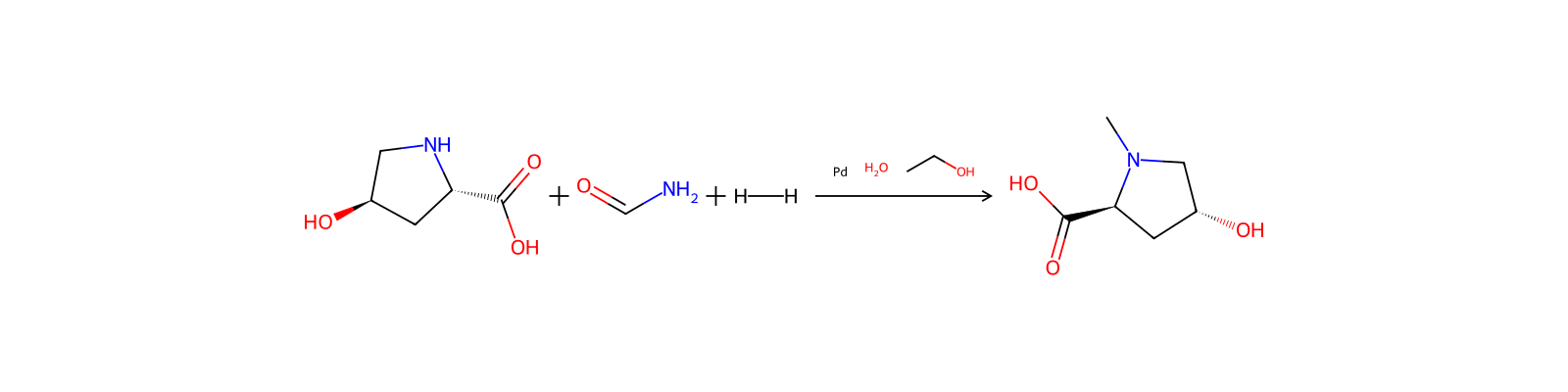
하이드록시프롤린
L-Hydroxyproline
데이터를 보충하는 중입니다. 잠시 후 페이지를 새로 고치면 최신 내용을 볼 수 있습니다

기본 정보
- CAS
51-35-4- 표준 SMILES
O=C(O)[C@@H]1C[C@@H](O)CN1- InChIKey
PMMYEEVYMWASQN-DMTCNVIQSA-N- 분자식
- C5H9NO3
- 평균 분자량
- 131.13 g/mol
- 단동위원소 질량
- 131.05824315
개요
Trans-4-hydroxy-L-proline is an optically active form of 4-hydroxyproline having L-trans-configuration. It has a role as a mouse metabolite, a plant metabolite and a human metabolite. It is a tautomer of a trans-4-hydroxy-L-proline zwitterion.
이름 및 식별자
- 우선 이름
- L-Hydroxyproline
- IUPAC
- (2S,4R)-4-hydroxypyrrolidine-2-carboxylic acid
- 현지명
- 하이드록시프롤린
- 영어명
- L-Hydroxyproline
- 분자식
- C5H9NO3
- 분자량
- 131.13
이름 및 동의어
L-Hydroxyproline51-35-4trans-4-Hydroxy-L-prolinehydroxyprolineHyprohydroxy-L-proline(4R)-4-hydroxy-L-prolinetrans-L-HydroxyprolineL-Proline, 4-hydroxy-, (4R)-trans-Hydroxyproline4-Hydroxy-2-pyrrolidinecarboxylic aciddelta-Hydroxyproline
이름 더 보기
하이드록시프롤린4-하이드록시프롤린Hyp(2S,4R)-4-HYDROXYPYRROLIDINE-2-CARBOXYLIC ACID4-HYDROXY-L-PROLINE4-HydroxyprolineH-HYP-OH4R-4-hydroxyproline4-HYDROXYPYRROLIDINE-2-CARBOXYLIC ACID5kg
L-Proline, 4-hydroxy-, trans-(2S,4R)-4-hydroxyprolineRMB44WO89XLUMISTORL-threo-4-hydroxyprolineNSC-46704(2S,4R)-4-hydroxy-2-pyrrolidinecarboxylic acidCHEBI:18095
데이터베이스 식별자
- CAS
51-35-4、618-28-0- PubChem CID
- 5810
- DTXSID
DTXSID10883225- ChEMBL
CHEMBL352418- ChEBI
CHEBI:18095- UNII
- RMB44WO89X
- EC Number
- 200-091-9
- Nikkaji
- J148.015D
물성
구조 계산 물성보충 중
- XLogP
- -3.3
- 극성 표면적
- 69.6 Ų
- 수소 결합 공여자 수
- 3
- 수소 결합 수용자 수
- 4
- 회전 가능 결합 수
- 1
- 무거운 원자 수
- 9
- 형식 전하
- 0
- 복잡도
- 125
실험 및 물리화학적 성질
Chemical ClassesBiological Agents -> Amino Acids and Derivatives
DrugsPharmaceuticals -> Listed in ZINC15
CosmeticsSkin conditioning; Surfactant; Antistatic; Hair conditioning
LogP-3.17
Food AdditivesUse unspecified -> FDA Substance added to food
Solubility
Soluble in water at 0, 25, 50, and 60 °C
361 mg/mL at 25 °C
Boiling PointDecomposes
Melting Point
274°C
274 - 275 °C
Physical Description
Solid; [Merck Index] White crystalline powder; [Alfa Aesar MSDS]
Solid
Dissociation ConstantspK1′ 1.82 and pK2′ 9.65
Collision Cross Section
안전 및 규제
안전 정보는 참고용이며, 공급업체의 물질안전보건자료(SDS), 관련 법규 및 전문가 평가를 대체하지 않습니다.
GHS 분류
GHS Classification
This chemical does not meet GHS hazard criteria for 89.3% (25 of 28) of all reports.
Warning
H315 (10.7%): Causes skin irritation [Warning Skin corrosion/irritation]
P261, P264, P264+P265, P271, P280, P302+P352, P304+P340, P305+P351+P338, P319, P321, P332+P317, P337+P317, P362+P364, P403+P233, P405, and P501 (click each P-code to see the statement)
Aggregated GHS information provided per 28 reports by companies from 4 notifications to the ECHA C&L Inventory. Each notification may be associated with multiple companies.
유해성 정보
Regulatory Information
Chemical: L-Proline, 4-hydroxy-, (4R)-
Status: Active Update: 27-04-2022 https://echa.europa.eu/registration-dossier/-/registered-dossier/21207
L-Proline, 4-hydroxy-, (4R)-: Does not have an individual approval but may be used under an appropriate group standard
Other Safety InformationIMAP assessments - L-Proline, 4-hydroxy-, trans-: Environment tier I assessment
Hazards SummaryMay cause irritation; [Alfa Aesar MSDS] See L-Proline.
Hazard Classes and CategoriesSkin Irrit. 2 (10.7%)
독성 정보
Carcinogen ClassificationNo indication of carcinogenicity to humans (not listed by IARC).
안전 데이터
- wgk
- 3
- tsca
- TSCA listed
- rtecs
화학 및 산업
약리 정보
Pharmacodynamics
Hydroxyproline as well as proline and glycine are the major components of collagen. Collagen is on one of the main building blocks of connective tissue such as skin, bone, and cartilage. Thus when these tissues are damaged, hydroxyproline is necessary for repair of the damaged area.
Tissue LocationsEpidermis
Cellular LocationsEndoplasmic reticulum
Metabolite PathwaysArginine: Glycine Amidinotransferase Deficiency (AGAT Deficiency)
용도 및 제조
Uses
An analog of proline and an non-essential amino acid found in collagen; [Merck Index]
This is an endogenously produced metabolite found in the human body. It is used in metabolic reactions, catabolic reactions or waste generation.
Use ClassificationCosmetics -> Skin conditioning; Surfactant; Antistatic; Hair conditioning
General Manufacturing InformationL-Proline, 4-hydroxy-, (4R)-: ACTIVE
응용 분야
개요A non-essential amino acid. Can be isolated from gelatin. Hydroxyproline has not been reported as added to food in any of the NAS surveys.
용도A natural constituent of animal structural proteins such as collagen and elastin. Several microorganisms producing proline trans-4- and cis-3-hydroxylase were discovered and these enzymes were applied to the industrial production of trans-4- and cis-3-hydroxy-L-proline.
일반 설명Pharmaceutical secondary standards for application in quality control provide pharma laboratories and manufacturers with a convenient and cost-effective alternative to the preparation of in-house working standards
관련 반응
448건


화합물 노트
불러오는 중…