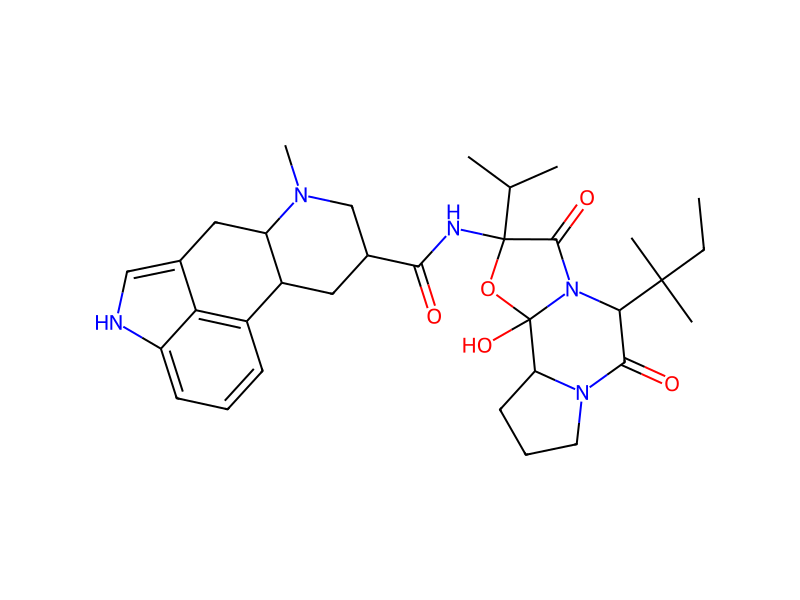
기본 정보
- CAS
8067-24-1- 표준 SMILES
CCC(C)(C)C1C(=O)N2CCCC2C2(O)OC(NC(=O)C3CC4c5cccc6[nH]cc(c56)CC4N(C)C3)(C(C)C)C(=O)N12- InChIKey
ONYMVHQTXOEAOV-TZWRWDCZNA-N- 분자식
- C33H45N5O5
- 평균 분자량
- 591.7 g/mol
- 단동위원소 질량
- 591.34206955
개요
Alkergot is a peptide ergot alkaloid.
이름 및 식별자
- 우선 이름
- Dihydroergotoxine Mesylate
- IUPAC
- N-[2-hydroxy-7-(2-methylbutan-2-yl)-5,8-dioxo-4-propan-2-yl-3-oxa-6,9-diazatricyclo[7.3.0.02,6]dodecan-4-yl]-7-methyl-6,6a,8,9,10,10a-hexahydro-4H-indolo[4,3-fg]quinoline-9-carboxamide
- 영어명
- Dihydroergotoxine mesylate
- 분자식
- C20H29N3O5S
- 분자량
- 423.53
이름 및 동의어
이름 더 보기
데이터베이스 식별자
- CAS
8067-24-1- PubChem CID
- 592735
- ChEMBL
CHEMBL2311030- ChEBI
CHEBI:181460- EC Number
- 630-416-3
물성
구조 계산 물성
- XLogP
- 3.5
- 극성 표면적
- 118 Ų
- 수소 결합 공여자 수
- 3
- 수소 결합 수용자 수
- 6
- 회전 가능 결합 수
- 5
- 무거운 원자 수
- 43
- 형식 전하
- 0
- 복잡도
- 1,180
실험 및 물리화학적 성질
Human Drugs
FDA approved drugs -> Active ingredient
FDA approved drugs -> Active ingredient
물리화학적 성질
- 저장 조건
- Store at RT
- 용해도
- 1 mg/ml · DMSO: Slightly Soluble; Methanol: 1 mg/ml
- 물리적 상태
- Solid
- 색상
- White to off-white
- InChIKey
- ONYMVHQTXOEAOV-TZWRWDCZNA-N
- SMILES
- C12C3=CC=CC=1[C@@]1([H])C[C@H](CN(C)[C@]1([H])CC2=CN3)C(=O)N[C@@H](C)CO.S(=O)(=O)(O)C |&1:6,9,13,22,r|
안전 및 규제
GHS 분류
GHS Classification
Danger
H228 (57.1%): Flammable solid [Danger Flammable solids]
P203, P210, P240, P241, P261, P264, P264+P265, P270, P271, P273, P280, P301+P317, P302+P352, P304+P340, P305+P351+P338, P317, P318, P319, P321, P330, P332+P317, P337+P317, P362+P364, P370+P378, P403+P233, P405, and P501 (click each P-code to see the statement)
Aggregated GHS information provided per 7 reports by companies from 4 notifications to the ECHA C&L Inventory. Each notification may be associated with multiple companies.
유해성 정보
안전 데이터
- rtecs
- KE8800000
- ridadr
- 1544
- HS 번호
- 3003490000
- risk_code
- 60
- hazard_code
- T
- safety_code
- 53-36/37/39-45
- 포장분류
- III
- 위험 등급
- 6.1(b)
화학 및 산업
약리 정보
ATC Code
C - Cardiovascular system
QC - Cardiovascular system
Pharmacodynamics
The mechanism of action of ergoloid mesylate is not completely established but it is thought that it increases both the blood flow and cerebral metabolism. Some studies have shown a significant improvement in alertness and memory, as well as a decline in confusion while some other benefits have shown a lack of effect. Its action produces a damper in the impulses from the vasomotor center which reduces the vascular tone which translates in the slow of pulse rate, prevention of compensatory tachycardia. To know more about the individual components of the ergoloid mixture, please visit [DB11274], [DB11273] and [DB13345].
Mechanism of Action
The general mechanism of action of ergoloid mesylate is the dual action of partial agonism/antagonism of adrenergic, dopaminergic and serotonergic receptors. The pharmacological activity is determined by the degree of activity of each component at the receptor site. To know more about the individual components of the ergoloid mixture, please visit [DB11275], [DB11274], [DB11273] and [DB13345].
Metabolism/Metabolites
Most of the metabolism of ergoloid mesylate is hepatic and it is performed very rapidly after absorption. After exposition in vitro, the major metabolites identified are hydroxy-dihydroergocornine, hydroxy-dihydroergocryptine and hydroxy-dihydroergocristine. All metabolic transformations seem to be related to the activity of the cytochrome CYP3A4. To know more about the individual components of the ergoloid mixture, please visit [DB11274], [DB11273] and [DB13345].
MeSH Pharmacological Classification
Drugs that bind to but do not activate alpha-adrenergic receptors thereby blocking the actions of endogenous or exogenous adrenergic agonists. Adrenergic alpha-antagonists are used in the treatment of hypertension, vasospasm, peripheral vascular disease, shock, and pheochromocytoma.
Drugs used to cause dilation of the blood vessels.
Drugs used to specifically facilitate learning or memory, particularly to prevent the cognitive deficits associated with dementias. These drugs act by a variety of mechanisms.
Absorption, Distribution and Excretion
The maximal plasma concentration of the components of the mixture of ergoloid mesylates is approximately 0.04 mcg/l. The analysis of the concentration of the major metabolites of each component indicates that all ergoloid mesylate are rapidly transformed after absorption. This finding is supported as they were found in one order of magnitude higher in concentration when compared to the original form. Ergoloid mesylate seems to have a very low absorption of only 25%. From this absorption by the GI tract, approximately 50% of the absorbed dose is eliminated by first-pass metabolism. After absorption, the maximal plasma concentration is attained after 3-4 hours and the oral bioavailability is very low. Simultaneous food ingestion has no effect on the extent of absorption but it does lower the absorption rate. To know more about the individual components of the ergoloid mixture, please visit [DB11274], [DB11273] and [DB13345].
The ergoloid mesylate mixture is mainly excreted via bile in feces. The ratio of the eliminated dose via urine after intravenous and oral administration is 8.4% and 2% respectively. Urinary excretion of the unchanged drug is very small and bile excretion is represented mainly by ergot metabolites conformed as conjugated compounds. To know more about the individual components of the ergoloid mixture, please visit [DB11274], [DB11273] and [DB13345].
The volume of distribution is about 2 L/kg. To know more about the individual components of the ergoloid mixture, please visit [DB11274] and [DB13345].
To know more about the individual components of the ergoloid mixture, please visit [DB11274] and [DB13345].
응용 분야
개요Ergoloid, also known as dihydroergotoxine mesylate, is a mixture of the ergot alkaloids dihydroergocornine, dihydroergocrystine, and dihydroergocryptine. It blocks reflex vasodilation and vasoconstriction induced by norepinephrine in dogs when injected into the kidney at a dose of 0.15 mg. Ergoloid blocks norepinephrine-induced cAMP production in rat brain cortical homogenates ex vivo in a dose-dependent manner. It also acts as an erectogenic agent in rats. Formulations containing ergoloid have been used in the treatment of migraine headaches and vascular dementias.
용도Cognition adjuvant. Dihydroergotoxine mesylate binds with high affinity to GABAA receptor Cl- channel. Interacts with central dopaminergic, serotonergic and adrenergic (a1) receptors. Exhibits antirproliferative activity in vitro. Displays cognition-enhancing, anticonvulsant and sedative activity in vivo. Dihydroergotoxine mesylate is a substrate of GABA Receptor.
공급사74 곳
추가 설명
정의ChEBI: Dihydroergotoxine mesylate is a mixture of hydrogenated ergot alkaloids consisting of the methanesulfonic acid salts of dihydroergocornine (R = CHMe2), dihydroergocristine (R = CH2Ph), and alpha- and beta-dihydroer ocryptine (R = CH2CHMe2 and CH(Me)Et, respectively). It is used for the symptomatic treatment of mild to moderate dementia in the elderly, although its value is not established.
관련 반응
현재 필터 조건에 해당하는 반응 기록이 없습니다.
화합물 노트
불러오는 중…