사염화탄소
사염화탄소 · 사클로로메탄,사염화메탄,테크라클로로메탄,퍼클로로메탄 · 카본테트라클로라이드 · 카본 테트라클로라이드 · 사염화 탄소 · CCl4 · TETRACHLOROMETHANE · PERCHLOROMETHANE
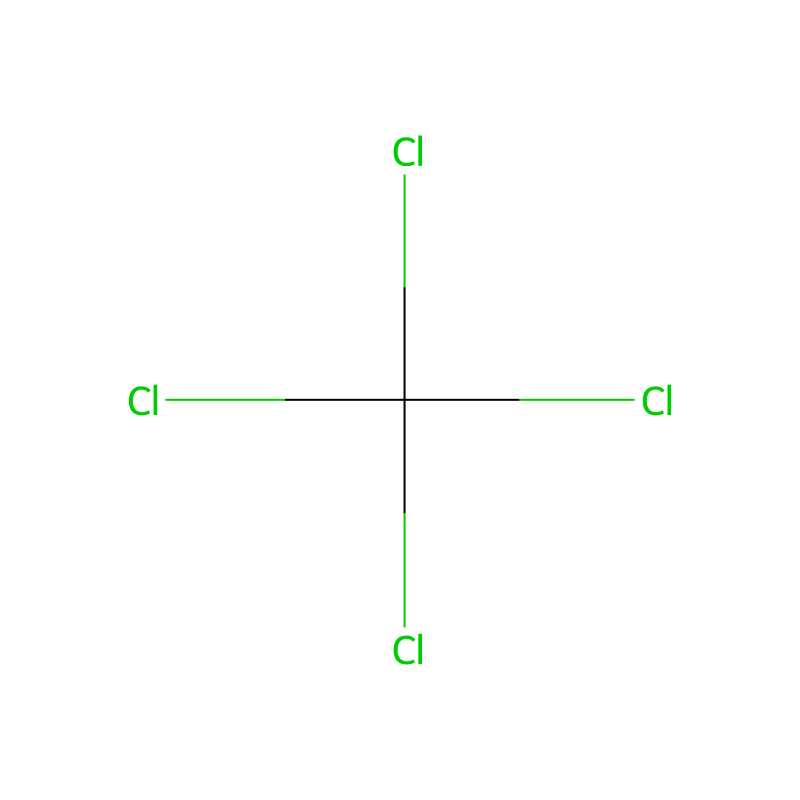
식별자 및 물리적 특성
| CAS No. | 56-23-5 |
|---|---|
| 분자식 | CCl4 |
| 평균 분자량 | 153.8 g/mol |
| 단동위원소 질량 | 151.87541072 g/mol |
| SMILES | ClC(Cl)(Cl)Cl |
| InChIKey | VZGDMQKNWNREIO-UHFFFAOYSA-N |
| PubChem CID | 5943 |
| ChEMBL | CHEMBL44814 |
| ChEBI | CHEBI:27385 |
| EC No. | 200-262-8 |
| DTXSID | DTXSID8020250 |
| 현지명 | 사염화탄소 |
화학 및 물리적 성질
| XLogP | 2.8 |
|---|---|
| 극성 표면적 | 0 |
| 수소 결합 공여자 수 | 0 |
| 수소 결합 수용자 수 | 0 |
| 회전 가능 결합 수 | 0 |
| 무거운 원자 수 | 5 |
| 형식 전하 | 0 |
| 복잡도 | 19.1 |
| 물질 분류 | Hazardous Air Pollutants (HAPs)Carcinogens |
| Solvents | Solvents -> Chlorinated Aliphatics |
| SpringerMaterials Properties | Gibbs energy |
| 농약 | Pesticide -> EPA IRISAgrochemicals -> Pesticide active substancesActive substance -> EU Pesticides database: Not approvedVolatile Organic Compound (VOC) (Pesticide/Volatile Organic Compound (VOC)) |
| LogP(분배 계수) | log Kow = 2.832.64 |
| 냄새 | SweetCharacteristic, ether-like odorSweetish, distinctive odorCharacteristic non-irritant odor140~584ppm(평균 = 252ppm)에서 감지 가능한 미묘하고 달콤하며 자극적인 냄새 |
| 밀도 | 1.59 at 68 °F (USCG, 1999) - Denser than waterwill sink1.5940 g/cu cm at 20 °CSaturated liquid density: 99.080 lb/cu ftliquid heat capacity: 0.219 Btu/lb °Fliquid viscosity: 0.922 centipoiseideal gas heat capacity: 0.130 Btu/lb °F (all at 75 °F)Liquid thermal conductivity: 0.690 Btu-inch/hr-sq ft °Fsaturated vapor pressure: 1.874 lb/sq insaturated vapor density: 0.05069 lb/cu ft (all at 70 °F)Relative density (water = 1): 1.59 (20 °C)1.594 g/mL at 25 °C(lit.) |
| Viscosity | 2.03X10⁻³ Pa.s at 250.00 K2.03 mPa*s at -23 °C |
| Color/Form | LiquidColorless, clear, heavy liquidColorless liquid |
| 용해도 | less than 1 mg/mL at 70 °F (NTP, 1992)In water, 793 mg/L at 25 °CIn water, 1160 mg/L at 25 °C, 800 mg/L at 20 °CMiscible with alcohol, benzene, chloroform, ether, carbon disulfide, petroleum ether, oilsSoluble in ethanol, acetonemiscible with ethyl ether, benzene, chloroformSoluble in naphthaMiscible with ethanol, benzene, chloroform, ether, carbon disulfide (U.S. EPA, 1985), petroleum ether, solvent naphtha, and volatile oils (Yoshida et al., 1983a). |
| Corrosivity | Liquid carbon tetrachloride attacks some forms of plastics, rubber, and coatings. |
| Endocrine Disruptors | Potential endocrine disrupting compound |
| 녹는점 | -23 °C |
| 끓는 점 | 76-77 °C(lit.) |
| 증기 밀도 | 5.32 (vs air) |
| 증기압 | 4.05 psi ( 20 °C) |
| 굴절률 | n20/D 1.460(lit.) |
| 인화점 | −2 °F |
| 저장 조건 | 2-8°C |
| 물리적 상태 | 액체 |
| 색상 | 무색의 |
| 후각 역치 | 4.6ppm |
| 생물학적 소스 | rat |
| 용해도 | 0.8g/L(20℃) |
| 비열 | Cp(liquid): 0.85 J/(g·K)Cp(gas): 0.54 J/(g·K), at 25℃ |
| Merck | 13,1826 |
| BRN | 1098295 |
| 헨리 상수 | 2.15 at 30 °C (headspace-GC, Sanz et al., 1997) |
| 유전율 | 2.2(20℃) |
| InChIKey | VZGDMQKNWNREIO-UHFFFAOYSA-N |
| LogP(분배 계수) | 2.830 |
| 표면장력 | 26.95mN/m at 20°C |
| NIST | Carbon tetrachloride(56-23-5) |
| EPA | Carbon tetrachloride (56-23-5) |
화학적 성질
Carbon tetrachloride, CC14, also known as tetrachloromethane, perchloro methane, and benzinoform, is a colorless liquid with a boiling point of 77 °C (170 OF). It is used as a solvent for lacquers, resin, and rubbers,and as a dry cleaning agent.
안전 및 규제
| GHS 분류 | DangerH301: Toxic if swallowed [Danger Acute toxicity, oral]P203, P260, P261, P262, P264, P270, P271, P273, P280, P301+P316, P302+P352, P304+P340, P316, P318, P319, P321, P330, P361+P364, P403+P233, P405, P501, and P502 (click each P-code to see the statement)H301+H311+H331 (34.4%): Toxic if swallowed, in contact with skin or if inhaled [Danger Acute toxicity, oralacute toxicity, dermalacute toxicity, inhalation]P203, P260, P261, P262, P264, P270, P271, P272, P273, P280, P301+P316, P302+P352, P304+P340, P316, P318, P319, P321, P330, P333+P317, P361+P364, P362+P364, P403+P233, P405, P501, and P502 (click each P-code to see the statement) |
|---|---|
| 규제 정보 | Chemical: Methane, tetrachloro-Hazard Traits - CarcinogenicityCardiovascular ToxicityDevelopmental ToxicityHepatotoxicity and Digestive System ToxicityNephrotoxicity and Other Toxicity to the Urinary SystemNeurotoxicityReproductive ToxicityMethane, tetrachloro- is listed on the EPA's Chemical Data Reporting (CDR) system. Manufacturers and importers of Methane, tetrachloro- are required to report information about their production and use of this chemical to the EPA under the Toxic Substances Control Act (TSCA). (40 eCFR Part 711)Status: Active Update: 02-02-2023 https://echa.europa.eu/registration-dossier/-/registered-dossier/14940Carbon tetrachloride: HSNO Approval: HSR002930 Approved with controlsThe New Jersey Worker and Community Right to Know Act requires public and private employers to provide information about hazardous substances at their workplaces. (N.J.S.A. 34:5A-1 et. seq.) |
| 기타 안전 정보 | IMAP assessments - Methane, tetrachloro-: Environment tier II assessment |
| 운송 라벨(DOT) | Poison |
| 화재 위험 | Special Hazards of Combustion Products: Forms poisonous phosgene gas when exposed to open flames.· Non-combustible, substance itself does not burn but may decompose upon heating to produce corrosive and/or toxic fumes.Not combustible. Gives off irritating or toxic fumes (or gases) in a fire. |
| 화재 가능성 |
용도
개요
Carbon tetrachloride is a manufactured chemical and does not occur naturally in the environment. It is produced by chlorination of a variety of low molecular weight hydrocarbons such as carbon disulfide, methane, ethane, propane, or ethylene dichloride and also by thermal chlorination of methyl chloride. Carbon tetrachloride is a precursor for chlorofluorocarbon (CFC) gases that have been used as aerosol propellant. A decrease in this use is occurring due to the agreement reached in the Montreal Protocol for the reduction of environmental concentrations of ozone-depleting chemicals, including carbon tetrachloride.
역사
In the 1890s, commercial manufacturing processes were being investigated by the United Alkali Co. in England. At the same time it was also produced in Germany, exported to the United States, and retailed as a spotting agent under the trade name Carbona. Large-scale production of carbon tetrachloride in the United States commenced in the early 1900s. By 1914, annual production fell just short of 4500 metric tons and was used primarily for dry cleaning and for charging fire extinguishers. During World War I, U.S. production of carbon tetrachloride expanded greatly; its use was extended to grain fumigation and the rubber industry. In 1934 it was supplanted as the predominant dry-cleaning agent in the United States by perchloroethylene, which is much less toxic and more stable. During the years immediately preceding World War II, trichloroethylene began to displace carbon tetrachloride from its then extensive market in the United States as a metal degreasing solvent. Carbon tetrachloride is more difficult to recover from degreasing operations, more readily hydrolyzed, and more toxic than trichloroethylene C2HCl3. The demands of World War II stimulated production and marked the beginning of its use as the starting material for chlorofluoromethanes, by far the most important application for carbon tetrachloride.
용도
Carbon tetrachloride is used as a solvent, infire extinguishers, in dry cleaning, and in themanufacture of fluorocarbon propellents.As solvent for oils, fats, lacquers, varnishes, rubber waxes, resins; starting material in manufacture of organic Compounds. Pharmaceutic aid (solvent).
일반 설명
Carbon tetrachloride appears as a clear colorless liquid with a characteristic odor. Denser than water (13.2 lb / gal) and insoluble in water. Noncombustible. May cause illness by inhalation, skin absorption and/or ingestion. Used as a solvent, in the manufacture of other chemicals, as an agricultural fumigant, and for many other uses.
제조 및 합성 방법
생산 방법
Carbon tetrachloride is made by the reaction of carbon disulfide and chlorine in the presence of a catalyst, such as iron or antimony pentachloride: CS2 + 3Cl2 → CCl4 + S2Cl2 Sulfur chloride is removed by treatment with caustic soda solution. The product is purified by distillation. Alternatively, CCl4 may be prepared by heating a mixture of chlorine and methane at 250 to 400°C. CH4 + 4Cl2 → CCl4 + 4HCl