기본 정보
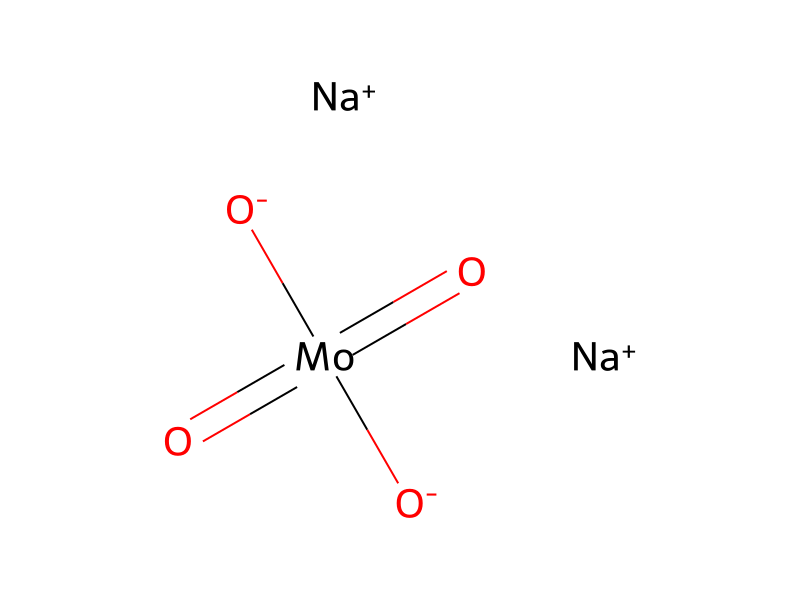
- 표준 SMILES
[Na+].[Na+].[O]=[Mo](=[O])([O-])[O-]- InChIKey
TVXXNOYZHKPKGW-UHFFFAOYSA-N- 분자식
- MoO4.2Na
- 평균 분자량
- 205.93 g/mol
개요
Sodium molybdate (anhydrous) is an inorganic sodium salt having molybdate as the counterion. It has a role as a NMR chemical shift reference compound and a poison. It contains a molybdate.
이름 및 식별자
- 우선 이름
- Sodium Molybdate
- IUPAC
- disodium;dioxido(dioxo)molybdenum
- 현지명
- 소듐 몰리브데이트
- 영어명
- Sodium molybdate
- 분자식
- MoNa2O4
- 분자량
- 205.91714
이름 및 동의어
Sodium molybdateDisodium molybdateSodium molybdate(VI)Natriummolybdatsodium molybdenum oxideMolybdic acid, disodium saltsodium molybdate (anhydrous)Na2MoO4Anhydric sodium molybdate948QAQ08I1Molybdate (MoO42-), disodium, (T-4)-Molybdenum (as sodium)
이름 더 보기
몰리브데넘산나트륨(몰리브덴산나트륨)소듐몰리브데이트몰리브데넘산소듐몰리브데넘산나트륨(몰리브덴산나트륨)(SODIUMMOLYBDATE)다이소듐 몰리브데이트다이소듐 테트라옥소몰리브데이트몰리브데넘 소듐 옥사이드몰리브데넘산 소듐몰리브데이트 (MoO42-), 다이소듐, (T-4)-몰리브데이트 (MoO42-), 소듐 (1:2), (T-4)-몰리브드산 (H2MoO4), 다이소듐 염소듐 테트라옥소몰리브데이트(2-)몰리브덴산나트륨(VI)molybdicAnhydrous sodium molybdateSodium molybdatdisodiummolybdateSodiumMolybdateGrSodamidemolybdate
CHEBI:75215NSC-77389RefChem:887699231-551-77631-95-0Molybdate disodiumNatriummolybdat [German]Sodium molybdate (VAN)
데이터베이스 식별자
- CAS
13466-16-5、7631-95-0- PubChem CID
- 61424
- ChEBI
CHEBI:75215- UNII
- 948QAQ08I1
- EC Number
- 231-551-7
물성
구조 계산 물성
- 극성 표면적
- 80.3 Ų
- 수소 결합 공여자 수
- 0
- 수소 결합 수용자 수
- 4
- 회전 가능 결합 수
- 0
- 무거운 원자 수
- 7
- 형식 전하
- 0
- 복잡도
- 62.2
실험 및 물리화학적 성질
Chemical ClassesMetals -> Metals, Inorganic Compounds
Density
3.78 g/cm³
~3.5 @25 °C
SolubilitySolubility in water, g/100ml at 100 °C: 84
Melting Point
687 °C
686 °C
Physical Description
Large Crystals; Dry Powder; Liquid; Liquid; Other Solid
White solid; [ICSC] Colorless crystalline solid; [Sigma-Aldrich MSDS]
WHITE POWDER.
물리화학적 성질
- 녹는점
- 687 °C · 687 °C (lit.)
- 밀도
- 3.78 g/mL · 3.78 g/mL at 25 °C (lit.)
- 굴절률
- 1.714 · 1.714
- 저장 조건
- 4 °C, · Store at 4°C, protect from light, stored under nitrogen
- 용해도
- 20.6 mg/mL · insoluble in EtOH; insoluble in DMSO; ≥20.6 mg/mL in H2O
- 물리적 상태
- 가루
- Specific Gravity
- 3.28 · 3.28
- 색상
- 하얀색
- 냄새
- 냄새 없는
- 수용성
- 물에 용해됩니다.
- 비열
- 0.69 J/ · Cp(crystal): 0.69 J/(g·K), at 25℃
- Merck
- 14 · 14,8645
- 안정성
- 안정적인. 강한 산화제와 호환되지 않습니다.
- 화장품 원료 기능
- 부식 방지
- InChI
- 1S/Mo.2Na.4O/q;2*+1;;;2*-1
- InChIKey
- TVXXNOYZHKPKGW-UHFFFAOYSA-N
- SMILES
- [Na+].[Na+].[O-][Mo]([O-])(=O)=O
- NIST
- sodium molybdate(VI)(7631-95-0)
- EPA
- Disodium molybdate (7631-95-0)
화학적 성질
Sodium molybdate is the sodium salt of molybdic acid. It forms white, rhombic crystals that are sparingly soluble in water and insoluble in acetone. Crystallization from an alkaline aqueous solution (pH above 8) yields the dihydrate, which appears as white rhombohedral crystals with a relative density of 3.28. In this structure, the molybdate anion (MoO₄²⁻) exhibits a regular tetrahedral coordination. Upon heating to 100°C, the dihydrate loses two water molecules to form the anhydrous compound. The anhydrous form is readily soluble in water but insoluble in ethyl acetate.Gradually acidifying a sodium molybdate solution to lower its pH induces the polymerization of molybdate ions, forming various polymolybdates such as sodium dimolybdate, trimolybdate, tetramolybdate, octamolybdate, and decamolybdate.Although molybdenum can form compounds in oxidation states from zero to +6, only the hexavalent molybdate compounds are stable. The primary ore for producing molybdate raw materials is molybdenite (MoS₂).
안전 및 규제
GHS 분류
GHS Classification
This chemical does not meet GHS hazard criteria for 64.5% (493 of 764) of all reports.
Warning
H315 (33.1%): Causes skin irritation [Warning Skin corrosion/irritation]
P261, P264, P264+P265, P271, P280, P302+P352, P304+P340, P305+P351+P338, P317, P319, P321, P332+P317, P337+P317, P362+P364, P403+P233, P405, and P501 (click each P-code to see the statement)
Aggregated GHS information provided per 764 reports by companies from 13 notifications to the ECHA C&L Inventory. Each notification may be associated with multiple companies.
Danger
유해성 정보
Regulatory Information
Chemical: Molybdic acid (H2MoO4), disodium salt
Molybdate (MoO42-), sodium (1:2), (T-4)- is listed on the EPA's Chemical Data Reporting (CDR) system. Manufacturers and importers of Molybdate (MoO42-), sodium (1:2), (T-4)- are required to report information about their production and use of this chemical to the EPA under the Toxic Substances Control Act (TSCA). (40 eCFR Part 711)
Status: Active Update: 03-03-2023 https://echa.europa.eu/registration-dossier/-/registered-dossier/15826
Sodium molybdate: Non hazardous
Other Safety InformationIMAP assessments - Molybdic acid (H2MoO4), disodium salt: Human health tier I assessment
Fire HazardsCombustible under specific conditions. Risk of fire and explosion on contact with magnesium.
Hazards Summary
No developmental toxicity reported in 1972 study of hamsters; Molybdenum accumulation in reproductive tissues and histopathological testicular changes observed in male rats exposed to high doses for 60 days; [REPROTOX] Oral LD50 (rat) = 250 mg/kg also reported; Causes fatty liver degeneration, and changes in renal tubules in oral lethal-dose studies of dogs, guinea pigs, and rats; Causes abnormal liver function tests, kidney changes, weight loss, normocytic anemia, and other musculoskeletal changes in oral studies of rats; [RTECS] Aerosol causes eye and respiratory tract irritation; Chronic exposure may have effects on the respiratory tract; Possible human carcinogen; [ICSC] A skin and strong eye irritant; Toxic by inhalation; [Sigma-Aldrich MSDS] See Molybdenum.
Chemical DangersDecomposes on heating. This produces toxic fumes including sodium oxide. Reacts violently with halogens. This generates fire and explosion hazard.
Hazard Classes and Categories
Skin Irrit. 2 (33.1%)
Acute toxicity (Oral) - Category 3
안전 및 보호
Fire FightingIn case of fire in the surroundings, use appropriate extinguishing media.
First Aid Measures
Fresh air, rest. Refer for medical attention.
Remove contaminated clothes. Rinse and then wash skin with water and soap.
First rinse with plenty of water for several minutes (remove contact lenses if easily possible), then refer for medical attention.
Give one or two glasses of water to drink. Refer for medical attention .
Safe StorageSeparated from strong oxidants and halogens.
Spillage DisposalSweep spilled substance into covered containers. Personal protection: particulate filter respirator adapted to the airborne concentration of the substance.
Eye PreventionWear safety goggles or eye protection in combination with breathing protection if powder.
Fire PreventionNO open flames.
Inhalation RiskA harmful concentration of airborne particles can be reached quickly when dispersed.
Skin PreventionProtective gloves.
Exposure PreventionAVOID ALL CONTACT!
Ingestion PreventionDo not eat, drink, or smoke during work.
Inhalation PreventionUse local exhaust or breathing protection.
Threshold Limit Values (TLV)
0.5 [mg/m3], as Mo, respirable fraction
(as Mo, respirable fraction): 0.5 mg/m
독성 정보
Adverse EffectsOccupational hepatotoxin - Secondary hepatotoxins: the potential for toxic effect in the occupational setting is based on cases of poisoning by human ingestion or animal experimentation.
Exposure RoutesThe substance can be absorbed into the body by inhalation.
Signs and Symptoms
Cough. Sore throat.
Redness.
Redness.
Abdominal pain. Nausea. Vomiting. Diarrhoea.
ICSC Environmental DataEnvironmental effects from the substance have not been investigated adequately.
Toxicity DataLC50 (rat) > 2,080 mg/m3/4hr
안전 데이터
- wgk
- 1
- tsca
- TSCA listed
- rtecs
- QA5075000
- risk_code
- 36/37/38
- hazard_code
- Xi
- safety_code
- 26-36
- 기존화학 물질
- KE-12357
- 스토리지 클래스
- 13 - Non Combustible Solids
화학 및 산업
용도 및 제조
Uses
Used to make pigments; Also used as a corrosion inhibitor, bath additive for finishing metals, reagent for alkaloids, and micronutrient; [Merck Index] Permitted for use as an inert ingredient in non-food pesticide products; [EPA]
Electroplating [Category: Plate]
U.S. Production2023: 7,000,000 - <8,500,000 lb
Consumer UsesOther
Industry UsesPigment
Household ProductsInformation on 65 consumer products that contain Sodium molybdate in the following categories is provided:
General Manufacturing Information
Utilities
Molybdate (MoO42-), sodium (1:2), (T-4)-: ACTIVE
응용 분야
용도분석시약(알카로이드시약),카제인 접착제의 첨가제,안료제조.
용도Sodium Molybdate is used in method for preparing fermentation medium with reduced color and viscosity.
일반 설명Sodium molybdate has corrosion resistant properties. On heating, it undergoes degradation and releases Na2O fumes.
상·하류 제품 정보
상류 원료
하류 제품
공급사50 곳
河北创海生物科技有限公司+86-86-13131129325 · [email protected]
河北展药生物科技有限公司15369953316 +8615369953316 · [email protected]
武汉吉业升化工有限公司027-83360216 18040558719 · [email protected]
Dayang Chem (Hangzhou) Co.,Ltd.+86-0571-88938639 17705817739 · [email protected]
阿法埃莎(中国)化学有限公司400-6106006 · [email protected]
安耐吉化学&3A(安徽泽升科技股份有限公司)400-0056266 · [email protected]
上海瀚鸿科技股份有限公司021-54306202 13764082696 · [email protected]
山东洛克化工有限公司17653113209 13065062079 · [email protected]
上海景颜化工科技有限公司13817811078 · [email protected]
上海泰坦科技股份有限公司400-6009262 15618770481 · [email protected]
MedChemexpress LLC021-58955995 · [email protected]
山东西亚化学有限公司13355009207 13355009207 · [email protected]
广东大小化工有限公司1866-171603 18666171603 · [email protected]
天津希恩思生化科技有限公司400 638 7771 · [email protected]
Xiamen AmoyChem Co., Ltd+86-86-5926051114 · [email protected]
Hebei Qige Biological Technology Co. Ltd+86 +8618733132031
上海特伯化学科技有限公司+86-21-60341587 · [email protected]
上海遐瑞医药科技有限公司+86 21 61551611
淄博爱肯新材料科技有限公司0533-4915568 18653327685 · [email protected]
北京环宇世纪化学科技有限公司hysj_bj.com
HBCChem, Inc.+1-510-219-6317 · [email protected]
上海毕得医药科技股份有限公司400-164-7117 18317119277 · [email protected]
日照力德士化工有限公司010-51268198 · [email protected]
美岚实业(上海)有限公司021-58958189 · [email protected]
上海麦克林生化科技股份有限公司15221275939 15221275939 · [email protected]
杭州杰恒化工有限公司0571-87396432 · [email protected]
上海有朋化工有限公司021-69005955 13701776567 · [email protected]
北京海力扬化学科技有限公司13718199399 · [email protected]
北京欣赛维化学科技有限公司010-56218822 13717722232 · [email protected]
四川海诺威科技有限公司13708085536 13708085536 · [email protected]
上海凯赛化工有限公司021-33516722 13701817765 · [email protected]
上海彤源化工有限公司021-021-69182866 13701855675 · [email protected]
成都润泽本土化工有限公司13096311329 028-88469284 616445927 · [email protected]
北京华扬致成科技有限公司13716033033 · [email protected]
上海蓝润化学有限公司021-69515658 ; 69515628 13701998368 · [email protected]
上海容立化学科技有限公司021-69992220 13701886816 · [email protected]
上海康拓化工有限公司021-69185552 13701777608 · [email protected]
湖北巨胜科技有限公司027-59599241 18871490274 · [email protected]
Sigma-Aldrich西格玛奥德里奇(上海)贸易有限公司021-61415566 800-8193336 · [email protected]
杭州鼎燕化工有限公司0571-87157530-8003 18267553885 · [email protected]
厦门志信化学有限公司+86-5922680277 +86-13806087780 · [email protected]
山东智尚新材料有限公司+8617653113209 · [email protected]
荆州市尹杰化工有限公司18008658728 · [email protected]
武汉吉业升化工有限公司15927120776 · [email protected]
sgtlifesciences pvt ltd+91-8790379245 · [email protected]
成都京欣科技有限公司028-85005297 13980656781 · [email protected]
南京艾比克斯生化科技有限公司025-87193546 18652950785 · [email protected]
北京华威锐科化工科技有限公司89508211 18501085097 · [email protected]
艾万拓威达优尔国际贸易(上海)有限公司400-821-8006 · [email protected]
广州市齐云生物技术有限公司020-61288194 61288195 · [email protected]
추가 설명
순도시험(1) 액성 : 이 품목의 수용액(1→20)의 pH는 10.0 이하이어야 한다. (2) 용상 : 이 품목 1.0g에 물 20mL를 가하여 녹일 때, 그 탁도는 거의 징명 이하이어야 한다. (3) 암모늄 : 이 품목 1.0g을 정밀히 달아 증류플라스크에 넣고 물 140mL 및 산화마그네슘 2g을 가하여 증류장치에 연결한다. 100mL 플라스크에 흡수액으로 붕산용액(1→200) 20mL를 넣고 증류장치 냉각기의 끝을 흡수액에 담그고 분당 5~7mL가 유출되도록 가열온도를 조절하여 증류액 60mL를 받는다. 냉각기의 아래 끝은 소량의 물로 세척하여 넣고 물을 가하여 100mL로 한 액을 시험용액으로 한다. 따로, 대조액은 암모늄표준용액(이 액 1mL는 암모늄 0.01mg 함유) 1.0mL를 증류플라스크에 넣은 다음 이하 시험용액과 동일하게 조작하여 증류액 60mL를 받는다. 냉각기의 아래 끝은 소량의 물로 세척하여 넣고 물을 가하여 100mL로 한 액을 대조액으로 한다. 시험용액 30mL와 대조액 30mL를 각각 네슬러관에 넣고 페놀니트로프루시드나트륨시액 6mL씩을 가하여 흔들어 섞은 다음 차아염소산나트륨․수산화나트륨시액 4mL 및 물을 가하여 50mL씩으로 하고 섞어준 후 60분간 방치한 다음 색을 비교하였을 때, 시험용액의 색은 대조액의 색보다 진하여서는 아니 된다(0.001% 이하). 시 액 페놀니트로프루시드나트륨시액 : 페놀 5g 및 펜타시아노니트로실철(III)산나트륨이수화물 25mg에 물을 가하여 500mL로 한다. 이 액은 냉암소에 보존한다. 차아염소산나트륨․수산화나트륨시액 : 차아염소산나트륨 1.05g 및 수산화나트륨 15g에 물을 가하여 1,000mL로 한다. 이 액은 사용 시 조제한다. (4) 염화물 : 이 품목 1.0g에 묽은질산 10mL를 가해주고 가열하여 녹여주고 식힌 액을 시험용액으로 하여 염화물시험법에 따라 시험할 때, 그 양은 0.01N 염산 0.14mL에 대응하는 양 이하이어야 한다. (5) 질산염 : 이 품목 1.0g을 취하여 물 10mL를 가하여 녹이고 인디고카민시액 0.05mL와 황산 10mL를 가하였을 때, 나타난 청색은 5분이내에 완전히 사라져서는 아니 된다(0.003% 이하). (6) 황산염 : 이 품목 1.0g에 뜨거운 물 5mL를 가해주고 녹인 다음 질산 5mL를 가하여 수욕상에서 증발 건고한 다음 염산(1→4) 1mL 및 물 10mL를 가하여 침전시킨 다음 물을 가하여 50mL로 하고 여과한 액을 시험용액으로 하여 황산염시험법에 따라 시험할 때, 그 양은 0.01N 황산 0.1mL에 대응하는 양 이하이어야 한다. (7) 인산염 : 이 품목 2.5g을 폴리에틸렌(PE) 재질의 비이커에 취하고 물 70mL를 가하여 녹여주고 염산(1→10)을 가하여 pH 4~5로 조절한 다음 브롬시액 2mL를 넣고 다시 염산(1→10)으로 pH 1.7~1.9로 조절한다. 이 액을 유리비이커에 옮겨 끓기 시작할 때까지 가열하고 약 20℃로 식힌 다음 물을 가하여 90mL로 하고 200mL 분액깔때기에 옮겨준다. 이에 염산 10mL와 에테르 20mL를 넣어 3분간 세게 흔들어 섞고 물층을 취하여 A액으로 한다. 에테르층은 염산(1→10) 10mL씩 4회 세척하고 에테르층에 염화제일주석시액(염화제일주석 2g에 염산을 가하여 100mL로 한 액) 0.2mL를 가하여 30초간 흔들어 섞은 다음 에테르를 넣어 25mL로 한 액의 색은 다음의 대조액의 색보다 진하여서는 아니 된다. 따로, 이 품목 0.5g을 폴리에틸렌(PE) 재질의 비이커에 취하고 인산염표준용액(0.01mg/mL) 1mL, 규산염표준용액(0.01mg/mL) 10mL 및 물 60mL를 가하여 녹여주고 염산(1→10)을 가하여 pH 4~5로 조절한 다음 브롬시액 2mL를 넣고 다시 염산(1→10)으로 pH 1.7~1.9로 조절한다. 이 액을 유리 비이커에 옮겨 끓기 시작할 때까지 가열하고 약 20℃로 식힌 다음 물을 가하여 90mL로 하고 200mL 분액깔때기에 옮겨준다. 이에 염산 10mL와 에테르 20mL를 넣어 3분간 세게 흔들어 섞고 물층을 취하여 B액으로 한다. 에테르층을 염산(1→10) 10mL씩 4회 세척하고 에테르층에 상기 염화제일주석시액 0.2mL를 가하여 30초간 흔들어 섞은 다음 에테르를 넣어 25mL로 한 청색의 액을 대조액으로 한다(0.0005% 이하). (8) 규산염 : 순도시험 (7)의 A액에 물을 가하여 100mL로 하고 200mL 분액깔때기에 옮겨주고 이에 염산 10mL 및 n-부탄올 50mL를 넣고 5분간 세게 흔들어 섞은 다음 물층은 버리고 n-부탄올층은 염산(1→10) 10mL씩 4회 세척한 다음 n-부탄올층에 (7)항의 염화제일주석시액 0.5mL를 넣어 30분간 흔들어 섞어주고 n-부탄올을 가하여 50mL로 한 액의 색은 다음의 대조액의 색보다 진하여서는 아니 된다. 따로, 순도시험 (7)의 B액에 물을 가하여 100mL로 하고 200mL 분액깔때기에 옮겨주고 이에 염산 10mL 및 n-부탄올 50mL를 넣고 5분간 세게 흔들어 섞은 다음 물층은 버리고 n-부탄올층은 염산(1→10) 10mL씩 4회 세척한 다음 n-부탄올층에 (7)항의 염화제일주석시액 0.5mL를 넣어 30분간 흔들어 섞어주고 n-부탄올을 가하여 50mL로 한 청색의 액을 대조액으로 한다(0.005% 이하). (9) 납 : 이 품목 5.0g을 취하여 원자흡광광도법 또는 유도결합플라즈마발광광도법에 따라 시험할 때, 그 양은 2.0ppm 이하이어야 한다. (10) 철 : 이 품목 0.4g에 물을 가하여 40mL로 하고 10% 수산화나트륨용액 5mL를 넣어 5분간 끓여주고 식힌 다음 10% 주석산용액 30mL를 넣고 200mL 분액깔때기에 옮겨준다. 이에 염산히드록실아민․과염소산암모늄시액 20mL 및 암모니아수(2→5) 3mL를 넣고 pH 4로 조절한 후 0.2% ο-페난트로린용액 2m
확인시험(1) 이 품목은 염색반응시험법에 따라 시험할 때, 황색을 나타낸다. (2) 이 품목의 질산산성용액에 인산이나트륨시액을 가하면 황색 침전물이 생성되고 이에 암모니아수를 가해주면 녹는다.
정량법이 품목 0.6g을 정밀히 달아 물 50mL를 가하여 녹인 후 초산(1→3) 2mL 및 물을 가하여 200mL로 하여 끓을 때까지 열을 가한 다음 초산납시액을 가하여 5분간 끓인 다음 방치하여 침전을 가라앉힌다. 이를 여과한 후 납이온의 반응이 없어질 때까지 따뜻한 물로 씻어 주고 침전을 건조한 다음 560~625℃에서 회화하여 몰리브덴산납의 무게를 측정한다.시 액 초산납시액 : 초산납 1.5g에 물을 가하여 20mL로 하고 이 액에 초산 5방울을 가한다.
정의ChEBI: Sodium molybdate (anhydrous) is an inorganic sodium salt having molybdate as the counterion. It has a role as a poison and a NMR chemical shift reference compound. It contains a molybdate.
관련 반응
21건


연결된 노트
불러오는 중…