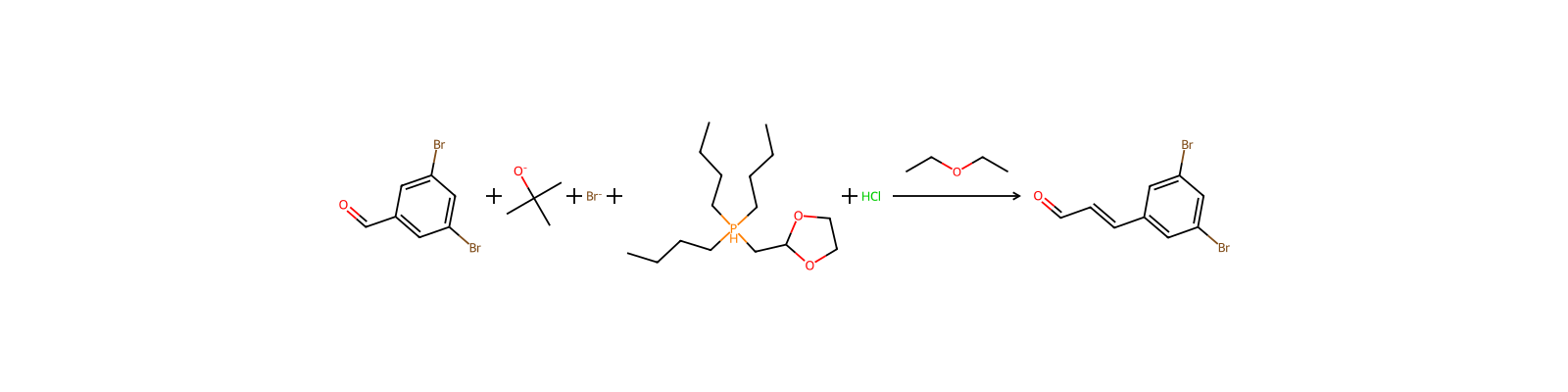
HRID 43251반응물로
3,5-Dibromobenzaldehyde

56990-02-4O=Cc1cc(Br)cc(Br)c1ZLDMZIXUGCGKMB-UHFFFAOYSA-N56990-02-4DTXSID80347485안전 정보는 참고용이며, 공급업체의 물질안전보건자료(SDS), 관련 법규 및 전문가 평가를 대체하지 않습니다.
Danger
H314 (85.1%): Causes severe skin burns and eye damage [Danger Skin corrosion/irritation]
P260, P261, P264, P264+P265, P271, P280, P301+P330+P331, P302+P352, P302+P361+P354, P304+P340, P305+P351+P338, P305+P354+P338, P316, P319, P321, P332+P317, P337+P317, P362+P364, P363, P403+P233, P405, and P501 (click each P-code to see the statement)
Aggregated GHS information provided per 47 reports by companies from 4 notifications to the ECHA C&L Inventory. Each notification may be associated with multiple companies.
용도3,5-Dibromobenzaldehyde is a dibrominated benzaldehyde that is a very useful building block for the preparation of a wide range of biologically active compounds such as a antibacterials. The non-AIE active compound 3,5-dibromobenzaldehyde (DBB) could be used as the core to synthesize AIE luminogens, which differs from the traditional synthetic methods that are heavily dependent on the AIE active core. The three obtained DBB derivatives (S1, S2 and S3) displayed typical AIE features in which the quantum efficiencies of the solid film state were much higher than their solution state. The emission of these DBB derivatives could be fine-tuned by varying the substituents on the DBB rings[1].


