
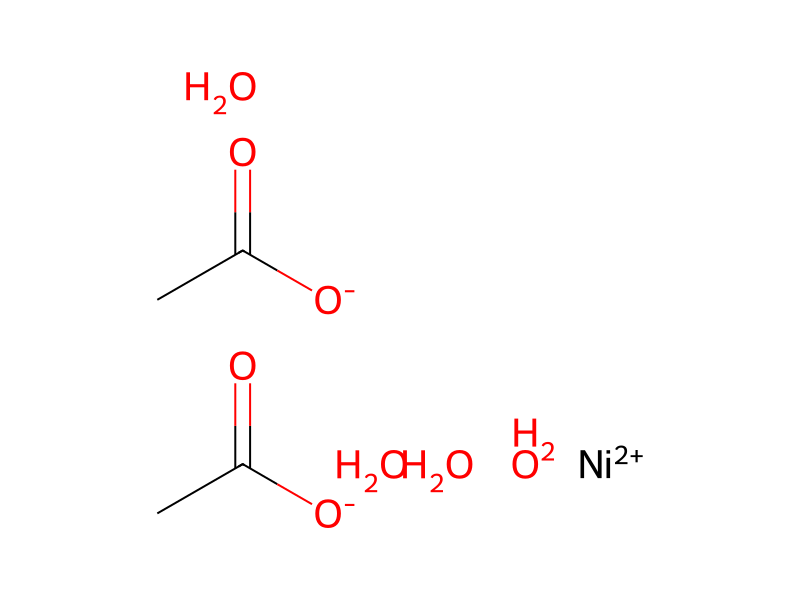
기본 정보
- 표준 SMILES
CC(=O)[O-].CC(=O)[O-].O.O.O.O.[Ni+2]- InChIKey
OINIXPNQKAZCRL-UHFFFAOYSA-L- 분자식
- C4H14NiO8
- 평균 분자량
- 248.84 g/mol
- 단동위원소 질량
- 248.00421031
이름 및 식별자
- 우선 이름
- Nickel acetate tetrahydrate
- IUPAC
- nickel(2+);diacetate;tetrahydrate
- 현지명
- 니켈 아세트산 테트라수화물
- 영어명
- Nickel(II) acetate tetrahydrate
- 분자식
- C4H14NiO8
- 분자량
- 248.84
이름 및 동의어
6018-89-9Nickel(II) acetate tetrahydrateNICKEL ACETATE TETRAHYDRATENickel diacetate tetrahydrateUNII-6SOA8L05606SOA8L0560Acetic acid, nickel(2+) salt, tetrahydrateDTXSID9075458NICKEL(2+) ACETATE TETRAHYDRATENICKEL ACETATE (NI(OAC)2.4H2O)ACETIC ACID, NICKEL(2+) SALT, HYDRATE (2:1:4)RefChem:165655
이름 더 보기
니켈아세트산테트라수화물아세트산,니켈(2+)염,테트라수화물도금제,봉공처리제염화니켈니켈염화물니켈로우스염화물니켈이염화물니켈(II)염화물아세트산니켈4수화물니켈아세트산테트라수화물(NICKELACETATETETRAHYDRATE)NICKEL ACETATENICKEL ACETATE HYDRATENickle AcetateNICKEL ACETATE 4H2ONICKEL ACETATE TETRAACETIC ACID NICKEL SALTNICKEL(II) ACETATE 4 H2O(II) acetate tetrahydrateNickel(II) acetate hydrate
DTXCID3042768Acetic acid, Nickel(2+)salt, tetrahydrate611-946-4nickel(2+);diacetate;tetrahydrateNickel( cento) acetate tetrahydrateNickel() acetate tetrahydratenickel (II) acetate tetrahydrateAcetic Acid Nickel(2+) Salt Tetrahydrate; Diacetatonickel TetrahydrateNickel Acetate [Ni(OAc)2.4H2O] Tetrahydrate; Nickel Acetate Tetrahydrate; Nickel Diacetate Tetrahydrate; Nickel(2+) Acetate Tetrahydrate; Nickel(2+) Diacetate Tetrahydrate
데이터베이스 식별자
- CAS
6018-89-9- PubChem CID
- 62601
- DTXSID
DTXSID9075458- UNII
- 6SOA8L0560
- EC Number
- 611-946-4
물성
구조 계산 물성
- 극성 표면적
- 84.3 Ų
- 수소 결합 공여자 수
- 4
- 수소 결합 수용자 수
- 8
- 회전 가능 결합 수
- 0
- 무거운 원자 수
- 13
- 형식 전하
- 0
- 복잡도
- 25.5
실험 및 물리화학적 성질
Chemical Classes
Metals -> Nickel Compounds, Inorganic
Carcinogens
Density1.74 @25 °C
Physical DescriptionGreen solid with acetic odor; [Merck Index] Water soluble; [Ullmann]
물리화학적 성질
- 녹는점
- °Cd ec.)
- 끓는 점
- 16 ℃ · 16℃
- 밀도
- 1.798 g/mL · 1.798 g/mL at 25 °C(lit.)
- 저장 조건
- Inert atmosphere,Room Temperature
- 용해도
- 2 O, · soluble in H2O, ethanol
- 물리적 상태
- 고체
- Specific Gravity
- 1.798 · 1.798
- 색상
- 흰색에서 황백색까지
- 수용성
- 182 g/L · 182g/L(20℃)
- Merck
- 14 · 14,6499
- BRN
- 3730764 · 3730764
- 안정성
- 안정적인.
- 주요 응용
- 배터리 전구체촉매재료 합성 전구체
- InChI
- 1S/2C2H4O2.Ni.4H2O/c2*1-2(3)4;;;;;/h2*1H3,(H,3,4);;4*1H2/q;;+2;;;;/p-2
- InChIKey
- OINIXPNQKAZCRL-UHFFFAOYSA-L
- SMILES
- [H]O[H].[H]O[H].[H]O[H].[H]O[H].CC(=O)O[Ni]OC(C)=O
- EPA
- Nickel diacetate tetrahydrate (6018-89-9)
화학적 성질
green monoclinic crystal(s); hygroscopic; used in textiles as a mordant [HAW93]
안전 및 규제
GHS 분류
GHS Classification
Danger
H302 (100%): Harmful if swallowed [Warning Acute toxicity, oral]
P203, P233, P260, P261, P264, P270, P271, P272, P280, P284, P301+P317, P302+P352, P304+P340, P317, P318, P319, P321, P330, P333+P317, P342+P316, P362+P364, P403, P405, and P501 (click each P-code to see the statement)
Aggregated GHS information provided per 2133 reports by companies from 9 notifications to the ECHA C&L Inventory. Each notification may be associated with multiple companies.
Danger
H302: Harmful if swallowed [Warning Acute toxicity, oral]
유해성 정보
Regulatory Information
Chemical: Acetic acid, nickel(2+) salt, tetrahydrate
Nickel acetate, tetrahydrate: Does not have an individual approval but may be used under an appropriate group standard
The New Jersey Worker and Community Right to Know Act requires public and private employers to provide information about hazardous substances at their workplaces. (N.J.S.A. 34:5A-1 et. seq.)
Other Safety InformationIMAP assessments - Water soluble nickel(2+) salts: Environment tier II assessment
Hazards SummarySee Nickel and linked occupational diseases.
Hazard Classes and Categories
Acute Tox. 4 (100%)
Acute toxicity - category 4
Carcinogens
안전 및 보호
Threshold Limit Values (TLV)0.1 [mg/m3], inhalable fraction, as Ni
Permissible Exposure Limit (PEL)1.0 [mg/m3], as Ni
Protective Action Criteria (PAC)
1.1 [mg/m3]
12 [mg/m3]
69 [mg/m3]
Immediately Dangerous to Life or Health (IDLH)10.0 [mg/m3], as Ni
독성 정보
Adverse EffectsSkin Sensitizer - An agent that can induce an allergic reaction in the skin.
안전 데이터
- wgk
- 3
- tsca
- Yes
- rtecs
- QR6126000
- ridadr
- UN 3077 9 / PGIII
- HS 번호
- 29152990
- risk_code
- 45-22-43-40-68-50/53-48/23-42/43-20/22-61-49
- hazard_code
- T,Xn,N
- safety_code
- 53-36/37-45-24-22-61-60
- 포장분류
- III
- 위험 등급
- 9
- Hazard Classifications
- Acute Tox. 4 InhalationAcute Tox. 4 OralAquatic Acute 1Aquatic Chronic 1Carc. 1AMuta. 2Repr. 1BResp. Sens. 1Skin Sens. 1STOT RE 1
- 스토리지 클래스
- 6.1C - Combustible acute toxic Cat.3toxic compounds or compounds which causing chronic effects
화학 및 산업
용도 및 제조
Uses
Used as a catalyst and mordant for dyeing textiles; [Merck Index] Used in electroplating, as a sealant for anodized aluminum, and to make other nickel compounds; [HSDB]
Aluminum Producing [Category: Industry]
응용 분야
용도알마이트 착색, 도금, 봉공처리제.
용도Nickel(II) acetate tetrahydrate can be used in synthesis of polynuclear-nickel polyoxotungstate cluster compounds that are ideal for the design of molecular magnets.
상·하류 제품 정보
상류 원료
하류 제품
공급사50 곳
国药集团化学试剂有限公司86-21-63210123 · [email protected]
北京华美互利生物化工010-56205725 · [email protected]
湖北永阔科技有限公司027-59223108 15972152991 · [email protected]
上海阿拉丁生化科技股份有限公司400-6206333 13167063860 · [email protected]
南通润丰石油化工有限公司66017690 19952660367 · [email protected]
武汉欣扬瑞和化学科技有限公司153-07155313 15307155313 · [email protected]
Dayang Chem (Hangzhou) Co.,Ltd.+86-0571-88938639 17705817739 · [email protected]
Hebei Yanxi Chemical Co., Ltd.+86-17531190177 · [email protected]
Syntechem Co.,Ltd[email protected]
上海迈瑞尔生化科技有限公司4006356688 18621169109 · [email protected]
天津中信凯泰化工有限公司022-66880623 · [email protected]
阿法埃莎(中国)化学有限公司400-6106006 · [email protected]
安耐吉化学&3A(安徽泽升科技股份有限公司)400-0056266 · [email protected]
武汉卡诺斯科技有限公司027-83238443 15327105076 · [email protected]
上海瀚鸿科技股份有限公司021-54306202 13764082696 · [email protected]
上海景颜化工科技有限公司13817811078 · [email protected]
湖北广奥生物科技有限公司027-02702759223056 18162699093 · [email protected]
Zhejiang J&C Biological Technology Co.,Limited+1-2135480471 · [email protected]
山东西亚化学有限公司13355009207 13355009207 · [email protected]
玛雅试剂+86 (573) 82222445 (0)18006601000 452520369 · [email protected]
四川库利南科技有限公司400-1166-196 18981987031 · [email protected]
天津希恩思生化科技有限公司400 638 7771 · [email protected]
南京化学试剂股份有限公司025-58369808 17895012682 · [email protected]
斯百全化学(上海)有限公司021-021-021-67601398-809-809-809 15221380277 · [email protected]
艾科试剂4008-755-333 18080918076 · [email protected]
武汉欣扬瑞和化学科技有限公司027-83855316 18171155316
赛默飞世尔科技(中国)有限公司800-810-5118 · [email protected]
北京伊诺凯科技有限公司400-810-7969 010-59572699 · [email protected]
上海健超生物科技有限公司150-2103-5486 18017383231 · [email protected]
武汉普洛夫生物科技有限公司17612776928 · [email protected]
淄博爱肯新材料科技有限公司0533-4915568 18653327685 · [email protected]
上海将来实业股份有限公司021-61552785 · [email protected]
HBCChem, Inc.+1-510-219-6317 · [email protected]
成都零六生物科技有限公司400-1166-196 13458535857 · [email protected]
湖北瑞今化学有限公司027 83642615 13995607107 · [email protected]
上海麦克林生化科技股份有限公司15221275939 15221275939 · [email protected]
杭州杰恒化工有限公司0571-87396432 · [email protected]
武汉弘德悦欣医药科技有限公司027-83855396 15271852016
成都润泽本土化工有限公司13096311329 028-88469284 616445927 · [email protected]
池州凯隆进出口贸易有限公司[email protected]
Sigma-Aldrich西格玛奥德里奇(上海)贸易有限公司021-61415566 800-8193336 · [email protected]
桦特昇生物科技(武汉)有限公司027-59207879 1972026995 18140587686 · [email protected]
九鼎化学(上海)科技有限公司4009209199 · [email protected]
Henan Alfa Chemical Co., Ltd+8618339805032 · [email protected]
厦门志信化学有限公司+86-5922680277 +86-13806087780 · [email protected]
浙江珲达生物科技有限公司0571-89903022 18679456698 · [email protected]
廊坊乾耀科技有限公司0316-2132008 19932680339 · [email protected]
成都润泽本土化工有限公司028-88469284 18000562381 · [email protected]
北京华威锐科化工科技有限公司89508211 18501085097 · [email protected]
上海源叶生物科技有限公司13636370518 · [email protected]
관련 반응
27건


연결된 노트
불러오는 중…