홈MCP워크벤치Skills
홈워크벤치알림마이페이지
llms.txt · MCP 가이드개인정보처리방침 · 이용약관 · 지원v1.8.0
  1. 홈
  2. /화합물

1,2-디브로모프로판

1,2-Dibromopropane
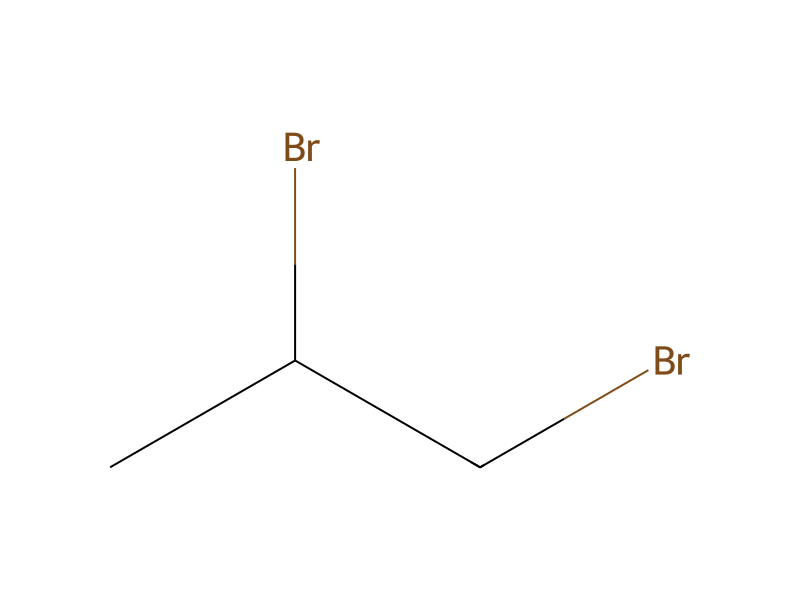
HCID 6553
새 노트새 반응견적 요청하기
인쇄 미리보기
기본 정보개요이름 및 식별자물성안전 및 규제화학 및 산업관련 반응화합물 노트
부분 구조 검색유사 구조 찾기

기본 정보

CAS
78-75-1
표준 SMILES
CC(Br)CBr
InChIKey
XFNJYAKDBJUJAJ-UHFFFAOYSA-N
분자식
C3H6Br2
평균 분자량
201.89 g/mol
단동위원소 질량
199.88362439

개요

1,2-dibromopropane is a colorless liquid. (NTP, 1992)

이름 및 식별자

우선 이름
1,2-Dibromopropane
IUPAC
1,2-dibromopropane
현지명
1,2-디브로모프로판
영어명
1,2-Dibromopropane
분자식
C3H6Br2
분자량
201.89

이름 및 동의어

1,2-DIBROMOPROPANE78-75-1Propylene dibromidePropane, 1,2-dibromo-2,3-DibromopropaneFGB8O5N903DTXSID60870403RefChem:71833DTXCID60818128201-139-1MFCD00000148Propylene Bromide
이름 더 보기
1,2-디브로모프로판1,2-Dobromopropane1,2-Dibromopropane98%1,2 - Propylene DibromideCH2BrCHBrCH31.2-DibroMopro1,2-Dibrompropan(RS)-Dibrompropan1,2-dibromo-propan
1,2-DIBROMOPROPANE-D6CCRIS 6710HSDB 7379EINECS 201-139-1BRN 1718884UNII-FGB8O5N903AI3-154051,2 dibromopropane

데이터베이스 식별자

CAS
78-75-1
PubChem CID
6553
DTXSID
DTXSID60870403
UNII
FGB8O5N903
EC Number
201-139-1
Nikkaji
J1.957G

물성

구조 계산 물성

XLogP
2.2
극성 표면적
0 Ų
수소 결합 공여자 수
0
수소 결합 수용자 수
0
회전 가능 결합 수
1
무거운 원자 수
5
형식 전하
0
복잡도
20.9

실험 및 물리화학적 성질

Chemical ClassesOther Classes -> Halogenated Aliphatics, Saturated
Density · 2건

1.94 at 68 °F (NTP, 1992) - Denser than water; will sink

1.9324 g/cu cm at 20 °C

Viscosity1.623 cP at 20 °C
Color/FormColorless liquid
Solubility · 2건

In water, 1.43X10+3 mg/L at 25 °C

Soluble in ethanol, ether, and chloroform; slightly soluble in carbon tetrachloride.

Flash PointFlash point: <-75 °C
Boiling Point · 2건

284 to 288 °F at 760 mmHg (NTP, 1992)

141.9 °C

DecompositionWhen heated to decomposition it emits toxic fumes of /hydrogen bromide/.
Melting Point · 2건

-67.4 °F (NTP, 1992)

-55.49 °C

Vapor Density7 (NTP, 1992) - Heavier than air; will sink (Relative to Air)
Vapor Pressure

안전 및 규제

안전 정보는 참고용이며, 공급업체의 물질안전보건자료(SDS), 관련 법규 및 전문가 평가를 대체하지 않습니다.

GHS 분류

GHS Classification · 4건

Warning

H226 (91.8%): Flammable liquid and vapor [Warning Flammable liquids]

P210, P233, P240, P241, P242, P243, P261, P264, P264+P265, P270, P271, P273, P280, P301+P317, P302+P352, P303+P361+P353, P304+P340, P305+P351+P338, P317, P321, P330, P332+P317, P337+P317, P362+P364, P370+P378, P391, P403+P235, and P501 (click each P-code to see the statement)

Aggregated GHS information provided per 49 reports by companies from 6 notifications to the ECHA C&L Inventory. Each notification may be associated with multiple companies.

유해성 정보

DOT LabelCombustible Liquid
Fire HazardsThis compound is considered non-flammable. (NTP, 1992)
Health HazardsSYMPTOMS: Irritant and narcotic in high conc.
Hazards Summary · 1건

Increased liver enzymes in feeding studies of mice; Some evidence of mutagenicity; Emergency medical treatment: see 2-Bromopropane. [HSDB] High concentrations may have irritating and narcotic effects; [CAMEO] A mutagen; Effects in high-dose animal studies include fatty liver degeneration and acute renal failure; [RTECS]

Reactive GroupHalogenated Organic Compounds
Reactivity Profile · 1건

Halogenated aliphatic compounds, such as 1,2-DIBROMOPROPANE, are moderately or very reactive. Halogenated organics generally become less reactive as more of their hydrogen atoms are replaced with halogen atoms. Materials in this group may be incompatible with strong oxidizing and reducing agents. Also, they may be incompatible with many amines, nitrides, azo/diazo compounds, alkali metals, and epoxides. This compound is considered nonflammable. (NTP, 1992)

화학 및 산업

약리 정보

Metabolism/Metabolites · 3건

... The following four metabolites were identified in the liver at 12 h after treatment with 1,2-DBP, by liquid chromatography-electrospray ionization tandem mass spectrometry (LC-ESI/MS): M1, 2-hydroxypropylglutathione; M2, 2-oxopropylglutathione; M3, N-acetyl-S-(2-hydroxypropyl)-L-cysteine; and M4, N-acetyl-S-(2-oxopropyl)-L-cysteine. Ions of individual conjugates were observed at m/z 366, 364, 222 and 220, respectively. Characteristic product ions at m/z 237, 217, 204 and 202 for the identification of M1, M2, M3 and M4 were observed, respectively. In the sera isolated from the same animals, only mercapturic acids (M3 and M4) were observed by LC-ESI/MS. When female BALB/c mice were treated orally with 1,2-DBP at doses of 150, 300 and 600 mg kg(-1) once for 12 h, the production of glutathione conjugates and mercapturic acids in liver was apparently dose dependent, as were the concentrations of them in sera. When the production of metabolites from 1,2-DBP was investigated in liver following oral treatment with 600 mg kg(-1) 1,2-DBP for 6, 12, 24 and 48 h, metabolite concentrations were greatest at the first time point (6 h).

1,2-Dibromopropane was administered orally in doses of 50-350 mg/kg to male Wistar rats. Four mercapturic acids were identified in urine by GC/MS, viz. N-acetyl-S-(2-oxopropyl)-L-cysteine (I), N-acetyl-S-(2-hydroxypropyl)-L-cysteine (II), N-acetyl-S-(1-carboxyethyl)-L-cysteine (III), and N-acetyl-S-(2-bromo-2-propenyl)-L-cysteine (IV). Mercapturic acid IV was a minor metabolite which could only be measured at doses of 200 mg/kg or higher. In 24 hr, urinary excretion of mercapturic acids amounted to about 36% of the dose (11% I, 21% II, 4% III, 0.2% IV). No dose dependency was found up to the highest dose.

Bromine is mainly absorbed via inhalation, but may also enter the body through dermal contact. Bromine salts can be ingested. Due to its reactivity, bromine quickly forms bromide and may be deposited in the tissues, displacing other halogens. (L626)

용도 및 제조

Uses · 2건

Used as a research chemical; [HSDB]

Research chemical

Methods of ManufacturingPrepared from propyl bromide and Br in the presence of AlCl3 or AlBr3.

관련 반응

33건
반응 기록 만들기
HRID 252279 반응식
HRID 252279반응물로uspto-grants-2011_01
HRID 514185 반응식
HRID 514185반응물로uspto-grants-2015_08
HRID 573922 반응식
HRID 573922반응물로uspto-grants-2015_05
HRID 666816 반응식
HRID 666816반응물로Training data from https://doi.org/10.1039/C8SC04228D (3/10)
HRID 728282 반응식
HRID 728282반응물로uspto-grants-1991_09
HRID 841853 반응식
HRID 841853반응물로uspto-grants-2002_04
HRID 894597 반응식
HRID 894597반응물로uspto-grants-1981_08
HRID 924276 반응식
HRID 924276반응물로uspto-grants-2016_03
1 / 5 페이지

화합물 노트

불러오는 중…

이 페이지에서기본 정보개요이름 및 식별자물성안전 및 규제화학 및 산업관련 반응화합물 노트
더보기
새 노트새 반응견적 요청하기
· 2건

7.84 [mmHg]

7.84 mm Hg at 25 °C

Surface Tension34.14 dyne/cm at 20 °C

물리화학적 성질

녹는점
-55 °C · -55 °C
끓는 점
140 · 140-142 °C(lit.)
밀도
1.937 g/mL · 1.937 g/mL at 25 °C(lit.)
굴절률
20 · n20/D 1.519(lit.)
인화점
35 °C · 35 °C
저장 조건
Flammables area
용해도
유기용매: 혼화성
물리적 상태
투명한 액체
색상
Colorless to Light yellow to Light orange
수용성
약간 용해됨
Merck
14 · 14,7853
BRN
1718884 · 1718884
Henry's Law Constant
5.3 · 5.3×10-3 mol/(m3Pa) at 25℃, Albanese et al. (1987)
Dielectric constant
4.3 · 4.2999999999999998
안정성
안정적인. 가연성. 강산화제, 강염기, 마그네슘과 호환되지 않습니다.
InChI
1S/C3H6Br2/c1-3(5)2-4/h3H,2H2,1H3
InChIKey
XFNJYAKDBJUJAJ-UHFFFAOYSA-N
SMILES
CC(Br)CBr
NIST
1 · Propane, 1,2-dibromo-(78-75-1)
EPA
1 · 1,2-Dibromopropane (78-75-1)

화학적 성질

1,2-Dibromopropane is considered non-flammable and non-explosive liquid.

Air and Water Reactions
Insoluble in water.
Hazard Classes and CategoriesFlam. Liq. 3 (91.8%)
Critical Temperature and PressureCritical temperature = 371 °C; critical pressure = 3.07X10+4 mm Hg

안전 및 보호

Fire FightingThis material is considered to be non-flammable. (NTP, 1992)
First Aid · 1건

EYES: First check the victim for contact lenses and remove if present. Flush victim's eyes with water or normal saline solution for 20 to 30 minutes while simultaneously calling a hospital or poison control center. Do not put any ointments, oils, or medication in the victim's eyes without specific instructions from a physician. IMMEDIATELY transport the victim after flushing eyes to a hospital even if no symptoms (such as redness or irritation) develop.

Fire Fighting Procedures · 1건

If material on fire or involved in fire: Do not extinguish fire unless flow can be stopped. Use water in flooding quantities as fog. Solid streams of water may be ineffective. Cool all affected containers with flooding quantities of water. Use alcohol foam, dry chemical or carbon dioxide. Keep run-off water out of sewers and water sources. /Bromopropanes/

Nonfire Spill Response · 1건

SMALL SPILLS AND LEAKAGE: If you should spill this chemical, use absorbent paper to pick up all liquid spill material. Your contaminated clothing and absorbent paper should be sealed in a vapor-tight plastic bag for eventual disposal. Solvent wash all contaminated surfaces with acetone followed by washing with a strong soap and water solution. Do not reenter the contaminated area until the Safety Officer (or other responsible person) has verified that the area has been properly cleaned.

Preventive Measures · 2건

If material on fire or involved in fire: Do not extinguish fire unless flow can be stopped. Use water in flooding quantities as fog. Solid streams of water may be ineffective. Cool all affected containers with flooding quantities of water. Use alcohol foam, dry chemical or carbon dioxide. Keep run-off water out of sewers and water sources. /Bromopropanes/

Personnel protection: Avoid breathing vapors. Keep upwind. Do not handle broken packages unless wearing appropriate personal protective equipment. If contact with the material anticipated, wear appropriate chemical protective clothing. /Bromopropanes/

Isolation and EvacuationExcerpt from ERG Guide 128 [Flammable Liquids (Water-Immiscible)]:
Personal Protective Equipment (PPE) · 2건

RECOMMENDED RESPIRATOR: Where the neat test chemical is weighed and diluted, wear a NIOSH-approved half face respirator equipped with an organic vapor/acid gas cartridge (specific for organic vapors, HCl, acid gas and SO2) with a dust/mist filter.

Personnel Protection: ... Wear appropriate chemical protective gloves, boots and goggles. /Bromopropanes/

독성 정보

Treatment · 1건

EYES: irrigate opened eyes for several minutes under running water. INGESTION: do not induce vomiting. Rinse mouth with water (never give anything by mouth to an unconscious person). Seek immediate medical advice. SKIN: should be treated immediately by rinsing the affected parts in cold running water for at least 15 minutes, followed by thorough washing with soap and water. If necessary, the person should shower and change contaminated clothing and shoes, and then must seek medical attention. INHALATION: supply fresh air. If required provide artificial respiration.

Health Effects · 1건

Bromine vapour causes irritation and direct damage to the mucous membranes. Elemental bromine also burns the skin. The bromide ion is a central nervous system depressant and chronic exposure produces neuronal effects. This is called bromism and can result in central reactions reaching from somnolence to coma, cachexia, exicosis, loss of reflexes or pathologic reflexes, clonic seizures, tremor, ataxia, loss of neural sensitivity, paresis, papillar edema of the eyes, abnormal speech, cerebral edema, delirium, aggressiveness, and psychoses. (L625, L626, L627)

Environmental Fate · 3건

TERRESTRIAL FATE: Based on a classification scheme(1), an estimated Koc value of 80(SRC), determined from a water solubility of 1.43X10+3 mg/L(2) and a regression-derived equation(3), indicates that 1,2-dibromopropane is expected to have high mobility in soil(SRC). Volatilization of 1,2-dibromopropane from moist soil surfaces is expected to be an important fate process(SRC) given an estimated Henry's Law constant of 1.46X10⁻³ atm-cu m/mole(SRC), calculated from a vapor pressure of 7.84 mm Hg(4) and water solubility of 1.43X10+3 mg/L(2). 1,2-Dibromopropane is expected to volatilize from dry soil surfaces(SRC) based upon its vapor pressure(4). Biodegradation data were not available(SRC, 2005).

AQUATIC FATE: Based on a classification scheme(1), an estimated Koc value of 80(SRC), determined from a water solubility of 1.43X10+3 mg/L(2) and a regression-derived equation(3), indicates that 1,2-dibromopropane is not expected to adsorb to suspended solids and sediment(SRC). Volatilization from water surfaces is expected(3) based upon an estimated Henry's Law constant of 1.46X10⁻³ atm-cu m/mole(SRC), calculated from its vapor pressure, 7.84 mm Hg(4), and water solubility, 1.43X10+3 mg/L(3). Using this Henry's Law constant and an estimation method(3), volatilization half-lives for a model river and model lake are 2 hours and 6 days, respectively(SRC). According to a classification scheme(5), an estimated BCF of 10(SRC), from its water solubility(2) and a regression-derived equation(6), suggests the potential for bioconcentration in aquatic organisms is low(SRC). Using hydrolysis rates measured at elevated temperatures, a hydrolysis half-life of 320 days (rate constant = 2.5X10⁻⁸ per second) at 25 °C and pH 7 was calculated for 1,2-dibromopropane(7,8). Biodegradation data were not available(SRC, 2005).

ATMOSPHERIC FATE: According to a model of gas/particle partitioning of semivolatile organic compounds in the atmosphere(1), 1,2-dibromopropane, which has a vapor pressure of 7.84 mm Hg at 25 °C(2), is expected to exist solely as a vapor in the ambient atmosphere. Vapor-phase 1,2-dibromopropane is degraded in the atmosphere by reaction with photochemically-produced hydroxyl radicals(SRC); the half-life for this reaction in air is estimated to be 37 days(SRC), calculated from its rate constant of 4.3X10⁻¹³ cu cm/molecule-sec at 25 °C(SRC) that was derived using a structure estimation method(3). 1,2-dibromopropane does not contain chromophores that absorb at wavelengths >290 nm and therefore is not expected to be susceptible to direct photolysis by sunlight(SRC).

Adverse EffectsNeurotoxin - Acute solvent syndrome
Exposure RoutesOral (L626) ; inhalation (L626) ; dermal (L626)
Toxicity Summary · 1건

Bromine is a powerful oxidizing agent and is able to release oxygen free radicals from the water in mucous membranes. These free radicals are also potent oxidizers and produce tissue damage. In additon, the formation of hydrobromic and bromic acids will result in secondary irritation. The bromide ion is also known to affect the central nervous system, causing bromism. This is believed to be a result of bromide ions substituting for chloride ions in the in actions of neurotransmitters and transport systems, thus affecting numerous synaptic processes. (L626, L627, A543)

Signs and Symptoms · 1건

Bromine vapour causes irritation and direct damage to the mucous membranes. Symptoms include lacrimation, rhinorrhoea, eye irritation with mucous secretions from the oropharyngeal and upper airways, coughing, dyspnoea, choking, wheezing, epistaxis, and headache. The bromide ion is a central nervous system depressant producing ataxia, slurred speech, tremor, nausea, vomiting, lethargy, dizziness, visual disturbances, unsteadiness, headaches, impaired memory and concentration, disorientation and hallucinations. This is called bromism. (L626, L627)

Soil Adsorption/Mobility · 1건

The Koc of 1,2-dibromopropane is estimated as 80(SRC), using a water solubility of 1.43X10+3 mg/L(1) and a regression-derived equation(2). According to a classification scheme(3), this estimated Koc value suggests that 1,2-dibromopropane is expected to have high mobility in soil.

Artificial Pollution Sources1,2-Diromopropane's production and use as a research chemical(1) may result in its release to the environment through various waste streams(SRC).
Carcinogen ClassificationNo indication of carcinogenicity to humans (not listed by IARC).
Environmental Bioconcentration · 1건

An estimated BCF of 10 was calculated for 1,2-dibromopropane(SRC), using a water solubility of 1.43X10+3 mg/L(1) and a regression-derived equation(2). According to a classification scheme(3), this BCF suggests the potential for bioconcentration in aquatic organisms is low(SRC).

Volatilization from Water/Soil · 1건

The Henry's Law constant for 1,2-dibromopropane is estimated as 1.46X10⁻³ atm-cu m/mole(SRC) derived from its vapor pressure, 7.84 mm Hg(1), and water solubility, 1.43X10+3 mg/L(2). This Henry's Law constant indicates that 1,2-dibromopropane is expected to volatilize rapidly from water surfaces(3). Based on this Henry's Law constant, the volatilization half-life from a model river (1 m deep, flowing 1 m/sec, wind velocity of 3 m/sec)(3) is estimated as 2 hours(SRC). The volatilization half-life from a model lake (1 m deep, flowing 0.05 m/sec, wind velocity of 0.5 m/sec)(3) is estimated as 6 days(SRC). 1,2-Dibromopropane's estimated Henry's Law constant indicates that volatilization from moist soil surfaces may occur(SRC). The potential for volatilization of 1,2-dibromopropane from dry soil surfaces may exist(SRC) based upon the vapor pressure(1).

안전 데이터

wgk
3
tsca
TSCA listed
rtecs
TX8574000
ridadr
UN 1993 3/PG 3
HS 번호
29033036
risk_code
10-20/22-36/37/38-20/21/22-40
hazard_code
Xn
safety_code
23-24/25-36/37/39-26-16-45-27
포장분류
III
위험 등급
3
Hazard Classifications
Acute Tox. 4 InhalationAcute Tox. 4 OralAquatic Chronic 2Eye Irrit. 2Flam. Liq. 3Skin Irrit. 2
스토리지 클래스
3 - Flammable liquids
유해 물질 데이터
78-75-1(Hazardous Substances Data)
General Manufacturing InformationPropane, 1,2-dibromo-: ACTIVE
응용 분야 · 2건

용도1,2-Dibromopropane is used in organic synthesis and solvent. It was used to study the effect of reductant concentration, reductant contact time and suspension pH on reductive dechlorination of carbon tetrachloride by soil manipulated with Fe(II) and HS-. It was used as internal standard during the determination of nitrogenous disinfection byproduct trichloronitromethane by gas chromatography mass spectrometry.

일반 설명1,2-dibromopropane is a colorless liquid. Prepared from propyl bromide and Br in the presence of AlCl3 or AlBr3. (NTP, 1992)

제조 방법 · 1건

1,2-Dibromopropane is synthesized from bromopropane by bromination. First mix bromopropane and iron powder, heat to 40-50°C, slowly add bromine, and continue to reflux for 2h after adding. Then, the iron slag was filtered off, and the filtrate was washed several times with water, once with 5% sodium carbonate solution, and then with 5% sodium thiosulfate solution to remove free bromine. Dry with anhydrous calcium chloride. Fractional distillation, collecting 139-142 ℃ fraction is the finished product of 1,2-dibromopropane.

상·하류 제품 정보

상류 원료

염화칼슘

하류 제품

Glutaronitrile1,3-디아미노프로판cis-1-Bromo-1-propene1-브로모-1-프로펜Ethyl 6,7-dihydro-5H-pyrazolo[5,1-b][1,3]oxazine-3-carboxylate1-(2-(trifluoromethyl)phenyl)cyclobutane-1-carbonitrile