
HRID 1171917생성물로
데이터를 보충하는 중입니다. 잠시 후 페이지를 새로 고치면 최신 내용을 볼 수 있습니다
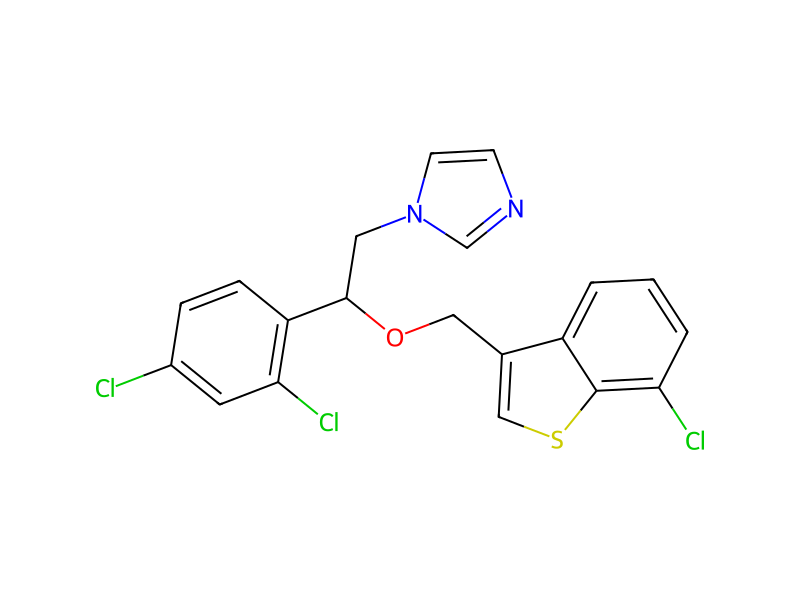
99592-32-2Clc1ccc(C(Cn2ccnc2)OCc2csc3c(Cl)cccc23)c(Cl)c1JLGKQTAYUIMGRK-UHFFFAOYSA-N1-{2-[(7-chloro-1-benzothiophen-3-yl)methoxy]-2-(2,4-dichlorophenyl)ethyl}imidazole is a member of the class of imidazoles that carries a 2-[(7-chloro-1-benzothiophen-3-yl)methoxy]-2-(2,4-dichlorophenyl)ethyl group at position 1. It is a dichlorobenzene, a member of imidazoles, an ether and a member of 1-benzothiophenes.
Practically insoluble
6.37e-03 g/L
안전 정보는 참고용이며, 공급업체의 물질안전보건자료(SDS), 관련 법규 및 전문가 평가를 대체하지 않습니다.
Warning
H315 (100%): Causes skin irritation [Warning Skin corrosion/irritation]
P261, P264, P264+P265, P271, P280, P302+P352, P304+P340, P305+P351+P338, P319, P321, P332+P317, P337+P317, P362+P364, P403+P233, P405, and P501 (click each P-code to see the statement)
The GHS information provided by 1 company from 1 notification to the ECHA C&L Inventory.
Sertaconazole interacts with 14-α demethylase, a cytochrome P-450 enzyme necessary to convert lanosterol to ergosterol. As ergosterol is an essential component of the fungal cell membrane, inhibition of its synthesis results in increased cellular permeability causing leakage of cellular contents. Sertaconazole may also inhibit endogenous respiration, interact with membrane phospholipids, inhibit the transformation of yeasts to mycelial forms, inhibit purine uptake, and impair triglyceride and/or phospholipid biosynthesis.
D - Dermatologicals
G - Genito urinary system and sex hormones
QD - Dermatologicals
QG - Genito urinary system and sex hormones
Sertaconazole is an imidazole/triazole type antifungal agent. Sertaconazole is a highly selective inhibitor of fungal cytochrome P-450 sterol C-14 α-demethylation via the inhibition of the enzyme cytochrome P450 14α-demethylase. This enzyme converts lanosterol to ergosterol, and is required in fungal cell wall synthesis. The subsequent loss of normal sterols correlates with the accumulation of 14 α-methyl sterols in fungi and may be partly responsible for the fungistatic activity of fluconazole. Mammalian cell demethylation is much less sensitive to fluconazole inhibition. Sertaconazole exhibits <i>in vitro</i> activity against <i>Cryptococcus neoformans</i> and <i>Candida spp.</i> Fungistatic activity has also been demonstrated in normal and immunocompromised animal models for systemic and intracranial fungal infections due to <i>Cryptococcus neoformans</i> and for systemic infections due to Candida albicans.
Sertaconazole interacts with 14-α demethylase, a cytochrome P-450 enzyme necessary to convert lanosterol to ergosterol. As ergosterol is an essential component of the fungal cell membrane, inhibition of its synthesis results in increased cellular permeability causing leakage of cellular contents. Sertaconazole may also inhibit endogenous respiration, interact with membrane phospholipids, inhibit the transformation of yeasts to mycelial forms, inhibit purine uptake, and impair triglyceride and/or phospholipid biosynthesis.
72W71I16EG
SERTACONAZOLE
Established Pharmacologic Class [EPC] - Azole Antifungal
Chemical Structure [CS] - Azoles
Sertaconazole is an Azole Antifungal.
99592-32-2DTXSID0048551CHEMBL1201196CHEBI:83682Use (kg; approx.) in Germany (2009): >100
For the topical treatment of interdigital tinea pedis in immunocompetent patients 12 years of age and older, caused by <i>Trichophyton rubrum</i>, <i>Trichophyton mentagrophytes</i>, and <i>Epidermophyton floccosum</i>.
개요Sertaconazole has been developed and launched for the treatment of dermatological fungal infections by Ferrer Internacional S. A. Mylan received FDA approval for sertaconazole nitrate cream for the treatment of athlete's foot (tinea pedis) at the end of 2003.
용도An imidazole antifungal agent, inhibits the synthesis of ergosterol, an essential cell wall component of fungi.


