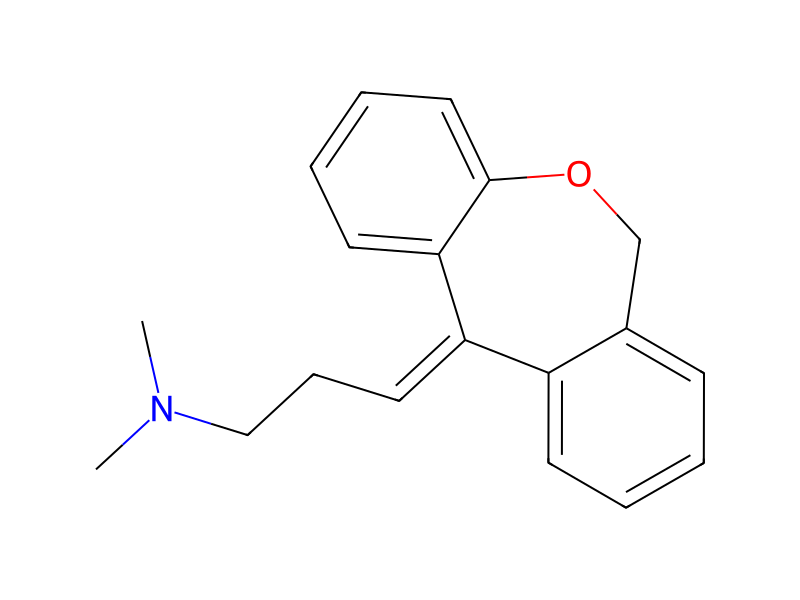
기본 정보
- CAS
3607-18-9- 표준 SMILES
CN(C)CC/C=C1/c2ccccc2COc2ccccc21- InChIKey
ODQWQRRAPPTVAG-BOPFTXTBSA-N- 분자식
- C19H21NO
- 평균 분자량
- 279.4 g/mol
- 단동위원소 질량
- 279.16231429
개요
Doxepin is a dibenzooxepine that is 6,11-dihydrodibenzo[b,e]oxepine substituted by a 3-(dimethylamino)propylidene group at position 11. It is used as an antidepressant drug. It has a role as an antidepressant. It is a dibenzooxepine and a tertiary amino compound.
이름 및 식별자
- 우선 이름
- (Z)-Doxepin
- IUPAC
- (3Z)-3-(6H-benzo[c][1]benzoxepin-11-ylidene)-N,N-dimethylpropan-1-amine
- 현지명
- 시독세핀
- 영어명
- Cidoxepin
- 분자식
- C19H21NO
- 분자량
- 279.38
이름 및 동의어
Cidoxepin(Z)-DoxepinCidoxepinaCidoxepinum3607-18-9Doxepin, (z)-CidoxepineF96TTB8728Doxepin trans-form hydrochlorideCHEBI:36691DTXSID301318253RefChem:1051271
이름 더 보기
시독세핀[3H]-Doxepintrans-Form hydrochloride
DTXCID80197028cis-doxepinCidoxepin [INN]Doxepin (Z)-isomerUNII-F96TTB8728(3Z)-3-(6H-benzo[c][1]benzoxepin-11-ylidene)-N,N-dimethylpropan-1-amineCHEMBL1017403-Dibenz[b,e]oxepin-11(6H)-ylidene-N,N-dimethyl-1-propanamine
데이터베이스 식별자
- CAS
3607-18-9- PubChem CID
- 667468
- DTXSID
DTXSID301318253- ChEMBL
CHEMBL101740- ChEBI
CHEBI:4710- UNII
- F96TTB8728
- Nikkaji
- J8.179E、J9.508G
물성
구조 계산 물성
- XLogP
- 4.3
- 극성 표면적
- 12.5 Ų
- 수소 결합 공여자 수
- 0
- 수소 결합 수용자 수
- 2
- 회전 가능 결합 수
- 3
- 무거운 원자 수
- 21
- 형식 전하
- 0
- 복잡도
- 363
실험 및 물리화학적 성질
DrugsPharmaceuticals
Boiling Point154-157 ºC at 0.03 mmHg
Melting Point185-191 ºC
Dissociation Constants8.96
물리화학적 성질
- 녹는점
- 192 · 192-193°
안전 및 규제
독성 정보
Treatment
Obtain an ECG and immediately initiate cardiac monitoring. Protect the patient's airway, establish an intravenous line and initiate gastric decontamination. A minimum of six hours of observation with cardiac monitoring and observation for signs of CNS or respiratory depression, hypotension, cardiac dysrhythmias and/or conduction blocks, and seizures is strongly advised. If signs of toxicity occur at any time during this period, extended monitoring is recommended. (L1712)
Health Effects
hypotension, postural collapse (if patient arises too fast from lying/sitting position to standing), arrhythmias (sinus-tachycardia, bradycardia, av-blockade). Allergic/toxic effetcs also include skin rash, photosensitivity, liver damage of the cholostatic type (rarely), hepatitis (extremely rare), leuko- or thrombopenia (rarely), agranulocytosis (very rarely), hypoplastic anemia (rarely). [Wikipedia]
Exposure RoutesWell-absorbed from the GI tract. Peak plasma concentrations occur within 2 hours of oral administration.
Toxicity Summary
The mechanism of action of doxepin is not completely understood. It is thought that like amitriptyline, doxepin enhances the actions of norepinephrine and serotonin by blocking their reuptake at the neuronal membrane. However, doxepin weakly inhibits the reuptake of dopamine. Doxepin may also act on histamine H<sub>1</sub>-receptors, resulting in sedative effects, and β-adrenergic receptors. It is also an antagonist of 5-hydroxytryptamine (serotonin) receptors, alpha-1 adrenergic receptor, and muscarinic cholinergic receptors.
Signs and SymptomsCardiac dysrhythmias, severe hypotension, convulsions, and CNS depression, including coma. Changes in the electrocardiogram, particularly in QRS axis or width, are clinically significant indicators of tricyclic antidepressant toxicity.
Carcinogen ClassificationNo indication of carcinogenicity to humans (not listed by IARC).
Toxicity DataLD50: 26 mg/kg (Intravenous, Mouse) (A308)
LD50: 16 mg/kg (Intravenous, Rat) (A308)
화학 및 산업
약리 정보
Protein BindingEquilibrium dialysis indicates a mean protein binding of 75.5% for doxepin and 76% for desmethyldoxepin.
Pharmacodynamics
Similar to other tricyclic antidepressants, doxepin was shown, in preclinical trials, to decrease the electrical activity of the brain, prolong the hexobarbital-induced sleep and block avoidance behavior without affecting the conditioned emotional response. At high doses, it also produces symptoms of central nervous system depression. Doxepin is known to cause antidepressant, sedative, and anticholinergic effects. At high doses, its anticholinergic and antiadrenergic properties are the most prevalent which limit its efficacy. These effects are observed at high doses where its affinity for H1 histamine receptor is lost and its binding to other receptors is observed. The maximal antidepressive effects of doxepin are present around two weeks following initiation of therapy. However, the sedative effects of doxepin, usually used for the treatment of insomnia or anxiety, are observed immediately after administration.
Mechanism of Action
Doxepin exact mechanism of action is not very clear. However, doxepin is known to be a selective histamine H1 receptor blocker. This effect on histamine receptors indicates effectiveness in skin conditions. Breaking its function according to the different effect, doxepin's antidepressive action is primarily associated with the inhibition of the central nervous system biogenic amine reuptake; more specifically, norepinephrine and serotonin at synaptic nerve terminals. This effect increases the level of monoamines in the synaptic site which in order increases the activity at the post-synaptic neuron receptor sites. It has been suggested that doxepin also desensitizes both serotonin 1A receptors and beta-adrenergic receptors. It is known that the lack of dopamine transporters in the frontal cortex and the transmission of dopamine in this region is largely inactivated by the effect of norepinephrine reuptake. Hence, doxepin action on the frontal cortex is suggested to increase dopamine neurotransmission in this area.
Biological Half-LifeThe mean elimination half-life is reported to be of 15 hours.
Metabolism/Metabolites
관련 반응
0건
현재 필터 조건에 해당하는 반응 기록이 없습니다.
화합물 노트
불러오는 중…