
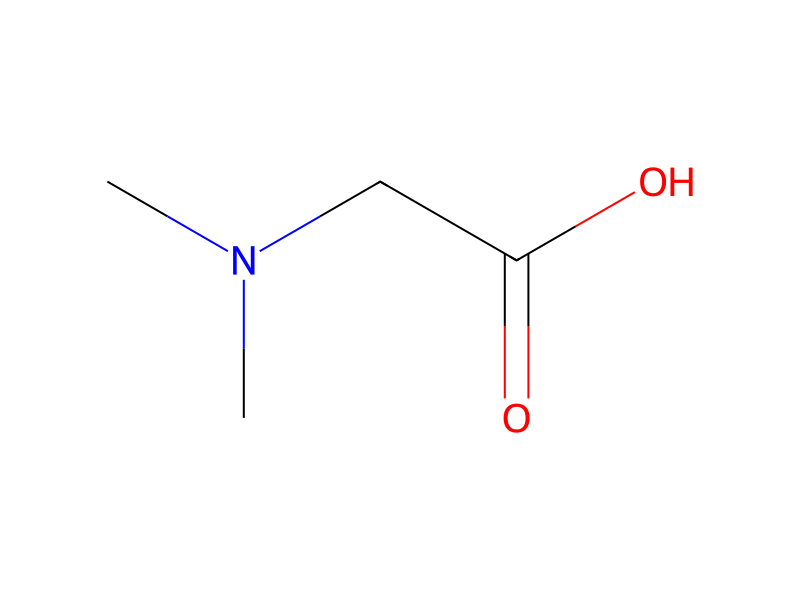
기본 정보
- 표준 SMILES
CN(C)CC(=O)O- InChIKey
FFDGPVCHZBVARC-UHFFFAOYSA-N- 분자식
- C4H9NO2
- 평균 분자량
- 103.12 g/mol
- 단동위원소 질량
- 103.06332853
이름 및 식별자
- 우선 이름
- N,N-Dimethylglycine
- IUPAC
- 2-(dimethylamino)acetic acid
- 영어명
- N,N-Dimethylglycine
- 분자식
- C4H9NO2
- 분자량
- 103.12
이름 및 동의어
N,N-dimethylglycine1118-68-9dimethylglycine2-(dimethylamino)acetic acid(Dimethylamino)acetic acidN-Methylsarcosineglycine, N,N-dimethyl-N,N-Dimethylaminoacetic acid7797M4CPPADTXSID6074336CHEBI:177242-(dimethylazaniumyl)acetate
이름 더 보기
N-Me-Sar-OHAKOS BB-5614N-DiMethylglycineN,N-DimthylglycineN. N-methylglycinen,n-dimethyl-glycin
RefChem:57349DTXCID1033244214-267-8N,N-Dimethyl GlycineMFCD00004283dimethyl glycineBRN 1700261DMG
데이터베이스 식별자
- CAS
1118-68-9- PubChem CID
- 673
- DTXSID
DTXSID6074336- ChEMBL
CHEMBL1232274- ChEBI
CHEBI:17724- UNII
- 7797M4CPPA
- EC Number
- 214-267-8
- Nikkaji
- J135.420E
물성
구조 계산 물성
- XLogP
- -2.9
- 극성 표면적
- 40.5 Ų
- 수소 결합 공여자 수
- 1
- 수소 결합 수용자 수
- 3
- 회전 가능 결합 수
- 2
- 무거운 원자 수
- 7
- 형식 전하
- 0
- 복잡도
- 70
실험 및 물리화학적 성질
LogP
-2.91
-2.91
Boiling Point63.9
Melting Point
185.5
185.5 °C
Physical DescriptionSolid
Dissociation Constants2.04
Collision Cross Section
119.7 Ų [M+H]+ [CCS Type: DT; Method: single field calibrated with Agilent tune mix (Agilent)]
116 Ų [M+H]+ [CCS Type: TW; Method: calibrated with polyalanine]
123.1 Ų [M+H]+
물리화학적 성질
- 녹는점
- 178 · 178-182 °C(lit.)
- 끓는 점
- 193.35 °C · 193.35°C (rough estimate)
- 밀도
- 1 g/cm3 · 1 g/cm3
- 굴절률
- 1.4674 · 1.4674 (estimate)
- 저장 조건
- Keep in dark place,Sealed in dry,Room Temperature
- 용해도
- 메탄올(약간 용해됨), 물(약간 용해됨)
- 산도 계수 (pKa)
- 9.89 · 9.89(at 25℃)
- 물리적 상태
- 결정성 분말
- 색상
- 흰색에서 약간 노란색
- 수용성
- 녹는
- Merck
- 14 · 14,3244
- BRN
- 1700261 · 1700261
- InChI
- 1S/C4H9NO2/c1-5(2)3-4(6)7/h3H2,1-2H3,(H,6,7)
- InChIKey
- FFDGPVCHZBVARC-UHFFFAOYSA-N
- SMILES
- CN(C)CC(O)=O
- EPA
- Glycine, N,N-dimethyl- (1118-68-9)
화학적 성질
white to slightly yellow crystalline powder
안전 및 규제
GHS 분류
GHS Classification
This chemical does not meet GHS hazard criteria for 53.2% (58 of 109) of all reports.
Warning
H302 (46.8%): Harmful if swallowed [Warning Acute toxicity, oral]
P264, P270, P301+P317, P330, and P501 (click each P-code to see the statement)
Aggregated GHS information provided per 109 reports by companies from 4 notifications to the ECHA C&L Inventory.;Reported as not meeting GHS hazard criteria per 58 of 109 reports by companies.;There are 3 notifications provided by 51 of 109 reports by companies with hazard statement code(s).;Information may vary between notifications depending on impurities, additives, and other factors. The percentage value in parenthesis indicates the notified classification ratio from companies that provide hazard codes. Only hazard codes with percentage values above 10% are shown. For more detailed information, please visit ECHA C&L website.
유해성 정보
Regulatory Information
PMN - indicates a commenced PMN (Pre-Manufacture Notices) substance.
Status: Active Update: 22-05-2018 https://echa.europa.eu/registration-dossier/-/registered-dossier/19838
Dimethylglycine: Non hazardous
Hazard Classes and CategoriesAcute Tox. 4 (46.8%)
규제 정보
Regulatory Information
PMN - indicates a commenced PMN (Pre-Manufacture Notices) substance.
Status: Active Update: 22-05-2018 https://echa.europa.eu/registration-dossier/-/registered-dossier/19838
Dimethylglycine: Non hazardous
안전 데이터
- wgk
- 3
- tsca
- TSCA listed
- rtecs
- MB9865000
- 독성
- rat,LD50,oral,> 650mg/kg (650mg/kg),BEHAVIORAL: ATAXIABLOOD: CHANGES IN SPLEENGASTROINTESTINAL: "HYPERMOTILITY, DIARRHEA",Acute Toxicity Data. Journal of the American College of Toxicology, Part B. Vol. 1, Pg. 199, 1992.
- HS 번호
- 29224999
- risk_code
- 22-36/37/38
- hazard_code
- Xn,Xi
- safety_code
- 24/25-36/37-26
- 위험 등급
- IRRITANT
- 기존화학 물질
- KE-11416
- F 고인화성물질
- 3
- 스토리지 클래스
- 11 - Combustible Solids
화학 및 산업
약리 정보
Tissue LocationsKidney;Liver;Placenta
Cellular LocationsCytoplasm;Mitochondria
Metabolite Pathways
3-Phosphoglycerate dehydrogenase deficiency;Cystathionine Beta-Synthase Deficiency;Dihydropyrimidine Dehydrogenase Deficiency (DHPD);Dimethylglycine Dehydrogenase Deficiency;Dimethylglycine Dehydrogenase Deficiency;Glycine N-methyltransferase Deficiency;Glycine, serine and threonine metabolism;Glycine, serine and threonine metabolism;Homocystinuria-megaloblastic anemia due to defect in cobalamin metabolism, cblG complementation type;Hyperglycinemia, non-ketotic;Total 18 pathways, visit the HMDB page for details
용도 및 제조
General Manufacturing InformationGlycine, N,N-dimethyl-: ACTIVE
응용 분야
개요N,N-Dimethylglycine (DMG) is a N-methylated product of the amino acid glycine. It is found in beans and liver. It can be formed from trimethylglycine upon the loss of one of its methyl groups. It is also a byproduct of the metabolism of choline. When DMG was first discovered, it was referred to as vitamin B16, but, unlike true B vitamins, deficiency of DMG in the diet does not lead to any ill-effects meaning it does not meet the definition of a vitamin. It is used in comparative analysis with other N-methylated glycines. N,N-Dimethylglycine is used in the development of glycine-based ionic liquids and emulsifiers, and as a substrate to identify, differentiate and characterize amino acid methyltransferase(s). It is potentially useful as a biomarker of protein degradation in COPD patients.
역사N,N-Dimethylglycine was discovered in 1943. It is found in some but not all formulations of pangamic acid (vitamin B15). Pangamic acid has been sold as a dietary supplement in the United States at least since the late 1970s, when the lay press celebrated its benefits. Although pangamic acid is also known as vitamin B16, it is not actually a vitamin because no deficiency state has been identified, and it has no known nutritional value.
용도N,N-Dimethylglycine is used as an athletic performance enhancer and immunostimulant. It is also used in the treatment of autism, epilepsy and mitochondrial disease. It is also employed as a biomarker of protein degradation in chronic obstructive lung disease (COPD) patients. Further, it is used as a substrate to identify, differentiate and characterize amino acid methyltransferase. It plays an important role for the development of glycine-based ionic liquids and emulsifiers.
일반 설명N,N-Dimethylglycine is a type of quaternary ammonium compound which exhibits a variety of biological effects.
제조 방법
N,N-Dimethylglycine is commercially available as the free form amino acid, and as the hydrochloride salt [2491-06-7 ]. DMG may be prepared by the alkylation of glycine via the Eschweiler–Clarke reaction. In this reaction, glycine is treated with aqueous formaldehyde in formic acid that serves as both solvent and reductant. Hydrochloric acid is added thereafter to give the hydrochloride salt. The free amino acid may been obtained by neutralization of the acid salt, which has been performed with silver oxide. H2NCH2COOH + 2 CH2O + 2 HCOOH →(CH3)2NCH2COOH + 2 CO2 + 2 H2O.
상·하류 제품 정보
상류 원료
하류 제품
공급사50 곳
国药集团化学试剂有限公司86-21-63210123 · [email protected]
梯希爱(上海)化成工业发展有限公司021-67121386 · [email protected]
衢州润东化工有限公司0570-8789886 18892685668 · [email protected]
爱斯特(成都)生物制药股份有限公司+86-28-85122536 85324413 · [email protected]
山东前元高分子材料有限公司18678041314 18765609661 · [email protected]
韶远科技(上海)有限公司021-50795510 4000665055 · [email protected]
科瑞迪化学400-821-5857 021-64326257 · [email protected]
Syntechem Co.,Ltd[email protected]
上海迈瑞尔生化科技有限公司4006356688 18621169109 · [email protected]
阿法埃莎(中国)化学有限公司400-6106006 · [email protected]
太原市瑞和丰科贸有限公司+86 351 7031519 · [email protected]
安耐吉化学&3A(安徽泽升科技股份有限公司)400-0056266 · [email protected]
武汉凯威斯科技有限公司86-027-67849912 · [email protected]
上海瀚鸿科技股份有限公司021-54306202 13764082696 · [email protected]
上海柯维化学技术有限公司021-64609169 18901607656 · [email protected]
上海相辉医药科技有限公司13761987713 · [email protected]
上海景颜化工科技有限公司13817811078 · [email protected]
嘉兴市艾森化工有限公司0573-85285100 18627885956 · [email protected]
Pure Chemistry Scientific Inc.001-857-928-2050 or 1-888-588-9418 · [email protected]
上海攀鸿化工科技有限公司021-56491756 13512199871 · [email protected]
孝感深远化工有限公司15527621225; 15527621225 · [email protected]
山东西亚化学有限公司13355009207 13355009207 · [email protected]
玛雅试剂+86 (573) 82222445 (0)18006601000 452520369 · [email protected]
四川库利南科技有限公司400-1166-196 18981987031 · [email protected]
天津希恩思生化科技有限公司400 638 7771 · [email protected]
南京维奥化工有限公司Please Send Email 18652950785 · [email protected]
上海源叶生物科技有限公司13636370518 · [email protected]
上海思域化工科技有限公司86-21-34053660 · [email protected]
赛默飞世尔科技(中国)有限公司800-810-5118 · [email protected]
北京伊诺凯科技有限公司400-810-7969 010-59572699 · [email protected]
南京诺利斯医药科技有限公司13901585132 · [email protected]
江苏艾康生物医药研发有限公司025-66113011 13913916777 · [email protected]
上海健超生物科技有限公司150-2103-5486 18017383231 · [email protected]
TCI AMERICA800-4238616 · [email protected]
TOKYO CHEMICAL INDUSTRY CO., LTD.03-36680489 · [email protected]
TCI Europe320-37350700 · [email protected]
上海贤鼎生物科技有限公司4009209199 · [email protected]
深圳振强药物研发有限公司0755-66853366 13670046396 · [email protected]
深圳康特腾科技有限公司86-0755-86635001 · [email protected]
上海陶素生化科技有限公司021-33632979 · [email protected]
上海汇凯化学科技有限公司021-61995394 18916691159 · [email protected]
苏州爱玛特生物科技有限公司0512-56316828 4008675858 · [email protected]
北京环宇世纪化学科技有限公司hysj_bj.com
HBCChem, Inc.+1-510-219-6317 · [email protected]
上海笛柏生物科技有限公司400-008-9730,021-54359730 400-008-9730 · [email protected]
上海石洋化工有限公司021-56795766 · [email protected]
四川省维克奇生物科技有限公司028-81700200 18116577057 · [email protected]
成都零六生物科技有限公司400-1166-196 13458535857 · [email protected]
上海御略医药科技有限公司021-60345187 13671753212 · [email protected]
上海麦克林生化科技股份有限公司15221275939 15221275939 · [email protected]
추가 설명
정의ChEBI: N,N-dimethylglycine is an N-methylglycine that is glycine carrying two N-methyl substituents. It has a role as a human metabolite, a Daphnia magna metabolite and a mouse metabolite. It is a N-methyl-amino acid and a member of N-methylglycines. It is a tautomer of a N,N-dimethylglycine zwitterion.
관련 반응
1,037건


연결된 노트
불러오는 중…