
9,10-Dibromoanthracene
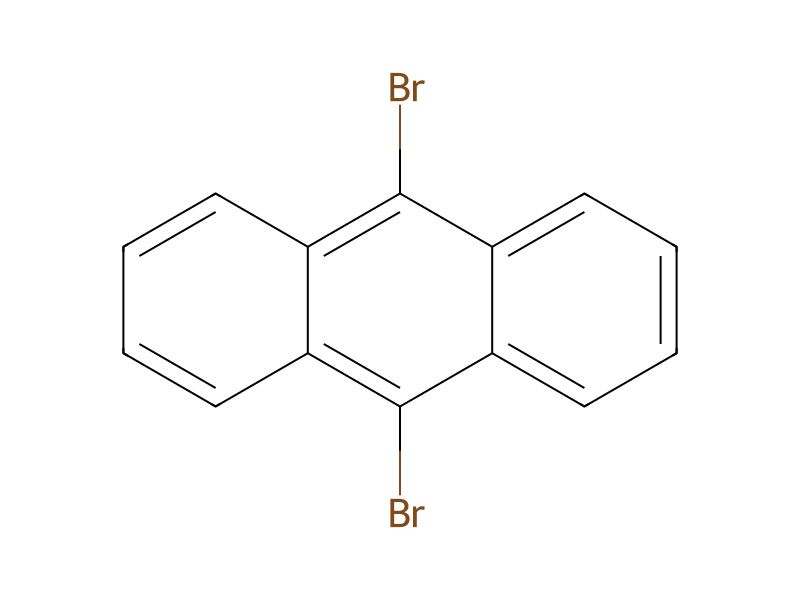
기본 정보
- CAS
523-27-3- 표준 SMILES
Brc1c2ccccc2c(Br)c2ccccc12- InChIKey
BRUOAURMAFDGLP-UHFFFAOYSA-N- 분자식
- C14H8Br2
- 평균 분자량
- 336.02 g/mol
- 단동위원소 질량
- 333.89928
이름 및 식별자
- 우선 이름
- 9,10-Dibromoanthracene
- IUPAC
- 9,10-dibromoanthracene
- 영어명
- 9,10-Dibromoanthracene
- 분자식
- C14H8Br2
- 분자량
- 336.02
이름 및 동의어
9,10-Dibromoanthracene523-27-3Anthracene, 9,10-dibromo-DTXSID5049312UNII-61CP7C5Y8261CP7C5Y82NSC 6263NSC-6263EINECS 208-342-4DTXCID00292689,10-DIBROMOANTHRACENE [MI]52f3-27-3
이름 더 보기
9,10-Dibromoanthracene99%9,10-anthracenems-Dibromoanthracene9, 10-Dibromoanthrac10-Dibromoanthracene9,I O-Dibromanthracen9,1-Dibromoanthracene9,1O-dibromoanthracene9,10-DIRBOMOANTHRACENE
RefChem:107475Anthracene, 9,10dibromo208-342-4BRUOAURMAFDGLP-UHFFFAOYSA-NInChI=1/C14H8Br2/c15-13-9-5-1-2-6-10(9)14(16)12-8-4-3-7-11(12)13/h1-89,10-Dibromo-anthraceneMFCD00001244Anthracene,10-dibromo-
데이터베이스 식별자
- CAS
523-27-3- PubChem CID
- 68226
- DTXSID
DTXSID5049312- ChEMBL
CHEMBL3183379- UNII
- 61CP7C5Y82
- EC Number
- 208-342-4
- Nikkaji
- J6.630C
물성
구조 계산 물성
- XLogP
- 5.8
- 극성 표면적
- 0 Ų
- 수소 결합 공여자 수
- 0
- 수소 결합 수용자 수
- 0
- 회전 가능 결합 수
- 0
- 무거운 원자 수
- 16
- 형식 전하
- 0
- 복잡도
- 203
실험 및 물리화학적 성질
PolymersOther Classes -> Halogenated Polyaromatics
SpringerMaterials Properties13C nuclear magnetic resonance spectrum
LogP6.29
Physical DescriptionYellow solid; [Merck Index]
물리화학적 성질
- 녹는점
- 223 · 223-224 °C (lit.)
- 끓는 점
- 342.21 °C · 342.21°C (rough estimate)
- 밀도
- 1.7167 · 1.7167 (estimate)
- 굴절률
- 1.63 · 1.6300 (estimate)
- 저장 조건
- Sealed in dry,Room Temperature
- 용해도
- 클로로포름에 용해됨
- 물리적 상태
- 푹신한 가루
- 색상
- 노란색에서 노란색-녹색
- 수용성
- 물에 용해됩니다.
- Merck
- 14 · 14,3018
- BRN
- 1912109 · 1912109
- InChI
- 1S/C14H8Br2/c15-13-9-5-1-2-6-10(9)14(16)12-8-4-3-7-11(12)13/h1-8H
안전 및 규제
안전 정보는 참고용이며, 공급업체의 물질안전보건자료(SDS), 관련 법규 및 전문가 평가를 대체하지 않습니다.
GHS 분류
GHS Classification
Warning
H315 (16.3%): Causes skin irritation [Warning Skin corrosion/irritation]
P261, P264, P264+P265, P271, P273, P280, P302+P352, P304+P340, P305+P351+P338, P319, P321, P332+P317, P337+P317, P362+P364, P391, P403+P233, P405, and P501 (click each P-code to see the statement)
Aggregated GHS information provided per 49 reports by companies from 6 notifications to the ECHA C&L Inventory. Each notification may be associated with multiple companies.
유해성 정보
Hazards SummaryAn irritant; [Alfa Aesar MSDS] See POLYCYCLIC AROMATIC HYDROCARBONS.
Hazard Classes and CategoriesSkin Irrit. 2 (16.3%)
안전 데이터
- wgk
- 3
- tsca
- TSCA listed
- ridadr
- UN 3077
- HS 번호
- 29039990
- risk_code
- 36/37/38-50/53
- hazard_code
- Xi,N
- safety_code
- 37/39-26-61-60-36
- 위험 등급
- 9
- Hazard Classifications
- Aquatic Acute 1Aquatic Chronic 1
- 스토리지 클래스
- 11 - Combustible Solids
화학 및 산업
용도 및 제조
General Manufacturing InformationAnthracene, 9,10-dibromo-: ACTIVE
응용 분야
개요9,10-Dibromoanthracene is an organic chemical compound containing anthracene with two bromine atoms substituted on its central ring. As a symmetrically brominated anthracene derivative, it is bearing functional groups to extend its conjugation further mainly via C-C bond forming i.e. Stille and Suzuki coupling reactions. It is notable in that it was the first single molecule to have a chemical reaction observed by an atomic force microscope and scanning tunneling microscopy. It is a low-molecular-weight organic semiconductor. It can used as an initiator in visible-spectrum solar-light-mediated benzylic C–H oxygenation through solar light or the blue LED activate[1-2].
용도9,10-Dibromoanthracene is a dibrominated polycyclic aromatic hydrocarbon (PAH). 9,10-Dibromoanthracene is often used as an energy acceptor and activator in reactions that produce chemiluminescence.
제조 방법
9,10-Dibromoanthracene is synthesized by the bromination of anthracene. The bromination reaction is carried out at room temperature using carbon tetrachloride as a solvent. Using 80-85% anthracene as raw material, adding bromine to react for half an hour, the yield is 83-88%.
상·하류 제품 정보
상류 원료
하류 제품
관련 반응
32건


화합물 노트
불러오는 중…