
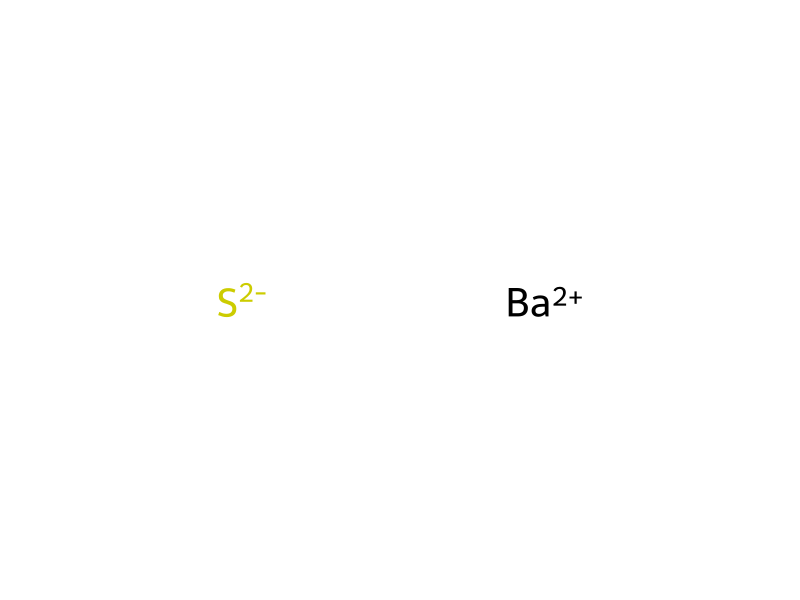
기본 정보
- 표준 SMILES
[Ba+2].[S-2]- InChIKey
CJDPJFRMHVXWPT-UHFFFAOYSA-N- 분자식
- BaS
- 평균 분자량
- 169.39 g/mol
- 단동위원소 질량
- 169.8773182
개요
Barium sulfide is a sulfide salt and a barium salt.
이름 및 식별자
- 우선 이름
- Barium sulfide
- IUPAC
- barium(2+) sulfide
- 현지명
- 황화 바륨
- 영어명
- BARIUM SULFIDE
- 분자식
- BaHS
- 분자량
- 170.4
이름 및 동의어
Barium sulfideBarium sulphideBariumsulfidBARIUM MONOSULFIDETV3U2GEW4HCHEBI:32590DTXSID30892157RefChem:916717barium(2+) ion sulfanediideDTXCID701324628244-214-421109-95-5
이름 더 보기
황화바륨황화바륨바륨설파이드BaSBlack ashyellowpowderEinecs 244-214-4Sulfurated barytabariumsulfide(bas)
Barium sulfide (bas)barium(2+);sulfideBarium sulfide, blackEINECS 256-814-3EINECS 232-376-9barium hydrogen sulfideUNII-PET6ZVZ3MK[BaS]
데이터베이스 식별자
- CAS
21109-95-5、50864-67-0、8011-62-9- PubChem CID
- 6857597
- DTXSID
DTXSID30892157- ChEBI
CHEBI:32590- UNII
- TV3U2GEW4H
- EC Number
- 244-214-4
물성
구조 계산 물성
- 극성 표면적
- 1 Ų
- 수소 결합 공여자 수
- 0
- 수소 결합 수용자 수
- 1
- 회전 가능 결합 수
- 0
- 무거운 원자 수
- 2
- 형식 전하
- 0
- 복잡도
- 0
실험 및 물리화학적 성질
Chemical ClassesMetals -> Metals, Inorganic Compounds
CosmeticsDepilatory
SpringerMaterials Propertiesphonon wavenumber
Physical Description
Dry Powder
Water-soluble, gray powder; [Hawley] Smells like rotten eggs; Hydrolyzes in water; [MSDSonline]
물리화학적 성질
- 녹는점
- 1200 °C · 1200°C
- 밀도
- 4.25 g/mL · 4.25 g/mL at 15 °C(lit.)
- 물리적 상태
- 가루
- Specific Gravity
- 4.25 · 4.25
- 색상
- 옅은 회색에서 노란색까지
- 수용성
- 물에는 용해되지만 알코올에는 용해되지 않습니다.
- 비열
- 0.29 J/ · Cp(crystal): 0.29 J/(g·K), at 25℃
- Merck
- 14 · 14,995
- 안정성
- 안정적이지만 가열하면 분해됩니다. 산, 산화제, 물과 호환되지 않습니다.
- 화장품 원료 기능
- 제모제
- InChI
- 1S/Ba.S
- InChIKey
- OTMNKCRTGBGNPN-UHFFFAOYSA-N
- SMILES
- S=[Ba]
- NIST
- Barium sulfide(21109-95-5)
- EPA
- Barium sulfide (21109-95-5)
화학적 성질
colourless crystals, or white to grey-brown powder,
안전 및 규제
GHS 분류
GHS Classification
Warning
H302: Harmful if swallowed [Warning Acute toxicity, oral]
P261, P264, P270, P271, P273, P301+P317, P304+P340, P317, P330, P391, and P501 (click each P-code to see the statement)
Danger
H290 (82.7%): May be corrosive to metals [Warning Corrosive to Metals]
P234, P260, P261, P264, P270, P271, P273, P280, P301+P316, P301+P317, P301+P330+P331, P302+P361+P354, P304+P340, P305+P354+P338, P316, P317, P321, P330, P363, P390, P391, P405, P406, and P501 (click each P-code to see the statement)
유해성 정보
Regulatory Information
Chemical: Barium sulfide (BaS)
Barium sulfide (BaS) is listed on the EPA's Chemical Data Reporting (CDR) system. Manufacturers and importers of Barium sulfide (BaS) are required to report information about their production and use of this chemical to the EPA under the Toxic Substances Control Act (TSCA). (40 eCFR Part 711)
Status: Active Update: 28-11-2022 https://echa.europa.eu/registration-dossier/-/registered-dossier/13592
Other Safety InformationIMAP assessments - Soluble Sulfide Salts: Human health tier II assessment
Hazards SummaryHarmful by ingestion and inhalation; [ESIS] Reacts with acid to form hydrogen sulfide; [www.ci.tucson.az.us/arthazards/medium.html] Contact with acid liberates toxic gas; [MSDSonline] SeeBarium.
Hazard Classes and Categories
Met. Corr. 1 (82.7%)
Hazardous to the aquatic environment (acute) - category 1
Acute toxicity (Oral) - Category 4
Acute Tox. 4 *
안전 및 보호
Exposure Control and Personal Protection0.5 [mg/m3], as Ba, inhalable fraction (soluble compds)[German Research Foundation (DFG)]
Minimum Risk LevelIntermediate Oral: 0.2 mg/kg/day (L134)
Chronic Oral: 0.2 mg/kg/day (L134)
Threshold Limit Values (TLV)0.5 [mg/m3], as Ba
Permissible Exposure Limit (PEL)0.5 [mg/m3], as Ba
Immediately Dangerous to Life or Health (IDLH)50.0 [mg/m3], as Ba
독성 정보
TreatmentIntravenous infusion of potassium often relieves many of the symptoms of barium toxicity. (L214)
Health Effects
The health effects of the different barium compounds depend on how well the compound dissolves in water or the stomach contents. At low doses, barium acts as a muscle stimulant, while higher doses affect the nervous system, causing cardiac irregularities, tremors, weakness, anxiety, dyspnea, paralysisand possibly death. Barium may also cause gastrointestinal disturbances, damage the kidneys and cause decreases in body weight. (L214)
Adverse EffectsNephrotoxin - The chemical is potentially toxic to the kidneys in the occupational setting.
Exposure RoutesOral (L214) ; inhalation (L214)
Toxicity Summary
Barium is a competitive potassium channel antagonist that blocks the passive efflux of intracellular potassium, resulting in a shift of potassium from extracellular to intracellular compartments. The intracellular translocation of potassium results in a decreased resting membrane potential, making the muscle fibers electrically unexcitable and causing paralysis. Some of these barium's effects may also be due to barium induced neuromuscular blockade and membrane depolarization. (L214)
Signs and Symptoms
Ingesting excess barium may cause vomiting, abdominal cramps, diarrhea, difficulties in breathing, increased or decreased blood pressure, numbness around the face, and muscle weakness. High levels may result in changes in heart rhythm or paralysis and possibly death. (L214)
Carcinogen ClassificationNo indication of carcinogenicity to humans (not listed by IARC).
Toxicity DataLD50: 375 mg/kg (Oral, Rat) (L275)
안전 데이터
- wgk
- 2
- tsca
- TSCA listed
- ridadr
- UN 2813 4.3/PG 2
- HS 번호
- 2830908500
- risk_code
- 20/22-31-50-36/37/38-41-35
- hazard_code
- Xn,N,Xi,C
- safety_code
- 28-61
- 포장분류
- III
- 위험 등급
- 4.3
- 기존화학 물질
- KE-02093
- Hazard Classifications
- Acute Tox. 3 OralAcute Tox. 4 InhalationAquatic Acute 1Met. Corr. 1Skin Corr. 1A
- 스토리지 클래스
- 4.3 - Hazardous materials which set free flammable gases upon contact with water
화학 및 산업
약리 정보
Metabolism/Metabolites
Barium compounds are absorbed via ingestion and inhalation, the extent of which depends on the individual compound. In the body, the majority of the barium is found in the bone, while small amounts exists in the muscle, adipose, skin, and connective tissue. Barium is not metabolized in the body, but it may be transported or incorporated into complexes or tissues. Barium is excreted in the urine and faeces. (L214)
용도 및 제조
Uses
Used to remove hair and to make luminous paints, lithopone, and vulcanized rubber; [Merck Index] Used for dehiding, flame retarding, and as a paint additive; [Hawley] Used in metallic patinas; [www.ci.tucson.az.us/arthazards/medium.html]
Painting (Pigments, Binders, and Biocides) [Category: Paint]
Applying metallic patinas [Category: Hobbies]
Barium sulfide is the precursor to barium carbonate and the pigment lithopone. (L211)
U.S. Production2023: 35,380,000 lb
Industry UsesIntermediate
Use ClassificationCosmetics -> Depilatory
General Manufacturing Information
All Other Basic Inorganic Chemical Manufacturing
Barium sulfide (BaS): ACTIVE
응용 분야
출처Barium sulfide occurs in the form of black ash, which is a gray to black impure product obtained from high temperature carbonaceous reduction of barite. It is the starting material in the manufacture of most barium compounds including barium chloride and barium carbonate. It is used in luminous paints; for dehairing hides; as a flame retardant; and for generating H2S.
용도Barium sulfide has different characters, so it is used in a variety of ways, such as in electronics, paint pigments, dehairing hides, flame retardant, luminous paints, and generating pure hydrogen sulfide. Barium sulfide can deviate X-rays and helps to give clearly image of the soft tissue. Barium sulfide is a precursor to other barium compounds and also used as a short wavelength emitters for electronic displays.
일반 설명Barium sulfide (BaS) is an inorganic compound that is used as a precursor in the production of barium compounds. These compounds can be used in a variety of applications, such as ceramics, luminous paints, additives, and flame retardants.
제조 방법
생산 방법Barium sulfide is grayish-white solid, formed by heating barium sulfate and carbon, reactive with H2O to form barium hydrosulfide, Ba(SH)2, solution. The latter is also made by saturation of barium hydroxide solution with H2S. Barium polysulfides are formed by boiling barium hydrosulfide with sulfur.
Barium sulfide can be prepared by the direct reaction of the elements, calcined in an inert atmosphere, at a 1:1.05 molecular ratio: Ba+S+heat→BaS Barium sulfide is prepared commercially by heating barite (BaO) with coal or petroleum coke in a rotary kiln at 1000°C to 1250°C in an oxygen-free atmosphere. The product, black ash, is a gray or black powder containing carbonaceous impurities and unreacted barite. Barium sulfide is separated from impurities by extraction with hot water and filtration. Barium sulfide may also be made by high temperature reduction of barium sulfate with methane.
상·하류 제품 정보
상류 원료
하류 제품
공급사50 곳
国药集团化学试剂有限公司86-21-63210123 · [email protected]
阿诺西(上海)生物技术有限公司400-1107768 15058188853 · [email protected]
上海阿拉丁生化科技股份有限公司400-6206333 13167063860 · [email protected]
山东瑞博恩新材料科技有限公司15064961989 · [email protected]
Hebei Chuanghai Biotechnology Co., Ltd+86-17732866630 · [email protected]
广州纳珑化工有限公司13192879270; 13192879270 · [email protected]
济南溪川化工科技有限公司18615562062 · [email protected]
武汉欣扬瑞和化学科技有限公司18171205315; 18171205315 · [email protected]
武汉零加一化工有限公司15972036926 15972036926 · [email protected]
江苏星科元信息科技有限公司400-605-7200 15335295587
武汉吉业升化工有限公司027-83360216 18040558719 · [email protected]
江苏艾康生物医药研发有限公司025-025-66113011 15955137747 · [email protected]
Baoji Guokang Healthchem co.,ltd+8615604608665 15604608665 · [email protected]
Dayang Chem (Hangzhou) Co.,Ltd.+86-0571-88938639 17705817739 · [email protected]
河北枫嘉新材料科技有限公司+86-0311-87836622 +86-18712993135 · [email protected]
上海迈瑞尔生化科技有限公司4006356688 18621169109 · [email protected]
武汉吉业升化工有限公司15387013945 · [email protected]
江苏普乐司生物科技有限公司0513-66017706 18551496367 · [email protected]
武汉市聚舜化工有限公司027-02783261126 18971318572 · [email protected]
阿法埃莎(中国)化学有限公司400-6106006 · [email protected]
安耐吉化学&3A(安徽泽升科技股份有限公司)400-0056266 · [email protected]
武汉吉业升化工有限公司13545274181 · [email protected]
广东云星生物技术有限公司0751-18902340975/189023400307 18902340307 · [email protected]
上海瀚鸿科技股份有限公司021-54306202 13764082696 · [email protected]
山东多聚化学有限公司0531-88779566 13105315100
山东西亚化学有限公司13355009207 13355009207 · [email protected]
广东大小化工有限公司1866-171603 18666171603 · [email protected]
四川库利南科技有限公司400-1166-196 18981987031 · [email protected]
武汉吉业升化工有限公司027-13545242311 13545242311 · [email protected]
斯百全化学(上海)有限公司021-021-021-67601398-809-809-809 15221380277 · [email protected]
艾科试剂4008-755-333 18080918076 · [email protected]
武汉吉业升化工有限公司15927657268 · [email protected]
PT CHEM GROUP LIMITED+86-85511178; +86-85511178 · [email protected]
上海将来实业股份有限公司400-0066400 13621662912 · [email protected]
安徽科迪达化工有限公司0554-2106669 · [email protected]
成都零六生物科技有限公司400-1166-196 13458535857 · [email protected]
成都润泽本土化工有限公司13096311329 028-88469284 616445927 · [email protected]
池州凯隆进出口贸易有限公司[email protected]
Sigma-Aldrich西格玛奥德里奇(上海)贸易有限公司021-61415566 800-8193336 · [email protected]
九鼎化学(上海)科技有限公司4009209199 · [email protected]
广东翁江化学试剂有限公司0751-2815987 13927875076 · [email protected]
HANGZHOU LEAP CHEM CO., LTD.+86-571-87711850 +86-15355479329 · [email protected]
武汉吉业升化工有限公司13343438917 · [email protected]
武汉吉业升化工有限公司15927120776 · [email protected]
武汉吉业升化工有限公司15307169873 · [email protected]
湖北兴银河化工有限公司13437271305 · [email protected]
启源(广东)医药化工有限公司18026564465 · [email protected]
南通市苏北化工原料有限公司0513-85290972 18762756250 · [email protected]
上海西陇生化科技有限公司021-52907766-8042
山东西亚化学有限公司4009903999 13395398332 · [email protected]
관련 반응
1건
연결된 노트
불러오는 중…