
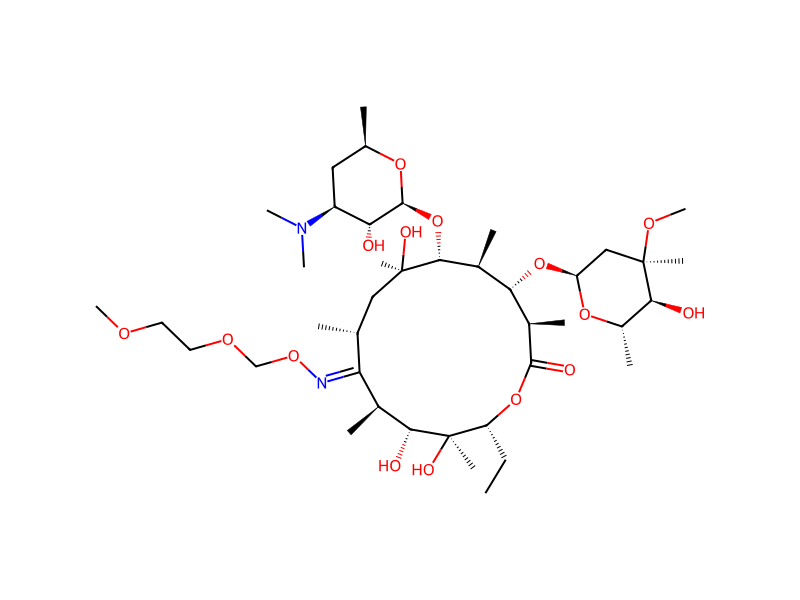
기본 정보
- CAS
80214-83-1- 표준 SMILES
CC[C@H]1OC(=O)[C@H](C)[C@@H](O[C@H]2C[C@@](C)(OC)[C@@H](O)[C@H](C)O2)[C@H](C)[C@@H](O[C@@H]2O[C@H](C)C[C@H](N(C)C)[C@H]2O)[C@](C)(O)C[C@@H](C)/C(=N\OCOCCOC)[C@H](C)[C@@H](O)[C@]1(C)O- InChIKey
RXZBMPWDPOLZGW-XMRMVWPWSA-N- 분자식
- C41H76N2O15
- 평균 분자량
- 837 g/mol
- 단동위원소 질량
- 836.52456972
개요
Roxithromycin is semisynthetic derivative of erythromycin A. It has a role as an antibacterial drug. It is a macrolide, an erythromycin derivative and a semisynthetic derivative. It is functionally related to an erythromycin A.
이름 및 식별자
- 우선 이름
- Roxithromycin
- IUPAC
- (3R,4S,5S,6R,7R,9R,10E,11S,12R,13S,14R)-6-[(2S,3R,4S,6R)-4-(dimethylamino)-3-hydroxy-6-methyloxan-2-yl]oxy-14-ethyl-7,12,13-trihydroxy-4-[(2R,4R,5S,6S)-5-hydroxy-4-methoxy-4,6-dimethyloxan-2-yl]oxy-10-(2-methoxyethoxymethoxyimino)-3,5,7,9,11,13-hexamethyl-oxacyclotetradecan-2-one
- 영어명
- Roxithromycin
- 분자식
- C41H76N2O15
- 분자량
- 837.05
이름 및 동의어
roxithromycinRulide80214-83-1RulidRU 28965RU 965InfectoroxitRU-965Roxi-paed 1A PharmaRoxitromycinRoxitromycineDTXSID8041117
이름 더 보기
RoxidRoxithromycin (Roxl-150)Roxithromycin Solution, 100ppmBrilidOveralSurlidAssoralForilin
NSC-75844321KOF230FACHEBI:48935RU-28965(9E)-erythromycin 9-(O-((2-methoxyethoxy)methyl)oxime)DTXCID6021117CHEBI:48844Erythromycin, 9-(O-((2-methoxyethoxy)methyl)oxime), (9E)-
데이터베이스 식별자
- CAS
80214-83-1- PubChem CID
- 6915744
- ChEMBL
CHEMBL1214185- ChEBI
CHEBI:48844- UNII
- 21KOF230FA
- EC Number
- 617-007-5
물성
구조 계산 물성
- XLogP
- 3.1
- 극성 표면적
- 217 Ų
- 수소 결합 공여자 수
- 5
- 수소 결합 수용자 수
- 17
- 회전 가능 결합 수
- 13
- 무거운 원자 수
- 58
- 형식 전하
- 0
- 복잡도
- 1,310
실험 및 물리화학적 성질
Drugs
Pharmaceuticals -> Antibiotics
Pharmaceuticals -> Antibiotics
Pharmaceuticals -> Listed in ZINC15
LogP3.46
Human DrugsBreast Feeding; Lactation; Anti-Bacterial Agents; Anti-Infective Agents; Macrolides
Dissociation Constants9.27
Collision Cross Section285.66 Ų [M+Na]+
물리화학적 성질
- 녹는점
- 111 · 111-118C
- 끓는 점
- 864.7 · 864.7±75.0 °C(Predicted)
- 밀도
- 1.25 · 1.25±0.1 g/cm3(Predicted)
- 인화점
- 110 ° · >110°(230°F)
- 저장 조건
- 2 · Sealed in dry,2-8°C
- 용해도
- 10 mg/mL · 클로로포름: 가용성10mg/mL
- 산도 계수 (pKa)
- 9.27 · pKa 9.27±0.01(H2O t = 25.0 I = 0.15 (KCl)) (Uncertain)
- 물리적 상태
- 가루
- 색상
- White to off-white
안전 및 규제
안전 정보는 참고용이며, 공급업체의 물질안전보건자료(SDS), 관련 법규 및 전문가 평가를 대체하지 않습니다.
GHS 분류
GHS Classification
Warning
H302 (100%): Harmful if swallowed [Warning Acute toxicity, oral]
P264, P270, P301+P317, P330, and P501 (click each P-code to see the statement)
Aggregated GHS information provided per 67 reports by companies from 2 notifications to the ECHA C&L Inventory.
Danger
H302: Harmful if swallowed [Warning Acute toxicity, oral]
유해성 정보
Regulatory InformationRoxithromycin: Does not have an individual approval but may be used under an appropriate group standard
Hazard Classes and Categories
Acute Tox. 4 (100%)
Acute toxicity (Oral) - Category 4
독성 정보
Drug Induced Liver Injury
Drug-Induced Liver Injury Severity and Toxicity (DILIst)
ROXITHROMYCIN
DILI Positive
DOI:10.1016/j.drudis.2019.09.022
Effects During Pregnancy and Lactation◉ Summary of Use during Lactation
안전 데이터
- wgk
- 3
- rtecs
- KF4990000
- HS 번호
- 29415000
- risk_code
- 22
- hazard_code
- Xn
- safety_code
- 26-24/25
- Hazard Classifications
- Acute Tox. 4 Oral
화학 및 산업
약리 정보
ATC Code
J - Antiinfectives for systemic use
QJ - Antiinfectives for systemic use
Protein Binding96%, mainly to alpha1-acid glycoproteins
Pharmacodynamics
Roxithromycin has the following antibacterial spectrum <i>in vitro</i>: <i>Streptococcus agalactiae</i>, <i>Streptococcus pneumoniae</i> (Pneumococcus), <i>Neisseria meningitides</i> (Meningococcus), <i>Listeria monocytogenes</i>, <i>Mycoplasma pneumoniae</i>, <i>Chlamydia trachomatis</i>, <i>Ureaplasma urealyticum</i>, <i>Legionella pneumophila</i>, <i>Helicobacter</i> (Campylobacter), <i>Gardnerella vaginalis</i>, <i>Bordetella pertussis</i>, <i>Moraxella catarrhalis</i> (<i>Branhamella Catarrhalis</i>), and <i>Haemophilus ducreyi</i>. Roxithromycin is highly concentrated in polymorphonuclear leukocytes and macrophages, achieving intracellular concentrations greater than those outside the cell. Roxithromycin enhances the adhesive and chemotactic functions of these cells which in the presence of infection produce phagocytosis and bacterial lysis. Roxithromycin also possesses intracellular bactericidal activity.
Mechanism of ActionRoxithromycin prevents bacterial growth by interfering with their protein synthesis. It binds to the 50S subunit of bacterial ribosomes and inhibits the translocation of peptides.
Biological Half-Life12 hours
Metabolism/Metabolites
Hepatic. Roxithromycin is only partially metabolised, more than half the parent compound being excreted unchanged. Three metabolites have been identified in urine and faeces: the major metabolite is descladinose roxithromycin, with N-mono and N-di-demethyl roxithromycin as minor metabolites. The respective percentage of roxithromycin and these three metabolites is similar in urine and faeces.
MeSH Pharmacological ClassificationSubstances that inhibit the growth or reproduction of BACTERIA.
관련 반응
1건
화합물 노트
불러오는 중…