
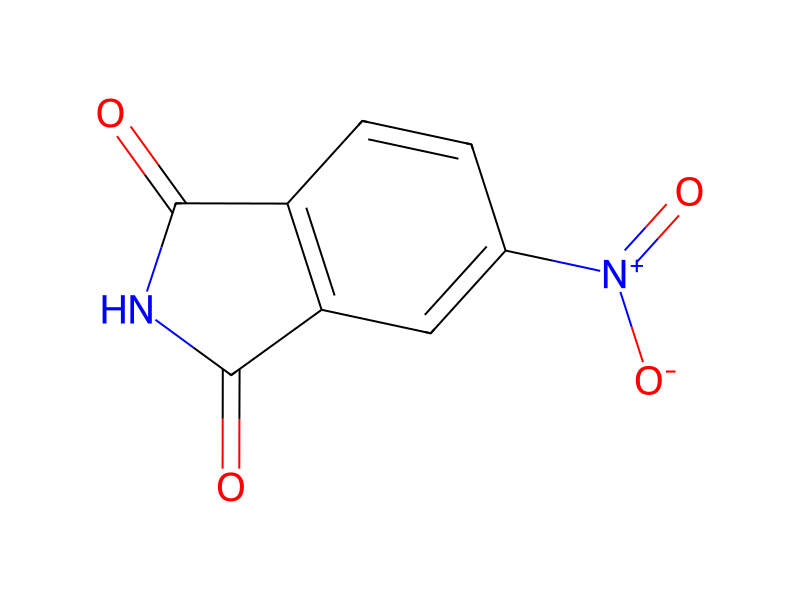
기본 정보
- 표준 SMILES
O=C1NC(=O)c2cc([N+](=O)[O-])ccc21- InChIKey
ANYWGXDASKQYAD-UHFFFAOYSA-N- 분자식
- C8H4N2O4
- 평균 분자량
- 192.13 g/mol
- 단동위원소 질량
- 192.01710661
이름 및 식별자
- 우선 이름
- 4-Nitrophthalimide
- IUPAC
- 5-nitroisoindole-1,3-dione
- 영어명
- 4-Nitrophthalimide
- 분자식
- C8H4N2O4
- 분자량
- 192.13
이름 및 동의어
4-NITROPHTHALIMIDE89-40-75-NitrophthalimidePhthalimide, 4-nitro-DTXSID102577626NA19UI3UNSC-5394DTXCID405776RefChem:100145201-905-55-nitroisoindoline-1,3-dione5-Nitro-1H-isoindole-1,3(2H)-dione
이름 더 보기
AKOS B0287334-Nitrophtalimide4-nitro-phthalimid4-NirtophthalimideP-NITRO-PHTHALIMIDE4-Nitrophthalimide>
1H-Isoindole-1,3(2H)-dione, 5-nitro-5-nitroisoindole-1,3-dione5-nitro-2,3-dihydro-1H-isoindole-1,3-dioneNSC 5394MFCD000058844-nitro-phthalimide5-nitro-phthalimide4-Nitrophthalimide, 98%
데이터베이스 식별자
- CAS
89-40-7- PubChem CID
- 6969
- DTXSID
DTXSID1025776- ChEMBL
CHEMBL1607202- UNII
- 26NA19UI3U
- EC Number
- 201-905-5
- Nikkaji
- J68.901G、J886.781J
물성
구조 계산 물성
- XLogP
- 1
- 극성 표면적
- 92 Ų
- 수소 결합 공여자 수
- 1
- 수소 결합 수용자 수
- 4
- 회전 가능 결합 수
- 0
- 무거운 원자 수
- 14
- 형식 전하
- 0
- 복잡도
- 309
실험 및 물리화학적 성질
Solubilityless than 0.1 mg/mL at 64 °F (NTP, 1992)
Melting Point356 to 360 °F (NTP, 1992)
Physical Description4-nitrophthalimide is a yellow powder. (NTP, 1992)
물리화학적 성질
- 녹는점
- 206 °C · 206 °C
- 끓는 점
- 328.09 °C · 328.09°C (rough estimate)
- 밀도
- 1.5513 · 1.5513 (rough estimate)
- 굴절률
- 1.49 · 1.4900 (estimate)
- 저장 조건
- Sealed in dry,Room Temperature
- 물리적 상태
- powder to crystal
- 산도 계수 (pKa)
- 7.79 · 7.79±0.20(Predicted)
- 색상
- 황색 분말
- 수용성
- 18 °C에서 · 18°C에서 <0.01g/100mL
- BRN
- 180224 · 180224
- 안정성
- 안정적인. 타기 쉬운. 습기, 물, 강산화제, 강염기와 호환되지 않습니다.
- 주요 응용
- 진단 검사 제조혈액학조직학
- InChI
- 1S/C8H4N2O4/c11-7-5-2-1-4(10(13)14)3-6(5)8(12)9-7/h1-3H,(H,9,11,12)
- InChIKey
- ANYWGXDASKQYAD-UHFFFAOYSA-N
- SMILES
- [O-][N+](=O)c1ccc2C(=O)NC(=O)c2c1
- NIST
- 4 · 4-Nitro-phthalimide(89-40-7)
- EPA
- 4 · 4-Nitrophthalimide (89-40-7)
화학적 성질
slight yellow powder
안전 및 규제
GHS 분류
GHS Classification
Warning
H315 (100%): Causes skin irritation [Warning Skin corrosion/irritation];H319 (100%): Causes serious eye irritation [Warning Serious eye damage/eye irritation];H335 (97.8%): May cause respiratory irritation [Warning Specific target organ toxicity, single exposure; Respiratory tract irritation]
P261, P264, P264+P265, P271, P280, P302+P352, P304+P340, P305+P351+P338, P319, P321, P332+P317, P337+P317, P362+P364, P403+P233, P405, and P501 (click each P-code to see the statement)
Aggregated GHS information provided per 46 reports by companies from 6 notifications to the ECHA C&L Inventory. Each notification may be associated with multiple companies.;Information may vary between notifications depending on impurities, additives, and other factors. The percentage value in parenthesis indicates the notified classification ratio from companies that provide hazard codes. Only hazard codes with percentage values above 10% are shown. For more detailed information, please visit ECHA C&L website.
유해성 정보
Fire HazardsFlash point data for this chemical are not available, however it is probably combustible. (NTP, 1992)
Reactive GroupAmines, Phosphines, and Pyridines;Nitro, Nitroso, Nitrate, and Nitrite Compounds, Organic
Reactivity Profile
A nitrated amine. Amines are combustible. The combustion of amines yields noxious NOx. REACTIVITY - Amines are chemical bases. They neutralize acids to form salts plus water. These acid-base reactions are exothermic. The amount of heat that is evolved per mole of amine in a neutralization is largely independent of the strength of the amine as a base. Amines may be incompatible with isocyanates, halogenated organics, peroxides, phenols (acidic), epoxides, anhydrides, and acid halides. Flammable gaseous hydrogen is generated by amines in combination with strong reducing agents, such as hydrides. Aromatic nitro compounds range from slight to strong oxidizing agents. If mixed with reducing agents, including hydrides, sulfides and nitrides, they may begin a vigorous reaction that culminates in a detonation. The aromatic nitro compounds may explode in the presence of a base such as sodium hydroxide or potassium hydroxide even in the presence of water or organic solvents. The explosive tendencies of aromatic nitro compounds are increased by the presence of multiple nitro groups.
Air and Water ReactionsThis compound can be hydrolyzed. (NTP, 1992). Insoluble in water.
Hazard Classes and CategoriesSkin Irrit. 2 (100%);Eye Irrit. 2 (100%);STOT SE 3 (97.8%)
안전 및 보호
Fire FightingFires involving this compound can be controlled using a dry chemical, carbon dioxide or Halon extinguisher. (NTP, 1992)
First Aid
EYES: First check the victim for contact lenses and remove if present. Flush victim's eyes with water or normal saline solution for 20 to 30 minutes while simultaneously calling a hospital or poison control center. Do not put any ointments, oils, or medication in the victim's eyes without specific instructions from a physician. IMMEDIATELY transport the victim after flushing eyes to a hospital even if no symptoms (such as redness or irritation) develop.;SKIN: IMMEDIATELY flood affected skin with water while removing and isolating all contaminated clothing. Gently wash all affected skin areas thoroughly with soap and water. If symptoms such as redness or irritation develop, IMMEDIATELY call a physician and be prepared to transport the victim to a hospital for treatment.;INHALATION: IMMEDIATELY leave the contaminated area; take deep breaths of fresh air. If symptoms (such as wheezing, coughing, shortness of breath, or burning in the mouth, throat, or chest) develop, call a physician and be prepared to transport the victim to a hospital. Provide proper respiratory protection to rescuers entering an unknown atmosphere. Whenever possible, Self-Contained Breathing Apparatus (SCBA) should be used; if not available, use a level of protection greater than or equal to that advised under Protective Clothing.;INGESTION: DO NOT INDUCE VOMITING. If the victim is conscious and not convulsing, give 1 or 2 glasses of water to dilute the chemical and IMMEDIATELY call a hospital or poison control center. Be prepared to transport the victim to a hospital if advised by a physician. If the victim is convulsing or unconscious, do not give anything by mouth, ensure that the victim's airway is open and lay the victim on his/her side with the head lower than the body. DO NOT INDUCE VOMITING. IMMEDIATELY transport the victim to a hospital. (NTP, 1992)
Nonfire Spill Response
SMALL SPILLS AND LEAKAGE: Should a spill occur while you are handling this chemical, FIRST REMOVE ALL SOURCES OF IGNITION, then you should dampen the solid spill material with 60-70% ethanol and transfer the dampened material to a suitable container. Use absorbent paper dampened with 60-70% ethanol to pick up any remaining material. Seal the absorbent paper, and any of your clothes, which may be contaminated, in a vapor-tight plastic bag for eventual disposal. Solvent wash all contaminated surfaces with 60-70% ethanol followed by washing with a soap and water solution. Do not reenter the contaminated area until the Safety Officer (or other responsible person) has verified that the area has been properly cleaned.;STORAGE PRECAUTIONS: You should store this material in a refrigerator. (NTP, 1992)
Personal Protective Equipment (PPE)
RECOMMENDED RESPIRATOR: Where the neat test chemical is weighed and diluted, wear a NIOSH-approved half face respirator equipped with an organic vapor/acid gas cartridge (specific for organic vapors, HCl, acid gas and SO2) with a dust/mist filter. (NTP, 1992)
안전 데이터
- wgk
- 3
- tsca
- TSCA listed
- rtecs
- TI5625000
- 독성
- mmo-sat 333 mg/plate EMMUEG 11(Suppl 12),1,88
- HS 번호
- 29251900
- risk_code
- 36/37/38
- hazard_code
- Xi
- safety_code
- 37/39-26-36-24/25
- 위험 참고 사항
- Irritant
- Hazard Classifications
- Eye Irrit. 2Skin Irrit. 2STOT SE 3
- 스토리지 클래스
- 11 - Combustible Solids
화학 및 산업
용도 및 제조
General Manufacturing Information1H-Isoindole-1,3(2H)-dione, 5-nitro-: ACTIVE
응용 분야
용도4-Nitrophthalimide is used as intermediate of organic synthesis and fluorescent dyes, it can be used to produce azo dyes, luminol, etc. It can also be used to prepare 4-nitrophthalonitrile, 5-cyanophthalide and other drug intermediates.
일반 설명Yellow powder.
제조 방법
4-Nitrophthalimide is synthesized from phthalimide by nitration. Cool the fuming nitric acid to below 5°C, slowly add concentrated sulfuric acid dropwise, and control the temperature to 10-13°C. Plus phthalimide. Leave at room temperature overnight. Then, it was poured into ice water with stirring, and the precipitate was precipitated below 20°C. Filter, wash with water, dry, and then recrystallize from ethanol to obtain 4-nitrophthalimide with a yield of 60%.
상·하류 제품 정보
상류 원료
하류 제품
공급사50 곳
国药集团化学试剂有限公司86-21-63210123 · [email protected]
格林斯柏生物科技(江苏)有限公司0523-87726088 13705266400 · [email protected]
梯希爱(上海)化成工业发展有限公司021-67121386 · [email protected]
河北创海生物科技有限公司+86-86-13131129325 · [email protected]
Dayang Chem (Hangzhou) Co.,Ltd.+86-0571-88938639 17705817739 · [email protected]
北京安司莫森技术有限公司010-82954736 13391601435 · [email protected]
Syntechem Co.,Ltd[email protected]
上海迈瑞尔生化科技有限公司4006356688 18621169109 · [email protected]
阿法埃莎(中国)化学有限公司400-6106006 · [email protected]
安耐吉化学&3A(安徽泽升科技股份有限公司)400-0056266 · [email protected]
上海瀚鸿科技股份有限公司021-54306202 13764082696 · [email protected]
上海景颜化工科技有限公司13817811078 · [email protected]
孝感深远化工有限公司15527621225; 15527621225 · [email protected]
玛雅试剂+86 (573) 82222445 (0)18006601000 452520369 · [email protected]
HONG KONG IPURE BIOLOGY CO.,LIMITED86 18062405514 18062405514 · [email protected]
四川库利南科技有限公司400-1166-196 18981987031 · [email protected]
天津希恩思生化科技有限公司400 638 7771 · [email protected]
湖南汇百侍生物科技有限公司0731-85526065 13308475853 · [email protected]
赛默飞世尔科技(中国)有限公司800-810-5118 · [email protected]
上海遐瑞医药科技有限公司+86 21 61551611
江苏艾康生物医药研发有限公司025-66113011 13913916777 · [email protected]
TCI AMERICA800-4238616 · [email protected]
TOKYO CHEMICAL INDUSTRY CO., LTD.03-36680489 · [email protected]
TCI Europe320-37350700 · [email protected]
上海贤鼎生物科技有限公司4009209199 · [email protected]
深圳康特腾科技有限公司86-0755-86635001 · [email protected]
越林试剂021-62960152 · [email protected]
上海湄水化工科技有限公司021-60549325 18616193163
日照力德士化工有限公司010-51268198 · [email protected]
美岚实业(上海)有限公司021-58958189 · [email protected]
上海石洋化工有限公司021-56795766 · [email protected]
上海爱蝶实业有限公司021-58957966 18930537195 · [email protected]
成都零六生物科技有限公司400-1166-196 13458535857 · [email protected]
广拓化学(上海)有限公司021-60899189-8001 18918189673 · [email protected]
上海御略医药科技有限公司021-60345187 13671753212 · [email protected]
上海永叶生物科技有限公司86-021-61559134 15921386130 · [email protected]
上海有朋化工有限公司021-69005955 13701776567 · [email protected]
北京海力扬化学科技有限公司13718199399 · [email protected]
北京欣赛维化学科技有限公司010-56218822 13717722232 · [email protected]
四川海诺威科技有限公司13708085536 13708085536 · [email protected]
上海凯赛化工有限公司021-33516722 13701817765 · [email protected]
上海彤源化工有限公司021-021-69182866 13701855675 · [email protected]
北京华扬致成科技有限公司13716033033 · [email protected]
上海蓝润化学有限公司021-69515658 ; 69515628 13701998368 · [email protected]
上海容立化学科技有限公司021-69992220 13701886816 · [email protected]
上海康拓化工有限公司021-69185552 13701777608 · [email protected]
池州凯隆进出口贸易有限公司[email protected]
桦特昇生物科技(武汉)有限公司027-59207879 1972026995 18140587686 · [email protected]
Nantong Haigine Pharma Technology Co., Ltd0086-513-86266699
潍坊市前进精细化工有限公司18753684562 · [email protected]
관련 반응
56건


연결된 노트
불러오는 중…