홈MCP워크벤치Skills
홈워크벤치알림마이페이지
llms.txt · MCP 가이드개인정보처리방침 · 이용약관 · 지원v1.8.0
  1. 홈
  2. /화합물

1,4-디클로로-2-니트로벤젠

2,5-Dichloronitrobenzene

HCID 6977
새 노트새 반응견적 요청하기
인쇄 미리보기
기본 정보개요이름 및 식별자물성안전 및 규제화학 및 산업관련 반응화합물 노트
부분 구조 검색유사 구조 찾기

기본 정보

CAS
89-61-2
표준 SMILES
O=[N+]([O-])c1cc(Cl)ccc1Cl
InChIKey
RZKKOBGFCAHLCZ-UHFFFAOYSA-N
분자식
C6H3Cl2NO2
평균 분자량
192 g/mol
단동위원소 질량
190.9540837

개요

1,4-Dichloro-2-Nitrobenzene can cause cancer according to California Labor Code.

이름 및 식별자

우선 이름
2,5-Dichloronitrobenzene
IUPAC
1,4-dichloro-2-nitrobenzene
현지명
1,4-디클로로-2-니트로벤젠
영어명
2,5-Dichloronitrobenzene
분자식
C6H3Cl2NO2
분자량
192

이름 및 동의어

1,4-Dichloro-2-nitrobenzene2,5-DICHLORONITROBENZENE89-61-2Benzene, 1,4-dichloro-2-nitro-1-Nitro-2,5-dichlorobenzene2,5-DichlornitrobenzenDTXSID7052602IY18G50FF4DTXCID1031175RefChem:73231201-923-3Nitro-p-dichlorobenzene
이름 더 보기
1,4-디클로로-2-나이트로벤젠1,4-디클로로-2-니트로벤젠2,5-디클로로-1-니트로벤젠2,5-다이클로로나이트로벤젠1,4-다이클로로-2-나이트로벤젠1,4-다이클로로-3-나이트로벤젠1-나이트로-2,5-다이클로로벤젠2,5-다이클로로-1-나이트로벤젠2-나이트로-1,4-다이클로로벤젠나이트로-p-다이클로로벤젠벤젠, 1,4-다이클로로-3-나이트로-2,5-DICHLORO-4-NITROBENZENE2.5-Dichloroni2,5-Dichlornitrobenzol2,5-DICHLORONITROBENZOL2,5-dichlornitrobenzeneDomperidone Impurity 10
Benzene, 2,5-dichloronitro-1,4-Dichloro-2-nitro-benzeneNSC 406125MFCD00007074NSC-6294NSC-406125Benzene,5-dichloronitro-WLN: WNR CG EG

데이터베이스 식별자

CAS
89-61-2
PubChem CID
6977
DTXSID
DTXSID7052602
ChEMBL
CHEMBL354761
UNII
IY18G50FF4
EC Number
201-923-3
Nikkaji
J3.548C

물성

구조 계산 물성

XLogP
2.9
극성 표면적
45.8 Ų
수소 결합 공여자 수
0
수소 결합 수용자 수
2
회전 가능 결합 수
0
무거운 원자 수
11
형식 전하
0
복잡도
159

실험 및 물리화학적 성질

Chemical ClassesNitrogen Compounds -> Nitros, Aromatic
pHpH = 6.9 (80 mg/L water) at 20 °C
SpringerMaterials PropertiesCrystal structure
LogP · 3건

log Kow = 3.09

2.93

3.09

Density · 4건

1.669 at 22 °C

Density: 1.479 g/cu cm at 75 °C

1.67 g/cm³

Relative density of the vapour/air-mixture at 20 °C (air = 1): 1.00

Color/FormPlates or prisms from alcohol, plates from ethyl acetate
Solubility · 4건

In water, 95 mg/L at 25 °C

In water, 92.1 mg/L at 20 °C

Soluble in ethanol, ether, benzene, carbon disulfide; slightly soluble in carbon tetrachloride

Solubility in water, g/100ml at 20 °C: 0.01 (very slightly soluble)

Flash Point135 °C
Boiling Point · 2건

267 °C

261 °C

Decomposition

안전 및 규제

안전 정보는 참고용이며, 공급업체의 물질안전보건자료(SDS), 관련 법규 및 전문가 평가를 대체하지 않습니다.

GHS 분류

GHS Classification · 6건

Danger

H350: May cause cancer [Danger Carcinogenicity]

P203, P280, P318, P405, and P501 (click each P-code to see the statement)

This chemical does not meet GHS hazard criteria for 1.1% (1 of 94) of reports.

Warning

H302 (98.9%): Harmful if swallowed [Warning Acute toxicity, oral]

유해성 정보

Regulatory Information · 5건

Chemical: Benzene, 1,4-dichloro-2-nitro-

Hazard Traits - Carcinogenicity

TP - indicates a substance that is the subject of a proposed TSCA section 4 test rule.

REACH registered substance: 1,4-dichloro-2-nitrobenzene (EC: 201-923-3)

1,4-Dichloro-2-nitrobenzene: Does not have an individual approval but may be used under an appropriate group standard

Other Safety InformationEvaluation - Benzene, 1,4-dichloro-2-nitro- (2,5-dichloronitrobenzene)
Fire HazardsCombustible. Gives off irritating or toxic fumes (or gases) in a fire.
Hazards Summary · 1건

No listed effects of short-term or long-term exposure (health effects have not been fully investigated); [ICSC] Can possibly induce methemoglobinemia; Can be absorbed through skin; Not a skin or eye irritant in rabbits; Not sensitizing in guinea pig maximization tests; No mortalities in rats exposed by inhalation to 47.6 mg/m3 for 7 hours; Increased liver weight (accompanied by hepatocellular hypertrophy), damage to the forestomach, increased bilirubin levels, and adverse male reproductive effects (depressed spermatogenesis) observed in 28-day oral study of rats; Cyanosis and methemoglobin formation observed in cats; [IUCLID] A mild skin and strong eye irritant; May induce methemoglobinemia; Harmful by ingestion and skin absorption; [Sigma-Aldrich MSDS] See 3,4-Dichloronitrobenzene.

UN Classification

화학 및 산업

약리 정보

Biological Half-LifeFollowing oral intake the biological half-life in fish is less than 3 days.
Metabolism/Metabolites · 1건

1,4-Dichloro-2-nitrobenzene is readily absorbed after oral administration or dermal application. The substance is metabolized to a number of products. Following oral application chiefly 2,5-dichloroaniline, the mercapturic acid derivative N-acetyl-S-(4-chloro-2-nitrophenyl)-L-cysteine as well as glucuronic and sulfuric acid conjugates of 4-amino-2,5-dichlorophenol were identified in urine.

Absorption, Distribution and Excretion1,4-Dichloro-2-nitrobenzene is readily absorbed after oral administration or dermal application.

용도 및 제조

Uses · 3건

Used as an intermediate in the chemical industry; [IUCLID] Used to make pigments, pesticides, and UV absorbents; [HSDB]

Used extensively in the manufacture of dyestuff intermediates

Used as an intermediate for pigments, pesticides and UV absorbents in closed systems

U.S. ProductionProduction volumes for non-confidential chemicals reported under the Inventory Update Rule. [Table#7968]
Methods of ManufacturingNitration of 1,4-dichlorobenzene with mixed acid at 35-65 °C results in a 98% yield of essentially pure 1,4-dichloro-2-nitrobenzene.
General Manufacturing InformationBenzene, 1,4-dichloro-2-nitro-: ACTIVE

제조 방법

생산 방법Nitration of 1,4-dichlorobenzene with mixed acid at 35 – 65 ℃ results in a 98 % yield of essentially pure 2,5-Dichloronitrobenzene.

관련 반응

153건
반응 기록 만들기
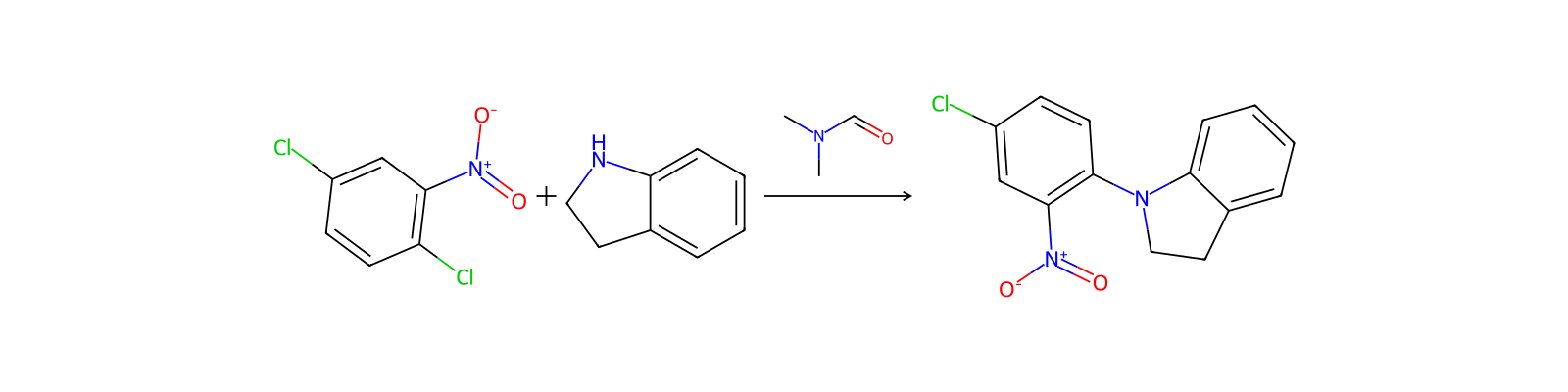
HRID 3997 반응식
HRID 3997반응물로uspto-grants-1988_02
HRID 4003 반응식
HRID 4003반응물로uspto-grants-1988_02
HRID 4055 반응식
HRID 4055반응물로uspto-grants-1988_02
HRID 4061 반응식
HRID 4061반응물로uspto-grants-1988_02
HRID 21680 반응식
HRID 21680반응물로uspto-grants-1995_06
HRID 26705 반응식
HRID 26705반응물로uspto-grants-1979_04
HRID 34312 반응식
HRID 34312반응물로uspto-grants-1988_08
HRID 34317 반응식
HRID 34317반응물로uspto-grants-1988_08
1 / 20 페이지

화합물 노트

불러오는 중…

이 페이지에서기본 정보개요이름 및 식별자물성안전 및 규제화학 및 산업관련 반응화합물 노트
더보기
새 노트새 반응견적 요청하기
When heated to decomposition it emits very toxic fumes of /hydrogen chloride and nitrogen oxides/.
Melting Point · 2건

56 °C

55 °C

Vapor DensityRelative vapor density (air = 1): 6.6

물리화학적 성질

녹는점
52 · 52-54 °C(lit.)
끓는 점
267 °C · 267 °C
밀도
1 · 1,442 g/cm3
증기 밀도
6.6 · 6.6 (vs air)
증기압
0.1 mm · <0.1 mm Hg ( 25 °C)
굴절률
1.439 · 1.4390 (estimate)
인화점
230 °F · >230 °F
저장 조건
30 °C · Store below +30°C.
용해도
0.083 g/L · 0.083g/L
물리적 상태
solid
색상
옅은 노랑
폭발한계
2.4 · 2.4-8.5%(V)
수용성
물, 에탄올, 에테르, 벤젠, 이황화탄소에 용해됩니다. 사염화탄소에 약간 용해됩니다.
BRN
778109 · 778109
Henry's Law Constant
8.2 · 8.2×10-1 mol/(m3Pa) at 25℃, Altschuh et al. (1999)
InChI
1S/C6H3Cl2NO2/c7-4-1-2-5(8)6(3-4)9(10)11/h1-3H
InChIKey
RZKKOBGFCAHLCZ-UHFFFAOYSA-N
SMILES
[O-][N+](=O)c1cc(Cl)ccc1Cl
LogP
2.87 at · 2.87 at 25℃
NIST
1 · Benzene, 1,4-dichloro-2-nitro-(89-61-2)
EPA
2 · 2,5-Dichloronitrobenzene (89-61-2)

화학적 성질

yellow flakes

UN Hazard Class: 6.1; UN Pack Group: II
Chemical DangersDecomposes on heating. This produces toxic and corrosive fumes including hydrogen chloride (see ICSC 0163) and nitrogen oxides (see ICSC 0282). Reacts with strong oxidants and bases.
Packaging and LabellingDo not transport with food and feedstuffs.
Hazard Classes and Categories · 6건

Acute Tox. 4 (98.9%)

Acute toxicity (ingestion) - category 4

Acute toxicity (Oral) - Category 4

Acute toxicity (Oral) - Category 4

Carcinogenicity - Category 1B

Carcinogenicity - Category 1B

Explosive Limits and PotentialExplosive limits , vol% in air: 2.4-8.5
Skin, Eye, and Respiratory Irritations · 2건

A skin and eye irritant.

1,4-Dichloro-2-nitrobenzene is mildly irritating to eyes and non-irritating to skin.

안전 및 보호

Fire FightingUse water spray, dry powder, foam, carbon dioxide.
First Aid Measures · 4건

Fresh air, rest.

Rinse and then wash skin with water and soap. Refer for medical attention .

Rinse with plenty of water (remove contact lenses if easily possible).

Rinse mouth. Refer for medical attention .

Safe StorageSeparated from bases, strong oxidants and food and feedstuffs. Store in an area without drain or sewer access. Provision to contain effluent from fire extinguishing.
Disposal Methods · 1건

SRP: The most favorable course of action is to use an alternative chemical product with less inherent propensity for occupational harm/injury/toxicity or environmental contamination. Recycle any unused portion of the material for its approved use or return it to the manufacturer or supplier. Ultimate disposal of the chemical must consider: the material's impact on air quality; potential migration in soil or water; effects on animal and plant life; and conformance with environmental and public health regulations.

Spillage Disposal · 1건

Personal protection: particulate filter respirator adapted to the airborne concentration of the substance, protective clothing, protective gloves and face shield. Do NOT let this chemical enter the environment. Sweep spilled substance into sealable containers. If appropriate, moisten first to prevent dusting. Carefully collect remainder. Then store and dispose of according to local regulations.

Preventive Measures · 1건

SRP: The scientific literature for the use of contact lenses by industrial workers is inconsistent. The benefits or detrimental effects of wearing contact lenses depend not only upon the substance, but also on factors including the form of the substance, characteristics and duration of the exposure, the uses of other eye protection equipment, and the hygiene of the lenses. However, there may be individual substances whose irritating or corrosive properties are such that the wearing of contact lenses would be harmful to the eye. In those specific cases, contact lenses should not be worn. In any event, the usual eye protection equipment should be worn even when contact lenses are in place.

Eye PreventionWear safety spectacles.
Fire PreventionNO open flames.
Inhalation RiskA harmful concentration of airborne particles can be reached quickly when dispersed, especially if powdered.
Skin PreventionProtective gloves.
Exposure PreventionPREVENT DISPERSION OF DUST! STRICT HYGIENE!
Ingestion PreventionDo not eat, drink, or smoke during work.

독성 정보

Ecotoxicity Values · 5건

EC50; Species: Chlorella pyrenoidosa (Green Algae) exponential growth phase, 2 X10+8 cells/mL; Conditions: freshwater, static, 25 °C, pH 6.6; Concentration: 2100 ug/L for 96 hr (95% confidence interval: 1500-2800 ug/L); Effect: growth, general />98% purity formulation/

LC50; Species: Daphnia magna (Water Flea) age <24 hr; Conditions: freshwater, static, 20 °C, pH 8.2, hardness 250 mg/L CaCO3. dissolved oxygen >6.5 mg/L; Concentration: 11000 ug/L for 48 hr (95% confidence interval: 5600-18000 ug/L) />98% purity formulation/

LC50; Species: Daphnia magna (Water Flea) age <24 hr; Conditions: freshwater, static, 20 °C, pH 8.2, hardness 250 mg/L CaCO3. dissolved oxygen >6.5 mg/L; Concentration: 3800 ug/L for 21 days (95% confidence interval: 3600-4000 ug/L) />98% purity formulation/

LC50; Species: Poecilia reticulata (Guppy) age 3-4 weeks; Conditions: freshwater, static, 25 °C, pH 8.2, hardness 250 mg/L CaCO3; Concentration: 4900 ug/L for 14 days />98% purity formulation/

For more Ecotoxicity Values (Complete) data for 1,4-Dichloro-2-nitrobenzene (6 total), please visit the HSDB record page.

Environmental Fate · 3건

TERRESTRIAL FATE: Based on a classification scheme(1), an estimated Koc value of 590(SRC), determined from a structure estimation method(2), indicates that 1,4-dichloro-2-nitrobenzene is expected to have low mobility in soil(SRC). Volatilization of 1,4-dichloro-2-nitrobenzene from moist soil surfaces is expected to be an important fate process(SRC) given a Henry's Law constant of 1.5X10⁻⁵ atm-cu m/mole(3). 1,4-Dichloro-2-nitrobenzene is not expected to volatilize from dry soil surfaces(SRC) based upon a vapor pressure of 0.00383 mm Hg at 25 °C(4). 1,4-Dichloro-2-nitrobenzene absorbs UV light above 290 nm and will photodegrade in sunlight(4). Utilizing the Japanese MITI test, 4% of the theoretical BOD was reached in four weeks(5) indicating that biodegradation is not an important environmental fate process in soil(SRC).

AQUATIC FATE: Based on a classification scheme(1), an estimated Koc value of 590(SRC), determined from a structure estimation method(2), indicates that 1,4-dichloro-2-nitrobenzene is expected to adsorb to suspended solids and sediment(SRC). Volatilization from water surfaces is expected(3) based upon a Henry's Law constant of 1.5X10⁻⁵ atm-cu m/mole at 25 °C(4). Using this Henry's Law constant and an estimation method(3), volatilization half-lives for a model river and model lake are 4.4 and 36 days, respectively(SRC). According to a classification scheme(5), observed BCF values of 18-118, measured in carp and rainbow trout(6,7), suggests the potential for bioconcentration in aquatic organisms is low to moderate(SRC). 1,4-Dichloro-2-nitrobenzene has an epilson of 0.00126 at 300 nm in aqueous solution(8) which indicates the compound may be susceptible to direct photolysis(SRC); an approximated quantum yield of 0.01 can be used to estimate a half-life of 34 days in a model sunlit body of water with a 500 cm depth(2). In an aqueous hydrolysis test (OECD Test guideline 111), benzene, 1,4-dichloro-2-nitro was stable to abiotic hydroylsis at pHs 4, 7 and 9 at 25 °C(8). Utilizing the Japanese MITI test, 4% of the theoretical BOD was reached in four weeks(6) indicating that biodegradation is not an important environmental fate process in water(SRC).

ATMOSPHERIC FATE: According to a model of gas/particle partitioning of semivolatile organic compounds in the atmosphere(1), 1,4-dichloro-2-nitrobenzene, which has a vapor pressure of 0.00383 mm Hg at 25 °C(2), expected to exist solely as a vapor in the ambient atmosphere. Vapor-phase 1,4-dichloro-2-nitrobenzene is degraded in the atmosphere by reaction with photochemically-produced hydroxyl radicals(SRC); the half-life for this reaction in air is estimated to be 320 days(SRC), calculated from its rate constant of 5X10-14 cu cm/molecule-sec at 25 °C(SRC) that was derived using a structure estimation method(3). 1,4-Dichloro-2-nitrobenzene absorbs UV light above 290 nm and therefore is photodegraded in sunlight(2).

Adverse EffectsOccupational hepatotoxin - Secondary hepatotoxins: the potential for toxic effect in the occupational setting is based on cases of poisoning by human ingestion or animal experimentation.
Exposure RoutesThe substance can be absorbed into the body by ingestion and through the skin.
Average Daily IntakeFor indirect exposure to 1,4-dichloro-2-nitrobenzene via the environment, the daily intake through drinking water is estimated to be 2.6X10⁻⁵ mg/kg/day and through fish is calculated as 1.2X10⁻³ mg/kg/day(1).
Ecotoxicity Excerpts · 2건

/AQUATIC SPECIES/ Following the exposure of algae (Chlorella pyrenoidosa) for 96 hours to 2.1 mg/L, 50% inhibition of growth has been observed... For water fleas (Daphnia magna), 48-hr EC50 value (immobilization) amounts to 11 mg/L and the 21-day EC50 value to 3.8 mg/L. In a semi-static 21-day reproduction test the lowest concentrations at which the population growth rate and mean length of the animals significantly (p<0.01) decreased were 1.8 mg/L and 3.2 mg/L respectively. For fish (Leuciscus idus), the value of acute toxicity (96-hr LC50) in an open system under semi-static conditions is 6.3 mg/L and the corresponding value (48-hr LC50) in a closed system under static conditions is 4.5 mg/L. The lowest 96-hr LC0 was 3.15 mg/L. In the prolonged fish toxicity test under semi-static conditions a 14 day LC50 value of 4.9 mg/L has been found for Poecilia reticulata.

/PLANTS/ 1,4-Dichloro-2-nitrobenzene at concentrations > 42.2 mg/L is phytotoxic (6-day EC50; reduction in fresh weight) to higher plants (seedlings of cucumber and bean).

Animal Concentrations1,4-Dichloro-2-nitrobenzene was detected in zebra mussels (Dreissena polymorpha) collected from the Rhine-Meuse delta in 1994 at concentrations of 0.021-0.030 mg/kg wet weight(1).
Signs and Symptoms · 2건

Cough.

Redness.

ICSC Environmental DataThe substance is toxic to aquatic organisms. The substance may cause long-term effects in the aquatic environment. It is strongly advised not to let the chemical enter into the environment.
Soil Adsorption/Mobility · 1건

Using a structure estimation method based on molecular connectivity indices(1), the Koc of 1,4-dichloro-2-nitrobenzene can be estimated to be 590(SRC). According to a classification scheme(2), this estimated Koc value suggests that 1,4-dichloro-2-nitrobenzene is expected to have low mobility in soil. 1,4-Dichloro-2-nitrobenzene did not leach in column leachate tests designed to assess leaching potential from wastes in landfill sites(3).

Human Toxicity Excerpts · 1건

/OTHER TOXICITY INFORMATION/ 1,4-Dichloro-2-nitrobenzene is mildly irritating to eyes and non-irritating to skin. When tested in animals the product has been proved to be a non-sensitizer; however, there are indications of skin sensitization in man.

Artificial Pollution Sources1,4-Dichloro-2-nitrobenzene's production and use in the manufacture of dyestuff intermediates, pesticides and UV absorbents(1,2) may result in its release to the environment through various waste streams(SRC).

안전 데이터

wgk
2
tsca
TSCA listed
rtecs
CZ5260000
ridadr
UN 3077 9/PG 3
HS 번호
29049085
risk_code
22-36-51/53
hazard_code
Xn,N
safety_code
26-60
포장분류
III
위험 등급
9
기존화학 물질
2008-2-30
Hazard Classifications
Acute Tox. 4 OralAquatic Chronic 2
스토리지 클래스
11 - Combustible Solids
유해 물질 데이터
89-61-2(Hazardous Substances Data)

상·하류 제품 정보

상류 원료

물p-Dichlorobenzene질산p-다이클로로벤젠황산Benzaldehyde, 3,6-dichloro-2-nitro-3,4-Dinitroaniline1-(4-클로로-2-니트로페닐)에타논3-Chloro-4-nitroaniline4-Chloro-2-nitrobenzoic acid

하류 제품

4-클로로-2-니트로아닐린클로자핀6-클로루신돌2,5-디클로로아닐린N-(2-아미노-4-클로로페닐)안트라닐산4-Chloro-2-nitrophenol2,5-Dichlorophenylhydrazine hydrochloride4-클로로-2-니트로톨루엔2-Amino-4,4'-dichlorodiphenyl ether5-클로로-2-메톡시아닐린5- 클로로 -2- 페녹실아닐린Azoic Diazo Component 334-클로로-N-(4-메톡시페닐)-2-니트로아닐린4-클로로-2-니트로-N-페닐아닐린