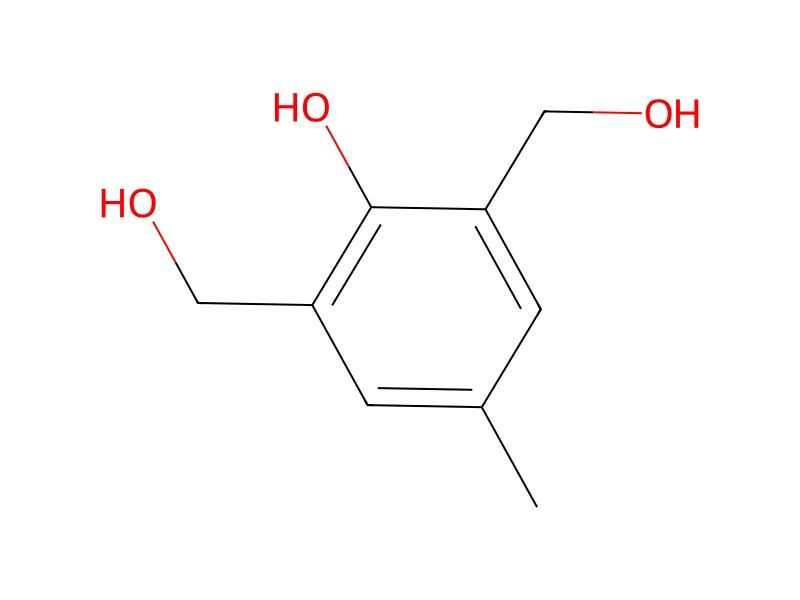
2-히드록시-5-메틸-1,3-벤젠디메탄올
2,6-Dimethylol-p-cresol
데이터를 보충하는 중입니다. 잠시 후 페이지를 새로 고치면 최신 내용을 볼 수 있습니다
기본 정보
- CAS
91-04-3- 표준 SMILES
Cc1cc(CO)c(O)c(CO)c1- InChIKey
KUMMBDBTERQYCG-UHFFFAOYSA-N- 분자식
- C9H12O3
- 평균 분자량
- 168.19 g/mol
- 단동위원소 질량
- 168.07864424
이름 및 식별자
- 우선 이름
- 2,6-Dimethylol-p-cresol
- IUPAC
- 2,6-bis(hydroxymethyl)-4-methylphenol
- 현지명
- 2-히드록시-5-메틸-1,3-벤젠디메탄올
- 영어명
- 2,6-Bis(hydroxymethyl)-p-cresol
- 분자식
- C9H12O3
- 분자량
- 168.19
이름 및 동의어
2,6-Bis(hydroxymethyl)-p-cresol91-04-32,6-Bis(hydroxymethyl)-4-methylphenol2,6-Dimethylol-p-cresol2-Hydroxy-5-methyl-1,3-benzenedimethanol1,3-BENZENEDIMETHANOL, 2-HYDROXY-5-METHYL-2,6-Dimethylol-4-methylphenol2,6-Di(hydroxymethyl)-p-cresolNSC 15838alpha1,alpha,2-TrihydroxymesityleneEINECS 202-036-4BRN 1240237
이름 더 보기
2-하이드록시-5-메틸-1,3-벤젠디메탄올2-히드록시-5-메틸-1,3-벤젠디메탄올2,6-비스(하이드록시메틸)-p-크레졸(2-Hydroxy-5-Methyl-1,3-phenylene)diMethanol2,6-BIS(HYDROXYMETHYL)-4-CRESOL3,5-bis(hydroxymethyl)-p-cresolAKOS BC-1882AKOS BBS-00000256RARECHEM AL BD 0246
Q99HT08S5NDML-PC.alpha.1,.alpha.3-Mesitylenediol, 2-hydroxy-NSC-1583826DMPCalpha(sup 1),alpha(sup 3),2-Trihydroxymesitylenealpha1,alpha3-Mesitylenediol, 2-hydroxy-DTXSID2059017
데이터베이스 식별자
- CAS
91-04-3- PubChem CID
- 7039
- DTXSID
DTXSID2059017- UNII
- Q99HT08S5N
- EC Number
- 202-036-4
- Nikkaji
- J182.075C
물성
구조 계산 물성보충 중
- XLogP
- 0.7
- 극성 표면적
- 60.7 Ų
- 수소 결합 공여자 수
- 3
- 수소 결합 수용자 수
- 3
- 회전 가능 결합 수
- 2
- 무거운 원자 수
- 12
- 형식 전하
- 0
- 복잡도
- 124
실험 및 물리화학적 성질
SpringerMaterials PropertiesChemical shift
물리화학적 성질
- 녹는점
- 128 · 128-130 °C(lit.)
- 끓는 점
- 237.12 °C · 237.12°C (rough estimate)
- 밀도
- 1.0812 · 1.0812 (rough estimate)
- 증기 밀도
- 5.8 · 5.8 (vs air)
- 굴절률
- 1.4371 · 1.4371 (estimate)
- 저장 조건
- Sealed in dry,Room Temperature
- 용해도
- very faint turbidity in THF
- 물리적 상태
- powder to crystal
- 산도 계수 (pKa)
- 10.2 · 10.20±0.23(Predicted)
- 색상
- 흰색에서 노란색, 주황색으로
- BRN
- 1240237 · 1240237
- InChI
- InChI=1S/C9H12O3/c1-6-2-7(4-10)9(12)8(3-6)5-11/h2-3,10-12H,4-5H2,1H3
- InChIKey
- KUMMBDBTERQYCG-UHFFFAOYSA-N
- SMILES
- C1(CO)=CC(C)=CC(CO)=C1O
- NIST
- 1 · A1,a3-mesityllenediol, 2-hydroxy-(91-04-3)
안전 및 규제
안전 정보는 참고용이며, 공급업체의 물질안전보건자료(SDS), 관련 법규 및 전문가 평가를 대체하지 않습니다.
GHS 분류
GHS Classification
This chemical does not meet GHS hazard criteria for 2.1% (1 of 47) of reports.
Warning
H315 (97.9%): Causes skin irritation [Warning Skin corrosion/irritation]
P261, P264, P264+P265, P271, P280, P302+P352, P304+P340, P305+P351+P338, P319, P321, P332+P317, P337+P317, P362+P364, P403+P233, P405, and P501 (click each P-code to see the statement)
Aggregated GHS information provided per 47 reports by companies from 6 notifications to the ECHA C&L Inventory. Each notification may be associated with multiple companies.
유해성 정보
Regulatory InformationChemical: 1,3-Benzenedimethanol, 2-hydroxy-5-methyl-
Hazard Classes and CategoriesSkin Irrit. 2 (97.9%)
안전 데이터
- wgk
- 3
- tsca
- TSCA listed
- rtecs
- CZ6440000
- HS 번호
- 29072990
- risk_code
- 36/37/38
- hazard_code
- Xi
- safety_code
- 26-37/39
- 기존화학 물질
- KE-05-0216
- 위험 참고 사항
- Irritant
- Hazard Classifications
- Eye Irrit. 2Skin Irrit. 2STOT SE 3
- 스토리지 클래스
- 11 - Combustible Solids
화학 및 산업
용도 및 제조
General Manufacturing Information1,3-Benzenedimethanol, 2-hydroxy-5-methyl-: ACTIVE
응용 분야
용도2,6-Bis(hydroxymethyl)-p-cresol was used as a bridging ligand in binuclear oxovanadium(V) compound, which on exposure to white light and aerial oxygen forms an oligomeric compound.
제조 방법
The synthesis method for 2,6-Bis(hydroxymethyl)-p-cresol is as follows:Aqueous formaldehyde (21.5 g, 37%) is added to a solution of p-cresol (10.8 g, 0.1 mol) and NaOH (5.0 g) in HO (20 mL).The mixture is stirred at room temperature for 24 hours.The mixture is filtered and washed with saturated aqueous NaCl (100 mL).The resulting salt is dissolved in water (400 mL) and neutralized with acetic acid.Pale pink crystals are obtained and filtered.The crystals are washed with H2O and dissolved in hot ethyl acetate (40 mL).The solution is dried over Na2SO4 and filtered while still hot.The solution is concentrated to 27 mL and recrystallized overnight.The product crystals are filtered and washed with cold ethyl acetate.The crystals are air dried.
상·하류 제품 정보
상류 원료
하류 제품
관련 반응
45건


화합물 노트
불러오는 중…