
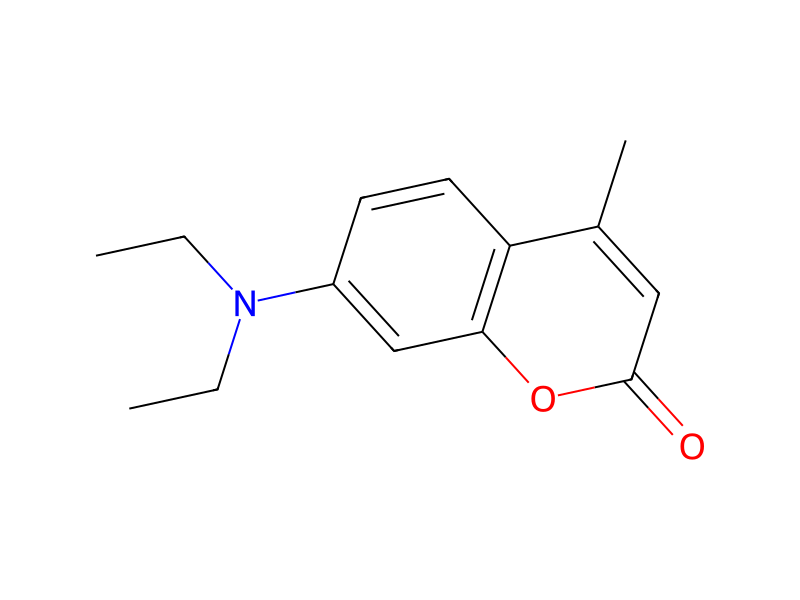
기본 정보
- 표준 SMILES
CCN(CC)c1ccc2c(C)cc(=O)oc2c1- InChIKey
AFYCEAFSNDLKSX-UHFFFAOYSA-N- 분자식
- C14H17NO2
- 평균 분자량
- 231.29 g/mol
- 단동위원소 질량
- 231.12592878
개요
7-diethylamino-4-methylcoumarin is a light tan grains. Gives bright blue-white fluorescence in very dilute solutions. (NTP, 1992)
이름 및 식별자
- 우선 이름
- 4-Methyl-7-diethylaminocoumarin
- IUPAC
- 7-(diethylamino)-4-methylchromen-2-one
- 현지명
- 쿠마린 1
- 영어명
- 7-Diethylamino-4-methylcoumarin
- 분자식
- C14H17NO2
- 분자량
- 231.29
이름 및 동의어
4-Methyl-7-diethylaminocoumarinRefChem:5463187-DIETHYLAMINO-4-METHYLCOUMARIN91-44-1Coumarin 17-(Diethylamino)-4-methyl-2H-chromen-2-oneCoumarin 47Coumarin 4607-(Diethylamino)-4-methylcoumarin4-Methyl-7-(diethylamino)coumarin2H-1-Benzopyran-2-one, 7-(diethylamino)-4-methyl-Calcofluor White SD
이름 더 보기
쿠마린1쿠마린1다이에틸아미노메틸쿠마린7-디에틸아미노-4-메틸쿠마린Fluorescent Brightener 140blancophorffgFluorescent Brightener 52hakkolpcoumarin460
Blancophor AWBlancophor FFGHakkol PUvitex WGSMDAC)DiethylaminomethylcoumarinCalcofluor White RWCoumarin, 7-(diethylamino)-4-methyl-
데이터베이스 식별자
- CAS
61968-71-6、91-44-1- PubChem CID
- 7050
- DTXSID
DTXSID9025035- ChEMBL
CHEMBL315348- ChEBI
CHEBI:51938- UNII
- 1SFJ7F6R2C
- EC Number
- 202-068-9、612-902-7
- Nikkaji
- J48.490C
물성
구조 계산 물성
- XLogP
- 3.1
- 극성 표면적
- 29.5 Ų
- 수소 결합 공여자 수
- 0
- 수소 결합 수용자 수
- 3
- 회전 가능 결합 수
- 3
- 무거운 원자 수
- 17
- 형식 전하
- 0
- 복잡도
- 320
실험 및 물리화학적 성질
Chemical ClassesDyes -> Coumarin Dyes
CosmeticsStabilizing
SpringerMaterials PropertiesAngular frequency
Color/Form
CRYSTALS FROM ALCOHOL & BENZENE-PETROLEUM ETHER
GRANULAR; LIGHT-TAN COLOR
Solubility
Slightly soluble in hot solvent (NTP, 1992)
SLIGHTLY SOL IN HOT WATER; SOL IN ALC, ETHER, ACETONE, ORDINARY ORGANIC SOLVENTS
SOL IN AQ ACID SOLN, RESINS, VARNISHES, VINYLS; SLIGHTLY SOL IN ALIPHATIC HYDROCARBONS
Melting Point
154 to 162 °F (NTP, 1992)
89 °C
Physical Description
7-diethylamino-4-methylcoumarin is a light tan grains. Gives bright blue-white fluorescence in very dilute solutions. (NTP, 1992)
Light-tan solid; [HSDB] Solution has bright blue-white fluorescence if very dilute; [CAMEO] Pale yellow crystalline powder; [Alfa Aesar MSDS]
Collision Cross Section176.4 Ų [M+Na]+ [CCS Type: DT; Buffer gas: N2; Ionization: ESI+; Dataset: TOXCAST; Source Identifier: DTXSID9025035]
물리화학적 성질
- 녹는점
- 72 · 72-75 °C (lit.)
- 끓는 점
- 240 °C · 240 °C / 6.5mmHg
- 밀도
- 1.122 · 1.122
- 증기압
- 0 · 0-0.003Pa at 20-25℃
- 굴절률
- 1.53 · 1.5300 (estimate)
- 인화점
- 152 °C · 152°C
- 저장 조건
- Sealed in dry,Room Temperature
- 용해도
- 클로로포름(약간 용해됨), 메탄올(약간 용해됨)
- 산도 계수 (pKa)
- 3.51 · 3.51±0.20(Predicted)
- 물리적 상태
- 결정성 분말
- 색상
- 연한 베이지부터 연한 보라색까지
- 수용성
- 약간 용해됨
- BRN
- 193303 · 193303
- 안정성
- 안정적인. 강한 산화제와 호환되지 않습니다.
- 화장품 원료 기능
- 광안정기
- InChI
- 1S/C14H17NO2/c1-4-15(5-2)11-6-7-12-10(3)8-14(16)17-13(12)9-11/h6-9H,4-5H2,1-3H3
- InChIKey
- AFYCEAFSNDLKSX-UHFFFAOYSA-N
- SMILES
- CCN(CC)c1ccc2C(C)=CC(=O)Oc2c1
- LogP
- 2.523 · 2.523-2.8 at 23-25℃
- NIST
- 7 · Coumarin, 7-(diethylamino)-4-methyl-(91-44-1)
- EPA
- 7 · 7-Diethylamino-4-methylcoumarin (91-44-1)
화학적 성질
light tan powder
안전 및 규제
GHS 분류
GHS Classification
This chemical does not meet GHS hazard criteria for 28.7% (222 of 773) of reports.
Warning
H312 (60.2%): Harmful in contact with skin [Warning Acute toxicity, dermal]
P261, P264, P264+P265, P271, P280, P302+P352, P304+P340, P305+P351+P338, P317, P319, P321, P332+P317, P337+P317, P362+P364, P403+P233, P405, and P501 (click each P-code to see the statement)
Aggregated GHS information provided per 773 reports by companies from 19 notifications to the ECHA C&L Inventory. Each notification may be associated with multiple companies.
유해성 정보
Regulatory Information
Chemical: 2H-1-Benzopyran-2-one, 7-(diethylamino)-4-methyl-
Status: Active Update: 28-01-2021 https://echa.europa.eu/registration-dossier/-/registered-dossier/18846
2H-1-Benzopyran-2-one, 7-(diethylamino)-4-methyl-: Does not have an individual approval but may be used under an appropriate group standard
Other Safety InformationIMAP assessments - Coumarins: Human health tier II assessment
Hazards SummaryEmergency treatment: Irritants; [HSDB] Causes somnolence and ataxia in oral lethal-dose studies of mice; [RTECS] A skin and strong eye irritant; [Alfa Aesar MSDS] See Coumarin.
Reactive GroupAmines, Phosphines, and Pyridines
Special Reports
TOXICOLOGICAL REVIEW OF PHOTOTOXICITY, DERMAL & MEMBRANE IRRITATION CAUSED BY COUMARIN.[GLOXHUBER C, BLOCHING H; TOXICOLOGIC PROPERTIES OF FLUORESCENT WHITENING AGENTS; WINEK CL & SHANOR SP (ED), TOXICOLOGY ANNUAL, VOL 3. NY: MARCEL DEKKER, INC, 1979, PP 171-203]
Reactivity Profile
7-DIETHYLAMINO-4-METHYLCOUMARIN is a lactone (behaves as an ester) and an amine. Amines are chemical bases. They neutralize acids to form salts plus water. These acid-base reactions are exothermic. The amount of heat that is evolved per mole of amine in a neutralization is largely independent of the strength of the amine as a base. Amines may be incompatible with isocyanates, halogenated organics, peroxides, phenols (acidic), epoxides, anhydrides, and acid halides. Flammable gaseous hydrogen is generated by amines in combination with strong reducing agents, such as hydrides.
Air and Water ReactionsNo rapid reaction with air. No rapid reaction with water.
Hazard Classes and CategoriesAcute Tox. 4 (60.2%)
안전 및 보호
First Aid
EYES: First check the victim for contact lenses and remove if present. Flush victim's eyes with water or normal saline solution for 20 to 30 minutes while simultaneously calling a hospital or poison control center. Do not put any ointments, oils, or medication in the victim's eyes without specific instructions from a physician. IMMEDIATELY transport the victim after flushing eyes to a hospital even if no symptoms (such as redness or irritation) develop.
Nonfire Spill Response
SMALL SPILLS AND LEAKAGE: Should a spill occur while you are handling this chemical, FIRST REMOVE ALL SOURCES OF IGNITION, then you should dampen the solid spill material with ethanol and transfer the dampened material to a suitable container. Use absorbent paper dampened with ethanol to pick up any remaining material. Seal the absorbent paper, and any of your clothes, which may be contaminated, in a vapor-tight plastic bag for eventual disposal. Solvent wash all contaminated surfaces with ethanol followed by washing with a soap and water solution. Do not reenter the contaminated area until the Safety Officer (or other responsible person) has verified that the area has been properly cleaned.
Personal Protective Equipment (PPE)
RECOMMENDED RESPIRATOR: Where the neat test chemical is weighed and diluted, wear a NIOSH-approved half face respirator equipped with an organic vapor/acid gas cartridge (specific for organic vapors, HCl, acid gas and SO2) with a dust/mist filter. (NTP, 1992)
안전 데이터
- wgk
- 2
- tsca
- TSCA listed
- rtecs
- GN6370000
- 독성
- LD50 oral in rat: 5gm/kg
- HS 번호
- 29322090
- risk_code
- 36/37/38-20/21
- hazard_code
- Xn
- safety_code
- 37/39-26
- 기존화학 물질
- KE-10410
- 스토리지 클래스
- 11 - Combustible Solids
- 유해 물질 데이터
- 91-44-1(Hazardous Substances Data)
화학 및 산업
용도 및 제조
Uses
Used as an optical brightener (textile, detergent, plastics, and varnish/lacquer industries) and as an invisible marking agent; Also used in coatings (paper, labels, and book covers) and as a laser dye; [HSDB] Coumarins are used as fluorescent dyes and also as laser dyes. Fluorescent dyes not only absorb light; they also emit light to produce very bright colors. They are used to dye textile fibers, plastics, inks, and to make pigments for paints and lacquers. [Ullmann: Laser Dyes; Fluorescent Dyes; Disperse Dyes]
Pulp and Paper Processing [Category: Industry]
OPTICAL BLEACH IN TEXTILE INDUSTRY; IN COATINGS FOR PAPER, LABELS, BOOK COVERS, ETC; INVISIBLE MARKING AGENT; TO LIGHTEN PLASTICS, RESINS, VARNISHES & LACQUERS
OPTICAL BRIGHTENER IN TEXTILE AND DETERGENT INDUSTRIES; LASER DYE
U.S. Exports
(1977) No Data
(1979) No Data
U.S. Imports
(1977) 4.99X10+4 GRAMS (PRINCPL CUSTMS DISTS)
(1979) No Data
U.S. Production
(1977) PROBABLY GREATER THAN 2.27X10+6 GRAMS
(1979) PROBABLY GREATER THAN 2.27X10+6 GRAMS
Methods of ManufacturingREACTION OF M-DIETHYLAMINOPHENOL WITH ETHYL ACETOACETATE
Household ProductsInformation on 3 consumer products that contain Diethylaminomethylcoumarin in the following categories is provided:
Use ClassificationCosmetics -> Stabilizing
General Manufacturing Information2H-1-Benzopyran-2-one, 7-(diethylamino)-4-methyl-: ACTIVE
응용 분야
용도Optical bleach in textile industry, in coatings for paper, labels, book covers, etc.; to lighten plastics, resins, varnishes, and lacquers; invisible marking agent.
일반 설명Light tan grains. Gives bright blue-white fluorescence in very dilute solutions.
상·하류 제품 정보
상류 원료
하류 제품
공급사8 곳
Dayang Chem (Hangzhou) Co.,Ltd.+86-0571-88938639 17705817739 · [email protected]
杭州洁汉化工有限公司+86-571-86217390; +8618058761490 · [email protected]
湖北达豪化工有限公司027-027-59106191 13986034860 · [email protected]
爆牛贸易重庆有限公司+86-023-6139-8061 +86-86-13650506873 · [email protected]
广州市海珠区正鸿商行020-82550624 13016020539 · [email protected]
AFINE CHEMICALS LIMITED+86-571-85134551 +86-18958018566 · [email protected]
湖北鑫红利化工有限公司027-027-59106151 15172325309 · [email protected]
Dideu Industries Group Limited+8617392712697 · [email protected]
관련 반응
5건


연결된 노트
불러오는 중…