
디피바로일메탄
2,2,6,6-Tetramethyl-3,5-heptanedione
데이터를 보충하는 중입니다. 잠시 후 페이지를 새로 고치면 최신 내용을 볼 수 있습니다
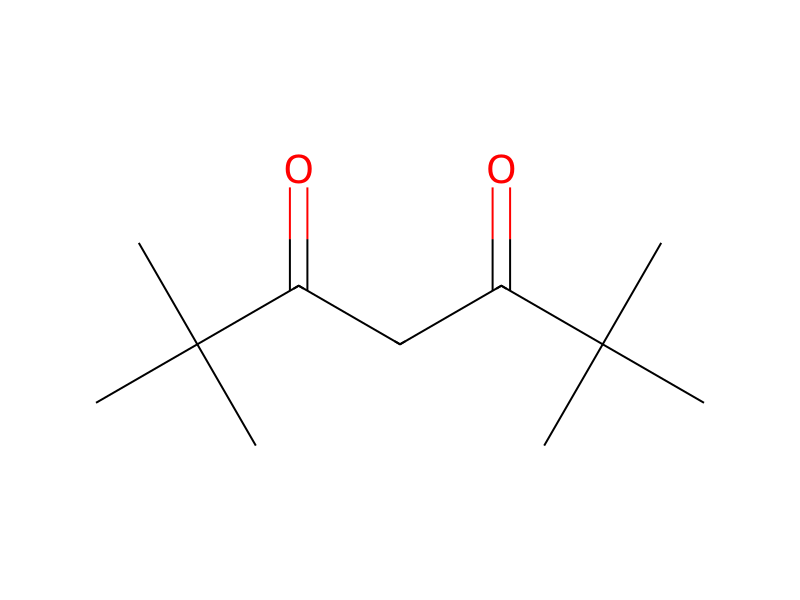
기본 정보
- CAS
1118-71-4- 표준 SMILES
CC(C)(C)C(=O)CC(=O)C(C)(C)C- InChIKey
YRAJNWYBUCUFBD-UHFFFAOYSA-N- 분자식
- C11H20O2
- 평균 분자량
- 184.27 g/mol
- 단동위원소 질량
- 184.14632988
이름 및 식별자
- 우선 이름
- 2,2,6,6-Tetramethyl-3,5-heptanedione
- IUPAC
- 2,2,6,6-tetramethylheptane-3,5-dione
- 현지명
- 디피바로일메탄
- 영어명
- 2,2,6,6-Tetramethyl-3,5-heptanedione
- 분자식
- C11H20O2
- 분자량
- 184.28
이름 및 동의어
1118-71-4Dipivaloylmethane2,2,6,6-Tetramethyl-3,5-heptanedione3,5-Heptanedione, 2,2,6,6-tetramethyl-DTXSID7049396R8UI909HOYNSC-1742962,2,6,6,-tetramethyl-3,5-heptanedioneDTXCID4029355RefChem:134758214-268-32,2,6,6-Tetramethylheptane-3,5-dione
이름 더 보기
2,2,6,6-테트라메틸-3,5-헵테인다이온디피바로일메탄2,2,6,6-테트라메틸-3,5-헵탄디온2,2,6,6-Tetramethyl heptanedione2,2,6,6-Tetramethyl-3,5-heptadionebutan-1-ol,propan-2-ol,titaniumdpm-h5-heptanedione6-Tetramethyl-3
MFCD000088482,2,6,6-tetramethyl-heptane-3,5-dioneUNII-R8UI909HOY1,3-Di-tert-butyl-1,3-propanedione; Dipivaloylmethane; NSC 174296dipivaloyl methaneEINECS 214-268-3TMHDNSC 174296
데이터베이스 식별자
- CAS
1118-71-4- PubChem CID
- 70700
- DTXSID
DTXSID7049396- ChEMBL
CHEMBL3186481- UNII
- R8UI909HOY
- EC Number
- 214-268-3
- Nikkaji
- J4.487C
물성
구조 계산 물성보충 중
- XLogP
- 2.6
- 극성 표면적
- 34.1 Ų
- 수소 결합 공여자 수
- 0
- 수소 결합 수용자 수
- 2
- 회전 가능 결합 수
- 4
- 무거운 원자 수
- 13
- 형식 전하
- 0
- 복잡도
- 189
물리화학적 성질
- 녹는점
- 19 °C · 19 °C
- 끓는 점
- 80 °C/12 · 80 °C/12 mmHg
- 밀도
- 0.9 · 0.90
- 굴절률
- 1.46 · 1.46
- 인화점
- 67 °C · 67 °C
- 저장 조건
- Sealed in dry,Room Temperature
- 용해도
- 혼합하기가 어렵습니다.
- 산도 계수 (pKa)
- 11.6 · 11.60±0.10(Predicted)
- 물리적 상태
- clear liquid
- 색상
- Colorless to Light yellow
- Specific Gravity
- 0.883 · 0.883
- BRN
- 1447269 · 1447269
- InChI
- 1S/C11H20O2/c1-10(2,3)8(12)7-9(13)11(4,5)6/h7H2,1-6H3
- InChIKey
- YRAJNWYBUCUFBD-UHFFFAOYSA-N
- SMILES
- CC(C)(C)C(=O)CC(=O)C(C)(C)C
- LogP
- 2.818 · 2.818 (est)
- EPA
- 3 · 3,5-Heptanedione, 2,2,6,6-tetramethyl- (1118-71-4)
화학적 성질
안전 및 규제
안전 정보는 참고용이며, 공급업체의 물질안전보건자료(SDS), 관련 법규 및 전문가 평가를 대체하지 않습니다.
안전 데이터
- wgk
- 3
- tsca
- TSCA listed
- ridadr
- UN 1993 / PGIII
- HS 번호
- 2914190090
- risk_code
- 22-40-36/37/38
- hazard_code
- Xn
- safety_code
- 24/25-36-26-22
- 기존화학 물질
- KE-33594
- 스토리지 클래스
- 10 - Combustible liquids
화학 및 산업
응용 분야
용도2,2,6,6-tetramethyl-3,5-heptanedione was used in the synthesis of α-aryl-β-diketones1 and dicyanamidobenzene-bridge diruthenium complex.
일반 설명Acylation, a replacement to silylation, allows the conversion of compounds that consist of active hydrogens (-OH, -SH and -NH) into esters, thioesters, and amides via the action of a carboxylic acid or derivative. The carbonyl group adjacent to the halogenated carbons is known to improve the electron capture detector (ECD) response. Acylation has several advantages:It enhances the stability of compounds by protecting unstable groups.It may confer volatility on substances like carbohydrates or amino acids, that have several polar groups that they are non-volatile and usually decompose on heating.It facilitates the separations not possible with underivatized compounds.Compounds are detectable at very low levels with an ECD.2,2,6,6-Tetramethyl-3,5-heptanedione is a reagent used to form fragmentation-directing derivatives for GC/MS analysis.
상·하류 제품 정보
상류 원료
관련 반응
350건


화합물 노트
불러오는 중…