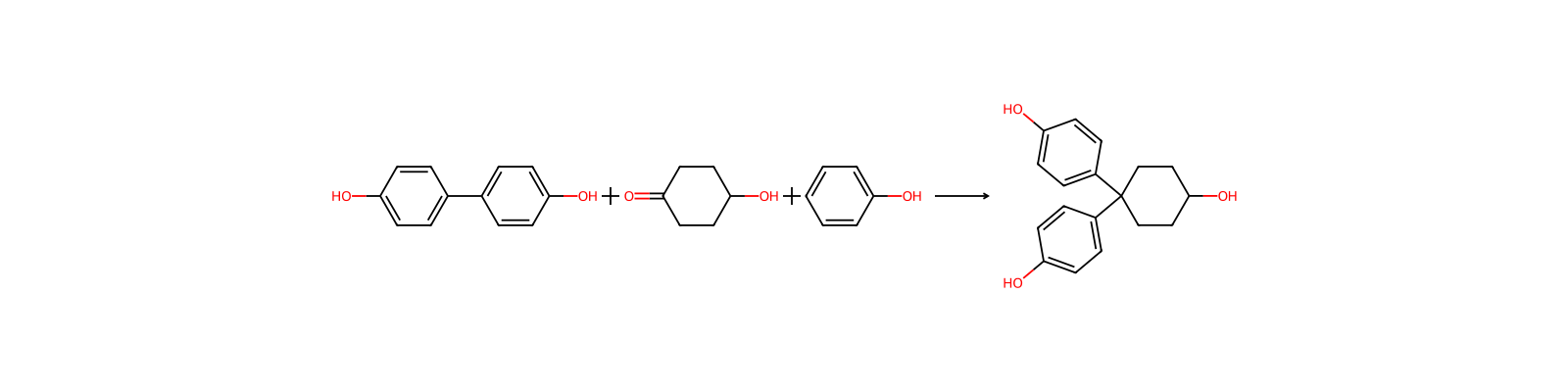
4-4'-다이하이드록시디페닐
4,4'-Dihydroxybiphenyl
데이터를 보충하는 중입니다. 잠시 후 페이지를 새로 고치면 최신 내용을 볼 수 있습니다

기본 정보
- CAS
92-88-6- 표준 SMILES
Oc1ccc(-c2ccc(O)cc2)cc1- InChIKey
VCCBEIPGXKNHFW-UHFFFAOYSA-N- 분자식
- C12H10O2
- 평균 분자량
- 186.21 g/mol
- 단동위원소 질량
- 186.06807956
이름 및 식별자
- 우선 이름
- 4,4'-Dihydroxybiphenyl
- IUPAC
- 4-(4-hydroxyphenyl)phenol
- 현지명
- 4-4'-다이하이드록시디페닐
- 영어명
- 4,4'-Biphenol
- 분자식
- C12H10O2
- 분자량
- 186.21
이름 및 동의어
4,4'-Dihydroxybiphenyl92-88-64,4'-BIPHENOL4,4'-Biphenyldiol[1,1'-Biphenyl]-4,4'-diolBiphenyl-4,4'-diolp,p'-Biphenolp,p'-Diphenol4,4'-dihydroxydiphenylAntioxidant DOD4,4'-Dioxydiphenyl4,4'-Bisphenol
이름 더 보기
4-4'-다이하이드록시디페닐[1,1'-바이페닐]-4,4'-디올4,4'-다이하이드록시다이페닐4,4'-비페놀PPDPBIPHENOLDOD(1R,2R)-Cyclohexane-1,2-diolBIPHENOL SUBL5
p,p'-DihydroxybiphenylASM DOD(1,1'-Biphenyl)-4,4'-diolDihydroxybiphenylDTXSID1029120NSC-8711DTXCID709120GM-W06
데이터베이스 식별자
- CAS
92-88-6- PubChem CID
- 7112
- DTXSID
DTXSID1029120- ChEMBL
CHEMBL76398- ChEBI
CHEBI:34367- UNII
- R8994A0904
- EC Number
- 202-200-5
- Nikkaji
- J45.978J
물성
구조 계산 물성보충 중
- XLogP
- 3.6
- 극성 표면적
- 40.5 Ų
- 수소 결합 공여자 수
- 2
- 수소 결합 수용자 수
- 2
- 회전 가능 결합 수
- 1
- 무거운 원자 수
- 14
- 형식 전하
- 0
- 복잡도
- 145
실험 및 물리화학적 성질
Vapor Pressure0.00000079 [mmHg]
Physical Description
Dry Powder; Other Solid
Off-white, light beige, or light gray odorless powder; [Acros Organics MSDS]
Kovats Retention Index
1979
2046
물리화학적 성질
- 녹는점
- 280 · 280-282 °C(lit.)
- 끓는 점
- 280.69 °C · 280.69°C (rough estimate)
- 밀도
- 1.22 · 1.22
- 증기압
- 0 Pa · 0Pa at 25℃
- 굴절률
- 1.601 · 1.6010 (estimate)
- 저장 조건
- Sealed in dry,Room Temperature
- 산도 계수 (pKa)
- 9.74 · 9.74±0.26(Predicted)
- 물리적 상태
- 가루
- 색상
- 미색에서 밝은 베이지 또는 밝은 회색까지
- 수용성
- 난용성
- BRN
- 1908886 · 1908886
- 화장품 원료 기능
- 피부의 멜라닌 생성을 줄입니다피부 보호
안전 및 규제
안전 정보는 참고용이며, 공급업체의 물질안전보건자료(SDS), 관련 법규 및 전문가 평가를 대체하지 않습니다.
GHS 분류
GHS Classification
This chemical does not meet GHS hazard criteria for 0.5% (1 of 211) of reports.
Warning
H312 (44.1%): Harmful in contact with skin [Warning Acute toxicity, dermal];H315 (26.1%): Causes skin irritation [Warning Skin corrosion/irritation];H317 (55.9%): May cause an allergic skin reaction [Warning Sensitization, Skin];H319 (25.6%): Causes serious eye irritation [Warning Serious eye damage/eye irritation];H335 (25.1%): May cause respiratory irritation [Warning Specific target organ toxicity, single exposure; Respiratory tract irritation];H411 (18.5%): Toxic to aquatic life with long lasting effects [Hazardous to the aquatic environment, long-term hazard];H412 (55.5%): Harmful to aquatic life with long lasting effects [Hazardous to the aquatic environment, long-term hazard]
P261, P264, P264+P265, P271, P272, P273, P280, P302+P352, P304+P340, P305+P351+P338, P317, P319, P321, P332+P317, P333+P317, P337+P317, P362+P364, P391, P403+P233, P405, and P501 (click each P-code to see the statement)
Aggregated GHS information provided per 211 reports by companies from 15 notifications to the ECHA C&L Inventory. Each notification may be associated with multiple companies.;Reported as not meeting GHS hazard criteria per 1 of 211 reports by companies.;There are 14 notifications provided by 210 of 211 reports by companies with hazard statement code(s).;Information may vary between notifications depending on impurities, additives, and other factors. The percentage value in parenthesis indicates the notified classification ratio from companies that provide hazard codes. Only hazard codes with percentage values above 10% are shown. For more detailed information, please visit ECHA C&L website.
유해성 정보
Regulatory Information
Chemical: [1,1'-Biphenyl]-4,4'-diol
[1,1'-Biphenyl]-4,4'-diol is listed on the EPA's Chemical Data Reporting (CDR) system. Manufacturers and importers of [1,1'-Biphenyl]-4,4'-diol are required to report information about their production and use of this chemical to the EPA under the Toxic Substances Control Act (TSCA). (40 eCFR Part 711)
Status: Active Update: 30-03-2023 https://echa.europa.eu/registration-dossier/-/registered-dossier/15910;Status: Active Update: 07-03-2018 https://echa.europa.eu/registration-dossier/-/registered-dossier/22776
화학 및 산업
용도 및 제조
UsesUsed to make plastics and as a laboratory reagent; [ECHA REACH Registrations]
U.S. Production2023: 10,000,000 - <25,000,000 lb;2022: 10,000,000 - <25,000,000 lb;2021: 10,000,000 - <25,000,000 lb;2020: 10,000,000 - <25,000,000 lb
Consumer UsesMonomers
Industry UsesMonomers;Intermediate
General Manufacturing Information
All Other Chemical Product and Preparation Manufacturing;Plastics Material and Resin Manufacturing
[1,1'-Biphenyl]-4,4'-diol: ACTIVE
응용 분야
용도4,4'-biphenol be used intermediate liquid crystal polymers raw materials. Synthetic polymers, due to its excellent heat resistance, it is used as polyester, urethane modified monomer, polycarbonate, polysulfone, and epoxy resin, for the manufacture of an excellent engineering plastics and composite materials. Antioxidant antioxidants for rubber and plastics. Dye intermediates or petroleum products stabilizer.
제조 방법
생산 방법4,4'-Biphenol can be synthesized in excellent yields by debutylation of 3,3',5,5'-tetra-tert-butyl-4,4'-dihydroxybiphenyl. Other production processes are the alkaline fusion of 4,4'-biphenyldisulfonic acid, the boil down of benzidinebisdiazonium salts, and the decarboxylation of 4,4'-dihydroxybiphenyl-2-carboxylic acid. Symmetrically alkylated 4,4'-dihydroxybiphenyls such as 4,4'-dihydroxy-2,2',3,3',5,5',6,6'-hexamethylbiphenyl are preferably obtained by the oxidative coupling of the corresponding substituted monophenols. Here, diphenoquinones are generally formed in the first step which must be reduced. Phenol itself always gives isomeric mixtures of dihydroxybiphenyls on coupling with various oxidants. These mixtures are also formed by alkaline fusion of 4,4'-dihydroxybiphenylsulfone.
관련 반응
112건


화합물 노트
불러오는 중…