
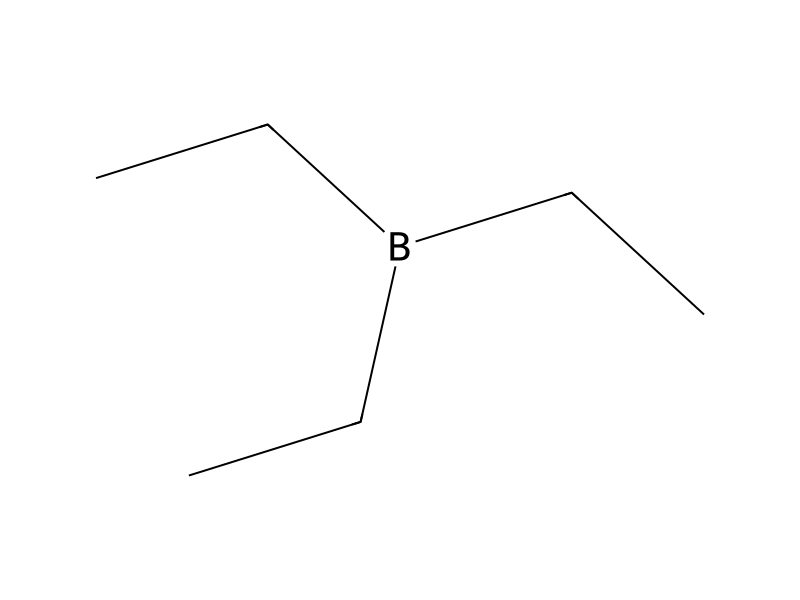
기본 정보
- 표준 SMILES
CCB(CC)CC- InChIKey
LALRXNPLTWZJIJ-UHFFFAOYSA-N- 분자식
- C6H15B
- 평균 분자량
- 98 g/mol
- 단동위원소 질량
- 98.12668088
개요
used in the radical deuteration reaction of ribonucleoside derivatives
이름 및 식별자
- 우선 이름
- Triethylborane
- IUPAC
- triethylborane
- 현지명
- 트리에틸보란
- 영어명
- Triethylborane
- 분자식
- C6H15B
- 분자량
- 97.99
이름 및 동의어
Triethylborane97-94-9TRIETHYLBORONBorane, triethyl-TriethylborineBoron triethylBoron ethylZ3S980Z4P3DTXSID2052653RefChem:191525DTXCID9031226202-620-9
이름 더 보기
트리에틸보란트리에틸붕소(C2H5)3BBorethylTriethylbotriethyl-boranborane,triethyl-
HSDB 897EINECS 202-620-9UNII-Z3S980Z4P3BRN 1731462BEt3Et3BTriethylborane (1.0 M in THF)4-04-00-04359 (Beilstein Handbook Reference)
데이터베이스 식별자
- CAS
97-94-9- PubChem CID
- 7357
- DTXSID
DTXSID2052653- UNII
- Z3S980Z4P3
- EC Number
- 202-620-9
- Nikkaji
- J55.478B
물성
구조 계산 물성
- 극성 표면적
- 0 Ų
- 수소 결합 공여자 수
- 0
- 수소 결합 수용자 수
- 0
- 회전 가능 결합 수
- 3
- 무거운 원자 수
- 7
- 형식 전하
- 0
- 복잡도
- 25.7
실험 및 물리화학적 성질
Chemical ClassesMetals -> Metalloid Compounds (Boron)
Density0.70 g/cu cm at 23 °C
Color/Form
Colorless liquid
Colorless fuming liquid
Solubility
Soluble in alcohol, ether
Miscible with most organic solvents; immiscible with water
Flash Point-33 °F (-36 dec C) (open cup) /table/
Boiling Point95 °C
DecompositionWhen heated to decomposition or upon contact with air it emits toxic acrid smoke and irritating fumes.
Melting Point-93 °C
Vapor Pressure
53.0 [mmHg]
53 mm Hg at 25 °C /est/
Refractive IndexIndex of refraction: 1.3971
Heat of Combustion20,000 BTU/LB
Physical DescriptionColorless liquid; [Merck Index]
물리화학적 성질
- 녹는점
- -92 °C · -92°C
- 끓는 점
- 95 °C · 95°C
- 밀도
- 0.865 g/mL · 0.865 g/mL at 25 °C
- 증기압
- 67 hPa · 67hPa at 25℃
- 굴절률
- 20 · n20/D 1.380
- 인화점
- 1 °F · 1 °F
- 저장 조건
- 0 · 0-6°C
- 물리적 상태
- 액체
- 색상
- 무색~연한 호박색
- 수용성
- 물에서 분해되다
- 비열
- 2.46 J/ · Cp(liquid): 2.46 J/(g·K), at 25℃
- Merck
- 14 · 14,9668
- BRN
- 1731462 · 1731462
- InChI
- 1S/C6H15B/c1-4-7(5-2)6-3/h4-6H2,1-3H3
- InChIKey
- LALRXNPLTWZJIJ-UHFFFAOYSA-N
- SMILES
- CCB(CC)CC
- NIST
- Borane, triethyl-(97-94-9)
- EPA
- Borane, triethyl- (97-94-9)
화학적 성질
Clear colourless to light amber solution. Miscible with most organic solvents; immiscible with water.
안전 및 규제
GHS 분류
GHS Classification
Danger
H225 (16.4%): Highly Flammable liquid and vapor [Danger Flammable liquids]
P203, P210, P222, P231, P233, P240, P241, P242, P243, P260, P264, P264+P265, P270, P271, P280, P284, P301+P316, P301+P330+P331, P302+P335+P334, P302+P361+P354, P303+P361+P353, P304+P340, P305+P354+P338, P316, P317, P318, P320, P321, P330, P363, P370+P378, P403+P233, P403+P235, P405, and P501 (click each P-code to see the statement)
Aggregated GHS information provided per 256 reports by companies from 10 notifications to the ECHA C&L Inventory. Each notification may be associated with multiple companies.
Danger
H225: Highly Flammable liquid and vapor [Danger Flammable liquids]
유해성 정보
Regulatory Information
Chemical: Borane, triethyl-
Status: Active Update: 19-08-2021 https://echa.europa.eu/registration-dossier/-/registered-dossier/19345
Borane, triethyl-: HSNO Approval: HSR001432 Approved with controls
Fire PotentialSpontaneously flammable in air
Hazards Summary
Highly irritating; Animals exposed to high inhalation dose have lung irritation and convulsions; Oral LD50 (rat) = 235 mg/kg; . . . would decompose before occupational exposure can occur. [HSDB] Spontaneously flammable; [Merck Index] Corrosive to skin and eyes; [eChemPortal: ERMA] The trialkylborons are not soluble nor reactive in water; Toxic to rats at nonpyrophoric concentrations; [Ullmann] Pyrophoric; A corrosive substance that can cause injury to the skin, eyes, and respiratory tract; [MSDSonline] See Tri-n-butylborane.
RCRA Requirements
[40 CFR 261.32; U.S. National Archives and Records Administration's Electronic Code of Federal Regulations. Available from: http://www.gpoaccess.gov/ecfr as of December 15, 2004)] D003; A solid waste containing triethylboron may become characterized as a hazardous waste when subjected to testing for reactivity as stipulated in 40 CFR 261.23, and if so characterized, must be managed as a hazardous waste.
EPA Hazardous Waste NumberD003; A waste containing triethylboron may (or may not) be characterized a hazardous waste following testing for the reactivity characteristics as prescribed by the Resource Conservation and Recovery Act (RCRA) regulations.
NFPA Hazard Classification
1 - Materials that, under emergency conditions, can cause significant irritation.
3 - Liquids and solids that can be ignited under almost all ambient temperature conditions. Materials produce hazardous atmospheres with air under almost all ambient temperatures or, though unaffected by ambient temperatures, are readily ignited under almost all conditions.
2 - Materials that readily undergo violent chemical changes at elevated temperatures and pressures.
W - No water: Materials that react violently or explosively with water.
Hazard Classes and Categories
Flam. Liq. 2 (16.4%)
Flammable liquids - Category 2
State Drinking Water Guidelines
(CA) CALIFORNIA 1000 ug/L /Boron/
(NH) NEW HAMPSHIRE 630 ug/L /Boron/
(ME) MAINE 1,400 ug/L /Boron/
(MN) MINNESOTA 1,000 ug/L /Boron/
(WI) WISCONSIN 960 ug/L /Boron/
Federal Drinking Water GuidelinesEPA 600 ug/L /Boron/
Shipping Name/ Number DOT/UN/NA/IMO
[40 CFR 261.32; U.S. National Archives and Records Administration's Electronic Code of Federal Regulations. Available from: http://www.gpoaccess.gov/ecfr as of December 15, 2004)] D003; A solid waste containing triethylboron may become characterized as a hazardous waste when subjected to testing for reactivity as stipulated in 40 CFR 261.23, and if so characterized, must be managed as a hazardous waste.
Explosive Limits and Potential... May ... explode in moist air ... /Boranes/
Skin, Eye, and Respiratory Irritations
... Strong irritant
... May produce irritation of the nasal mucous membranes, the respiratory tract, and eyes. /Boron compounds/
안전 및 보호
Fire Fighting ProceduresDo NOT use halogenated extinguishing agents.
Disposal Methods
SRP: The most favorable course of action is to use an alternative chemical product with less inherent propensity for occupational exposure or environmental contamination. Recycle any unused portion of the material for its approved use or return it to the manufacturer or supplier. Ultimate disposal of the chemical must consider: the material's impact on air quality; potential migration in soil or water; effects on animal, aquatic, and plant life; and conformance with environmental and public health regulations.
Preventive Measures
SRP: The scientific literature for the use of contact lenses in industry is conflicting. The benefit or detrimental effects of wearing contact lenses depend not only upon the substance, but also on factors including the form of the substance, characteristics and duration of the exposure, the uses of other eye protection equipment, and the hygiene of the lenses. However, there may be individual substances whose irritating or corrosive properties are such that the wearing of contact lenses would be harmful to the eye. In those specific cases, contact lenses should not be worn. In any event, the usual eye protection equipment should be worn even when contact lenses are in place.
All equipment should be fully enclosed and carefully designed to eliminate any likelihood of autoignition. All equipment must be purged before opening. All possible sources of ignition should be eliminated and processes in which boron hydrides are heated must be minutely controlled. Automatic leak detectors with visual and acoustic warning signals should be fitted. Where possible, processes should be automated or operated by remote control. /Boron hydrides/
All containers should be thoroughly flushed before maintenance work is carried out on them and, in event of leakage, only persons with adequate personal protective equipment should be allowed in vicinity of containers. /Boranes/
Other Standards Regulations and Guidelines
Limit for livestock is 5 ug/ml boron in water. /Boron/
0.5 mg/l maximum (USSR) /Boron in drinking water/
독성 정보
Environmental Fate
TERRESTRIAL FATE: Triethylboron is spontaneously flammable in air and reacts with water(1). Triethylboron should have a very short existence in the environment(SRC).
AQUATIC FATE: Triethylboron is spontaneously flammable in air and reacts with water(1). Triethylboron should have a very short existence in the environment(SRC).
ATMOSPHERIC FATE: According to a model of gas/particle partitioning of semivolatile organic compounds in the atmosphere(1), triethylboron, which has an estimated vapor pressure of 53 mm Hg at 25 °C(SRC), determined from a fragment constant method(2), is expected to exist solely as a vapor in the ambient atmosphere. Triethylboron is spontaneously flammable in air and reacts with water(3). Triethylboron should have a very short existence in the environment(SRC).
Adverse EffectsNeurotoxin - Other CNS neurotoxin
Medical SurveillanceNo specific considerations are needed for boric acid or borates except for general health and liver and kidney function. /Boric acid and borates/
Soil Adsorption/MobilityTriethylboron is spontaneously flammable in air and reacts with water(1). Adsorption to soil or suspended particles in water is not considered an important environmental fate for triethylboron(SRC).
Artificial Pollution Sources
Triethylboron's production and use as an igniter or fuel for jet and rocket engines, fuel additive, olefin polymerization catalyst, and as a chemical intermediate(1) may result in its release to the environment through various waste streams(SRC).
Environmental BiodegradationTriethylboron is spontaneously flammable in air and reacts with water(1). Biodegradation in not considered an important environmental fate for triethylboron(SRC).
Environmental BioconcentrationTriethylboron is spontaneously flammable in air and reacts with water(1). Bioconcentration is not considered an important environmental fate for triethylboron(SRC).
Volatilization from Water/SoilTriethylboron is spontaneously flammable in air and reacts with water(1). Volatilization from water or soil is not considered an important environmental fate for triethylboron(SRC).
Non-Human Toxicity Excerpts/LABORATORY ANIMALS: Acute Exposure/ Animal /inhalation/ experiments show that the vapor ... causes pulmonary irritation and convulsions.
Environmental Abiotic DegradationTriethylboron is spontaneously flammable in air and reacts with water(1). These reactions should be the dominant fate processes for triethylboron(SRC).
Probable Routes of Human Exposure
Occupational exposure to triethylboron may occur through inhalation and dermal contact with this compound at workplaces where triethylboron is produced or used. When used commercially, triethylboron would need to be handled in an inert atmosphere. The high reactivity, rapid decomposition, and commercial handling techniques suggest that triethylboron would decompose before occupational exposure can occur, should small amounts be released. Exposure to the general population is not be expected because of the spontaneous decomposition of triethylboron on contact with oxygen or moisture. (SRC)
Environmental Fate/Exposure Summary
Triethylboron's production and use as an igniter or fuel for jet and rocket engines, fuel additive, olefin polymerization catalyst, and as a chemical intermediate may result in its release to the environment through various waste streams. If released to air, an estimated vapor pressure of 53 mm Hg at 25 °C indicates triethylboron will exist solely as a vapor in the ambient atmosphere. Triethylboron is spontaneously flammable in air and reacts with water. These rapid reactions should dominate over all other environmental fate processes, and triethylboron should have a very short existence in the environment. Occupational exposure to triethylboron may occur through inhalation and dermal contact with this compound at workplaces where triethylboron is produced or used. When used commercially, triethylboron would need to be handled in an inert atmosphere. The high reactivity, rapid decomposition, and commercial handling techniques suggest that triethylboron would decompose before occupational exposure can occur, should small amounts be released. Exposure to the general population is not be expected because of the spontaneous decomposition of triethylboron on contact with oxygen or moisture. (SRC)
규제 정보
RCRA Requirements
[40 CFR 261.32; U.S. National Archives and Records Administration's Electronic Code of Federal Regulations. Available from: http://www.gpoaccess.gov/ecfr as of December 15, 2004)] D003; A solid waste containing triethylboron may become characterized as a hazardous waste when subjected to testing for reactivity as stipulated in 40 CFR 261.23, and if so characterized, must be managed as a hazardous waste.
State Drinking Water Guidelines
(CA) CALIFORNIA 1000 ug/L /Boron/
(NH) NEW HAMPSHIRE 630 ug/L /Boron/
(ME) MAINE 1,400 ug/L /Boron/
(MN) MINNESOTA 1,000 ug/L /Boron/
(WI) WISCONSIN 960 ug/L /Boron/
Federal Drinking Water GuidelinesEPA 600 ug/L /Boron/
안전 데이터
- wgk
- 2
- tsca
- TSCA listed
- rtecs
- ED2100000
- ridadr
- UN 3399 4.3/PG 2
- 독성
- LD50 orl-rat: 235 mg/kg 14KTAK -,693,64
- HS 번호
- 29319090
- risk_code
- 12-17-19-22-34-66-67-65-62-51/53-48/20-11-40-37
- hazard_code
- F+,C,N,F
- safety_code
- 7-9-16-23-26-29-33-36/37/39-43-45-61-43A-62
- 포장분류
- II
- 위험 등급
- 3
- F 고인화성물질
- 2-10
- Hazard Classifications
- Aquatic Chronic 2Asp. Tox. 1Eye Dam. 1Flam. Liq. 2Repr. 2Skin Corr. 1ASTOT RE 1 InhalationSTOT SE 3
- 스토리지 클래스
- 4.3 - Hazardous materials which set free flammable gases upon contact with water
- 유해 물질 데이터
- 97-94-9(Hazardous Substances Data)
화학 및 산업
용도 및 제조
Uses
Used as a fuel additive, fuel igniter, polymerization catalyst, and intermediate; [HSDB] Used in organic syntheses (radical initiator and blocking agent); [Merck Index]
Petroleum Production and Refining [Category: Industry]
Fuel additive; igniter or fuel for jet and rocket engines; olefin polymerization catalyst; intermediate
Triethylborane (TEB) is used by the USAF as a fuel additive to nonhypergolic propellants to increase fuel ignition speed and retard engine flameout.
Methods of ManufacturingReaction of triethylaluminum and boron halide, or diborane and ethylene
General Manufacturing Information
Borane, triethyl-: ACTIVE
Mixtures with triethylaluminum have been used as hypergolic igniters for rocket propulsion systems.
Because of the low volume of organoboranes and the expensive raw material that are required for manufacture, organoboranes are expensive /chemical products/.
응용 분야
용도Triethylborane reacted with 8-hydroxyquinoline to synthesize three 8--hydroxyquinolato (q) boron compounds B(C2H5)2q (1), BPh2q (2), and B(2-naph)2q (3).
제조 방법
Triethylborane is prepared by reacting triethylaluminium with boron halides or by reacting diborane with ethylene: (C₂H₅)₃Al + BCl₃ → (C₂H₅)₃B + AlCl₃B₂H₆ + CH₂=CH₂ → (C₂H₅)₃B
상·하류 제품 정보
하류 제품
공급사50 곳
梯希爱(上海)化成工业发展有限公司021-67121386 · [email protected]
阿诺西(上海)生物技术有限公司400-1107768 15058188853 · [email protected]
上海源象化学有限公司17312431727 · [email protected]
上海阿拉丁生化科技股份有限公司400-6206333 13167063860 · [email protected]
武汉欣扬瑞和化学科技有限公司153-07155313 15307155313 · [email protected]
杭州摩库生物医药科技有限公司+86-057181025280; +8617767106207 · [email protected]
Baoji Guokang Healthchem co.,ltd+8615604608665 15604608665 · [email protected]
Dayang Chem (Hangzhou) Co.,Ltd.+86-0571-88938639 17705817739 · [email protected]
上海迈瑞尔生化科技有限公司4006356688 18621169109 · [email protected]
阿法埃莎(中国)化学有限公司400-6106006 · [email protected]
安耐吉化学&3A(安徽泽升科技股份有限公司)400-0056266 · [email protected]
广东云星生物技术有限公司0751-18902340975/189023400307 18902340307 · [email protected]
上海瀚鸿科技股份有限公司021-54306202 13764082696 · [email protected]
上海格物致知医药科技有限公司21-21-54301573 13917723525 · [email protected]
常州市华阳科技有限公司+8615250961469 · [email protected]
武汉市皇臻生物化工有限公司13795480948 · [email protected]
山东西亚化学有限公司13355009207 13355009207 · [email protected]
广东大小化工有限公司1866-171603 18666171603 · [email protected]
玛雅试剂+86 (573) 82222445 (0)18006601000 452520369 · [email protected]
四川库利南科技有限公司400-1166-196 18981987031 · [email protected]
艾科试剂4008-755-333 18080918076 · [email protected]
上海思域化工科技有限公司86-21-34053660 · [email protected]
赛默飞世尔科技(中国)有限公司800-810-5118 · [email protected]
北京伊诺凯科技有限公司400-810-7969 010-59572699 · [email protected]
TOKYO CHEMICAL INDUSTRY CO., LTD.03-36680489 · [email protected]
天津思博宁医药科技有限公司0086-22-60330256
深圳康特腾科技有限公司86-0755-86635001 · [email protected]
北京京土恒盛化工科技有限公司00-13911456598 13911456598 · [email protected]
南京毕科生物科技有限公司025-58906079 15151970915 · [email protected]
上海丽康新材料有限公司+86-16631818819 +86-17736933208 · [email protected]
PT CHEM GROUP LIMITED+86-85511178; +86-85511178 · [email protected]
上海湄水化工科技有限公司021-60549325 18616193163
HBCChem, Inc.+1-510-219-6317 · [email protected]
美岚实业(上海)有限公司021-58958189 · [email protected]
上海爱蝶实业有限公司021-58957966 18930537195 · [email protected]
广拓化学(上海)有限公司021-60899189-8001 18918189673 · [email protected]
雷丁试剂0510-85629785 18013409632 · [email protected]
上海麦克林生化科技股份有限公司15221275939 15221275939 · [email protected]
康迪斯化工(湖北)有限公司13125172151 · [email protected]
上海嵩爰化工科技有限公司010-1234567 18521000990 · [email protected]
Xiamen Eagle Chemical Limited Corporation+86-18900207489 · [email protected]
LUYUNJIA CHEMISTRY XIAMEN LIMITED+86-592-5360779 +86-13055435203
衢州普林斯生物科技有限公司0570-6581212 13567026655 · [email protected]
池州凯隆进出口贸易有限公司[email protected]
Sigma-Aldrich西格玛奥德里奇(上海)贸易有限公司021-61415566 800-8193336 · [email protected]
盘锦研峰科技有限公司400-106-2016 17800804092 · [email protected]
盘锦研峰科技有限公司400-1062016 18612996721 · [email protected]
康迪斯化工(湖北)有限公司13343438265 · [email protected]
郑州科豫隆化工产品有限公司17319789407 17319789407 · [email protected]
上海波以尔化工有限公司021-50182298 021-50180596 · [email protected]
관련 반응
233건






연결된 노트
불러오는 중…