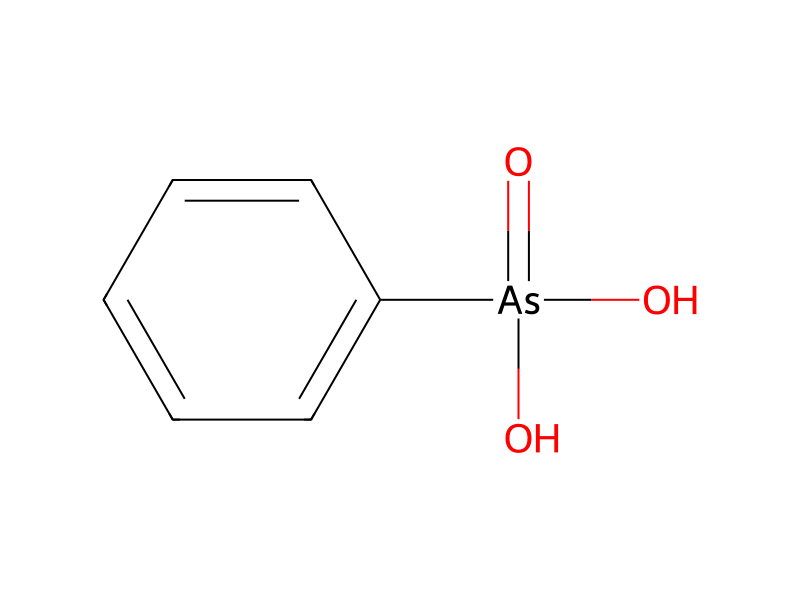
기본 정보
- 표준 SMILES
O=[As](O)(O)c1ccccc1- InChIKey
LVKZSFMYNWRPJX-UHFFFAOYSA-N- 분자식
- C6H7AsO3
- 평균 분자량
- 202.04 g/mol
- 단동위원소 질량
- 201.96111558
개요
Benzenearsonic acid is a colorless solid. Used as an analytical reagent for tin. (EPA, 1998)
이름 및 식별자
- 우선 이름
- Phenylarsonic Acid
- IUPAC
- phenylarsonic acid
- 현지명
- 벤젠알소닉 산
- 영어명
- Phenylarsonic acid
- 분자식
- C6H7AsO3
- 분자량
- 202.04
이름 및 동의어
이름 더 보기
데이터베이스 식별자
- CAS
98-05-5- PubChem CID
- 7365
- DTXSID
DTXSID6059158- ChEMBL
CHEMBL364571- ChEBI
CHEBI:29851- UNII
- 57F9KU116M
- EC Number
- 202-631-9
- Nikkaji
- J73.249D
물성
구조 계산 물성
- 극성 표면적
- 57.5 Ų
- 수소 결합 공여자 수
- 2
- 수소 결합 수용자 수
- 3
- 회전 가능 결합 수
- 1
- 무거운 원자 수
- 10
- 형식 전하
- 0
- 복잡도
- 145
실험 및 물리화학적 성질
LogP
log Kow= 0.06
0.03 (calculated) (calculated)
Density
1.76 (EPA, 1998) - Denser than water; will sink
1.760 at 25 °C
Relative density (water = 1): 1.76
1.76 @25 °C
Solubility
Sol in 40 parts water, 50 parts alcohol; insol in chloroform
Solubility in water: poor
Decomposition
When heated to decomposition it emits toxic fumes of /arsenic/.
160 °C
Melting Point
320 °F decomposes (EPA, 1998)
158 °C (with decomp)
Physical Description
Benzenearsonic acid is a colorless solid. Used as an analytical reagent for tin. (EPA, 1998)
Colorless solid with various forms; Poor solubility in water; [ICSC] White powder, soluble in water; [MSDSonline]
COLOURLESS SOLID IN VARIOUS FORMS.
물리화학적 성질
- 녹는점
- 160 °C · 160 °C
- 끓는 점
- 66 °C · 66 °C(Press: 1 Torr)
- 밀도
- 1 · 1,76 g/cm3
- 용해도
- 3.2 %, · 물에 3.2%, 에탄올에 15.5%.
- 산도 계수 (pKa)
- 2 · pK2: 8.48(+1) (22°C)
- 물리적 상태
- 가루
- 색상
- 하얀색
- Specific Gravity
- 1.76 · 1.76
- 수용성
- 31.6 g/L · 31.6g/L(28 ºC)
- Merck
- 14 · 14,1067
- EPA
- Benzenearsonic acid (98-05-5)
화학적 성질
white to slightly yellow crystalline powder
안전 및 규제
GHS 분류
GHS Classification
Danger
H301 (97.8%): Toxic if swallowed [Danger Acute toxicity, oral]
P261, P264, P270, P271, P273, P301+P316, P304+P340, P316, P321, P330, P391, P403+P233, P405, and P501 (click each P-code to see the statement)
Aggregated GHS information provided per 46 reports by companies from 4 notifications to the ECHA C&L Inventory. Each notification may be associated with multiple companies.
Danger
H301: Toxic if swallowed [Danger Acute toxicity, oral]
유해성 정보
Regulatory Information
Chemical: Arsonic acid, phenyl-
Restricted substance: Phenylarsonic acid
Phenylarsonic acid: Does not have an individual approval but may be used under an appropriate group standard
The New Jersey Worker and Community Right to Know Act requires public and private employers to provide information about hazardous substances at their workplaces. (N.J.S.A. 34:5A-1 et. seq.)
Fire Hazards
Benzenearsonic acid emits poisonous fumes of arsenic when heated to decomposition. (EPA, 1998)
Not combustible. Gives off irritating or toxic fumes (or gases) in a fire.
Hazards Summary
Can cause arsenic poisoning; [ICSC] Almost nothing is known regarding health effects of organic arsenic compounds in humans. Studies in animals show that some simple organic arsenic compounds are less toxic than inorganic forms. Ingestion of methyl and dimethyl compounds can cause diarrhea and damage to the kidneys. [ATSDR ToxProfiles] Toxic by ingestion; [Sax] Oral LDLo (rat) = 50 mg/kg; [RTECS] A skin, eye, and mucous membrane irritant; [MSDSonline] See Arsanilic acid.
FIFRA Requirements
If material involved in fire: Extinguish fire using agent suitable for type of surrounding fire. (Material itself does not burn or burns with difficulty.) Use water in flooding quantities as fog. Use foam, dry chemical, or carbon dioxide. /Arsenical cmpd, liquid, NOS/
If material involved in fire: Extinguish fire using agent suitable for type of surrounding fire. (Material itself does not burn or burns with difficulty.) Use water in flooding quantities as fog. Use foam, dry chemical, or carbon dioxide. /Arsenical cmpd, solid, NOS/
안전 및 보호
Fire Fighting
(Non-Specific -- Arsenical Compound, Solid, n.o.s.) Use water in flooding quantities as fog. Avoid breathing dusts and fumes; keep upwind; wear self-contained breathing apparatus.
In case of fire in the surroundings, use appropriate extinguishing media.
First Aid Measures
Fresh air, rest. Refer for medical attention.
Remove contaminated clothes. Rinse skin with plenty of water or shower. Refer for medical attention .
Rinse with plenty of water for several minutes (remove contact lenses if easily possible). Refer for medical attention.
Disposal Methods
SRP: At the time of review, criteria for land treatment or burial (sanitary landfill) disposal practices are subject to significant revision. Prior to implementing land disposal of waste residue (including waste sludge), consult with environmental regulatory agencies for guidance on acceptable disposal practices.
Spillage Disposal
Personal protection: complete protective clothing including self-contained breathing apparatus. Do NOT wash away into sewer. Sweep spilled substance into covered sealable containers. Carefully collect remainder. Then store and dispose of according to local regulations.
독성 정보
Treatment
Arsenic poisoning can be treated by chelation therapy, using chelating agents such as dimercaprol, EDTA or DMSA. Charcoal tablets may also be used for less severe cases. In addition, maintaining a diet high in sulfur helps eliminate arsenic from the body. (L20)
Exposure Routes
The substance can be absorbed into the body by inhalation and by ingestion.
Oral (L2) ; inhalation (L2); dermal (L2)
Toxicity Summary
Arsenic and its metabolites disrupt ATP production through several mechanisms. At the level of the citric acid cycle, arsenic inhibits pyruvate dehydrogenase and by competing with phosphate it uncouples oxidative phosphorylation, thus inhibiting energy-linked reduction of NAD+, mitochondrial respiration, and ATP synthesis. Hydrogen peroxide production is also increased, which might form reactive oxygen species and oxidative stress. Arsenic's carginogenicity is influenced by the arsenical binding of tubulin, which results in aneuploidy, polyploidy and mitotic arrests. The binding of other arsenic protein targets may also cause altered DNA repair enzyme activity, altered DNA methylation patterns and cell proliferation. (T1, A17)
Signs and Symptoms
Abdominal pain. Confusion. Diarrhoea. Dizziness. Drowsiness. Headache. Vomiting. Incoordination. Paralysis. Symptoms may be delayed.
Further see Inhalation.
Abdominal pain. Confusion. Diarrhoea. Dizziness. Dullness. Headache. Vomiting. Incoordination. Muscle paralysis. Further see Inhalation.
Exposure to lower levels of arsenic can cause nausea and vomiting, decreased production of red and white blood cells, abnormal heart rhythm, damage to blood vessels, and a sensation of burn (T1).
Non-Human Toxicity Values
LD50 Mouse oral 270 ug/kg
LD50 Rabbit iv 16 mg/kg
규제 정보
FIFRA Requirements
If material involved in fire: Extinguish fire using agent suitable for type of surrounding fire. (Material itself does not burn or burns with difficulty.) Use water in flooding quantities as fog. Use foam, dry chemical, or carbon dioxide. /Arsenical cmpd, liquid, NOS/
If material involved in fire: Extinguish fire using agent suitable for type of surrounding fire. (Material itself does not burn or burns with difficulty.) Use water in flooding quantities as fog. Use foam, dry chemical, or carbon dioxide. /Arsenical cmpd, solid, NOS/
Atmospheric Standards
(a) The owner or operator of an existing glass melting furnace subject to the provisions of this subpart shall comply with either paragraph (a)(1) or (a)(2) of this section ... (1) Uncontrolled total arsenic emissions from the glass melting furnace shall be less than 2.5 Mg (2.7 ton) per year, or ... (2) Total arsenic emissions from glass melting furnace shall be conveyed to a control device and reduced by at least 85%. /Total arsenic/
(b) The owner or operator of a new or modified glass melting furnace subject to the provisions of this subpart shall comply with either paragraph (b)(1) or (b)(2) of this section ... (1) Uncontrolled total arsenic emissions from the glass melting furnace shall be less than 0.4 Mg (0.44 ton) per year, or ... (2) Total arsenic emissions from glass melting furnace shall be conveyed to a control device and reduced by at least 85%. /Total arsenic/
The owner or operator of each copper converter subject to the provisions of this subpart shall reduce inorganic arsenic emissions to the atmosphere by meeting the following design, equipment, work practice, and operational requirements: (1) Install, operate, and maintain a secondary hood system on each copper converter. Each secondary hood system shall consist of a hood enclosure, air curtain fan(s), exhaust system fan(s), and ductwork that conveys the captured emission to a control device ... (2) Optimize the capture of secondary inorganic arsenic emission by operating the copper converter and secondary hood systems at all times ... . /Inorganic arsenic/
CERCLA Reportable Quantities
Releases of CERCLA hazardous substances are subject to the release reporting requirement of CERCLA section 103, codified at 40 CFR part 302, in addition to the requirements of 40 CFR part 355. Benzenearsonic acid is an extremely hazardous substance (EHS) subject to reporting requirements when stored in amounts in excess of its threshold planning quantity (TPQ) of 10 or 10,000 lbs. Extremely hazardous substances that are solids are subject to either of two threshold planning quantities ... The lower quantity applies only if the solid exists in powdered for and has a particle size less than 100 microns; or is handled in solution or in molten form; or meets the criteria for a National Fire Protection Association (NFPA) rating of 2, 3 or 4 for reactivity. If the solid does not meet any of these criteria, it is subject to the upper ... threshold planning quantity ... .
Clean Water Act Requirements
Toxic pollutant designated pursuant to section 307(a)(1) of the Federal Water Pollution Control Act and is subject to effluent limitations. /Arsenic & cmpd/
For the maximum protection of human health from the potential carcinogenic effects due to exposure of arsenic through ingestion of contaminated water & contaminated aquatic organisms, the ambient water concn should be zero based on the nonthreshold assumption for this chemical. However, zero level may not be attainable at the present time. Therefore, the levels which may result in incremental increase of cancer risk over the lifetime are estimated at 1X10⁻⁵, 1X10⁻⁶, & 1X10⁻⁷. The corresponding criteria are 22 ng/l, 2.2 ng/l, & .22 ng/l, respectively .... For consumption of aquatic organisms only, excluding consumption of water, the levels are 175 ng/ml, 17.5 ng/l, & 1.75 ng/l, respectively. /Arsenic/
D004; A solid waste containing arsenic may or may not become characterized as a hazardous waste when subjected to the Toxicity Characteristic Leaching Procedure listed in 40 CFR 261.24, and if so characterized, must be managed as a hazardous waste.
State Drinking Water Guidelines
(AZ) ARIZONA 10 ug/L /Arsenic/
(CT) CONNECTICUT 10 ug/l /Arsenic/
안전 데이터
- tsca
- TSCA listed
- rtecs
- CY3150000
- ridadr
- 3280
- 독성
- LDLo orl-rat: 50 mg/kg JPETAB 93,287,48
- HS 번호
- 29310099
- risk_code
- 50/53-23/25
- hazard_code
- N-T
- safety_code
- 61-60-45-28A-20/21
- 포장분류
- III
- 위험 등급
- 6.1
- 유해 물질 데이터
- 98-05-5(Hazardous Substances Data)
화학 및 산업
약리 정보
Metabolism/Metabolites
Arsenic is absorbed mainly by inhalation or ingestion, as to a lesser extent, dermal exposure. It is then distributed throughout the body, where it is reduced into arsenite if necessary, then methylated into monomethylarsenic (MMA) and dimethylarsenic acid (DMA) by arsenite methyltransferase. Arsenic and its metabolites are primarily excreted in the urine. Arsenic is known to induce the metal-binding protein metallothionein, which decreases the toxic effects of arsenic and other metals by binding them and making them biologically inactive, as well as acting as an antioxidant. (L20)
용도 및 제조
Uses
Used as a reagent for tin and as a precipitant in niobium analysis; [HSDB]
Reagent for tin
As precipitant in niobium analysis
Not available.
응용 분야
용도Arsonic acids (arsonic acid, phenylarsonic acid, p-hydroxyphenylarsonic acid, arsanilic acid) react with the tetravalent metals of group IV of the periodic system to give water-insoluble complexes of composition MA2 . The composition of the precipitates is not exactly stoichiometric, and hence the precipitates are not suitable for direct gravimetric analysis. Instead, the precipitates are transformed by ignition to the corresponding metal oxides and weighed as such. The main advantage of the application of these reagents is the possibility offered of the selective determination of zirconium(IV), hafnium(IV) and titanium(IV) in the presence of many other metals, such as zinc, manganese, nickel, cobalt, aluminium, copper, calcium, magnesium and chromium. In practice they are utilized most frequently for the determination of zirconium. In strong mineral acidic media phenylarsonic acid forms water-insoluble precipitates with zirconium and hafnium only. In highly concentrated acetic acid solution the thorium phenylarsonate complex is also precipitated, which makes possible the separation of thorium from rare earth metals. The procedure gives satisfactory results in the presence of alkaline earth metals, iron, aluminium, manganese, cobalt, nickel, copper, zinc and bismuth.
일반 설명Colorless solid. Used as an analytical reagent for tin.
상·하류 제품 정보
상류 원료
하류 제품
공급사37 곳
관련 반응
현재 필터 조건에 해당하는 반응 기록이 없습니다.
연결된 노트
불러오는 중…