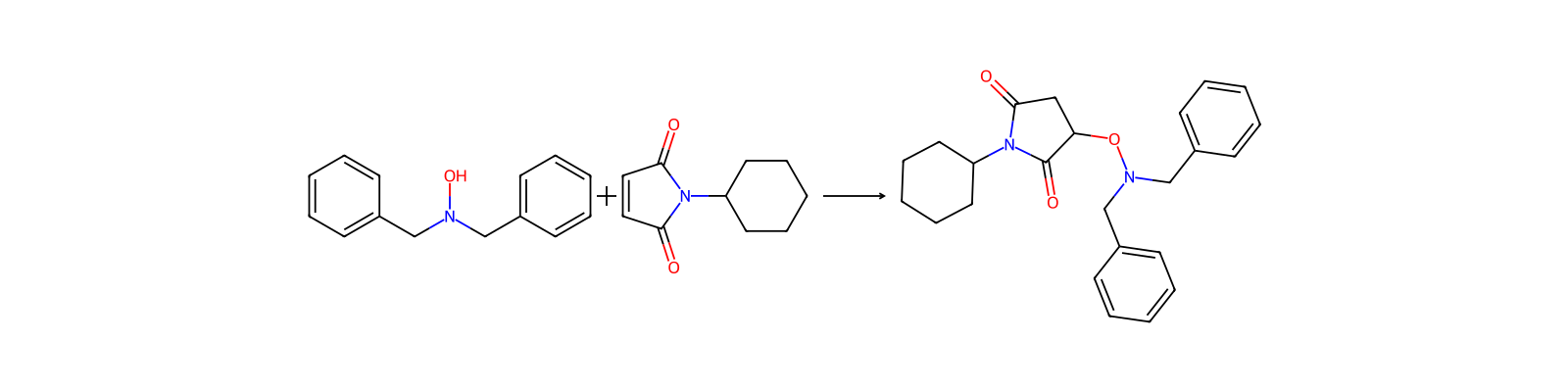
HRID 1129603반응물로
1H-Pyrrole-2,5-dione, 1-cyclohexyl-

1631-25-0O=C1C=CC(=O)N1C1CCCCC1BQTPKSBXMONSJI-UHFFFAOYSA-N1631-25-0DTXSID4061834CHEMBL4547552안전 정보는 참고용이며, 공급업체의 물질안전보건자료(SDS), 관련 법규 및 전문가 평가를 대체하지 않습니다.
Danger
H301 (30.2%): Toxic if swallowed [Danger Acute toxicity, oral]
P261, P264, P264+P265, P270, P271, P272, P273, P280, P301+P316, P302+P352, P304+P340, P305+P351+P338, P305+P354+P338, P317, P319, P321, P330, P332+P317, P333+P317, P337+P317, P362+P364, P391, P403+P233, P405, and P501 (click each P-code to see the statement)
Aggregated GHS information provided per 63 reports by companies from 7 notifications to the ECHA C&L Inventory. Each notification may be associated with multiple companies.
용도N-Cyclohexylmaleimide (CHMI, NCMI) may be used for the preparation of hyperbranched copolymers of p-(chloromethyl)styrene (CMS) and NCMI, via atom transfer radical copolymerization reaction.
일반 설명N-Cyclohexylmaleimide (CHMI, NCMI) is a cyclic imide. Diels-Alder reactions of 9-hydroxymethylanthracene with CHMI catalyzed by hydrophobic nanospace confined within the self-assembled Pd6 open cage bearing triimidazole walls have been reported. It undergoes Diels-Alder reactions with various aromatic hydrocarbons promoted by self-assembled coordination cage. This cage acts as nanometer-sized molecular flask and hence promotes this reaction. CHMI is reported to undergo radical polymerization readily under various polymerization conditions to afford poly(CHMI), having excellent thermal stability.