
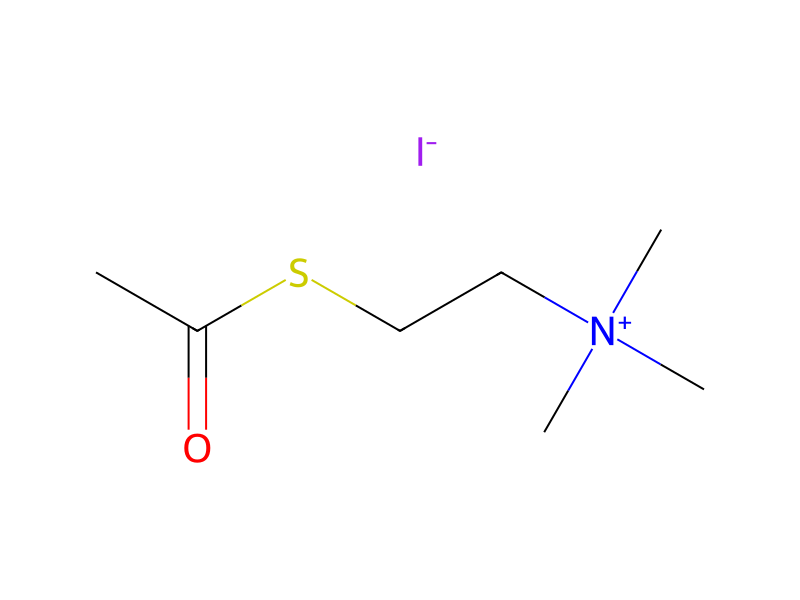
기본 정보
- 표준 SMILES
CC(=O)SCC[N+](C)(C)C.[I-]- InChIKey
NTBLZMAMTZXLBP-UHFFFAOYSA-M- 분자식
- C7H16INOS
- 평균 분자량
- 289.18 g/mol
- 단동위원소 질량
- 288.99973
이름 및 식별자
- 우선 이름
- Acetylthiocholine iodide
- IUPAC
- 2-acetylsulfanylethyl(trimethyl)azanium iodide
- 현지명
- 아세틸티오콜린요오드화물
- 영어명
- Acetylthiocholine iodide
- 분자식
- C7H16INOS
- 분자량
- 289.18
이름 및 동의어
Acetylthiocholine iodide1866-15-5S-Acetylthiocholine iodide2-Acetylthioethyltrimethylammonium iodide6SKH6P4YRNNSC-44139Ethanaminium, 2-(acetylthio)-N,N,N-trimethyl-, iodide (1:1)DTXSID50883764RefChem:109203DTXCID701023254217-474-1Acetylthiocholine diiodide
이름 더 보기
아세틸티오콜린요오드화물Acetylthiocholine ioAcetylthiocholinjodidacetylthiocholine iodieKamovsky-roots solutionIodine thioacetylcholineIodide thioacetylcholines-acetylthio-choliniodideacetylthiocholinediiodideacethylthiocholine iodide
Ethanaminium, 2-(acetylthio)-N,N,N-trimethyl-, iodideMFCD000118192-(Acetylthio)-N,N,N-trimethylethanaminium iodideC7H16INOSNSC 44139(2-Mercaptoethyl)trimethylammonium iodide acetate((2-Mercaptoethyl)trimethylammonium iodide acetate)2-(Acetylthio)-N,N,N-trimethylethan-1-aminium iodide
데이터베이스 식별자
- CAS
1866-15-5- PubChem CID
- 74629
- DTXSID
DTXSID50883764- UNII
- 6SKH6P4YRN
- EC Number
- 217-474-1
물성
구조 계산 물성
- 극성 표면적
- 42.4 Ų
- 수소 결합 공여자 수
- 0
- 수소 결합 수용자 수
- 3
- 회전 가능 결합 수
- 4
- 무거운 원자 수
- 11
- 형식 전하
- 0
- 복잡도
- 117
물리화학적 성질
- 녹는점
- 205 · 205-210 °C(lit.)
- 밀도
- 1.4885 · 1.4885 (estimate)
- 저장 조건
- 2 · 2-8°C
- 용해도
- 2 O: · H2O: 100 mg/mL
- 물리적 상태
- 가루
- 색상
- 하얀색
- 수용성
- 2 O: · H2O: 100mg/mL
- BRN
- 3916578 · 3916578
- InChI
- InChI=1S/C7H16NOS.HI/c1-7(9)10-6-5-8(2,3)4;/h5-6H2,1-4H3;1H/q+1;/p-1
- InChIKey
- NTBLZMAMTZXLBP-UHFFFAOYSA-M
- SMILES
- [N+](C)(C)(C)CCSC(=O)C.[I-]
- EPA
- 2 · Ethanaminium, 2-(acetylthio)-N,N,N-trimethyl-, iodide (1866-15-5)
화학적 성질
white crystalline powder
안전 및 규제
GHS 분류
GHS Classification
Danger
H301 (100%): Toxic if swallowed [Danger Acute toxicity, oral];H311 (97.9%): Toxic in contact with skin [Danger Acute toxicity, dermal];H315 (97.9%): Causes skin irritation [Warning Skin corrosion/irritation];H319 (97.9%): Causes serious eye irritation [Warning Serious eye damage/eye irritation];H335 (95.8%): May cause respiratory irritation [Warning Specific target organ toxicity, single exposure; Respiratory tract irritation]
P261, P262, P264, P264+P265, P270, P271, P280, P301+P316, P302+P352, P304+P340, P305+P351+P338, P316, P319, P321, P330, P332+P317, P337+P317, P361+P364, P362+P364, P403+P233, P405, and P501 (click each P-code to see the statement)
Aggregated GHS information provided per 48 reports by companies from 6 notifications to the ECHA C&L Inventory. Each notification may be associated with multiple companies.;Information may vary between notifications depending on impurities, additives, and other factors. The percentage value in parenthesis indicates the notified classification ratio from companies that provide hazard codes. Only hazard codes with percentage values above 10% are shown. For more detailed information, please visit ECHA C&L website.
유해성 정보
Regulatory Information
Chemical: Ethanaminium, 2-(acetylthio)-N,N,N-trimethyl-, iodide
2-Acetylthioethyltrimethylammonium iodide: Does not have an individual approval but may be used under an appropriate group standard
Hazard Classes and CategoriesAcute Tox. 3 (100%);Acute Tox. 3 (97.9%);Skin Irrit. 2 (97.9%);Eye Irrit. 2 (97.9%);STOT SE 3 (95.8%)
규제 정보
Regulatory Information
Chemical: Ethanaminium, 2-(acetylthio)-N,N,N-trimethyl-, iodide
2-Acetylthioethyltrimethylammonium iodide: Does not have an individual approval but may be used under an appropriate group standard
안전 데이터
- wgk
- 3
- tsca
- TSCA listed
- rtecs
- FZ9865000
- ridadr
- UN 2811 6.1/PG 3
- HS 번호
- 29309099
- risk_code
- 21-25-36/37/38
- hazard_code
- T,Xi
- safety_code
- 26-36
- 포장분류
- III
- 위험 등급
- 6.1
- F 고인화성물질
- 3-8-10
- Hazard Classifications
- Acute Tox. 3 DermalAcute Tox. 3 Oral
- 스토리지 클래스
- 6.1C - Combustible acute toxic Cat.3toxic compounds or compounds which causing chronic effects
화학 및 산업
용도 및 제조
General Manufacturing InformationEthanaminium, 2-(acetylthio)-N,N,N-trimethyl-, iodide (1:1): ACTIVE
응용 분야
개요Acetylthiocholine iodide, also known as ATCI, serves as both an acetylcholinesterase (AChE) substrate and a nicotinic acetylcholine receptor (AChR) agonist. ATCI itself is a colorless and odorless compound. It exhibits solubility in both water and ethanol. It is a synthetic compound extensively employed in laboratory experiments to measure the activity of AChE, a vital enzyme responsible for the breakdown of the neurotransmitter acetylcholine (ACh) in the central and peripheral nervous systems. Additionally, it enables the evaluation of drug effects on AChE activity and facilitates investigations into the impact of toxins on the nervous system. Acetylthiocholine iodide functions as an inhibitor of AChE. By binding to the enzyme′s active site, it prevents AChE from catalyzing the breakdown of ACh. Consequently, ACh accumulates in the synaptic cleft, leading to increased neuron excitability. This inhibition of AChE by ATCI ultimately results in a higher ACh concentration within the synaptic cleft, yielding a range of physiological effects. These effects encompass heightened muscle contraction, increased heart rate and blood pressure, elevated salivation, intensified bronchial secretions, and augmented gastrointestinal activity[1].
용도Acetylthiocholine iodide has been used as a substrate in the preparation of acetylcholine esterase (AChE) assay working solution for AChE activity assay. It has also been used as a component in phosphate buffer (PB) for cholinesterase assay.
상·하류 제품 정보
상류 원료
공급사50 곳
国药集团化学试剂有限公司86-21-63210123 · [email protected]
梯希爱(上海)化成工业发展有限公司021-67121386 · [email protected]
郑州阿尔法化工有限公司+86-18530059196 · [email protected]
上海阿拉丁生化科技股份有限公司400-6206333 13167063860 · [email protected]
Suzhou Victorypharm Co.,Ltd.+86-13916956214 · [email protected]
爱斯特(成都)生物制药股份有限公司+86-28-85122536 85324413 · [email protected]
Hebei Yanxi Chemical Co., Ltd.+86-17531190177 · [email protected]
科瑞迪化学400-821-5857 021-64326257 · [email protected]
上海将来实业股份有限公司400-0066400 13621662912 · [email protected]
Syntechem Co.,Ltd[email protected]
上海迈瑞尔生化科技有限公司4006356688 18621169109 · [email protected]
大连美仑生物技术有限公司0411-62910999 13889544652 · [email protected]
阿法埃莎(中国)化学有限公司400-6106006 · [email protected]
安耐吉化学&3A(安徽泽升科技股份有限公司)400-0056266 · [email protected]
上海景颜化工科技有限公司13817811078 · [email protected]
南京哈柏医药科技有限公司13376080562 13376090521 · [email protected]
山东西亚化学有限公司13355009207 13355009207 · [email protected]
四川库利南科技有限公司400-1166-196 18981987031 · [email protected]
上海耐士化工科技有限公司400-188-0725 +86 21 34310725 13611771617
湖南汇百侍生物科技有限公司0731-85526065 13308475853 · [email protected]
南京维奥化工有限公司Please Send Email 18652950785 · [email protected]
上海源叶生物科技有限公司13636370518 · [email protected]
艾科试剂4008-755-333 18080918076 · [email protected]
上海思域化工科技有限公司86-21-34053660 · [email protected]
赛默飞世尔科技(中国)有限公司800-810-5118 · [email protected]
北京伊诺凯科技有限公司400-810-7969 010-59572699 · [email protected]
Wuhan NCE Biomedical Co.,Ltd.4000-027-021 |24 +86-13986109188 | +86-15623472865 | +81-08033611988
TCI AMERICA800-4238616 · [email protected]
TOKYO CHEMICAL INDUSTRY CO., LTD.03-36680489 · [email protected]
TCI Europe320-37350700 · [email protected]
上海贤鼎生物科技有限公司4009209199 · [email protected]
山东康赛德生物科技有限公司18615616891 · [email protected]
越林试剂021-62960152 · [email protected]
南京杜莱生物技术有限公司025-84699383-8003;025-846993838003-8003 18013301590 · [email protected]
济南铭雅医药科技有限公司0531-85828981 · [email protected]
上海倍卓生物科技有限公司021-61119791,13386096464 · [email protected]
苏州信一药谷生物科技有限公司0512-65757861-8000 · [email protected]
上海将来实业股份有限公司400-0066400 13621662912 · [email protected]
上海将来实业股份有限公司021-61552785 · [email protected]
苏州乔纳森新材料科技有限公司0512-68312916,63926215 18912725070;18013709950 · [email protected]
上海笛柏生物科技有限公司400-008-9730,021-54359730 400-008-9730 · [email protected]
上海石洋化工有限公司021-56795766 · [email protected]
成都零六生物科技有限公司400-1166-196 13458535857 · [email protected]
苏州朗行生物科技有限公司0512-62968256 18550502935 · [email protected]
苏州络森生物科技有限公司0512-87888687 13626191410 · [email protected]
上海创赛科技有限公司400-6087598 15021221957 · [email protected]
上海鑫圭生物科技有限公司15121041756 · [email protected]
上海麦克林生化科技股份有限公司15221275939 15221275939 · [email protected]
杭州杰恒化工有限公司0571-87396432 · [email protected]
上海嵩爰化工科技有限公司010-1234567 18521000990 · [email protected]
관련 반응
2건

연결된 노트
불러오는 중…