
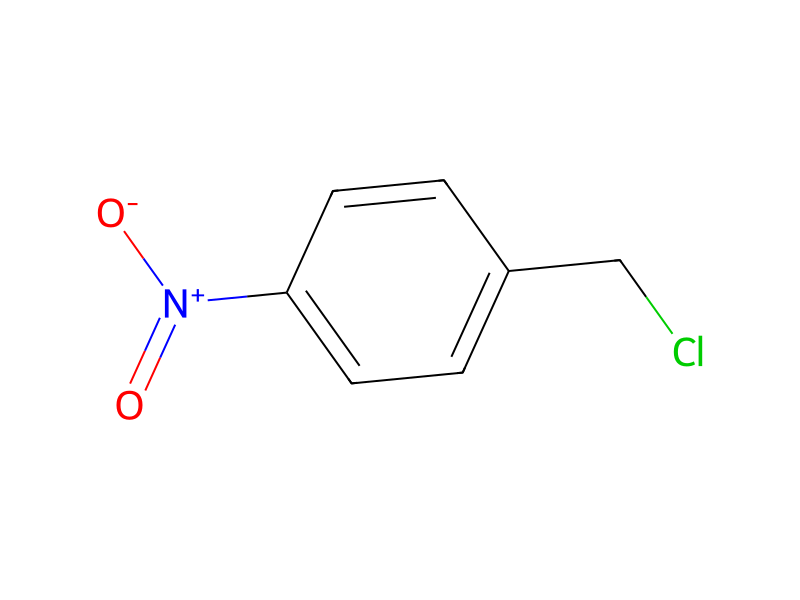
기본 정보
- 표준 SMILES
O=[N+]([O-])c1ccc(CCl)cc1- InChIKey
KGCNHWXDPDPSBV-UHFFFAOYSA-N- 분자식
- C7H6ClNO2
- 평균 분자량
- 171.58 g/mol
- 단동위원소 질량
- 171.00870611
개요
Benzene, 1-(chloromethyl)-4-nitro- is a solid. (EPA, 1998)
이름 및 식별자
- 우선 이름
- 4-Nitrobenzyl chloride
- IUPAC
- 1-(chloromethyl)-4-nitrobenzene
- 현지명
- 1-(클로로메틸)-4-니트로벤젠
- 영어명
- 4-Nitrobenzyl chloride
- 분자식
- C7H6ClNO2
- 분자량
- 171.58
이름 및 동의어
4-Nitrobenzyl chloride100-14-11-(Chloromethyl)-4-nitrobenzenep-Nitrobenzyl chlorideBenzene, 1-(chloromethyl)-4-nitro-alpha-Chloro-p-nitrotoluenep-(Chloromethyl)nitrobenzene4-(Chloromethyl)nitrobenzeneDTXSID40257454-nitrophenylmethyl chlorideToluene, alpha-chloro-p-nitro-3BLD9LVT3X
이름 더 보기
1-(클로로메틸)-4-나이트로벤젠1-(클로로메틸)-4-니트로벤젠p-nitrochlorideAKOS BBS-00003951NitrochlorobenzylNitrobenzylchlorideNitrobenzyl chloridà-chloro-4-nitrotolueneα-Chloro-4-nitrotoluene
BENZENE, 1-CHLOROMETHYL-4-NITRO-NSC-9803DTXCID105745CHEBI:87406para-nitrobenzyl chlorideRefChem:525941202-822-7alpha-Chloro-4-nitrotoluene
데이터베이스 식별자
- CAS
100-14-1- PubChem CID
- 7482
- DTXSID
DTXSID4025745- ChEMBL
CHEMBL176410- ChEBI
CHEBI:87406- UNII
- 3BLD9LVT3X
- EC Number
- 202-822-7
- Nikkaji
- J4.978F
물성
구조 계산 물성
- XLogP
- 2.5
- 극성 표면적
- 45.8 Ų
- 수소 결합 공여자 수
- 0
- 수소 결합 수용자 수
- 2
- 회전 가능 결합 수
- 1
- 무거운 원자 수
- 11
- 형식 전하
- 0
- 복잡도
- 138
실험 및 물리화학적 성질
Chemical ClassesNitrogen Compounds -> Nitros, Aromatic
SpringerMaterials PropertiesDensity
Density1.5647 (NTP, 1992) - Denser than water; will sink
Color/FormPlates or needles from alcohol
Solubility
Insoluble (NTP, 1992)
Sol in alcohol, ether, acetone, benzene
Boiling Point230 °C @760 [mm Hg]
Melting Point
159.8 °F (EPA, 1998)
71 °C
71 °C
Vapor Pressure0.05 [mm Hg] @25 °C
Refractive IndexIndex of refraction: 1.5647 at 62 °C
Physical Description
Benzene, 1-(chloromethyl)-4-nitro- is a solid. (EPA, 1998)
Plates or needles from alcohol; [HSDB]
Other Experimental PropertiesUV: 6794 (Sadtler Research Laboratories Spectral Collection) /Benzyl chloride, 2-nitro/
물리화학적 성질
- 녹는점
- 71 °C · 71 °C
- 끓는 점
- 112 °C · 112 °C (0.6 mmHg)
- 밀도
- 1.3246 · 1.3246 (rough estimate)
- 굴절률
- 1.5647 · 1.5647 (estimate)
- 용해도
- 50 mg/mL, · 클로로포름: 가용성 50mg/mL, 투명하거나 매우 약간 흐릿함, 희미한 노란색
- 물리적 상태
- 결정화된 바늘 또는 분말
- 색상
- 연노랑
- BRN
- 387187 · 387187
- 안정성
- 안정적인. 강한 산화제, 염기, 아민, 수분, 알코올과 호환되지 않습니다. 강철을 부식시킵니다. 물과 천천히 반응합니다. 타기 쉬운.
- InChI
- 1S/C7H6ClNO2/c8-5-6-1-3-7(4-2-6)9(10)11/h1-4H,5H2
- InChIKey
- KGCNHWXDPDPSBV-UHFFFAOYSA-N
- SMILES
- [O-][N+](=O)c1ccc(CCl)cc1
- NIST
- 4 · 4-Nitrobenzyl chloride(100-14-1)
- EPA
- 1 · 1-(Chloromethyl)-4-nitrobenzene (100-14-1)
화학적 성질
white to light yellow crystal powde
안전 및 규제
GHS 분류
GHS Classification
Danger
H302 (100%): Harmful if swallowed [Warning Acute toxicity, oral]
P260, P264, P270, P280, P301+P317, P301+P330+P331, P302+P361+P354, P304+P340, P305+P354+P338, P316, P321, P330, P363, P405, and P501 (click each P-code to see the statement)
Aggregated GHS information provided per 48 reports by companies from 5 notifications to the ECHA C&L Inventory. Each notification may be associated with multiple companies.
Warning
H302: Harmful if swallowed [Warning Acute toxicity, oral]
유해성 정보
Regulatory Information4-Nitrobenzyl chloride: Does not have an individual approval but may be used under an appropriate group standard
DOT LabelCorrosive
Fire HazardsIncompatible with sodium hydroxide. (EPA, 1998)
Health HazardsPoisonous if swallowed or dust is inhaled. (EPA, 1998)
Hazards SummaryPoisonous by ingestion and inhalation; [CAMEO] Corrosive; Causes burns; A lachrymator; May cause pneumonitis and pulmonary edema after inhalation of high concentrations; [MSDSonline]
Reactive GroupHalogenated Organic Compounds
Reactivity Profile
Incompatible with sodium hydroxide. [EPA, 1998]. A halogenated aromatic nitro compound. Aromatic nitro compounds range from slight to strong oxidizing agents. If mixed with reducing agents, including hydrides, sulfides and nitrides, they may begin a vigorous reaction that culminates in a detonation. The aromatic nitro compounds may explode in the presence of a base such as sodium hydroxide or potassium hydroxide even in the presence of water or organic solvents. The explosive tendencies of aromatic nitro compounds are increased by the presence of multiple nitro groups.
Air and Water ReactionsMay react slowly with water. (NTP, 1992)
CERCLA Reportable Quantities
Releases of CERCLA hazardous substances are subject to the release reporting requirement of CERCLA section 103, codified at 40 CFR part 302, in addition to the requirements of 40 CFR part 355. Benzene, 1-(chloromethyl)-4-nitro- is an extremely hazardous substance (EHS) subject to reporting requirements when stored in amounts in excess of its threshold planning quantity (TPQ) of 500/10,000 lbs.
Hazard Classes and Categories
Acute Tox. 4 (100%)
Acute toxicity (Oral) - Category 4
안전 및 보호
Fire FightingKeep unnecessary people away; isolate hazard area and deny entry. Stay upwind; keep out of low areas. Wear self-contained (positive pressure if available) breathing apparatus and full protective clothing.
First Aid
Signs and Symptoms of Acute Benzene, 1-(Chloromethyl)-4-Nitro-Exposure: Signs and symptoms of acute exposure to benzene, 1-(chloromethyl)-4-nitro- may be severe and include cyanosis (blue tint to the skin and mucous membranes), tachycardia (rapid heart rate), hypotension (low blood pressure), and cardiac arrhythmias. Respiratory depression and respiratory failure may also occur. Headache, lethargy, weakness, vertigo (dizziness), severe depression, and coma may be noted. GI symptoms include nausea and vomiting. Urine and vomitus may have the odor of bitter almonds.
Nonfire Spill ResponseKeep unnecessary people away; isolate hazard area and deny entry. Stay upwind; keep out of low areas. If water pollution occurs, notify appropriate authorities. Do not touch spilled material; stop leak if you can do so without risk.
Isolation and EvacuationExcerpt from ERG Guide 154 [Substances - Toxic and/or Corrosive (Non-Combustible)]:
Protective Action Criteria (PAC)
0.18 [mg/m3]
2.0 [mg/m3]
12 [mg/m3]
Personal Protective Equipment (PPE)
For emergency situations, wear a positive pressure, pressure-demand, full facepiece self-contained breathing apparatus (SCBA) or pressure- demand supplied air respirator with escape SCBA and a fully-encapsulating, chemical resistant suit. (EPA, 1998)
독성 정보
Adverse EffectsDermatotoxin - Skin burns.
Non-Human Toxicity Excerpts
The mutagenicity of 24 benzyl derivatives, containing a variety of substituents & leaving groups, were assayed in strain TA100 using Ames plate incorporation assay. P-nitrobenzyl chloride (12000 revertants/umole) was mutagenic. It was also mutagenic in strain TA98 (700 revertants/umole), but not in strain TA98NR (a strain deficient in nitro reducatase activity). This study suggests that nitrobenzyl derivatives were mutagenic due to nitro reductive metabolism.
Benzyl chloride, benzyl bromide, p-methylbenzyl chloride, & p-nitrobenzyl chloride were used to study chem reactivity with 4-(p-nitrobenzyl)pyridine & guanosine in vitro, in relation to mutagenic potency in Salmonella typhimurium & sister chromatid exchange (SCE) induction in CHO cells. Benzyl bromide was most reactive, followed by p-methylbenzyl chloride, benzyl chloride, & p-nitrobenzyl chloride. The order of mutagenicity was p-nitrobenzyl chloride much greater than benzyl bromide which was greater than benzyl chloride which was similar or equal to p-methylbenzyl chloride. They caused base-pair mutations only. The order of SCE-inducing ability decreased as follows: benzyl bromide greater than benzyl chloride which was similar or equal to p-nitrobenzyl chloride which was similar or equal to p-methylbenzyl chloride. The high mutagenicity of p-nitrobenzyl chloride in bacteria may be due to reactions other than direct aralkylation.
Toxicity DataLCLo (rat) = 280 mg/m3/4h
규제 정보
CERCLA Reportable Quantities
Releases of CERCLA hazardous substances are subject to the release reporting requirement of CERCLA section 103, codified at 40 CFR part 302, in addition to the requirements of 40 CFR part 355. Benzene, 1-(chloromethyl)-4-nitro- is an extremely hazardous substance (EHS) subject to reporting requirements when stored in amounts in excess of its threshold planning quantity (TPQ) of 500/10,000 lbs.
안전 데이터
- wgk
- 3
- tsca
- TSCA listed
- rtecs
- XS9093000
- ridadr
- UN 3261 8/PG 2
- HS 번호
- 29049090
- risk_code
- 22-34-36
- hazard_code
- C
- safety_code
- 26-36/37/39-45-27
- 포장분류
- II
- 위험 등급
- 8
- 기존화학 물질
- KE-05743
- F 고인화성물질
- 4.8-19-21
- Hazard Classifications
- Acute Tox. 4 OralSkin Corr. 1B
- 스토리지 클래스
- 8A - Combustible corrosive hazardous materials
- 유해 물질 데이터
- 100-14-1(Hazardous Substances Data)
화학 및 산업
약리 정보
Metabolism/Metabolites4-nitrobenzyl chloride has known human metabolites that include 4-nitrobenzyl-glutathione and S-(4-Nitrobenzyl)glutathione.
용도 및 제조
U.S. Exports(1987) No Data
U.S. Imports(1987) No Data
U.S. Production(1987) No Data
General Manufacturing InformationBenzene, 1-(chloromethyl)-4-nitro-: ACTIVE
응용 분야
용도4-Nitrobenzyl chloride was used to prepare unsymmetrically N,N′-bis(substituted) 4,13-diaza-18-crown-6-ether derivatives.
일반 설명Solid.
제조 방법
생산 방법Chlorination of 4-nitrotoluene at 190 ℃ without catalyst gives 4-Nitrobenzyl chloride. The alternative process of nitration of benzylchloride coproduces 2-nitrobenzyl chloride and requires a difficult separation stage.
상·하류 제품 정보
하류 제품
공급사21 곳
Xinxiang Juyuan Biological Technology Co., Ltd.+8615637360870 · [email protected]
武汉欣扬瑞和化学科技有限公司153-07155313 15307155313 · [email protected]
北京京土恒盛化工科技有限公司00-13911456598 13911456598 · [email protected]
上海麦克林生化科技股份有限公司15221275939 15221275939 · [email protected]
杭州杰恒化工有限公司0571-87396432 · [email protected]
Chongqing jooe co., ltd+86-15223382610 · [email protected]
XIAMEN EQUATION CHEMICAL CO.,LTD+86-5926515854 +86-18060954864 · [email protected]
西安乐纯化工有限责任公司029-15596886083 15596886083 · [email protected]
湖北中隆康盛精细化工有限公司027-027-83850368 18140587623 · [email protected]
上海阿拉丁生化科技股份有限公司6206333 13167063860 · [email protected]
上海源叶生物科技有限公司13636370518 · [email protected]
上海炎泽化工有限公司19901447308 19962611955 · [email protected]
上海吉至生化科技有限公司021-4009004166/18616739031 18616739031 · [email protected]
XIAMEN AMITY INDUSTRY AND TRADE CO., LTD.+8618950047208 · [email protected]
SUZHOU SENFEIDA CHEMICAL CO.,LTD+86-0512-83500002 +86-15195660023 · [email protected]
上海先臣化工有限公司+86-021-64606569 +86-18049800532 · [email protected]
上海宝杨宝欣生物科技有限公司021-56698539 19921169802 · [email protected]
上海珅桔化工有限公司13167128868 13248068001 · [email protected]
CD Chemical Group Limited+86-13651442114 · [email protected]
南京奥泽化工有限公司15189842686 · [email protected]
Dideu Industries Group Limited+8617392712697 · [email protected]
추가 설명
정의ChEBI: A C-nitro compound that is nitrobenzene in which the hydrogen at position 4 is replaced by a chloromethyl group.
관련 반응
145건


연결된 노트
불러오는 중…