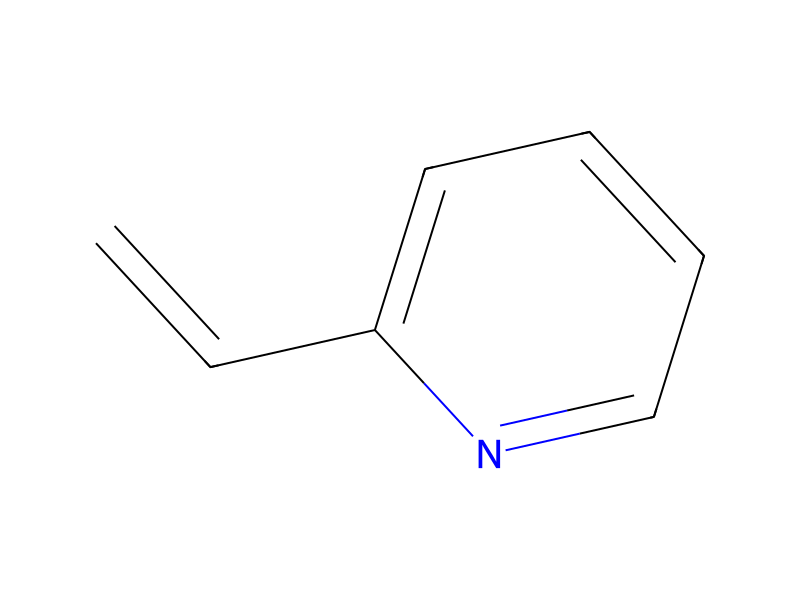
2-Vinylpyridine
100-69-6C=Cc1ccccn1KGIGUEBEKRSTEW-UHFFFAOYSA-NSee also: Vinylpyridines, stabilized (annotation moved to).
100-69-6、1337-81-1、25014-15-7、27476-03-5DTXSID1026667CHEMBL2134875log Kow= 1.54
1.39
0.9985 @ 20 °C/0 °C
Relative density (water = 1): 1.00
Very soluble in alcohol, ether, acetone
Soluble in oxygenated and chlorinated solvents
In water, 2.75X10+4 mg/l @ 20 °C
Solubility in water: moderate
The Guide in the 42 °C
42 °C
159.5 °C
159-160 °C
안전 정보는 참고용이며, 공급업체의 물질안전보건자료(SDS), 관련 법규 및 전문가 평가를 대체하지 않습니다.
This chemical does not meet GHS hazard criteria for 26.4% (57 of 216) of reports.
Danger
H226 (55.6%): Flammable liquid and vapor [Warning Flammable liquids]
P210, P233, P240, P241, P242, P243, P260, P261, P262, P264, P264+P265, P270, P271, P272, P273, P280, P301+P316, P301+P317, P301+P330+P331, P302+P352, P302+P361+P354, P303+P361+P353, P304+P340, P305+P354+P338, P316, P317, P321, P330, P333+P317, P361+P364, P362+P364, P363, P370+P378, P391, P403+P233, P403+P235, P405, and P501 (click each P-code to see the statement)
Aggregated GHS information provided per 216 reports by companies from 13 notifications to the ECHA C&L Inventory. Each notification may be associated with multiple companies.
Danger
Chemical: Pyridine, 2-ethenyl-
Pyridine, 2-ethenyl- is listed on the EPA's Chemical Data Reporting (CDR) system. Manufacturers and importers of Pyridine, 2-ethenyl- are required to report information about their production and use of this chemical to the EPA under the Toxic Substances Control Act (TSCA). (40 eCFR Part 711)
REACH registered substance: 2-vinylpyridine (EC: 202-879-8)
2-Vinylpyridine (stabilized with 4-t-butylpyrocatechol): Does not have an individual approval but may be used under an appropriate group standard
A skin, eye, nose, and mucous membrane irritant; May cause skin burns and sensitization; Emergency treatment: Pyridine; Pyridine is an irritant that causes CNS depression after ingestion of 1/2 cup or inhalation of 6-12 ppm; It can cause liver and kidney injury; [HSDB] May cause delayed burns to skin; A severe eye and respiratory tract irritant; May cause skin sensitization; [ICSC] A corrosive substance that can cause injury to the skin, eyes, and respiratory tract; Inhalation may cause chemical pneumonitis; May be absorbed through skin; [Alfa Aesar MSDS] May cause burns; Toxic if swallowed; Harmful if inhaled; May cause allergic skin reactions; [Aldrich MSDS] Vinylpyridines, stabilized (UN3073) has warning of explosive polymerization; [ERG 2016] See Pyridine.
... /IT IS/ ABSORBED FROM GI TRACT, SKIN & RESP TRACT IN ... /RATS & MICE/.
MAJORITY OF /PYRIDINE/ DERIVATIVES TESTED ... PENETRATE INTACT GUINEA PIG SKIN READILY. AMINOPYRIDINES, VINYLPYRIDINES & 4-PICOLINE PENETRATE SKIN MOST RAPIDLY & AMYL DERIV & 5-ETHYL-2-METHYLPYRIDINE ARE LEAST READILY ABSORBED. /VINYLPYRIDINES/
PYRIDINE & ITS ALKYL DERIVATIVES ARE ABSORBED FROM GI TRACT, INTRAPERITONEAL CAVITY & LUNGS. PERITONEAL ABSORPTION IS APPARENTLY ONLY SLIGHTLY MORE RAPID & COMPLETE THAN GI ABSORPTION ... IN GENERAL THE BASES ARE RAPIDLY ABSORBED THROUGH INTACT SKIN. /ALKYL DERIVATIVES OF PYRIDINE/
Used as an acrylic fiber comonomer, grafting reagent (ashless lubricant dispersants), and chemical intermediate; [HSDB]
Acrylic fiber comonomer; grafting reagent (ashless lubricant dispersants)
Used as a chemical intermediate for the synthesis of: 2-ethylpyridine; vinylpyridine copolymers, latex
2-Vinylpyridine is a large-volume specialty chemical used primarily for manufacturing terpolymers, e.g., styrene, butadiene, and vinylpyridine, used to coat fabric cords of tires and fabric-reinforced rubber products, such as belts.
2023: 1,000,000 - <5,000,000 lb
(1972) PROBABLY GREATER THAN 4.54X10+5 GRAMS
(1975) 2.0X10+9 GRAMS (CONSUMED IN TERPOLYMER)
...demand is as much as 3000 t annually
Alpha-picoline + formaldehyde (condensation/dehydration)
...manufactured by treatment of 2-methylpyridine with aqueous formaldehyde, followed by dehydration of the resulting intermediate alcohol. The reaction is carried out at 150 to 200 °C in an autoclave. After removal of unreacted 2-methylpyridine by distillation, concentrated aqueous sodium hydroxide is added to the residue and the resultant mixture is distilled under reduced pressure. During distillation, the dehydration of 2-(2-pyridyl)ethanol occurs to give 2-vinylpyridine as a distillate, which can be purified further by fractional distillation under reduced pressure in the presence of an inhibitor such as 4-tert-butylcatecohol.
불러오는 중…
DECOMPOSITION BY HEAT IS ACCOMPANIED BY RELEASE OF DANGEROUS CYANIDE FUMES.
When heated to decomp ... emits toxic fumes of /nitrogen oxides/.
Odor Threshold Low: 0.3 [ppm]
THE ODOR OF 2-VINYLPYRIDINE CAN BE DETECTED @ LEVELS OF APPROX 0.3 PPM & IS QUITE STRONG @ 0.5 PPM.
1.16 mg/cu m (odor low); 1.94 mg/cu m (odor high).
The odor of 2-vinylpyridine can be detected at exposure levels below 1 ppm (v/v). The unpleasant odor can be tolerated at concentrations that can produce acute symptoms and irritation. Special precautions should be taken to avoid skin and eye contact, as well as inhalation of the vapor.
The substance violently polymerizes. This generates fire or explosion hazard. May decompose explosively on shock, friction or concussion. Decomposes on heating and on burning. This produces toxic fumes of cyanide and nitrogen oxides. Reacts violently with strong oxidants.
/GUIDE 131P: FLAMMABLE LIQUIDS-TOXIC/ Health: TOXIC; may be fatal if inhaled, ingested or absorbed through skin. Inhalation or contact with some of these materials will irritate or burn skin and eyes. Fire will produce irritating, corrosive and/or toxic gases. Vapors may cause dizziness or suffocation. Runoff from fire control or dilution water may cause pollution. /Vinylpyridines, inhibited; Vinylpyridines, stabilized/
/GUIDE 131P: FLAMMABLE LIQUIDS-TOXIC/ Fire or Explosion: HIGHLY FLAMMABLE: Will be easily ignited by heat, sparks or flames. Vapors may form explosive mixtures with air. Vapors may travel to source of ignition and flash back. Most vapors are heavier than air. They will spread along ground and collect in low or confined areas (sewers, basements, tanks). Vapor explosion and poison hazard indoors, outdoors or in sewers. Those substances designated with a "P" may polymerize explosively when heated or involved in a fire. Runoff to sewer may create fire or explosion hazard. Containers may explode when heated. Many liquids are lighter than water. /Vinylpyridines, inhibited; Vinylpyridines, stabilized/
/GUIDE 131P: FLAMMABLE LIQUIDS-TOXIC/ Public Safety: CALL Emergency Response Telephone Number ... . As an immediate precautionary measure, isolate spill or leak area for at least 50 meters (150 feet) in all directions. Keep unauthorized personnel away. Stay upwind. Keep out of low areas. Ventilate closed spaces before entering. /Vinylpyridines, inhibited; Vinylpyridines, stabilized/
/GUIDE 131P: FLAMMABLE LIQUIDS-TOXIC/ Protective Clothing: Wear positive pressure self-contained breathing apparatus (SCBA). Wear chemical protective clothing that is specifically recommended by the manufacturer. It may provide little or no thermal protection. Structural firefighters' protective clothing provides limited protection in fire situations ONLY; it is not effective in spill situations where direct contact with the substance is possible. /Vinylpyridines, inhibited; Vinylpyridines, stabilized/
For more DOT Emergency Guidelines (Complete) data for 2-VINYLPYRIDINE (8 total), please visit the HSDB record page.
Vinyl pyridine
C: Compounds that autopolymerize due to peroxide formation if inhibitors are depleated or not present
Kelly
Flam. Liq. 3 (55.6%)
Flammable liquids - Category 3
No person may /transport,/ offer or accept a hazardous material for transportation in commerce unless that person is registered in conformance ... and the hazardous material is properly classed, described, packaged, marked, labeled, and in condition for shipment as required or authorized by ... /the hazardous materials regulations (49 CFR 171-177)./
The International Air Transport Association (IATA) Dangerous Goods Regulations are published by the IATA Dangerous Goods Board pursuant to IATA Resolutions 618 and 619 and constitute a manual of industry carrier regulations to be followed by all IATA Member airlines when transporting hazardous materials.
The International Maritime Dangerous Goods Code lays down basic principles for transporting hazardous chemicals. Detailed recommendations for individual substances and a number of recommendations for good practice are included in the classes dealing with such substances. A general index of technical names has also been compiled. This index should always be consulted when attempting to locate the appropriate procedures to be used when shipping any substance or article.
UN 3073; Vinylpyridines, inhibited
IMO 6.1; Vinylpyridines, inhibited
Fresh air, rest. Refer for medical attention.
Remove contaminated clothes. Rinse and then wash skin with water and soap. Refer for medical attention .
First rinse with plenty of water for several minutes (remove contact lenses if easily possible), then refer for medical attention.
Rinse mouth. Give one or two glasses of water to drink. Refer for medical attention .
SRP: At the time of review, criteria for land treatment or burial (sanitary landfill) disposal practices are subject to significant revision. Prior to implementing land disposal of waste residue (including waste sludge), consult with environmental regulatory agencies for guidance on acceptable disposal practices.
ALL OPERATIONS INVOLVING HANDLING ... SHOULD BE CONDUCTED IN WELL-VENTILATED CONDITIONS; PROCESS PLANT SHOULD ... BE ENCLOSED & FITTED WITH LOCAL EXHAUST VENTILATION.
SRP: The scientific literature for the use of contact lenses in industry is conflicting. The benefit or detrimental effects of wearing contact lenses depend not only upon the substance, but also on factors including the form of the substance, characteristics and duration of the exposure, the uses of other eye protection equipment, and the hygiene of the lenses. However, there may be individual substances whose irritating or corrosive properties are such that the wearing of contact lenses would be harmful to the eye. In those specific cases, contact lenses should not be worn. In any event, the usual eye protection equipment should be worn even when contact lenses are in place.
ACUTE TOXICITY INFORMATION ON ANIMALS & EXPERIENCE WITH INTERMITTENT EXPOSURES IN MAN SHOW THAT MORE THAN ORDINARY CARE IS NEEDED TO AVOID SKIN CONTACT & INHALATION.
SRP: Contaminated protective clothing should be segregated in such a manner so that there is no direct personal contact by personnel who handle, dispose, or clean the clothing. Quality assurance to ascertain the completeness of the cleaning procedures should be implemented before the decontaminated protective clothing is returned for reuse by the workers. Contaminated clothing should not be taken home at end of shift, but should remain at employee's place of work for cleaning.
TERRESTRIAL FATE: Based on a classification scheme(1), an estimated Koc value of 160(SRC), determined from a log Kow of 1.54(2) and a regression-derived equation(3), indicates that 2-vinylpyridine is expected to have moderate mobility in soil(SRC). 2-Vinylpyridine has a pKa of 4.98(6), which indicates that this compound will partially exist in the protonated form in moist acidic soils, and cations adsorb more strongly to soils than neutral molecules. Therefore, the mobility of 2-vinylpyridine is expected to be much lower in acidic soils than in neutral or alkaline soil(SRC). Volatilization of the neutral species of 2-vinylpyridine from moist soil surfaces is expected to be an important fate process(SRC) given an estimated Henry's Law constant of 3.6X10⁻⁶ atm-cu m/mole(SRC), using a fragment constant estimation method(4), however, the protonated form will not volatilize(SRC). The potential for volatilization of 2-vinylpyridine from dry soil surfaces may exist(SRC) based upon an estimated vapor pressure of 2.6 mm Hg(SRC), determined from a fragment constant method(5). Biodegradation of 2-vinylpyridine in soil is not expected to be a major fate process based on a single aerobic screening test showing that 2-vinylpyridine was not biodegraded over a 4-week period(2).
AQUATIC FATE: Based on a classification scheme(1), an estimated Koc value of 160(SRC), determined from a log Kow of 1.54(2)and a regression-derived equation(3), indicates that 2-vinylpyridine is not expected to adsorb to suspended solids and sediment(SRC). Volatilization from water surfaces is expected(3) based upon an estimated Henry's Law constant of 3.6X10⁻⁶ atm-cu m/mole(SRC), developed using a fragment constant estimation method(4). Using this Henry's Law constant and an estimation method(3), volatilization half-lives for a model river and model lake are 10 and 80 days, respectively(SRC). The pKa of 2-vinylpyridine is 4.98(7), indicating this compound will partially exist in the ionized form in acidic waters and cations do not volatilize(SRC). According to a classification scheme(5), a estimated BCF of 3(SRC), from its log Kow(2) and a regression-derived equation(6), suggests the potential for bioconcentration in aquatic organisms is low(SRC). Biodegradation of 2-vinylpyridine in water is not expected to be a major fate process based on a single aerobic screening test showing that 2-vinylpyridine was not biodegraded over a 4 week period(2).
ATMOSPHERIC FATE: According to a model of gas/particle partitioning of semivolatile organic compounds in the atmosphere(1), 2-vinylpyridine, which has an estimated vapor pressure of 2.6 mm Hg at 25 °C(SRC), determined from a fragment constant method(2), is expected to exist solely as a vapor in the ambient atmosphere. Vapor-phase 2-vinylpyridine is degraded in the atmosphere by reaction with photochemically- produced hydroxyl radicals(SRC); the half-life for this reaction in air is estimated to be 6.8 hours(SRC), calculated from its rate constant of 5.67X10⁻¹¹ cu cm/molecule-sec at 25 °C(3). Vapor-phase 2-vinylpyridine is also degraded in the atmosphere by reaction with ozone(SRC); the half-life for this reaction in air is estimated to be 13 hours(SRC), calculated from its rate constant of 2.1X10⁻¹⁷ cu cm/molecule-sec at 25 °C(SRC), determined using a structure estimation method(3).
Cough. Headache. Nausea. Sore throat.
MAY BE ABSORBED! Redness. Serious skin burns. Pain. Further see Inhalation.
Redness. Pain.
Further see Inhalation.
2-Vinylpyridine was detected in 2 of 21 industrial categories of wastewater effluents(1). Extract from the wastewater of a public owned sewage treatment works contained 2-vinylpyridine at an average concn of 68 mg/l; and the extract from wastewater of a rubber processing facility contained 2-vinylpyridine at an average concn of 209 mg/l(1).
The Koc of 2-vinylpyridine is estimated as 160(SRC), using a measured log Kow of 1.54(1) and a regression-derived equation(2). According to a classification scheme(3), this estimated Koc value suggests that 2-vinylpyridine is expected to have moderate mobility in soil. The pKa of 2-vinylpyridine is 4.98(4), which indicates that this compound will partially exist in the protonated form under acidic conditions. Cations adsorb more strongly to soil surfaces than neutral molecules thus adsorption of 2-vinylpyridine is expected to be greater in acidic soils(SRC).
2-Vinylpyridine (CAS # 100-60-6, 97.34%) was evaluated for subchronic oral toxicity in Crl:CD rats (30/sex/dose level) gavaged with doses of 0, 20, 60, or 180 mg/kg/day, 5 days/week for approximately 43 or 92 days. Three female rats (2/30 at 180 mg/kg/day, 1/30 at 60 mg/kg/day) died of a potential toxic cause on Days 15, 65, and 42, respectively. High dose rats exhibited clinical signs including convulsions and sialorrhea. A high dose regimen was also associated with diminished weight gain with decreased feed consumption in males, reduced feed consumption in 92-day females, slight platelet count elevations (males and females), and slightly depressed aspartate aminotransferase activity in males. On necropsy, "relevent lesions" in the study lethalities included pulmonary congestion and hemorrhage and sanguinous nasal discharge in the 65-day high dose female; congested lungs in the 15-day high dose female; salivation and hyperemic lungs in the 42-day 60 mg/kg female. While microscopic examination suggested gavage error as cause of death in 2 lethalities, one high-dose female exhibited slight congestion of lungs, liver, and kidneys, and minor hemorrhage of the thymus. At terminal necropsy, organ weights were increased, including relative liver (60, 180 mg/kg/day males and females), kidney (all-dose males and 180 mg/kg females), brain (180 mg/kg/day males), adrenal (20, 180 mg/kg/day males), testes (180 mg/kg/day males), and ovary (180 mg/kg/day females) weights. Increased organ weights were also significant on Interim 43-day sacrifice, including relative liver (60, 180 mg/kg males; 180 mg/kg females), kidney (180 mg/kg males), brain (20, 180 mg/kg males), adrenal (20, 180 mg/kg/day males), and testes (20, 180 mg/kg/day males) weights; absolute heart and relative heart to brain ratios were significantly decreased in 92-day males, while 43-day 20 mg/kg/day females had increased relative heart to brain ratios. Both 60 and 180 mg/kg/day regimens in males and females were associated with hemorrhage and thickening of the epithelial nonglandular stomach, the epithelial expansion attributable to acanthosis, hyperkeratosis, acute inflammatory cell infiltrates, and cytodegenerative necrosis on microscopic exam. Treatment-related lesions were not observed in 20 mg/kg/day males or females.
BRIEF EXPOSURES TO UNDETERMINED CONCN OF /2-VINYLPYRIDINE/ DURING LAB USE ... CAUSED EYE, NOSE & THROAT IRRITATION ... HEADACHE, NAUSEA, NERVOUSNESS, & ANOREXIA. SYSTEMIC SYMPTOMS ARE MILD TO TRANSIENT RESEMBLING THOSE OBSERVED WITH PYRIDINE EXPOSURES ... APPARENTLY PRODUCED BY LOWER CONCN.
DIRECT SKIN CONTACT WITH THE LIQUID RESULTS IN BURNING PAIN, FOLLOWED BY FAIRLY SEVERE SKIN BURNS IN SPITE OF IMMEDIATE ATTEMPTS TO CLEANSE THE SKIN. BURNS DEVELOP REDDISH BROWN COLOR THAT DISAPPEARS IN ... ABOUT 1 MO. SKIN SENSITIZATION HAS BEEN OBSERVED ... .
AT ... CONCN ... /ABOVE 0.5 PPM 2-VINYLPYRIDINE HAS/ A VERY UNPLEASANT NAUSEATING ODOR. ... THE UNPLEASANT ODOR CAN BE TOLERATED @ CONCN THAT WILL PRODUCE ACUTE SYMPTOMS & IRRITATIONS.
INHALATION TOXICITY OF 4-VINYLPYRIDINE IS GREATER THAN ... 2-VINYLPYRIDINE, & 4-VINYLPYRIDINE IS DEFINITELY MORE IRRITATING TO MUCOUS MEMBRANES.
For more Human Toxicity Excerpts (Complete) data for 2-VINYLPYRIDINE (6 total), please visit the HSDB record page.
2-Vinylpyridine's production and use as a monomer for polyvinylpyridine polymers used as tire-cord binders(1), in synthetic rubbers, photographic film, ion exchange resins as well as in pharmaceuticals(2) may result in its release to the environment through various waste streams(SRC).
An estimated BCF of 3 was calculated for 2-vinylpyridine(SRC), using a log Kow of 1.54(1) and a regression-derived equation(2). According to a classification scheme(3), this BCF suggests the potential for bioconcentration in aquatic organisms is low(SRC).
The Henry's Law constant for 2-vinylpyridine is estimated as 3.6X10⁻⁶ atm-cu m/mole(SRC) using a fragment constant estimation method(1). This Henry's Law constant indicates that 2-vinylpyridine is expected to volatilize from water surfaces(2). Based on this Henry's Law constant, the volatilization half-life from a model river (1 m deep, flowing 1 m/sec, wind velocity of 3 m/sec)(2) is estimated as 10 hours(SRC). The volatilization half-life from a model lake (1 m deep, flowing 0.05 m/sec, wind velocity of 0.5 m/sec)(2) is estimated as 80 days(SRC). 2-Vinylpyridine's Henry's Law constant(1) indicates that volatilization from moist soil surfaces may occur(SRC). However, 2-vinylpyridine is a weak base with a pKa of 4.98(4), which indicates this compound will partially exist in the protonated form in acidic conditions; cations do not volatilize from either moist soil or water surfaces. The potential for volatilization of 2-vinylpyridine from dry soil surfaces may exist(SRC) based upon an estimated vapor pressure of 2.6 mm Hg(SRC), determined from a fragment constant method(3).
Synthetic Rubber Manufacturing
Pyridine, 2-ethenyl-: ACTIVE
... been investigated for use in synthetic rubbers, photographic film, ion exchange resins, and other polymers as well as pharmaceuticals.
용도2-Vinylpyridine is a pyridine deriviative used in the preparation of poly(2-vinylpyridine) via radical polymerization. 2-Vinylpyridine is used to improve effectiveness of protective polymer coatings o n metals. 2-Vinylpyridine is an impurity of Betahistine (B324000).
일반 설명2-Vinylpyridine (2VP) is a water soluble pyridine derivative that can be used in the synthesis of poly(2-vinylpyridine) (P2VP) by anionic polymerization. It can be industrially prepared by treatment of 2-methylpyridine with an aqueous solution of formaldehyde in a temperature range of 150-200°C.
알파-피콜린 + 폼알데하이드 (압축/탈수) 알코올을 중간체로하여 탈수하는 과정을 거친뒤, 폼알데히드 수용액에 2-메틸피리딘을 약품처리하여 제조함. 이 반응은 고압 증기 멸균기(autoclave)에서 150~200 ℃의 온도로 이루어짐, 증류에 의해 반응하지 않은 2-메틸피리딘을 제거한 후에, 농축된 수산화나트륨 수용액을 첨가하고 압력을 감소시켜 혼합물을 증류시킴, 2-(2-피리딜)에탄올의 탈수로 증류된 물질인 2-비닐피리딘을 얻을 수 있으며, 4-tert-뷰틸카테콜과 같은 방해물질이 존재하는 상태에서 압력이 감소될 때 증류를 하여 추가적으로 정화를 시킬 수 있음