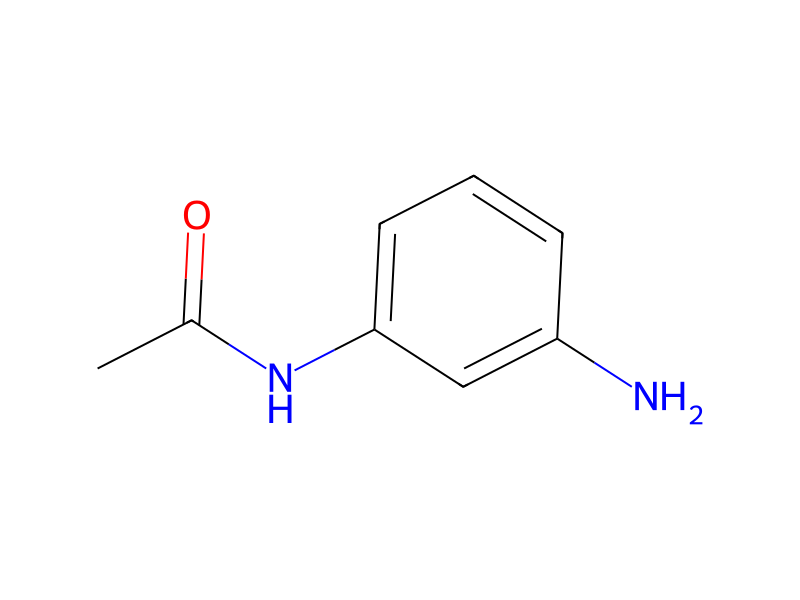
3'-아미노아세트아닐리드
m-Aminoacetanilide
기본 정보
- CAS
102-28-3- 표준 SMILES
CC(=O)Nc1cccc(N)c1- InChIKey
PEMGGJDINLGTON-UHFFFAOYSA-N- 분자식
- C8H10N2O
- 평균 분자량
- 150.18 g/mol
- 단동위원소 질량
- 150.07931295
개요
M-aminoacetanilide is a gray solid. (NTP, 1992)
이름 및 식별자
- 우선 이름
- m-Aminoacetanilide
- IUPAC
- N-(3-aminophenyl)acetamide
- 현지명
- 3'-아미노아세트아닐리드
- 영어명
- N1-(3-Aminophenyl)acetamide
- 분자식
- C8H10N2O
- 분자량
- 150.18
이름 및 동의어
N-(3-Aminophenyl)acetamide102-28-33'-AminoacetanilideM-AMINOACETANILIDE3-AcetamidoanilineAcetamide, N-(3-aminophenyl)-M-Acetaminoanilinem-(Acetylamino)anilineN-Acetyl-m-phenylenediamine3-Amino-N-acetylaniline3-Aminoacetanilid3-Acetylaminoaniline
이름 더 보기
3'-아미노아세트아닐리드N-(3-아미노페닐)아세타마이드N-아세틸-m-페닐엔다이아민META AMINO ACETANILIDE3-AMINOACETANILIDEFR-2203AKOS BB-8162WLN: ZR CMV13-AcetamidoaniLASISCHEM B52481
Acetanilide, 3'-amino-1-Amino-3-(acetylamino)benzene3-Aminoacetanilid [Czech]3-(Acetylamino)anilinem-AcetamidoanilineN-Acetyl-m-fenylendiaminCCRIS 4574NSC 165576
데이터베이스 식별자
- CAS
102-28-3- PubChem CID
- 7604
- DTXSID
DTXSID2024454- ChEMBL
CHEMBL1606123- UNII
- Q5K7HYS7JJ
- EC Number
- 203-021-5
- Nikkaji
- J43.351I
물성
구조 계산 물성
- XLogP
- 0.9
- 극성 표면적
- 55.1 Ų
- 수소 결합 공여자 수
- 2
- 수소 결합 수용자 수
- 2
- 회전 가능 결합 수
- 1
- 무거운 원자 수
- 11
- 형식 전하
- 0
- 복잡도
- 147
실험 및 물리화학적 성질
Chemical ClassesNitrogen Compounds -> Other Aromatics (Nitrogen)
SpringerMaterials Properties13C nuclear magnetic resonance spectrum
Solubility10 to 50 mg/mL at 75 °F (NTP, 1992)
Boiling PointDecomposes at 1449 °F (NTP, 1992)
Melting Point187.7 to 189.5 °F (NTP, 1992)
Physical Description
M-aminoacetanilide is a gray solid. (NTP, 1992)
Gray solid; [CAMEO] Light brown crystalline powder; [Acros Organics MSDS]
물리화학적 성질
- 녹는점
- 86 · 86-88 °C(lit.)
- 끓는 점
- 271.72 °C · 271.72°C (rough estimate)
- 밀도
- 1.1392 · 1.1392 (rough estimate)
- 굴절률
- 1.618 · 1.6180 (estimate)
- 저장 조건
- Keep in dark place,Inert atmosphere,Room temperature
- 물리적 상태
- powder to crystal
- 산도 계수 (pKa)
안전 및 규제
안전 정보는 참고용이며, 공급업체의 물질안전보건자료(SDS), 관련 법규 및 전문가 평가를 대체하지 않습니다.
GHS 분류
GHS Classification
Warning
H302 (21.1%): Harmful if swallowed [Warning Acute toxicity, oral]
P261, P264, P264+P265, P270, P271, P280, P301+P317, P302+P352, P304+P340, P305+P351+P338, P319, P321, P330, P332+P317, P337+P317, P362+P364, P403+P233, P405, and P501 (click each P-code to see the statement)
Aggregated GHS information provided per 57 reports by companies from 8 notifications to the ECHA C&L Inventory. Each notification may be associated with multiple companies.
유해성 정보
Regulatory InformationREACH registered substance: 3'-aminoacetanilide (EC: 203-021-5)
Fire HazardsFlash point data concerning this compound are not available, however, it is probably combustible. (NTP, 1992)
Health HazardsACUTE/CHRONIC HAZARDS: When heated to decomposition this compound emits toxic fumes. (NTP, 1992)
Hazards SummaryA mild eye irritant; [RTECS] An irritant; [Acros Organics MSDS] See Acetanilide.
Reactive GroupAmides and Imides
Reactivity Profile
Aromatic amines are chemical bases. They neutralize acids to form salts plus water. These acid-base reactions are exothermic. The amount of heat that is evolved per mole of amine in a neutralization is largely independent of the strength of the amine as a base. Amines may be incompatible with isocyanates, halogenated organics, peroxides, phenols (acidic), epoxides, anhydrides, and acid halides. Flammable gaseous hydrogen is generated by amines in combination with strong reducing agents, such as hydrides.
Air and Water ReactionsSoluble in water.
화학 및 산업
용도 및 제조
UsesUsed in organic synthesis; [NTP]
General Manufacturing InformationAcetamide, N-(3-aminophenyl)-: ACTIVE
응용 분야
용도3'-Aminoacetanilide is mainly used as reaction intermediates dyes and disperse dyes.
일반 설명Gray solid.
상·하류 제품 정보
상류 원료
관련 반응
105건


화합물 노트
불러오는 중…