Morpholine
모르폴린 · 1-옥사-4-아자시클로헥산 · 디에틸렌옥스이미드 · 디에틸렌이미드산화물 · 디에틸엔이미드산화물 · 몰포린 · 테트라히드로-1,4-옥사진 · 테트라히드로-1,4-이소옥사진
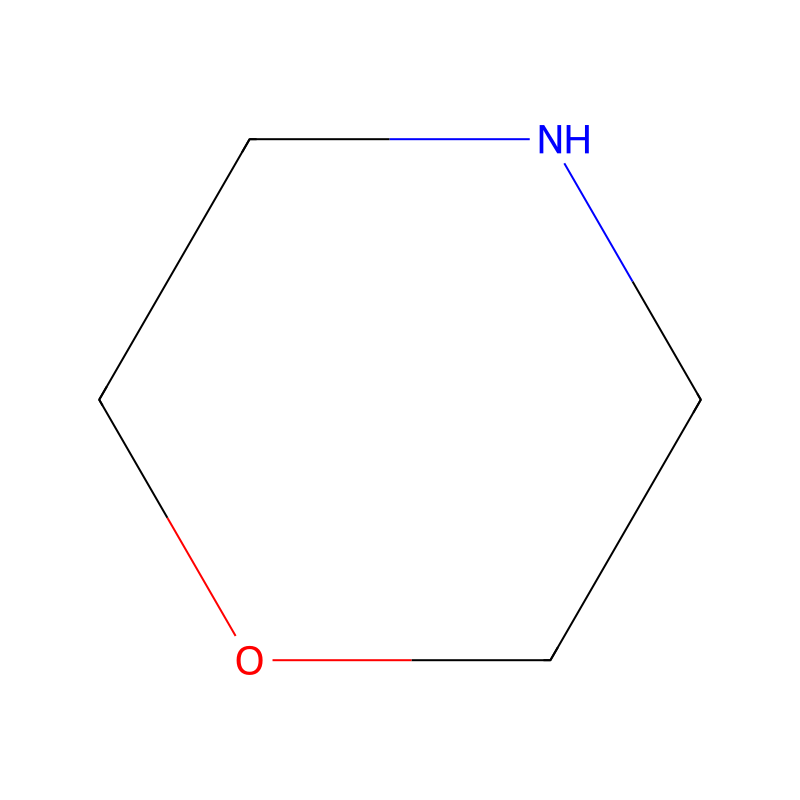
식별자 및 물리적 특성
| CAS No. | 110-91-8 |
|---|---|
| 분자식 | C4H9NO |
| 평균 분자량 | 87.12 g/mol |
| 단동위원소 질량 | 87.06841391 g/mol |
| SMILES | C1COCCN1 |
| InChIKey | YNAVUWVOSKDBBP-UHFFFAOYSA-N |
| PubChem CID | 8083 |
| ChEMBL | CHEMBL276518 |
| ChEBI | CHEBI:34856 |
| EC No. | 203-815-1 |
| DTXSID | DTXSID2025688 |
| 현지명 | 모르폴린 |
화학 및 물리적 성질
| XLogP | -0.9 |
|---|---|
| 극성 표면적 | 21.3 |
| 수소 결합 공여자 수 | 1 |
| 수소 결합 수용자 수 | 2 |
| 회전 가능 결합 수 | 0 |
| 무거운 원자 수 | 6 |
| 형식 전하 | 0 |
| 복잡도 | 34 |
| pH | Strong base11.2 (H2O)(undiluted) |
| LogP(분배 계수) | log Kow = -0.86 |
| 냄새 | Characteristic aminePenetratingWeak, ammonia- or fish-like odor특유의 아민 냄새 |
| 밀도 | 1 at 68 °F (USCG, 1999)1.007 at 20 °C/4 °CBulk density = 8.34 lb/gal at 20 °CRelative density (water = 1): 1.01.007 @ 20°C0.996 g/mL at 25 °C (lit.) |
| Viscosity | 2.23 cP at 20 °C |
| Color/Form | Colorless liquidMobile liquidColorless liquid [Note: A solid below 23 degrees F]. |
| 용해도 | Soluble (NTP, 1992)Solluble in organic solventsImmiscible with concn sodium hydroxide solnmiscible with acetone, benzene, ether, castor oil, methanol, ethanol, ethylene glycol, 2-hexanone, linseed oil, turpentine, pine oilmiscible with water with evolution of some heatIn water, 1.00X10+6 mg/L /miscible/1000 mg/mLSolubility in water: miscible물: 섞일 수 있음 |
| Corrosivity | Corrosive to metals |
| 인화점 | 100 °F (NTP, 1992)38 °CAnhydrous: 35 °C (closed cup), 38 °C (open cup)88% solution: 42 °C35 °C c.c.98 °F (open cup)(oc) 98 °F96 °F |
| 끓는 점 | 264 °F at 760 mmHg (NTP, 1992)128 °C129 °C128.9 °C @760 [mm Hg]126.0-130.0 °C 129 °C (lit.) |
| Decomposition | When heated to decomposition it emits highly toxic fumes of /nitric oxide/. |
| 녹는점 | 23.2 °F (NTP, 1992)-4.8 °CMP: 145-147 °Cprisms from alcoholsparingly soluble in water /Morpholine picrate/Soluble in water, methanol, ethanol, acetone, ethyl acetate, benzene, chloroformpractically insoluble in toluene, xylene, ether, petroleum ether, carbon tetrachlorideMP: 110-111 °Ccrystals from ethanol /Morpholine salicylate/-4.9 °C-5 °C-7--5 °C (lit.) |
| 증기 밀도 | 3 (vs air) |
| 증기압 | 31 mm Hg ( 38 °C) |
| 굴절률 | n20/D 1.454(lit.) |
| 저장 조건 | Store below +30°C. |
| 물리적 상태 | 액체 |
| pKa(산도 계수) | 8.33(at 25℃) |
| 색상 | APHA: ≤15 |
| 비중 | 0.996 |
| 폭발한계 | 1.4-15.2%(V) |
| 용해도 | 혼용 가능 |
| 비열 | Cp(liquid): 1.89 J/(g·K), at 25℃ |
| Merck | 14,6277 |
| BRN | 102549 |
| 헨리 상수 | 1.9×10² mol/(m3Pa) at 25℃, Nguyen (2013) |
| 유전율 | 7.3(25℃) |
| 안정성 | 안정적인. 가연성. 강산화제, 강산, 산 염화물, 산 무수물과 호환되지 않습니다. 흡습성. |
| 주요 응용 | 청소용품화장품환경음식 및 음료개인 위생 관리 |
| 화장품 원료 기능 | 버퍼링 |
| InChI | 1S/C4H9NO/c1-3-6-4-2-5-1/h5H,1-4H2 |
| InChIKey | YNAVUWVOSKDBBP-UHFFFAOYSA-N |
| SMILES | C1COCCN1 |
| LogP(분배 계수) | -0.860 |
| NIST | Morpholine(110-91-8) |
| EPA | Morpholine (110-91-8) |
화학적 성질
Morpholine is a colorless to yellow liquid with a weak ammonia or fish-like odor. The odor threshold is 0.01 ppm. The reactivity of morpholine is mainly due to its secondary amine group. It readily undergoes organic condensations, alkylations, and arylations, resulting in the formation of various N-substituted morpholine compounds. Ethers are relatively chemically inert, hence the oxygen is of relatively little consequence except as a member of the heterocyclic ring (Texaco Chemical Co. 1982).
안전 및 규제
| GHS 분류 | DangerH226: Flammable liquid and vapor [Warning Flammable liquids]H302: Harmful if swallowed [Warning Acute toxicity, oral]H312: Harmful in contact with skin [Warning Acute toxicity, dermal]H314: Causes severe skin burns and eye damage [Danger Skin corrosion/irritation]H332: Harmful if inhaled [Warning Acute toxicity, inhalation]P210, P233, P240, P241, P242, P243, P260, P261, P264, P270, P271, P280, P301+P317, P301+P330+P331, P302+P352, P302+P361+P354, P303+P361+P353, P304+P340, P305+P354+P338, P316, P317, P321, P330, P362+P364, P363, P370+P378, P403+P235, P405, and P501 (click each P-code to see the statement) |
|---|---|
| 규제 정보 | Chemical: MorpholineMorpholine is listed on the EPA's Chemical Data Reporting (CDR) system. Manufacturers and importers of Morpholine are required to report information about their production and use of this chemical to the EPA under the Toxic Substances Control Act (TSCA). (40 eCFR Part 711)Status: Active Update: 25-04-2023 https://echa.europa.eu/registration-dossier/-/registered-dossier/13364Status: Active Update: 29-06-2021 https://echa.europa.eu/registration-dossier/-/registered-dossier/32205Morpholine: HSNO Approval: HSR001204 Approved with controlsThe New Jersey Worker and Community Right to Know Act requires public and private employers to provide information about hazardous substances at their workplaces. (N.J.S.A. 34:5A-1 et. seq.) |
| 기타 안전 정보 | IMAP assessments - Morpholine: Human health tier II assessmentIMAP assessments - Morpholine: Environment tier I assessment |
| 운송 라벨(DOT) | Corrosive Flammable Liquid |
| 화재 위험 | FLAMMABLE. Flashback along vapor trail may occur. Vapor may explode if ignited in an enclosed area. Irritating vapors are generated when heated. Vapor is heavier than air and may travel some distance to source of ignition and flash back. (USCG, 1999)· Flammable/combustible material.· May be ignited by heat, sparks or flames.· Vapors may form explosive mixtures with air.· Vapors may travel to source of ignition and flash back.· Most vapors are heavier than air. They will spread along the ground and collect in low or confined areas (sewers, basements, tanks, etc.).· Vapor explosion hazard indoors, outdoors or in sewers.· Those substances designated with a (P) may polymerize explosively when heated or involved in a fire.· Runoff to sewer may create fire or explosion hazard.· Containers may explode when heated.· Many liquids will float on water.Flammable. Gives off irritating or toxic fumes (or gases) in a fire. Above 35 °C explosive vapour/air mixtures may be formed. |
| 화재 가능성 | A very dangrous fire hazard when exposed to flame, heat, or oxidizers. |
| 건강 유해성 | VAPOR: Irritating to eyes, nose and throat. If inhaled, will cause nausea, headache, or difficult breathing. LIQUID: Irritating to skin and eyes. (USCG, 1999)· May cause toxic effects if inhaled or ingested.· Contact with substance may cause severe burns to skin and eyes.· Fire will produce irritating, corrosive and/or toxic gases.· Vapors may cause dizziness or asphyxiation, especially when in closed or confined areas.· Runoff from fire control or dilution water may cause environmental contamination. |
| 유해성 요약 | Liver damage is prominent in animals exposed to high concentrations. Skin, eye, and respiratory irritation, but no chronic health effects, were reported after occupational exposure. [ACGIH] Corrosive to skin[Quick CPC] A corrosive substance that can cause pulmonary edema[ICSC] |
| 운송 번호 및 가이드(DOT) | 2054 132 |
| FDA 요건 | Morpholine is a food additive permitted for direct addition to food for human consumption, as long as 1) the quantity of the substance added to food does not exceed the amount reasonably required to accomplish its intended physical, nutritive, or other technical effect in food, and 2) any substance intended for use in or on food is of appropriate food grade and is prepared and handled as a food ingredient.Morpholine is an indirect food additive for use only as a component of adhesives. |
| 반응성 그룹 | Amines, Phosphines, and Pyridines |
| EC 분류 | Symbol: CR: 10-20/21/22-34S: (1/2)-23-36-45 |
| UN 분류 | UN Hazard Class: 8UN Subsidiary Risks: 3UN Pack Group: I |
| 소화 | Excerpt from ERG Guide 132 [Flammable Liquids - Corrosive]:Some of these materials may react violently with water.SMALL FIRE: Dry chemical, CO2, water spray or alcohol-resistant foam.LARGE FIRE: Water spray, fog or alcohol-resistant foam. If it can be done safely, move undamaged containers away from the area around the fire. Dike runoff from fire control for later disposal. Do not get water inside containers.FIRE INVOLVING TANKS, RAIL TANK CARS OR HIGHWAY TANKS: Fight fire from maximum distance or use unmanned master stream devices or monitor nozzles. Cool containers with flooding quantities of water until well after fire is out. Withdraw immediately in case of rising sound from venting safety devices or discoloration of tank. ALWAYS stay away from tanks in direct contact with flames. For massive fire, use unmanned master stream devices or monitor nozzlesif this is impossible, withdraw from area and let fire burn. (ERG, 2024)Use water spray, powder, alcohol-resistant foam, carbon dioxide. In case of fire: keep drums, etc., cool by spraying with water. |
| 응급 조치 | Fresh air, rest. Half-upright position. Artificial respiration may be needed. Refer for medical attention.Remove contaminated clothes. Rinse skin with plenty of water or shower. Refer for medical attention .First rinse with plenty of water for several minutes (remove contact lenses if easily possible), then refer for medical attention.Rinse mouth. Give one or two glasses of water to drink. Do NOT induce vomiting. Refer for medical attention . |
| 누출 비상 조치 | · CALL 911. Then call emergency response telephone number on shipping paper. If shipping paper not available or no answer, refer to appropriate telephone number listed on the inside back cover.· Keep unauthorized personnel away.· Stay upwind, uphill and/or upstream.· Ventilate closed spaces before entering, but only if properly trained and equipped.· ELIMINATE all ignition sources (no smoking, flares, sparks or flames) from immediate area.· All equipment used when handling the product must be grounded.· Do not touch or walk through spilled material.· Stop leak if you can do it without risk.· Prevent entry into waterways, sewers, basements or confined areas.· A vapor-suppressing foam may be used to reduce vapors.· Absorb with earth, sand or other non-combustible material.· For hydrazine, absorb with DRY sand or inert absorbent (vermiculite or absorbent pads).· Use clean, non-sparking tools to collect absorbed material.Large Spill· Dike far ahead of liquid spill for later disposal.· Water spray may reduce vapor, but may not prevent ignition in closed spaces. |
| 응급 처치 | EYES: First check the victim for contact lenses and remove if present. Flush victim's eyes with water or normal saline solution for 20 to 30 minutes while simultaneously calling a hospital or poison control center. Do not put any ointments, oils, or medication in the victim's eyes without specific instructions from a physician. IMMEDIATELY transport the victim after flushing eyes to a hospital even if no symptoms (such as redness or irritation) develop.SKIN: IMMEDIATELY flood affected skin with water while removing and isolating all contaminated clothing. Gently wash all affected skin areas thoroughly with soap and water. IMMEDIATELY call a hospital or poison control center even if no symptoms (such as redness or irritation) develop. IMMEDIATELY transport the victim to a hospital for treatment after washing the affected areas.INHALATION: IMMEDIATELY leave the contaminated areatake deep breaths of fresh air. If symptoms (such as wheezing, coughing, shortness of breath, or burning in the mouth, throat, or chest) develop, call a physician and be prepared to transport the victim to a hospital. Provide proper respiratory protection to rescuers entering an unknown atmosphere. Whenever possible, Self-Contained Breathing Apparatus (SCBA) should be usedif not available, use a level of protection greater than or equal to that advised under Protective Clothing.INGESTION: DO NOT INDUCE VOMITING. Corrosive chemicals will destroy the membranes of the mouth, throat, and esophagus and, in addition, have a high risk of being aspirated into the victim's lungs during vomiting which increases the medical problems. If the victim is conscious and not convulsing, give 1 or 2 glasses of water to dilute the chemical and IMMEDIATELY call a hospital or poison control center. IMMEDIATELY transport the victim to a hospital. If the victim is convulsing or unconscious, do not give anything by mouth, ensure that the victim's airway is open and lay the victim on his/her side with the head lower than the body. DO NOT INDUCE VOMITING. Transport the victim IMMEDIATELY to a hospital. (NTP, 1992)General First Aid:· Call 911 or emergency medical service.· Ensure that medical personnel are aware of the material(s) involved, take precautions to protect themselves and avoid contamination.· Move victim to fresh air if it can be done safely.· Administer oxygen if breathing is difficult.· If victim is not breathing:-- DO NOT perform mouth-to-mouth resuscitationthe victim may have ingested or inhaled the substance.-- If equipped and pulse detected, wash face and mouth, then give artificial respiration using a proper respiratory medical device (bag-valve mask, pocket mask equipped with a one-way valve or other device).-- If no pulse detected or no respiratory medical device available, provide continuous compressions. Conduct a pulse check every two minutes or monitor for any signs of spontaneous respirations.· Remove and isolate contaminated clothing and shoes.· For minor skin contact, avoid spreading material on unaffected skin.· In case of contact with substance, remove immediately by flushing skin or eyes with running water for at least 20 minutes.· For severe burns, immediate medical attention is required.· Effects of exposure (inhalation, ingestion, or skin contact) to substance may be delayed.· Keep victim calm and warm.· Keep victim under observation.· For further assistance, contact your local Poison Control Center.· Note: Basic Life Support (BLS) and Advanced Life Support (ALS) should be done by trained professionals.Specific First Aid:· For corrosives, in case of contact, immediately flush skin or eyes with running water for at least 30 minutes. Additional flushing may be required.(General first aid procedures)Eye: Irrigate immediately - If this chemical contacts the eyes, immediately wash (irrigate) the eyes with large amounts of water, occasionally lifting the lower and upper lids. Get medical attention immediately.Skin: Water flush immediately - If this chemical contacts the skin, immediately flush the contaminated skin with water. If this chemical penetrates the clothing, immediately remove the clothing and flush the skin with water. Get medical attention promptly.Breathing: Respiratory supportSwallow: Medical attention immediately - If this chemical has been swallowed, get medical attention immediately. |
| 안전 보관 | Fireproof. Separated from strong oxidants and acids. Dry. |
| Firefighting Hazards | Vapor is heavier than air and may travel some distance to source of ignition and flash back. |
| 노출 관리 및 개인 보호 | · Wear positive pressure self-contained breathing apparatus (SCBA).· Wear chemical protective clothing that is specifically recommended by the manufacturer when there is NO RISK OF FIRE.· Structural firefighters' protective clothing provides thermal protection but only limited chemical protection.5.0 [ppm] |
| 소화 절차 | Use dry chemical, carbon dioxide, or alcohol foam extinguishers. Vapors are heavier than air and will collect in low areas. Vapors may travel long distances to ignition sources and flashback. Vapors in confined areas may explode when exposed to fire. Containers may explode in fire. Storage containers and parts of containers may rocket great distances, in many directions. If material or contaminated runoff enters waterways, notify downstream users of potentially contaminated waters. Notify local health and fire officials and pollution control agencies. From a secure, explosion-proof location, use water spray to cool exposed containers. If cooling streams are ineffective (venting sound increases in volume and pitch, tank discolors or shows any signs of deforming), withdraw immediately to a secure position ... The only respirators recommended for fire fighting are self-contained breathing apparatuses that have full facepieces and are operated in a pressure-demand or other positive-pressure mode.If material on fire or involved in fire: Do not extinguish fire unless flow can be stopped. Use water in flooding quantities as fog. Solid streams of water may be ineffective. Cool all affected containers with flooding quantities of water. Apply water from as far a distance as possible. Use "alcohol" foam, carbon dioxide or dry chemical.Use flooding quantities of water as fog or spray, dry chemical, "alcohol resistant" foam, or carbon dioxide. Use water spray to keep fire-exposed containers cool. |
| 보관 조건 | Before entering confined space where this chemical may be present, check to make sure that an explosive concentration does not exist. Morpholine must be stored to avoid contact with strong acids, such as nitric acid, and strong oxidizers, such as chlorine dioxide, bromine, nitrates, and permanganates, since violent reactions occur.Separate from oxidizing materials and acids. Store in a cool, dry, well ventilated location. Outside or detached storage is preferred. Inside storage should be in a standard flammable liquids storage warehouse, room, or cabinet.Morpholine should be protected from atmospheric moisture and carbon dioxide. As morpholine corrodes copper, aluminum, zinc, and galvanized surfaces, the compound should be stored in iron or steel containers, preferably located outdoors, above ground, and surrounded by dykes to contain spills or leaks.Keep containers closed and store in a cool, dark place.Unstable if stored in copper or zinc containers. |
| 정리 방법 | Spill handling: evacuate and restrict persons not wearing protective equipment from area of spill or leak until cleanup is complete. Remove all ignition sources. Establish forced ventilation to keep levels below explosive limit. Absorb liquids in vermiculite, dry sand, earth, peat, carbon, or a similar material and deposit in sealed containers. Keep this chemical out of a confined space, such as a sewer, because of the possibility of an explosion, unless the sewer is designed to prevent the build-up of explosive concentrations. It may be necessary to contain and dispose of this chemical as a hazardous waste. If material or contaminated runoff enters waterways, notify downstream users of potentially contaminated waters. Contact your Department of Environmental Protection or your regional office of the federal EPA for specific recommendations.Environmental considerations - land spill: Dig a pit, pond, lagoon, holding area to contain liquid or solid material. /SRP: If time permits, pits, ponds, lagoons, soak holes, or holding areas should be sealed with an impermeable flexible membrane liner./ Dike surface flow using soil, sand bags, foamed polyurethane, or foamed concrete. Absorb bulk liquid with fly ash, cement powder, or commercial sorbents.Environmental considerations - water spill: Use natural barriers or oil spill control booms to limit spill travel. Remove trapped material with suction hoses.Environmental considerations - air spill: Apply water spray or mist to knock down vapors.For more Cleanup Methods (Complete) data for Morpholine (7 total), please visit the HSDB record page. |
| 비화재 누출 대응 | Excerpt from ERG Guide 132 [Flammable Liquids - Corrosive]:ELIMINATE all ignition sources (no smoking, flares, sparks or flames) from immediate area. All equipment used when handling the product must be grounded. Do not touch or walk through spilled material. Stop leak if you can do it without risk. Prevent entry into waterways, sewers, basements or confined areas. A vapor-suppressing foam may be used to reduce vapors. Absorb with earth, sand or other non-combustible material. For hydrazine, absorb with DRY sand or inert absorbent (vermiculite or absorbent pads). Use clean, non-sparking tools to collect absorbed material.LARGE SPILL: Dike far ahead of liquid spill for later disposal. Water spray may reduce vapor, but may not prevent ignition in closed spaces. (ERG, 2024) |
| 처리 방법 | SRP: The most favorable course of action is to use an alternative chemical product with less inherent propensity for occupational harm/injury/toxicity or environmental contamination. Recycle any unused portion of the material for its approved use or return it to the manufacturer or supplier. Ultimate disposal of the chemical must consider: the material's impact on air qualitypotential migration in soil or watereffects on animal and plant lifeand conformance with environmental and public health regulations.Package lots. Distill for reuse or package and label for disposal by burning.Small quantities. Wear eye protection, laboratory coat, and rubber gloves. Dissolve the morpholine (1 mL) in 50 mL of 3 M sulfuric acid (prepared by slowly adding 8 mL of concentrated sulfuric acid to 21 mL or water). Weigh 10 g of potassium permanganate and stir small portions of the solid into the morpholine solution over a period of about 1 hr. Stir the mixture at room temperature for 48 hr, and then neutralize the solution by adding solid sodium carbonate or a 10% solution of sodium hydroxide. Add solid sodium bisulfite until solution is colorless. Decant the clear liquid into the drain and discard any brown solid with regular refuse.Incineration is acceptable and the preferred method of disposalhowever, nitrogen oxide emission controls may be required to meet environmental regulations. Morpholine is also broken down by activated sludge and this is a possible method of disposal under controlled conditions.For more Disposal Methods (Complete) data for Morpholine (7 total), please visit the HSDB record page. |
| 상호 작용 | A group of seven female Sprague-Dawley rats /were fed/ 5 g morpholine together with 5 g nitrite/kg diet for 12 weeks. After 39 weeks, all of the animals developed hepato-cellular adenomas, six out of the seven hepatocellular carcinomas, two hemangioendotheliomas of the liver, one a cyst-adenocarcinoma of the liver, and one a renal adenoma. Rats fed morpholine or nitrite alone did not develop tumors.Pregnant rats /were fed/ on a diet containing various concentrations of morpholine, sodium nitrite, and NMOR (N-nitrosomorpholine) ... Hepatocellular carcinoma and hemangio-sarcomas of the liver and angiosarcoma of the lungs were the most common tumors observed in the rats. The neoplasms induced by nitrite and morpholine were morphologically similar to those induced by NMOR. High concentrations (1000 mg/kg) of morpholine and nitrite together were carcinogenic to rats. When the morpholine concentration was reduced and the nitrite concentration remained high, the incidence of hepatic cell carcinomas decreased with a linear dose-response relationship. When morpholine concentration remained high, with decreasing nitrite concentration, the number of hepatic tumors was sharply reduced. This agrees with the observation in vitro that the nitrosation of morpholine depends on the square of the nitrite concentration.Groups of 40 male MRC Wistar rats were treated for 2 yr with either 10 g morpholine/kg diet and drinking-water containing 3 g sodium nitrite/L, or with drinking-water containing 0.15 g NMOR/L. In both cases, one group of rats was also given sodium ascorbate (22.7 g/kg diet). The results of treatment with morpholine plus nitrite or with NMOR were similar to those reported /in the feeding experiments/. When ascorbate was present, the liver tumors induced by morpholine plus nitrite had a longer induction period (93 vs 54 weeks) and a slightly lower incidence (49% vs 65%). However, ascorbate did not affect liver tumor induction by preformed NMOR. Of those treated with morpholine, nitrite, and ascorbate, 21/39 animals developed forestomach tumors. In a similar study using Syrian hamsters, a high morpholine, high nitrite diet (1000 mg/kg) induced liver cancer in some animals. In contrast, hamsters fed NMOR in the diet seemed to have greater resistance to tumor induction.Bis(2,2-dimethyl-4-methanesulfonic acid sodium salt-1,2-dihydroquinoline)-6,6'-methane (MIDQ-DA) inhibited liver necrosis induced in rats by simultaneous admin of morpholine and sodium nitrite.For more Interactions (Complete) data for Morpholine (17 total), please visit the HSDB record page. |
| 표적 장기 | Eyes, skin, respiratory system, liver, kidneys |
| 생태독성 수치 | LC50Species: Brachydanio rerio (zebra fish)Conditions: 22 °C, pH 7.5, hardness 250 mg/L CaCO3, no aerationConcentration: >1000 mg/L for 96 hrSpecies: Leuciscus idus melanotus (golden orfe)Conditions: 20 °C, pH 8, hardness 220-320 mg/L CaCO3, continual aerationConcentration: 285 mg/L for 48 hr (95% confidence level: 250-340 mg/L)Concentration: 240 mg/L for 48 hr (95% confidence level: 100-301 mg/L)Species: Salmo gairdneri (rainbow trout)Conditions: 15 °C, pH 7.4, hardness 20 mg/L CaCO3, >95% oxygen saturationConcentration: 380 mg/L for 96 hr (95% confidence level: 375-460 mg/L)For more Ecotoxicity Values (Complete) data for Morpholine (19 total), please visit the HSDB record page. |
| 환경 거동 | TERRESTRIAL FATE: Based on a classification scheme(1), an estimated Koc value of 7.4(SRC), determined from a log Kow of -0.86(2) and a regression-derived equation(3), indicates that morpholine is expected to have very high mobility in soil(SRC). The pKa of morpholine is 8.49(4), indicating that this compound will partially exist in the cation form in the environment and cations generally adsorb more strongly to soils containing organic carbon and clay than their neutral counterparts(5). Volatilization of cationic morpholine from moist soil surfaces will not occur since ions do not volatilize(SRC). Volatilization of the neutral form of morpholine from moist soil surfaces may be an important fate process(SRC) given an estimated Henry's Law constant of 1.2X10⁻⁶ atm-cu m/mole(SRC), derived from its vapor pressure, 10.1 mm Hg(6), and assigned value for water solubility of 1.0X10+6 mg/L (miscible)(6). Morpholine is expected to volatilize from dry soil surfaces(SRC) based upon its vapor pressure(6). The theoretical BOD using activated sludge in the Japanese MITI test was 0% after 2 weeks(7). Results from longer biodegradation screening tests indicate morpholine is biodegradable in activated sludge with degradation rates of 87% to greater than 90% within 28 to 31 days, respectivelylag periods ranging from 7 to 21 days were observed for these tests(8,9). In a study investigating morpholine-degrading bacteria, it was noted that these bacteria were slow to become established, and could only be done so in biological treatment plants with a mean solids retention times of more than 8 days(10). Therefore, morpholine is expected to be biodegradable in environments where morpholine-degrading organisms are present and after acclimation to these organism is achieved(SRC).AQUATIC FATE: Based on a classification scheme(1), an estimated Koc value of 7.4(SRC), determined from a log Kow of -0.86(2) and a regression-derived equation(3), indicates that morpholine is not expected to adsorb to suspended solids and sediment(SRC). A pKa of 8.49(4) indicates morpholine will exist almost entirely in the cation form at pH values of 5 to 9 and therefore volatilization from water surfaces is not expected to be an important fate process(5). According to a classification scheme(6), measured BCF values of less than 0.3 to 0.65 and less than 2.8(7), suggest that bioconcentration in aquatic organisms is low(SRC). Only 3 out of 58 river die-away tests failed to biodegrade morpholine or failed to contain morpholine-degrading bacteria. Lag periods of approximately 6 to 50 days were observed(8). These data indicate that biodegradation in aquatic environments will vary depending on conditions(SRC).ATMOSPHERIC FATE: According to a model of gas/particle partitioning of semivolatile organic compounds in the atmosphere(1), morpholine, which has a vapor pressure of 10.1 mm Hg at 25 °C(2), is expected to exist solely as a vapor in the ambient atmosphere. Vapor-phase morpholine is degraded in the atmosphere by reaction with photochemically-produced hydroxyl radicals(SRC)the half-life for this reaction in air is estimated to be 2.8 hours(SRC), calculated from its rate constant of 1.4X10⁻¹⁰ cu cm/molecule-sec at 25 °C(SRC) that was derived using a structure estimation method(3). Morpholine does not contain chromophores that absorb at wavelengths >290 nm(4) and therefore is not expected to be susceptible to direct photolysis by sunlight(SRC). |
| 식품 조사 수치 | An average morpholine concentration in baked ham obtained from a local market (n = 5) in Kobe City, Japan was 0.20 ppm, testing date not specified. It was not detected in fish sausage (n = 5), cod roe (n = 3), spinach (n = 2 ), or miso (n = 2) (detection limit = 0.01 ppm)(1). During a study analyzing naturally-occurring secondary amines in locally purchased food, morpholine was detected in the following food items at concentrations of ppm: 0.5 in baked ham, 0.4 in frankfurters, 0.2 in evaporated milk, 1 in coffee (average of two brandsper dry weight), trace amounts (<0.1) in tea, 0.4 in canned beer, <0.2 in bottled beer, and <0.7 in wine(2). |
| 유해 작용 | Occupational hepatotoxin - Secondary hepatotoxins: the potential for toxic effect in the occupational setting is based on cases of poisoning by human ingestion or animal experimentation.Dermatotoxin - Skin burns.Toxic Pneumonitis - Inflammation of the lungs induced by inhalation of metal fumes or toxic gases and vapors.ACGIH Carcinogen - Not Classifiable. |
| 노출 경로 | The substance can be absorbed into the body by inhalation, through the skin and by ingestion.inhalation, skin absorption, ingestion, skin and/or eye contact |
| 독성 요약 | The safety of this ingredient has not been documented and substantiated. The CIR Expert Panel cannot conclude that Morpholine is safe for use in cosmetic products until such time that the appropriate safety data have been obtained and evaluated.Ingredients for which the data are insufficient and their use in cosmetics is not supported |
| 생태독성 발췌 | /AQUATIC SPECIES/ The toxicity threshold of morpholine for aerobic bacteria (after 16 hr) was 310 mg/L and for green-blue algae (after 193 hr), 1.7 mg/L. Inhibition of protozoa started at a morpholine concentration of 12 mg/L, and growth of algae was inhibited from 4.1 mg/L./AQUATIC SPECIES/ In a 192 hr test, the onset of inhibition by morpholine (in distilled water, pH 7.0) of cell multiplication (here defined as 3% in population growth) in the green alga Scenedesmus quadricauda in a turbidity test was noted at a concentration of 4.1 mg/L./AQUATIC SPECIES/ Selenastrum capricornutum grows exponentially without a lag phase in the presence as well as in the absence of morpholine, the growth being inhibited first at a concentration of 100 mg/L. The inhibition was most marked after 6 days, shortly before reaching the stationary phasethe no-observed-effect level (NOEL) was 10 mg/L ... Algal growth /in the same species was evaluated/ by measuring in vivo the fluorometric units at 48, 72, 96 hr, and 7 days. A 96 hr EC50 of 28 mg/L was determined./AQUATIC SPECIES/ Exposure of rainbow trout to 5.7 times 10 (-10) M (5 times 10 (-5) mg/L) morpholine during smolting period did not influence the subsequent neural response to this substance when tested immediately and 12 months after smolting. Perfusion of the olfactory organs with 1% morpholine for 10 min irreversibly inhibited the olfactory responsiveness to odorants./PLANTS/ 4.4 +/- 0.9 mol morpholine/cu m (383 mg/L) lowers the percentage germination of lettuce seeds (Lactuca sativa) by 50% of the control value. The seeds were kept on agar for 3 days in sealed plastic containers at a temperature of 30 °C. |
| Plant Concentrations | Morpholine was detected in the medicinal plant roots obtained from a local market in Ibadan, Nigeria(1). |
| Signs and Symptoms | Burning sensation. Cough. Laboured breathing. Shortness of breath. Symptoms may be delayed.MAY BE ABSORBED! Redness. Pain. Skin burns. Blisters.Redness. Pain. Blurred vision. Severe deep burns.Abdominal pain. Burning sensation. Cough. Diarrhoea. Nausea. Shock or collapse. Vomiting.irritation eyes, skin, nose, respiratory systemvisual disturbanceIn Animals: liver, kidney damage |
| Medical Surveillance | The following medical procedures should be made available to each employee who is exposed to morpholine at potentially hazardous levels: 1. Initial Medical Screening: Employees should be screened for history of certain medical conditions which might place the employee at increased risk from morpholine exposure. /These include/ chronic respiratory disease ... liver disease ... kidney disease ... eye disease ... /and/ skin disease. 2. Periodic Medical Examination: Any employee developing the above-listed conditions should be referred for further medical examination. |
| 대기 기준 | This action promulgates standards of performance for equipment leaks of Volatile Organic Compounds (VOC) in the Synthetic Organic Chemical Manufacturing Industry (SOCMI). The intended effect of these standards is to require all newly constructed, modified, and reconstructed SOCMI process units to use the best demonstrated system of continuous emission reduction for equipment leaks of VOC, considering costs, non air quality health and environmental impact and energy requirements. Morpholine is produced, as an intermediate or a final product, by process units covered under this subpart. |
| 직업 노출 등급(OEB) | A |
| 직업 노출 한계(OEL) | TWA: 20 ppm (70 mg/m3), STEL: 30 ppm (105 mg/m3) [skin] |
| 수질 위해 등급(WGK) | 3 |
| 즉시 생명 위험 농도 | 1,400 ppm [10% LEL] |
| TSCA 등재 상태 | TSCA listed |
| RTECS 번호 | QD6475000 |
| 운송 번호(UN) | UN 2054 |
| 독성 | LD50 orally in female rats: 1.05 g/kg (Smyth) |
| 관세 코드 | 2934 99 90 |
| 위험 문구(R) | 10-20/21/22-34 |
| 위험 표시 | C |
| 안전 문구(S) | 23-36-45 |
| 포장분류 | I |
| 위험 등급 | 8Acute Tox. 3 DermalAcute Tox. 3 InhalationAcute Tox. 4 OralEye Dam. 1Flam. Liq. 3Repr. 2Skin Corr. 1B |
| 기존화학 물질 | KE-33492 |
| 자연 발화 온도 | 590 °F |
| 저장 분류 | 3 - Flammable liquids |
| 유해 물질 데이터 | 110-91-8(Hazardous Substances Data) |
용도
용도
제품은실험실및 연구용 시약외의 용도로는사용할 수없음.
용도
Morpholine is made by dehydrating ethanolamines. Its main use is as a rubber accelerator in manufacturing tires. This process requires high temperature (300°F) and pressure, which increase the hazards. Morpholine is also used as a boiler water additive, brightener for detergents, and corrosion inhibitor, in the preservation of book paper, in waxes and polishes, and in organic synthesis.
일반 설명
An aqueous solution with a fishlike odor. Corrosive to tissue and moderately toxic by ingestion and inhalation.
제조 및 합성 방법
생산 방법
Morpholine is produced by reacting diethylene glycol, ammonia, and a small amount of hydrogen over a hydrogenation catalyst at 150-400°C and 30-400 atmospheres with the morpholine being recovered by fractional distillation. Various byproducts include 2-(2-aminoethoxy)ethanol and Af-alkylmorpholines (NRC 1981).