Huagongshe화공사 화학 정보 인쇄 보고서 · 연구 참고용
HCID 8564생성일: 2026년 10월 30일
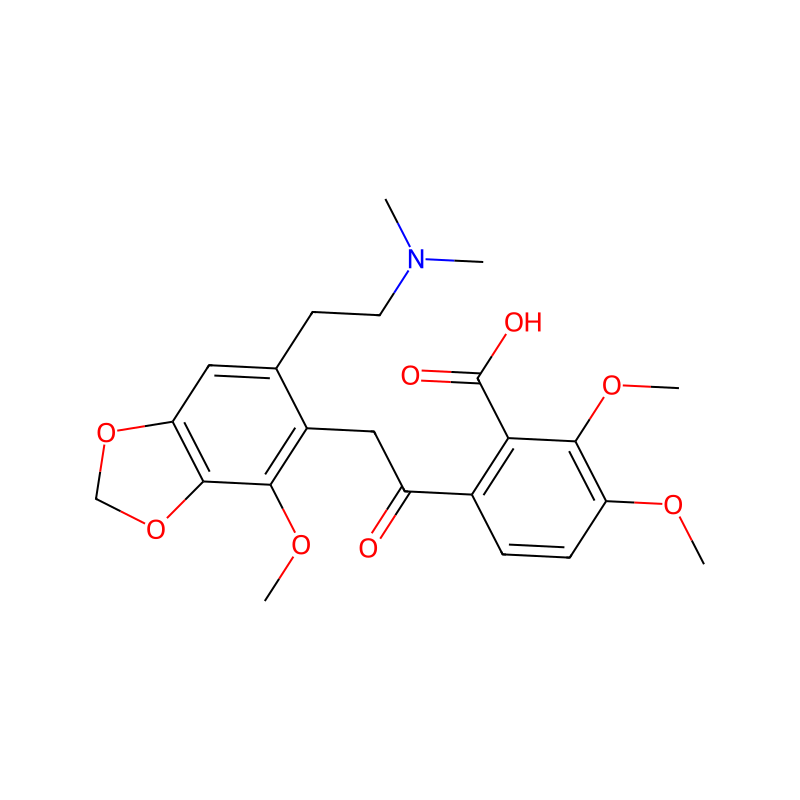
Narceine
NARCEINE · NARCEIN · CI 15511 · NIH 10760 · henyl)acetyl)- · CI 15511,Narceine · Narceine (base and/or unspecified salts) · 4-(methylenedioxy)phenyl)acetyl)-6-((6-(2-(dimethylamino)ethyl)-2-methoxy-
https://huagongshe.com/ko/chemical/8564
식별자 및 물리적 특성
| CAS No. | 131-28-2 |
|---|
| 분자식 | C23H27NO8 |
|---|
| 평균 분자량 | 445.5 g/mol |
|---|
| 단동위원소 질량 | 445.17366682 g/mol |
|---|
| SMILES | COc1ccc(C(=O)Cc2c(CCN(C)C)cc3c(c2OC)OCO3)c(C(=O)O)c1OC |
|---|
| InChIKey | DEXMFYZAHXMZNM-UHFFFAOYSA-N |
|---|
| PubChem CID | 8564 |
|---|
| ChEMBL | CHEMBL486305 |
|---|
| ChEBI | CHEBI:7480 |
|---|
| EC No. | 205-021-0 |
|---|
| DTXSID | DTXSID40156833 |
|---|
화학 및 물리적 성질
| XLogP | 0.5 |
|---|
| 극성 표면적 | 104 |
|---|
| 수소 결합 공여자 수 | 1 |
|---|
| 수소 결합 수용자 수 | 9 |
|---|
| 회전 가능 결합 수 | 10 |
|---|
| 무거운 원자 수 | 32 |
|---|
| 형식 전하 | 0 |
|---|
| 복잡도 | 643 |
|---|
| 의약품 | DEA NFLIS-Drug Category -> Narcotics |
|---|
| 용해도 | 0.78 mg/mL at 13 °C |
|---|
| 녹는점 | 145 °C138°mp 176° |
|---|
| Physical Description | Solid |
|---|
| 끓는 점 | 555.14°C (rough estimate) |
|---|
| 밀도 | 1.3285 (rough estimate) |
|---|
| 굴절률 | 1.5614 (estimate) |
|---|
| pKa(산도 계수) | pKb (20°) = 10.7, pKa = 9.3 |
|---|
| 용해도 | 579.1mg/L(15℃) |
|---|
안전 및 규제
| GHS 분류 | WarningH302 (100%): Harmful if swallowed [Warning Acute toxicity, oral]P261, P264, P264+P265, P270, P271, P280, P301+P317, P302+P352, P304+P340, P305+P351+P338, P319, P321, P330, P332+P317, P337+P317, P362+P364, P403+P233, P405, and P501 (click each P-code to see the statement)Aggregated GHS information provided per 13 reports by companies from 1 notifications to the ECHA C&L Inventory. Each notification may be associated with multiple companies. |
|---|
| Hazard Classes and Categories | Acute Tox. 4 (100%) |
|---|
용도
개요
An alkaloid of opium (Papaver somniferum) was first isolated by Pelletier in 1832 but not characterized until some years later by Couerbe and Anderson, the latter assigning to it the formula C23H2909N which was accepted until Freund showed that it contains H20 of crystallization. The base remains in the mother liquors after removal of the major alkaloids. It forms slender, colourless needles or prisms of the trihydrate, m.p. 170°C. It is optically inactive and dissolves readily in alkalies forming metallic derivatives. It behaves as a weak, monoacidic base forming well-crystallized salts. The hydrochloride crystallizes with 5.5 H20 from cold, dilute HCI, or as the trihydrate from hot solutions. From MeOH it yields crystals with 1 mole of solvent, m.p. 190-2°C. The aurichloride forms reddish-yellow needles, m.p. 130°C and the picrate has m.p. 195°C. With chlorine water, followed by the addition of ammonia, it gives a characteristic blood-red colour while with dilute iodine solution, the solid alkaloid develops a blue colour. With ethyl nitrite, narceine forms an oximino derivative which, on exhaustive methylation, furnishes trimethylamine, hemipinic acid and 2-cyano-3- methoxy-4: s-methylenedioxy-1-vinylbenzene.