
O-(2,4-dinitrophenyl)hydroxylamine
데이터를 보충하는 중입니다. 잠시 후 페이지를 새로 고치면 최신 내용을 볼 수 있습니다
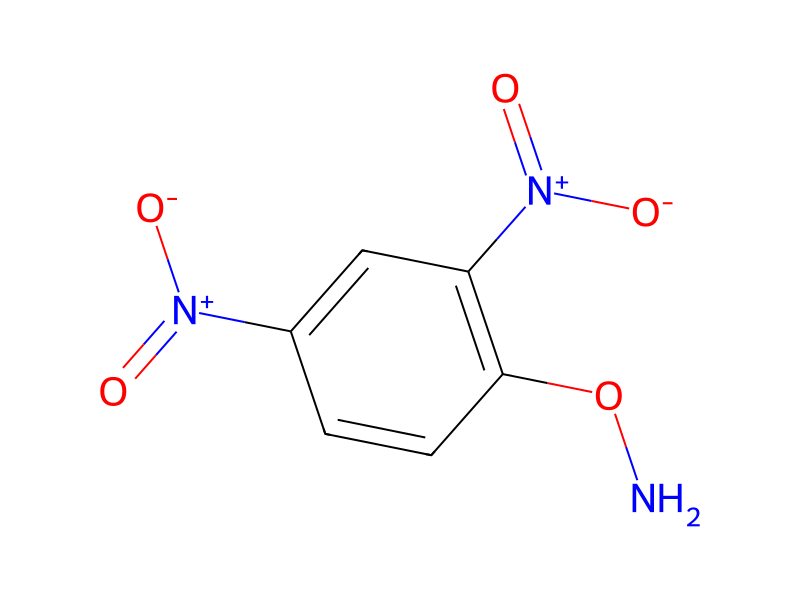
기본 정보
- CAS
17508-17-7- 표준 SMILES
NOc1ccc([N+](=O)[O-])cc1[N+](=O)[O-]- InChIKey
YLACRFYIUQZNIV-UHFFFAOYSA-N- 분자식
- C6H5N3O5
- 평균 분자량
- 199.12 g/mol
- 단동위원소 질량
- 199.02292026
개요
structure given in first source
이름 및 식별자
- 우선 이름
- O-(2,4-dinitrophenyl)hydroxylamine
- IUPAC
- O-(2,4-dinitrophenyl)hydroxylamine
- 영어명
- O-(2,4-dinitrophenyl)hydroxylamine
- 분자식
- C6H5N3O5
- 분자량
- 199.12
이름 및 동의어
O-(2,4-Dinitrophenyl)hydroxylamine17508-17-72,4-Dinitrophenoxyamine2,4-Nitrophenoxyamine1-Aminooxy-2,4-dinitrobenzeneI1308NOV00NSC-148499DTXSID20169926RefChem:855089DTXCID4092417241-512-6Hydroxylamine, O-(2,4-dinitrophenyl)-
이름 더 보기
2,4-DinitrophenylhydroxylamineNSC 1484994-dinitrophenyl)hydroxylamine1-aMinooxy-2,4-dinitro-benzeneHydroxylaMine,O-(2,4-dinitrophenyl)-O-(2,4-Dinitrophenyl)hydroxylamine,98%TIANFUCHEM--17508-17-7---O-(2,4-dinitrophenyl)hydroxylamine
DNPAC6H5N3O5MFCD00075001O-(2,4-dinitro-phenyl)-hydroxylamineUNII-I1308NOV001-(aminooxy)-2,4-dinitrobenzene1-Aminooxy-2,4-dinitrobenzene; 2,4-Dinitrophenoxyamine; 2,4-Nitrophenoxyamine; DNPA; NSC 148499;EINECS 241-512-6
데이터베이스 식별자
- CAS
17508-17-7- PubChem CID
- 87140
- DTXSID
DTXSID20169926- UNII
- I1308NOV00
- EC Number
- 241-512-6
- Nikkaji
- J287.066E
물성
구조 계산 물성보충 중
- XLogP
- 0.7
- 극성 표면적
- 127 Ų
- 수소 결합 공여자 수
- 1
- 수소 결합 수용자 수
- 6
- 회전 가능 결합 수
- 1
- 무거운 원자 수
- 14
- 형식 전하
- 0
- 복잡도
- 235
물리화학적 성질
- 녹는점
- 112.5 °C · 112.5°C
- 끓는 점
- 336.62 °C · 336.62°C (rough estimate)
- 밀도
- 1.6937 · 1.6937 (rough estimate)
- 굴절률
- 1.691 · 1.6910 (estimate)
- 저장 조건
- 2 · 2-8°C(protect from light)
- 용해도
- DMSO(적게), 메탄올(약간)에 용해됨
- 물리적 상태
- 고체
- 산도 계수 (pKa)
- -1.07 · -1.07±0.70(Predicted)
- 색상
- 노란색
- InChI
- InChI=1S/C6H5N3O5/c7-14-6-2-1-4(8(10)11)3-5(6)9(12)13/h1-3H,7H2
- InChIKey
- YLACRFYIUQZNIV-UHFFFAOYSA-N
- SMILES
- NOC1=CC=C([N+]([O-])=O)C=C1[N+]([O-])=O
화학적 성질
Light yellow solid
안전 및 규제
안전 정보는 참고용이며, 공급업체의 물질안전보건자료(SDS), 관련 법규 및 전문가 평가를 대체하지 않습니다.
GHS 분류
GHS Classification
Warning
H302 (95.6%): Harmful if swallowed [Warning Acute toxicity, oral]
P261, P264, P270, P272, P280, P301+P317, P302+P352, P321, P330, P333+P317, P362+P364, and P501 (click each P-code to see the statement)
Aggregated GHS information provided per 45 reports by companies from 6 notifications to the ECHA C&L Inventory. Each notification may be associated with multiple companies.
유해성 정보
Hazard Classes and CategoriesAcute Tox. 4 (95.6%)
안전 데이터
- tsca
- No
- HS 번호
- 29221990
- risk_code
- 22-36/37/38
- safety_code
- 26
화학 및 산업
응용 분야
용도O-(2,4-Dinitrophenyl)hydroxylamine is a rapid active-site-directed inhibitor of D-amino acid oxidase; modification results in specific incorporation of an amine group into an accessible nucleophilic r esidue with concomitant release of 2,4-dinitrophenol.
제조 방법
To a stirred solution of 13.3 gm (0.1 mole) of t-butyl JV-hydroxycar-bamate and 5.6 gm (0.1 mole) of potassium hydroxide in 200 ml of absolute ethanol is added 20.2 gm (0.1 mole) of 2,4-dinitrochlorobenzene. The resultant deep red solution is stirred at room temperature for 1 hr; then enough glacial acetic acid is added dropwise to produce a light yellow solution. The solution is poured into 1.5 liters of cold water. The yellow oil which separates is gradually converted to crystals. The solid -butyl JV-(2,4-dinitrophenoxy)carbamate is separated, dried, and recrystallized from an ethyl acetate-hexane mixture to afford 16.4 gm (53%), m.p. 74-75°C. To 15 ml of trifluoroacetic acid is added 4 gm (0.0133 mole) of the i-butyl J/V-(2,4-dinitrophenoxy)carbamate. After the evolution of carbon dioxide has subsided, the solution is poured into 100 ml of ice water. The resultant oily layer crystallizes on standing to afford 2.5 gm (95%), m.p. 112°C (from ethanol). Recently it was discovered that the alkylation of ethyl JV-hydroxy-carbamate under alkaline conditions, particularly in a DMF medium at 60°C in the presence of sodium bicarbonate, leads to the ultimate formation of O-alkylated hydroxylamines. On the other hand, at 80-85°C, the direct alkylation without the presence of a base ultimately leads to N-alkylhydrox-ylamines (see Table I) [59]. The reaction of ethylazidoformate with an alcohol, while perhaps hazardous, may have some merit (Eqs. 31-33). The overall yield, based on ethyl chloroformate, is said to be on the order of 60%.
상·하류 제품 정보
상류 원료
관련 반응
86건


화합물 노트
불러오는 중…