
HRID 648075생성물로
Monuron
데이터를 보충하는 중입니다. 잠시 후 페이지를 새로 고치면 최신 내용을 볼 수 있습니다
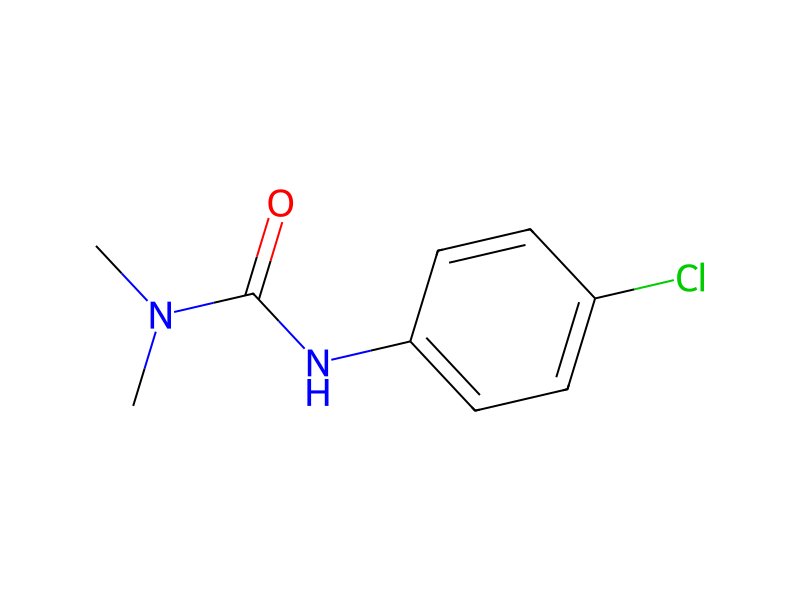
150-68-5CN(C)C(=O)Nc1ccc(Cl)cc1BMLIZLVNXIYGCK-UHFFFAOYSA-NMonuron appears as white crystalline solid or white powder with a slight odor. Melting point 175 °C. Moderately toxic by ingestion. Used as an herbicide.
150-68-5DTXSID0020311CHEMBL467623CHEBI:38214Herbicides
Active substance -> EU Pesticides database: Not approved
Pesticides -> Herbicides, Urea Derivative
Herbicides
Pesticide (Monuron) -> USDA PDB
SLIGHT ODOR
Odorless solid
1.27 at 68 °F (NTP, 1992) - Denser than water; will sink
1.27 @ 20 °C/20 °C
WHITE PLATES FROM METHANOL
THIN RECTANGULAR PRISMS FROM METHANOL
Platelets
less than 1 mg/mL at 70.7 °F (NTP, 1992)
Monuron-TCA is a crystalline solid; mp 78-81 °C. Solubility (room temperature): 918 mg/l water; 400 g/kg 1,2-dichloroethane; 177 g/kg methanol; 91 g/kg xylene. It is acidic in reaction and incompatible with alkaline materials. /Monuron Trichloroacetate/
VERY SLIGHTLY SOL IN NUMBER 3 DIESEL OIL; MODERATELY SOL IN METHANOL, ETHANOL, PRACTICALLY INSOL IN HYDROCARBON SOLVENTS
SLIGHTLY SOL IN OIL & POLAR SOLVENTS
Solubility (ppm): water 230 (@ 25 °C), acetone 52,000 (@ 27 °C), benzene 2900 (@ 27 °C)
Sol in benzene: 3 g/kg at 27 °C
338.9 to 340.7 °F (NTP, 1992)
170.5-171.5 °C
White, crystalline solid; odorless. Very low solubility in water and hydrocarbonsolvents; slightly soluble in oils; partially soluble inalcohols; stable toward oxidation and moisture.
안전 정보는 참고용이며, 공급업체의 물질안전보건자료(SDS), 관련 법규 및 전문가 평가를 대체하지 않습니다.
Warning
H302: Harmful if swallowed [Warning Acute toxicity, oral]
P203, P264, P270, P273, P280, P301+P317, P318, P330, P391, P405, and P501 (click each P-code to see the statement)
Warning
H302 (100%): Harmful if swallowed [Warning Acute toxicity, oral]
P203, P264, P270, P273, P280, P301+P317, P318, P330, P391, P405, and P501 (click each P-code to see the statement)
Chemical: Urea, N'-(4-chlorophenyl)-N,N-dimethyl-
Commission Regulation (EC) No 1490/2002
2002/2076
REACH registered substance: Monuron (EC: 205-766-1)
Urea, N'-(4-chlorophenyl)-N,N-dimethyl-: Does not have an individual approval but may be used as a component in a product covered by a group standard. It is not approved for use as a chemical in its own right.
The New Jersey Worker and Community Right to Know Act requires public and private employers to provide information about hazardous substances at their workplaces. (N.J.S.A. 34:5A-1 et. seq.)
SYMPTOMS: Symptoms of exposure to this compound may include fall in blood pressure, convulsions or coma. Other symptoms may include ataxia, drowsiness, hyporeflexia, pallor, tachypnea, dacryorrhea, aciduria, diarrhea, epistaxis, hyperreflexia and irritability.
Urea-derived herbicides have low toxicity in animal feeding studies; May induce methemoglobinemia; [HSDB] Systemic toxicity unlikely unless large amounts ingested; [EPA Pesticides, p. 122] Causes anemia and methemoglobinemia in animal experiments; [Merck Index]
As the federal pesticide law FIFRA directs, EPA is conducting a comprehensive review of older pesticides to consider their health and environmental effects and make decisions about their future use. Under this pesticide reregistration program, EPA examines health and safety data for pesticide active ingredients initially registered before November 1, 1984, and determines whether they are eligible for reregistration. In addition, all pesticides must meet the new safety standard of the Food Quality Protection Act of 1996. Monuron is found on List A, which contains most food use pesticides and consists of the 194 chemical cases (or 350 individual active ingredients) for which EPA issued registration standards prior to FIFRA, as amended in 1988. Case No: 0045; Pesticide type: Herbicide; Registration Standard Date: 06/30/83,07/01/83; Case Status: No products containing the pesticide are actively registered ... The case /is characterized/ as "cancelled." Under FIFRA, pesticide producers may voluntarily cancel their registered products. EPA also may cancel pesticide registrations if registrants fail to pay required fees or make/meet certain reregistration commitments, or if EPA reaches findings of unreasonable adverse effects.; Active ingredient (AI): Monuron; AI Status: The active ingredient is no longer contained in any registered pesticide products ... "cancelled."
MONURON is a chlorinated urea derivative. May react with azo and diazo compounds to generate toxic gases. May react with strong reducing agents to generate flammable gases. Reacts as a weak base. Combustion generates mixed oxides of nitrogen (NOx).
Acute Tox. 4 (100%)
Carcinogenicity - category 2
Acute toxicity (Oral) - Category 4
Carc. 2
EYES: First check the victim for contact lenses and remove if present. Flush victim's eyes with water or normal saline solution for 20 to 30 minutes while simultaneously calling a hospital or poison control center. Do not put any ointments, oils, or medication in the victim's eyes without specific instructions from a physician. IMMEDIATELY transport the victim after flushing eyes to a hospital even if no symptoms (such as redness or irritation) develop.
SMALL SPILLS AND LEAKAGE: Should a spill occur while you are handling this chemical, FIRST REMOVE ALL SOURCES OF IGNITION, then you should dampen the solid spill material with 60-70% ethanol and transfer the dampened material to a suitable container. Use absorbent paper dampened with 60-70% ethanol to pick up any remaining material. Seal the absorbent paper, and any of your clothes, which may be contaminated, in a vapor-tight plastic bag for eventual disposal. Solvent wash all contaminated surfaces with 60-70% ethanol followed by washing with a soap and water solution. Do not reenter the contaminated area until the Safety Officer (or other responsible person) has verified that the area has been properly cleaned.
Treatment at elevated temp by acid or base yields dimethylamine and 3,4-dichloroaniline. Hydrolysis is not recommended as a disposal procedure because of the generation of the toxic product, 3,4-dichloraniline and dimethylamine. Recommendable method: Incineration. Not recommendable method: Hydrolysis. Peer review: Incineration in a unit with effluent gas scrubbing is recommendable. (Peer-review conclusions of an IRPTC expert consultation May 1985))
IN PRESENCE OF MODERATE AMT OF CARBARYL, DEGRADATION /OF MONURON IN COTTON PLANTS/ BEYOND MONO-DEMETHYLATION WAS INHIBITED. ... 4-BENZOTHIOPHENE-N-METHYLCARBAMATE WAS AS EFFECTIVE AS CARBARYL.
FLAVINS (FLAVINMONONUCLEOTIDE) HAVE BEEN SHOWN TO CAUSE PHOTOINACTIVATION OF PHENYLUREAS, SUCH AS MONURON, IN VITRO.
LC50 BOBWHITE QUAIL GREATER THAN 5000 PPM/5 DAYS (AGE 17 DAYS, NO MORTALITY TO 5000 PPM)
LC50 JAPANESE QUAIL GREATER THAN 5000 PPM/5 DAYS (AGE 12 DAYS, NO MORTALITY AT 1250 PPM, 7% AT 2500 PPM, 21% AT 5000 PPM)
LC50 RING-NECKED PHEASANT 4682 PPM/5 DAYS (AGE 15 DAYS, 95% CONFIDENCE LIMIT 3902-5746 PPM)
LC50 MALLARD DUCK GREATER THAN 5000 PPM/5 DAYS (AGE 10 DAYS, NO MORTALITY AT 1250 PPM, 10% AT 2500 PPM, 10% AT 5000 PPM)
LC50 Japanese quail (Coturnix japonica), 14 days old, oral (5 day ad libitum in diet) >5,000 ppm
TERRESTRIAL FATE: Biodegradation appears to be the major process by which monuron may be lost from most soils(1-2). The loss of monuron from soil surface by photolysis may account for a small fraction of loss of monuron as most of the monuron would move deeper into soil with rain(1). Volatilization loss of monuron from dry soil or wet soils should not be important(1). Monuron may moderately leach in most soils(3-4). Depending on the nature of soil and climatic conditions, the field half-life of monuron in soil range from less than 30 days to 166 days(5-7).
AQUATIC FATE: At low concns (on the order of ug/l), the major process for the loss of monuron from water appears to be biodegradation(1-2). Neither hydrolysis nor any other chemical reaction is important for the loss of monuron in water(1,3). Monuron may photolyze in surface layers of water where sunlight penterates(1). The photolysis half-life of monuron in aqueous solution by natural sunlight is estimated to be 15 days(4). Photolysis is accelerated by the presence of surfactants(5). Based upon the low vapor pressure(6) and high water solubility(7), monuron should not volatilize from water. Monuron is not expected to bioconcentrate in aquatic organisms(7).
ATMOSPHERIC FATE: Based upon on its vapor pressure, 5.03X10⁻⁷ mm Hg at 25 °C(1), monuron is expected to be present partially in the vapor phase and partially in the particulate form in air(2,SRC). Vapor phase monuron will react with photochemically produced hydroxyl radicals with a half-life of 6.7 hr(3-4). Monuron may also be removed from the atmosphere by dry and wet deposition(SRC).
As the federal pesticide law FIFRA directs, EPA is conducting a comprehensive review of older pesticides to consider their health and environmental effects and make decisions about their future use. Under this pesticide reregistration program, EPA examines health and safety data for pesticide active ingredients initially registered before November 1, 1984, and determines whether they are eligible for reregistration. In addition, all pesticides must meet the new safety standard of the Food Quality Protection Act of 1996. Monuron is found on List A, which contains most food use pesticides and consists of the 194 chemical cases (or 350 individual active ingredients) for which EPA issued registration standards prior to FIFRA, as amended in 1988. Case No: 0045; Pesticide type: Herbicide; Registration Standard Date: 06/30/83,07/01/83; Case Status: No products containing the pesticide are actively registered ... The case /is characterized/ as "cancelled." Under FIFRA, pesticide producers may voluntarily cancel their registered products. EPA also may cancel pesticide registrations if registrants fail to pay required fees or make/meet certain reregistration commitments, or if EPA reaches findings of unreasonable adverse effects.; Active ingredient (AI): Monuron; AI Status: The active ingredient is no longer contained in any registered pesticide products ... "cancelled."
SUBSTITUTED UREAS ... IN LEAVES ... CAUSE COLLAPSE OF PARENCHYMA VESSELS. ... THEY INHIBIT PHOTOSYNTHESIS ... AND ARE POWERFUL INHIBITORS OF OXIDATION OF WATER TO OXYGEN (HILL REACTION) ... SUGGESTED THAT MONURON BLOCKS PHOTOSYNTHESIS AT SITE OF ELECTRON TRANSFER BY FLAVIN MONONUCLEOTIDE ... .
3-(P-CHLOROPHENYL)-1,1-DIMETHYLUREA YIELDS IN COTTON 3-(P-CHLOROPHENYL)-1-HYDROXYMETHYL-1-METHYLUREA; ALSO YIELDS 3-(P-CHLOROPHENYL)-1-METHYLUREA. /FROM TABLE/
COTTON PLANTS DEGRADED MONURON TO MONOMETHYLMONURON & P-CHLORO-PHENYLUREA BY SUCCESSIVE DEMETHYLATIONS & THEN TO P-CHLOROANILINE BY HYDROLYSIS OF AMIDE BOND.
IN MAMMALS, MONURON IS METABOLIZED (I) BY OXIDATIVE N-DEMETHYLATION, (II) BY HYDROXYLATION OF AROMATIC NUCLEUS & (III) BY FISSION OF UREA RESIDUE TO GIVE CHLOROANILINE DERIVATIVES.
YIELDS OF VARIOUS METABOLITES INDICATE THAT HYDROXYLATION FAVORS 2-POSITION RATHER THAN 3-POSITION. PHENOLIC METABOLITES WERE EXCRETED IN URINE AS CONJUGATES. 4-CHLORO-2-HYDROXYANILINE WAS EXCRETED AS THE N-ACETYL CMPD 2-ACETAMINO-5-CHLOROPHENOL.
For more Metabolism/Metabolites (Complete) data for MONURON (10 total), please visit the HSDB record page.
SUBSTITUTED UREAS ARE READILY ABSORBED BY PLANT ROOTS & TRANSLOCATED TO ACCUMULATE IN LEAVES ... THEY DO NOT PENETRATE READILY THROUGH LEAVES.
AFTER ADMIN OF 175 MG/KG BODY WT/DAY FOR 60 DAYS OR OF 0.1-20.0 MG/KG BODY WT FOR 6 MO, TISSUE RETENTION OF MONURON-RELATED SUBSTANCES OCCURRED /MOST/ IN LUNGS, /DECR RESPECTIVELY IN/ HEART, LIVER, BRAIN & KIDNEYS, MILK, BONE MARROW & THYROID GLAND.
IN RATS GIVEN 875 MG/KG BODY WT ORALLY, PEAK BLOOD CONCN OCCURRED 2 HR AFTER DOSING ... CMPD WAS DISTRIBUTED EVENLY THROUGHOUT BODY.
Used as a herbicide on roadways, industrial lots, and drainage ditches; [HSDB] No ACTIVE registrants found for selected chemical. [NPIRS]
As of July 1973, monuron is no longer registered for use on agricultural crops. [HSDB]
Farming (Pesticides) [Category: Industry]
The active ingredient is no longer contained in any registered pesticide products ... "cancelled."
The only known use of monuron is as a broad-spectrum herbicide for the control of many grasses and herbaceous weeds on non-cropland areas, such as right-of-way, industrial sites and drainage ditch banks.
AS A SOIL STERILANT MONURON IS PREFERRED ON MEDIUM TO HEAVY SOILS AND UNDER INTERMEDIATE RAINFALL CONDITIONS. AT STERILANT DOSAGES IT CONTROLS A WIDE RANGE OF ANNUAL AND PERENNIAL GRASSES AND BROADLEAF WEEDS ON NONCROP AREAS. /FORMER USE/
(1972) 5.1X10+7 G (PRINCPL CUSTMS DISTS)
(1975) 6.94X10+7 G (PRINCPL CUSTMS DISTS)
(1973) 6.5x10+7 g
(1971) 3.7X10+7 G (CONSUMPTION)
(1975) 9.1X10+7 G (CONSUMPTION)
REACTION OF P-CHLOROPHENYL ISOCYANATE WITH DIMETHYLAMINE
PREPD BY REACTING P-CHLOROPHENYL ISOCYANATE WITH DIMETHYLAMINE
p-Chloroaniline in dioxane or another inert solvent with anhydrous hydrogen chloride and phosgene at 70-75 °C forms p-chlorophenyl isocyanate, which at 25 °C with dimethylamine gives monuron.
WETTABLE POWDER (80% ACTIVE COMPONENT); WATER SUSPENSION 2.8 LB/GALLON ACTIVE INGREDIENT.
Wettable powder (800 g monuron/kg). Mixtures include: Urox, granular (55, 110 or 220 g monuron-TCA/kg), oil miscible liquid, oil/water miscible concentrate oil/water miscible concentrate, (monuron-TCA + 2,4-D)>.
(Monuron +) amitrole.
Monuron is available in the US as a technical grade product, as a wettable powder containing @ 80% of the chemical and as granular formulations containing 2.4-8%. Granular formulations containing both monuron and trichloroacetic acid are also available, with several concentrations of each ai.
Urea, N'-(4-chlorophenyl)-N,N-dimethyl-: ACTIVE
RESIDUES OF 1-7 MG/KG WERE TOLERATED ON ... FRUITS & VEGETABLES. AS OF JULY 1973 ... MONURON IS NO LONGER REGISTERED FOR USE ON ANY AGRICULTURAL CROP (US EPA, 1975).
... DIFFERENTIAL METAB IS ONE OF MAJOR FACTORS RESPONSIBLE FOR SELECTIVITY OF PHENYLUREA HERBICIDES. IN PARTICULAR, COTTON EXHIBITED REMARKABLE ABILITY TO DEGRADE MONURON ... IN CONTRAST TO CERTAIN MONOCOTYLEDONOUS PLANT SPECIES ... DIFFERENCES IN METAB ... BASED ON DIFFERENT RATES OF DEGRADATION AND NOT ON DIFFERENCES IN BIOCHEMICAL TRANSFORMATION PATHWAYS.
IT IS RECOMMENDED @ 10 TO 30 KG AI/HA FOR TOTAL WEED CONTROL OF NON-CROP AREAS; 5 TO 10 KG AI/HA SUFFICES FOR ANNUAL MAINTENANCE.
용도Monuron may be used as a reference standard in the determination of monuron in rice and corn using high performance liquid chromatography coupled with fluorescence detection combined with ultraviolet decomposition and post-column derivatization.
일반 설명White crystalline solid or white powder with a slight odor. Melting point 175°C. Moderately toxic by ingestion. Used as an herbicide.
정의ChEBI: A member of the class of ureas that is urea in which one of the nitrogens is substituted by a p-chlorophenyl group while the other is substituted by two methyl groups.

RECOMMENDED RESPIRATOR: Where the neat test chemical is weighed and diluted, wear a NIOSH-approved half face respirator equipped with a combination filter cartridge, i.e. organic vapor/acid gas/HEPA (specific for organic vapors, HCl, acid gas, SO2 and a high efficiency particulate filter). (NTP, 1992)
PROTECT SKIN & HAIR ... USE ONLY APPROVED RESPIRATORY PROTECTIVE EQUIPMENT, WHEN LABEL DIRECTIONS ADVISE NEED. /HERBICIDES/
Wear rubber gloves for all handling.
The following link will take the user to the National Toxicology Program (NTP) Test Agent Search Results page, which tabulates all of the "Standard Toxicology & Carcinogenesis Studies", "Developmental Studies", and "Genetic Toxicity Studies" performed with this chemical. Clicking on the "Testing Status" link will take the user to the status (i.e., in review, in progress, in preparation, on test, completed, etc.) and results of all the studies that the NTP has done on this chemical. [http://ntp-apps.niehs.nih.gov/ntp_tox/index.cfm?fuseaction=ntpsearch.searchresults&searchterm=150-68-5]
The Koc values for monuron determined from experimental adsorption isotherms or estimated using recommended regression equations range from 83 to 225(1-6). According to a suggested classification scheme(9), Koc values of this magnitude indicate that monuron is moderately to highly mobile in soil. Soil thin layer chromatographic studies also indicate that monuron is moderately mobile in soil(5,7). The adsorption of monuron in soil is virtually independent of pH and clay content of soil, but the adsorption increases with increase in organic carbon content(6,8). However, other investigators concluded that the adsorption of monuron increases with an increase in the clay content of soil(10).
Since monuron is commercially produced and used as a herbicide(1), it will be released to the environment during the manufacture and particularly during the use of the herbicide(SRC). Accidental spills during loading/unloading and shipment will also release monuron in the environment(SRC).
/INVESTIGATORS/ ... WERE ABLE TO ISOLATE FROM BROOKSTON SILTY CLAY LOAM A BACTERIUM OF GENUS PSEUDOMONAS WHICH UTILIZED MONURON AS SOLE SOURCE OF CARBON.
Several pure cultures of bacteria including Pseudomonas, Xanthomonas, Sarcina, and Bacillus and fungi including Penicillium and Aspergillus are capable of degrading monuron(1-3). The major process for the loss of monuron from water is biodegradation(3). At a concentration of 6-7 mg/l, no loss of monuron by mixed microorganisms from river water and sewage was observed in 16 wk(5). However, in a soil-water system, appreciable biodegradation occurred after 16 weeks and 15% of monuron was recovered after 128 wk(4). At an initial concn of 10 ug/l in sewage water, monuron started to mineralize on day 45 and about 20% of monuron mineralized by day 84(6). No mineralization of monuron was observed in 84 days at a concn of 10 mg/l(6). Besides carbon dioxide, products with chromatographic characteristics of 4-(chlorophenyl)urea and 4-chloroaniline were also identified(6).
Monuron is lost from soil primarily through biodegradation(1,3). Monuron loss from two soils was about 40% in 22 wk at a concn of 4 ppm(1). In a clay loam soil, approx. 10% of monuron mineralized to carbon dioxide in 90 days(1). Hydroxylation products of monuron have been identified in soil(5). Except for most heavily treated soils (above 16 lbs/acre), approx. 90% of monuron disappeared in 1 yr. During the second year, loss averaged about 62%(3). Monuron's degradation is a function of application rate(2). Biodegradation is favored by high temperature adequate moisture and high soil organic matter content(2). When monuron was incubated with sediments from a pond under anaerobic conditions, no ring-substituted products were detected in 73 days(4). Therefore, monuron may persist in soil and sediments under anaerobic conditions(SRC).
Monuron
Group 3: Not classifiable as to its carcinogenicity to humans
Volume Sup 7: Overall Evaluations of Carcinogenicity: An Updating of IARC Monographs Volumes 1 to 42, 1987; 440 pages; ISBN 92-832-1411-0 (out of print)
1991
1990
Monuron