Huagongshe화공사 화학 정보 인쇄 보고서 · 연구 참고용
Cyclododecane
Cyclododecan · yclododecane · CYCLODODECANE · Cyclododecane>Phenyl Acetate Impurity 70 · Cyclododecane in isooctane · CYCLODODECANE ISO 9001:2015 REACH
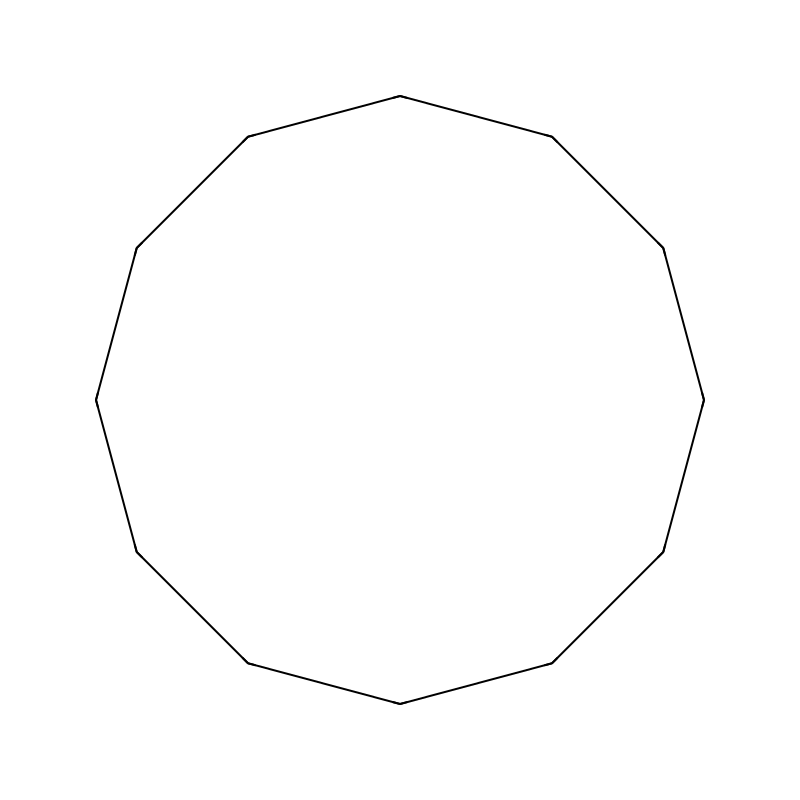
식별자 및 물리적 특성
| CAS No. | 294-62-2 |
|---|---|
| 분자식 | C12H24 |
| 평균 분자량 | 168.32 g/mol |
| 단동위원소 질량 | 168.18780077 g/mol |
| SMILES | C1CCCCCCCCCCC1 |
| InChIKey | DDTBPAQBQHZRDW-UHFFFAOYSA-N |
| PubChem CID | 9268 |
| ChEMBL | CHEMBL3185808 |
| EC No. | 206-033-9 |
| DTXSID | DTXSID9021552 |
화학 및 물리적 성질
| XLogP | 6.7 |
|---|---|
| 극성 표면적 | 0 |
| 수소 결합 공여자 수 | 0 |
| 수소 결합 수용자 수 | 0 |
| 회전 가능 결합 수 | 0 |
| 무거운 원자 수 | 12 |
| 형식 전하 | 0 |
| 복잡도 | 43 |
| 물질 분류 | Other Classes -> Aliphatics, Saturated (>C11) |
| SpringerMaterials Properties | Schoenflies notation |
| 밀도 | 0.82 g/cu cm at 80 °C0.790 |
| Color/Form | Needles from alcohol |
| 용해도 | Insoluble in watervery soluble in alcohol, ethyl ether |
| 끓는 점 | 247 °C111 °C / 17mmHg |
| 녹는점 | 60.4 °C59-61°C |
| 증기압 | 0.03 [mmHg]0.0295 mm Hg at 25 °C9.83Pa at 20℃ |
| Physical Description | Colorless crystals[MSDSonline] |
| 굴절률 | 1.4860 (estimate) |
| 인화점 | 88℃ |
| 저장 조건 | Sealed in dry,Room Temperature |
| 용해도 | 16μg/L at 20℃ |
| 헨리 상수 | 6.4×10⁻⁶ mol/(m3Pa) at 25℃, HSDB (2015) |
| 안정성 | 안정적인. 타기 쉬운. 강한 산화제와 호환되지 않습니다. |
| InChI | InChI=1S/C12H24/c1-2-4-6-8-10-12-11-9-7-5-3-1/h1-12H2 |
| InChIKey | DDTBPAQBQHZRDW-UHFFFAOYSA-N |
| SMILES | C1CCCCCCCCCCC1 |
| LogP(분배 계수) | 7.6 at 25℃ |
| EPA | Cyclododecane (294-62-2) |
화학적 성질
Cyclooctane and cyclononane are flammable liquids, and cyclododecane a volatile, flammable solid.
안전 및 규제
| GHS 분류 | This chemical does not meet GHS hazard criteria for 75% (3 of 4) of all reports.H413 (25%): May cause long lasting harmful effects to aquatic life [Hazardous to the aquatic environment, long-term hazard]P273, and P501 (click each P-code to see the statement)Aggregated GHS information provided per 4 reports by companies from 2 notifications to the ECHA C&L Inventory. |
|---|---|
| 규제 정보 | Status: Active Update: 18-02-2013 https://echa.europa.eu/registration-dossier/-/registered-dossier/2097Cyclododecane: Does not have an individual approval but may be used under an appropriate group standard |
| 유해성 요약 | May cause irritation[MSDSonline] |
| Special Reports | European Commission, ESISIUCLID Dataset, Cyclododecane (294-62-2) (2000 CD-ROM edition).[Available from the Database Query page as of March 3, 2009: http://ecb.jrc.ec.europa.eu/IUCLID-DataSheets/294622.pdf] |
| Hazard Classes and Categories | Aquatic Chronic 4 (25%) |
| 처리 방법 | SRP: The most favorable course of action is to use an alternative chemical product with less inherent propensity for occupational exposure or environmental contamination. Recycle any unused portion of the material for its approved use or return it to the manufacturer or supplier. Ultimate disposal of the chemical must consider: the material's impact on air qualitypotential migration in soil or watereffects on animal, aquatic, and plant lifeand conformance with environmental and public health regulations. |
| 체내 부담 | The expired air of 62 non-smoking humans was examined for the presence of environmental pollutants and other chemical constituents(1)cyclododecane was detected in the expired air of all three subject groups (diabetic, pre-diabetic and control)(1). |
| 생태독성 수치 | EC50Species: Daphnia pulex (Water flea, neaonate <24 hr old)Conditions: freshwater, static, 17 °C, hard waterConcentration: 21000 ug/L for 48 hrEffect: intoxication, immobilization /> or =96% purity/Species: Scenedesmus subspicatus (Algae)Concentration: >2.1 mg/L for 72 hrEffect: No effects on biomass or growth rate were observed. The range of test concentrations was limited by the water solubility. /Conditions of bioassay not specified in source examined/ |
| 환경 거동 | TERRESTRIAL FATE: Based on a classification scheme(1), an estimated Koc value of 5,300(SRC), determined from a structure estimation method(2), indicates that cyclododecane is expected to be immobile(SRC). Volatilization of cyclododecane from moist soil surfaces is expected to be an important fate process(SRC) given an estimated Henry's Law constant of 1.54 atm-cu m/mole(SRC), using a fragment constant estimation method(3). However, adsorption to soil is expected to attenuate volatilization(SRC). Cyclododecane is not expected to volatilize from dry soil surfaces(SRC) based upon an estimated vapor pressure of 2.9X10⁻² mm Hg at 25 °C(SRC), determined from a fragment constant method(4). A 6% of theoretical BOD using activated sludge in the Japanese MITI test(5), suggests that biodegradation is not an important environmental fate process in soil(SRC).AQUATIC FATE: Based on a classification scheme(1), an estimated Koc value of 5,300(SRC), determined from a structure estimation method(2), indicates that cyclododecane is expected to adsorb to suspended solids and sediment(SRC). Volatilization from water surfaces is expected(3) based upon an estimated Henry's Law constant of 1.54 atm-cu m/mole(SRC), developed using a fragment constant estimation method(4). Using this Henry's Law constant and an estimation method(3), volatilization half-lives for a model river and model lake are 4 hours and 5 days, respectively(SRC). However, volatilization from water surfaces is expected to be attenuated by adsorption to suspended solids and sediment in the water column. The estimated volatilization half-life from a model pond is 9 years if adsorption is considered(5). According to a classification scheme(6), a BCF range of 1,100-14,400(7) suggests that bioconcentration in aquatic organisms is very high, provided the compound is not metabolized by the organism(SRC). A 6% of theoretical BOD using activated sludge in the Japanese MITI test(7), suggests that biodegradation is not an important environmental fate process in water(SRC).ATMOSPHERIC FATE: According to a model of gas/particle partitioning of semivolatile organic compounds in the atmosphere(1), cyclododecane, which has an estimated vapor pressure of 0.029 mm Hg at 25 °C(SRC), determined from a fragment constant method(2), is expected to exist solely as a vapor in the ambient atmosphere. Vapor-phase cyclododecane is degraded in the atmosphere by reaction with photochemically-produced hydroxyl radicals(SRC)the half-life for this reaction in air is estimated to be 23 hours(SRC), calculated from its rate constant of 1.7X10⁻¹¹ cu cm/molecule-sec at 25 °C(SRC) that was derived using a structure estimation method(3). Cyclododecane does not contain chromophores that absorb at wavelengths >290 nm(4) and therefore is not expected to be susceptible to direct photolysis by sunlight(SRC). |
| 생태독성 발췌 | /AQUATIC SPECIES/ We have provided a hazard ranking for 19 classes of compounds representing many of the nearly 500 organic compounds identified by gas chromatography-mass spectrometry in lake trout (Salvelinus namaycush) and walleye (Stizostedion vitreum vitreum) from the Great Lakes and Lake St. Clair. We initially made a provisional hazard ranking based on available published and unpublished information on aquatic toxicity, bioaccumulation, occurrence and sources. Acute toxicity tests with Daphnia pulex at 17 °C in reconstituted hard water were performed with 30 compounds representative of the 19 classes that were highest in the provisional ranking. The resulting toxicity data, along with information on the compounds' occurrence in Great Lakes fish and their sources, were ranked and weighted and then used in calculating the revised hazard ranking. The 10 most hazardous classes, in descending order, are as follows (values shown are mean 48-hr EC50s, in ug/mL): arene halides (e.g., polychlorinated biphenyls, DDT), 0.0011phthalate esters, 0.133chlorinated camphenes (toxaphene), 0.0082polyaromatic hydrocarbons (PAHse.g., dimethyl-naphthalene) and reduced derivatives, 1.01chlorinated fused polycyclics (e.g., trans-nonachlor), 0.022nitrogen-containing compounds (e.g., O-methylhydroxylamine), 1.35alkyl halides (e.g., (bromomethyl)cyclohexene), 10.1cyclic alkanes (e.g., cyclododecane), 20.9silicon-containing compounds (e.g., dimethyldiethoxy silane), 1.25and heterocyclic nitrogen compounds (e.g., nicotine), 2.48. We recommend that chronic bioassays be conducted with fish and invertebrates to determine the sublethal effects of the following classes of compounds, for which few toxicity data are available: PAHs, heterocyclic nitrogen compounds, other nitrogen-containing compounds, alkyl halides, cyclic alkanes and silicon-containing compounds. Information from these types of studies will aid researchers in determining the possible causal role these contaminants play in the decline and reproductive impairment of Great Lakes fish. |
| Effluent Concentrations | Average cyclododecane emissions from PVC cushion vinyl floor covering three days and four weeks old were, 56 and 31 ug/sq m-hr, respectively(1). |
| Soil Adsorption/Mobility | Using a structure estimation method based on molecular connectivity indices(1), the Koc of cyclododecane can be estimated to be 5,300(SRC). According to a classification scheme(2), this estimated Koc value suggests that cyclododecane is expected to be immobile in soil. |
| Human Toxicity Excerpts | /SIGNS AND SYMPTOMS/ Cyclooctane and other volatile cycloalkanes are CNS depressants and have been identified as aspiration hazards./OTHER TOXICITY INFORMATION/ Cyclododecane is not a skin irritant. |
| Artificial Pollution Sources | Cyclododecane's production and use as a chemical intermediate(1) may result in its release to the environment through various waste streams(SRC). Its use as a mothproof agent(1) will result in its direct release to the environment(SRC). |
| Environmental Biodegradation | AEROBIC: Cyclododecane, present at 100 mg/L, reached 6% of its theoretical BOD in 2 weeks using an activated sludge inoculum at 30 mg/L in the Japanese MITI test(1). |
| Sediment/Soil Concentrations | SEDIMENT: Cyclododecane was detected not quantified in sediments collected from Tobin Lake (collection date not reported) near the Saskatchewan-Manitoba border in Canada(1). |
| Environmental Bioconcentration | A BCF range of 1,100-11,1000 and 1,800-14,400 was measured in fish for cyclododecane using a test chemical concentration of 30 and carp (Cyprinus carpio) which were exposed over an 10-week period(1). According to a classification scheme(2), these BCF values suggest the potential for bioconcentration in aquatic organisms is very high(SRC), provided the compound is not metabolized by the organism(SRC). |
| Volatilization from Water/Soil | The Henry's Law constant for cyclododecane is estimated as 1.54 atm-cu m/mole(SRC) using a fragment constant estimation method(1). This Henry's Law constant indicates that cyclododecane is expected to volatilize rapidly from water surfaces(2). Based on this Henry's Law constant, the volatilization half-life from a model river (1 m deep, flowing 1 m/sec, wind velocity of 3 m/sec)(2) is estimated as 4 hours(SRC). The volatilization half-life from a model lake (1 m deep, flowing 0.05 m/sec, wind velocity of 0.5 m/sec)(2) is estimated as 5 days(SRC). However, volatilization from water surfaces is expected to be attenuated by adsorption to suspended solids and sediment in the water column. The estimated volatilization half-life from a model pond is 9 years if adsorption is considered. Cyclododecane's Henry's Law constant indicates that volatilization from moist soil surfaces may occur(SRC). Cyclododecane is not expected to volatilize from dry soil surfaces(SRC) based upon an estimated vapor pressure of 0.029 mm Hg(SRC), determined from a fragment constant method(4). |
| TSCA 등재 상태 | TSCA listed |
| RTECS 번호 | GV2295000 |
| 운송 번호(UN) | 1325 |
| 관세 코드 | 29021990 |
| 안전 문구(S) | 24/25 |
| 포장분류 | III |
| 위험 등급 | 4.1 |
| 기존화학 물질 | KE-09139 |
| 유해 물질 데이터 | 294-62-2(Hazardous Substances Data) |
용도
용도
Cyclooctane and cyclononane are used as starting materials for organic synthesis. The major use of cyclododecane is as an intermediate for the production of chemicals used to make polyamides, polyesters, synthetic lubricating oils, and nylon 12; it is also used as a high-purity solvent. An emulsion of cyclododecane can be used to emulsify pesticides. It is also used as a mothproofing agent.