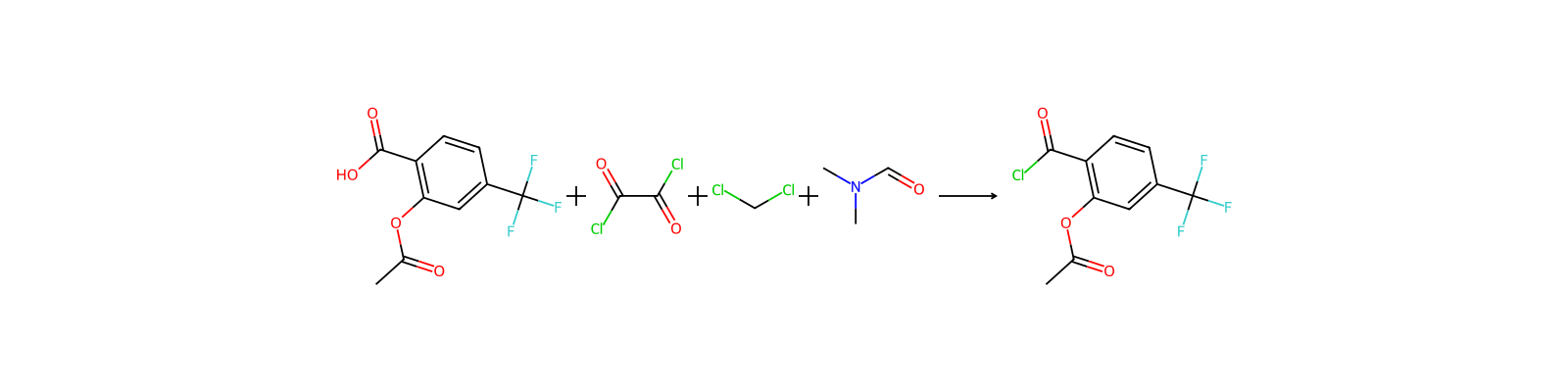
HRID 98027반응물로
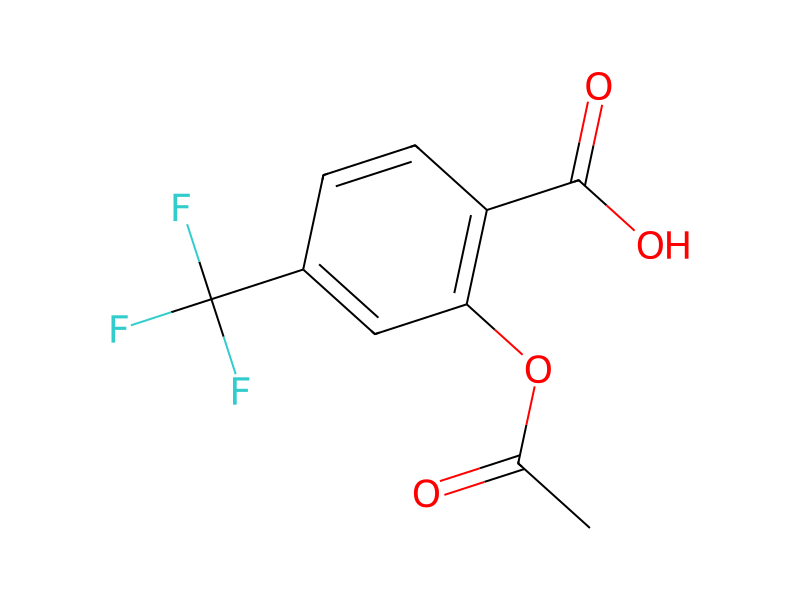
322-79-2CC(=O)Oc1cc(C(F)(F)F)ccc1C(=O)ORMWVZGDJPAKBDE-UHFFFAOYSA-N2-acetyloxy-4-(trifluoromethyl)benzoic acid is a member of benzoic acids, a member of salicylates and a carboxylic ester.
322-79-2DTXSID8045305CHEMBL1332032CHEBI:94721Pharmaceuticals -> Listed in ZINC15
Pharmaceuticals -> Blood and blood forming organs -> Antithrombotic agents
안전 정보는 참고용이며, 공급업체의 물질안전보건자료(SDS), 관련 법규 및 전문가 평가를 대체하지 않습니다.
Warning
H302 (100%): Harmful if swallowed [Warning Acute toxicity, oral]
P261, P264, P264+P265, P270, P271, P272, P280, P301+P317, P302+P352, P304+P340, P305+P351+P338, P319, P321, P330, P332+P317, P333+P317, P337+P317, P362+P364, P403+P233, P405, and P501 (click each P-code to see the statement)
Aggregated GHS information provided per 44 reports by companies from 6 notifications to the ECHA C&L Inventory. Each notification may be associated with multiple companies.
B - Blood and blood forming organs
QB - Blood and blood forming organs
Triflusal is an antithrombotic anticoagulant. It irreversibly inhibits the production of thromboxane-B2 in platelets by acetylating cycloxygenase-1. Triflusal affects many other targets such as NF kappa B, which is a gene expression regulatory factor for cycloxygenase-a and cytokines. Numerous studies comparing the efficacy and safety profile (i.e. systemic hemorrhage) between triflusal and acetylsalsylic acid has shown either no significant difference or a better effacy and safety profile for triflusal. Triflusal has been shown to protect cerebral tissue due to its inhibition of lipid peroxidation resulting from anoxia-reoxygenation.
Triflusal is chemically related to acetylsalicylic acid (ASA) and irreversibly inhibits cycloxygenase-1 (COX-1) in platelets. Acetylation of the active group of COX-1 prevents the formation of thromboxane-B2 in platelets. However, it is unique because it spares the arachidonic acid metabolic pathway in endothelial cells. In addition, it favors the production of nitric oxide, a vasodilator.
Drugs or agents which antagonize or impair any mechanism leading to blood platelet aggregation, whether during the phases of activation and shape change or following the dense-granule release reaction and stimulation of the prostaglandin-thromboxane system.

White to Off-White Solid
Absorbed in the small intestine with a bioavailability range from 83% to 100%. There is no significant difference between the absorption of the oral solution and capsule formulation. Triflusal displays a Cmax of 11.6 mcg/ml and a tmax of 0.88 h. The major metabolite of triflusal presents different pharmacokinetic properties by showing a Cmax and tmax of 92.7 mcg/ml and 4.96 h, respectively.
The elimination pathway of triflusal is primarily renal. Urine analysis has shown the presence of unchanged triflusal, HTB and the glycine conjugate of HTB.
The reported volume of distribution for triflusal is of 34L.
Renal clearance is 0.8 +/- 0.2L/h and 0.18 +/1 0.04L/h for triflusal and HTB, respectively.
용도An analog of Aspirin; inhibits platelet aggregation. Antithrombotic.