
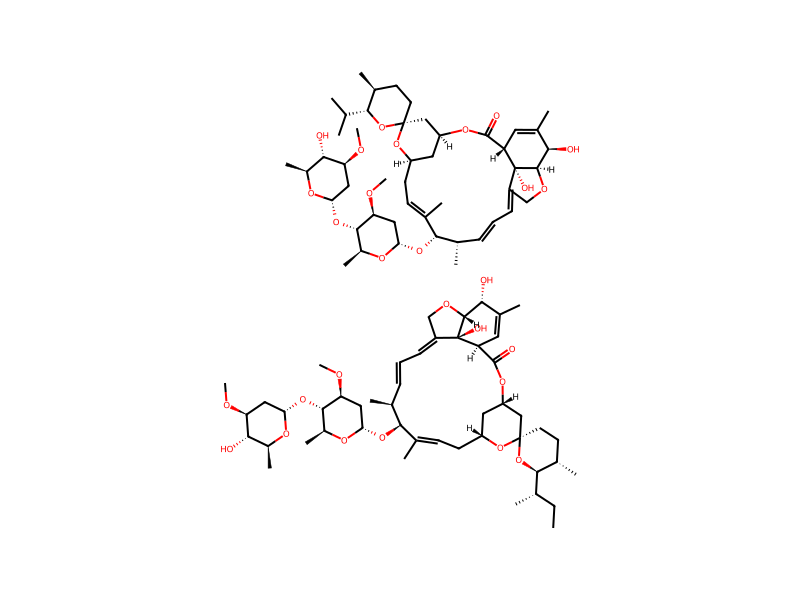
기본 정보
- CAS
70288-86-7- 표준 SMILES
CC[C@H](C)[C@H]1O[C@]2(CC[C@@H]1C)C[C@@H]1C[C@@H](C/C=C(\C)[C@@H](O[C@H]3C[C@H](OC)[C@@H](O[C@H]4C[C@H](OC)[C@@H](O)[C@H](C)O4)[C@H](C)O3)[C@@H](C)/C=C/C=C3\CO[C@@H]4[C@H](O)C(C)=C[C@@H](C(=O)O1)[C@]34O)O2.CO[C@H]1C[C@H](O[C@H]2[C@H](C)O[C@@H](O[C@@H]3/C(C)=C/C[C@@H]4C[C@@H](C[C@]5(CC[C@H](C)[C@@H](C(C)C)O5)O4)OC(=O)[C@@H]4C=C(C)[C@@H](O)[C@H]5OC/C(=C\C=C\[C@@H]3C)[C@]54O)C[C@@H]2OC)O[C@@H](C)[C@@H]1O- InChIKey
SPBDXSGPUHCETR-JFUDTMANSA-N- 분자식
- C95H146O28
- 평균 분자량
- 1,736.2 g/mol
개요
Ivermectin is a semi-synthetic antiparasitic medication derived from avermectins, a class of highly-active broad-spectrum antiparasitic agents isolated from the fermentation products of Streptomyces avermitilis. Ivermectin itself is a mixture of two avermectins, comprising roughly 90% 5-O-demethyl-22,23-dihydroavermectin A1a (22,23-dihydroavermectin B1a) and 10% 5-O-demethyl-25-de(1-methylpropyl)-22,23-dihydro-25-(1-methylethyl)avermectin A1a (22,23-dihydroavermectin B1b). Ivermectin is mainly used in humans in the treatment of onchocerciasis, but may also be effective against other worm infestations (such as strongyloidiasis, ascariasis, trichuriasis and enterobiasis). Applied topically, it may be used in the treatment of head lice infestation. With the advent of 2020 and the COVID-19 pandemic, ivermectin began garnering notoriety due to its off-label use for the prophylaxis and treatment of COVID-19. While studies are still ongoing, much of the evidence for ivermectin in COVID-19 relies on pre-print in vitro data, and the clinical utility of this data remains unclear. Due to a number of factors - for example, the relatively low number of patients per trial and the speed at which these trials were conducted - studies on the use of ivermectin in COVID-19 have been fraught with statistical errors and accusations of plagiarism. In addition, the use of aggregate patient data in large-scale meta-analyses (as opposed to individual patient data (IPD)) has been shown to disguise otherwise blatant data errors, such as extreme terminal digit bias and the duplication of blocks of patient records. Until high-quality, peer-reviewed data regarding both the safety and efficacy of ivermectin for COVID-19 in humans becomes available, the use of ivermectin for these purposes should be avoided in favour of thoroughly-vetted therapies (e.g. COVID-19 vaccines like [Comirnaty](https://go.drugbank.com/drugs/DB15696)).
이름 및 식별자
- 우선 이름
- Ivermectin CRS
- IUPAC
- (1R,4S,5'S,6R,6'R,8R,10E,12S,13S,14E,16E,20R,21R,24S)-6'-[(2S)-butan-2-yl]-21,24-dihydroxy-12-[(2R,4S,5S,6S)-5-[(2S,4S,5S,6S)-5-hydroxy-4-methoxy-6-methyloxan-2-yl]oxy-4-methoxy-6-methyloxan-2-yl]oxy-5',11,13,22-tetramethylspiro[3,7,19-trioxatetracyclo[15.6.1.14,8.020,24]pentacosa-10,14,16,22-tetraene-6,2'-oxane]-2-one;(1R,4S,5'S,6R,6'R,8R,10E,12S,13S,14E,16E,20R,21R,24S)-21,24-dihydroxy-12-[(2R,4S,5S,6S)-5-[(2S,4S,5S,6S)-5-hydroxy-4-methoxy-6-methyloxan-2-yl]oxy-4-methoxy-6-methyloxan-2-yl]oxy-5',11,13,22-tetramethyl-6'-propan-2-ylspiro[3,7,19-trioxatetracyclo[15.6.1.14,8.020,24]pentacosa-10,14,16,22-tetraene-6,2'-oxane]-2-one
- 영어명
- Ivermectin
- 분자식
- C48H74O14
- 분자량
- 875.09
이름 및 동의어
Ivermectin RSIvermectin CRSIvermectin (Standard)SCHEMBL44294SPBDXSGPUHCETR-JFUDTMANSA-NHMS6018O13HY-15310RIvermectine 100 microg/mL in AcetonitrileF556517IVERMECTINElvermectinIVOMEC
이름 더 보기
VERMECTINIVERMECTIN HCLStromectolIvermectin EP2000Avermectin B1a Dihydro Analogmk933Uvemec
데이터베이스 식별자
- CAS
70288-86-7- PubChem CID
- 9812710
물성
구조 계산 물성
- 극성 표면적
- 340 Ų
- 수소 결합 공여자 수
- 6
- 수소 결합 수용자 수
- 28
- 회전 가능 결합 수
- 15
- 무거운 원자 수
- 123
- 형식 전하
- 0
- 복잡도
- 3,340
실험 및 물리화학적 성질
SolubilityInsoluble
물리화학적 성질
- 저장 조건
- 2 · 2-8°C
- 용해도
- 2 O: · H2O: ≤1.0% KF
- 물리적 상태
- 가루
- 색상
- 하얀색
- 수용성
- 4 mg/L · 4mg/L(온도는 명시되지 않음)
- BCS Class
- 4 · 4/3
- 안정성
- 3 · 최대 3개월 동안 -20°에서 DMSO 또는 에탄올에 보관
- 주요 응용
- 의약품(소분자)
- InChIKey
- AZSNMRSAGSSBNP-XPNPUAGNSA-N
- EPA
- Ivermectin (70288-86-7)
화학적 성질
Crystalline Solid
안전 및 규제
안전 데이터
- wgk
- 3
- ridadr
- UN 2811 6.1/PG 2
- 독성
- LD50 in dogs, rhesus monkeys (mg/kg): about 80, more than 24 orally. (MSDS Merck & Co. Inc., 2003)
- HS 번호
- 29322090
- risk_code
- 61-25-36-36/38-22-28
- hazard_code
- T,Xn,T+
- safety_code
- 53-26-45-36-36/37-28
- 포장분류
- II
- 위험 등급
- 6.1(a)
- Hazard Classifications
- Acute Tox. 1 OralAcute Tox. 3 DermalAquatic Acute 1Aquatic Chronic 1
- 스토리지 클래스
- 6.1A - Combustible acute toxic Cat. 1 and 2very toxic hazardous materials
화학 및 산업
약리 정보
Protein Binding93%
Pharmacodynamics
Ivermectin is a semisynthetic, anthelminitic agent. It is an avermectin, a group of pentacyclic sixteen-membered lactones (i.e. a macrocyclic lactone disaccharide) derived from the soil bacterium _Streptomyces avermitilis_. Avermectins are potent and broad-spectrum anti-parasitic agents.
Mechanism of Action
Ivermectin binds selectively and with high affinity to glutamate-gated chloride ion channels in invertebrate muscle and nerve cells of the microfilaria. This binding causes an increase in the permeability of the cell membrane to chloride ions and results in hyperpolarization of the cell, leading to paralysis and death of the parasite. Ivermectin also is believed to act as an agonist of the neurotransmitter gamma-aminobutyric acid (GABA), thereby disrupting GABA-mediated central nervous system (CNS) neurosynaptic transmission. Ivermectin may also impair normal intrauterine development of _O. volvulus_ microfilariae and may inhibit their release from the uteri of gravid female worms.
Biological Half-LifeFollowing oral administration, the half-life of ivermectin is approximately 18 hours.
Metabolism/MetabolitesPrimarily hepatic. Ivermectin and/or its metabolites are excreted almost exclusively in the feces over an estimated 12 days, with less than 1 % of the administered dose excreted in the urine.
Absorption, Distribution and Excretion
Moderately well absorbed. Improved absorption with high fat meal.
Ivermectin is metabolized in the liver, and ivermectin and/or its metabolites are excreted almost exclusively in the feces over an estimated 12 days, with less than 1% of the administered dose excreted in the urine.
The volume of distribution is 3 to 3.5 L/kg and it does not cross the blood-brain barrier.
응용 분야
개요Ivermectin is an antiparasitic agent effective in the treatment of onchocerciasis, or "river blindness". Since ivermectin acts to prevent the adult worm from producing microfilariae, it needs to be administered only once or twice a year.
역사The discovery of ivermectin was the result of a landmark collaboration in the 1970s between Merck & Co. and the Kitasato Institute in Japan. Microbiologist Satoshi Ōmura isolated a new Streptomyces species—Streptomyces avermitilis—from Japanese soil and sent its cultures to Merck. Merck scientist William C. Campbell then discovered ivermectins, a natural product with potent anthelmintic activity. To reduce its toxicity to mammals and optimize its efficacy, Merck chemists performed semi-synthetic modifications on ivermectin, hydrogenating it to obtain the derivative ivermectin. This optimization significantly improved the drug's safety, leading to its market launch as a highly effective veterinary drug in 1981. Its historic contribution lies in its application in human medicine: after demonstrating its remarkable efficacy against river blindness, Merck decided in 1987 to donate ivermectin (Mectizan®) indefinitely for the control and elimination of river blindness and lymphatic filariasis worldwide. This achievement ultimately earned Satoshi Ōmura and Campbell the 2015 Nobel Prize in Physiology or Medicine.
제조 방법
The synthesis of ivermectin involves the hydrogenation of the naturally occurring avermectin B1 (abamectin) at the double bond linking C-22 and C-23. This results in a mixture of two homologues, 22, 23-dihydroavermectin B1a (H2B1a) and 22, 23-dihydroavermectin B1b (H2 B1b). The a- and b- nomenclature refers to the presence on C-25, of either a secondary butyl side chain or an isopropyl group, respectively. The biological activities of H2B1a and H2B1b are similar. Large-scale separation of the two homologues is not practical, and, hence, ivermectin is marketed as a mixture of H2 B1a (>80%) and H2 B1b (
상·하류 제품 정보
상류 원료
공급사100 곳
北京华美互利生物化工010-56205725 · [email protected]
上海阿拉丁生化科技股份有限公司400-6206333 13167063860 · [email protected]
上海如吉生物科技发展有限公司+86-21-65211385-8001 36031160 · [email protected]
江苏荣硕药业有限公司0000-15105138935 15105138935 · [email protected]
LGM Pharma1-(800)-881-8210 · [email protected]
武汉易泰科技有限公司上海分公司18930552037 · [email protected]
湖北威德利化学试剂有限公司17771473825 13385289472 · [email protected]
石家庄金石贝美进出口贸易有限公司0311-89171450 15373918792 · [email protected]
大连美仑生物技术有限公司0411-62910999 13889544652 · [email protected]
太原市瑞和丰科贸有限公司+86 351 7031519 · [email protected]
石家庄斯迪亚诺精细化工有限公司0311-89250318 13582355795 · [email protected]
上海景颜化工科技有限公司13817811078 · [email protected]
上海泰坦科技股份有限公司400-6009262 15618770481 · [email protected]
MedChemexpress LLC021-58955995 · [email protected]
合肥天健化工有限公司551-65418679 15856988503;15837135945 · [email protected]
武汉丰泰威远科技有限公司027-87465837 19945049750 · [email protected]
孝感深远化工有限公司15527621225; 15527621225 · [email protected]
四川库利南科技有限公司400-1166-196 18981987031 · [email protected]
湖南汇百侍生物科技有限公司0731-85526065 13308475853 · [email protected]
斯百全化学(上海)有限公司021-021-021-67601398-809-809-809 15221380277 · [email protected]
上海源叶生物科技有限公司13636370518 · [email protected]
深圳菲斯生物科技有限公司0755-83725681-603
上海思域化工科技有限公司86-21-34053660 · [email protected]
AdooQ BioScience, LLC+1 (866) 930-6790 · [email protected]
上海遐瑞医药科技有限公司+86 21 61551611
深圳振强药物研发有限公司0755-66853366 13670046396 · [email protected]
南京杜莱生物技术有限公司025-84699383-8003;025-846993838003-8003 18013301590 · [email protected]
广州爱纯医药科技有限公司020-39119399 18927568969 · [email protected]
南京生利德生物科技有限公司025-57798810 18652991625 · [email protected]
陕西帕尼尔生物科技有限公司13720616393;029-84385017-8003 13720616393 · [email protected]
深圳市石金谷科技有限公司(0086)755-61930359 (0086)18038192047 · [email protected]
湖北威德利化学试剂有限公司186-02735115 18602735115 · [email protected]
湖北鑫源顺医药化工有限公司13971561712, 13995564702, 027-50664929 · [email protected]
上海湄水化工科技有限公司021-60549325 18616193163
上海将来实业股份有限公司400-0066400 13621662912 · [email protected]
上海将来实业股份有限公司021-61552785 · [email protected]
天津阿尔塔科技有限公司022-65378550-8551 · [email protected]
HBCChem, Inc.+1-510-219-6317 · [email protected]
四川省维克奇生物科技有限公司028-81700200 18116577057 · [email protected]
湖南华腾制药有限公司400-8592883 · [email protected]
上海麦克林生化科技股份有限公司15221275939 15221275939 · [email protected]
杭州杰恒化工有限公司0571-87396432 · [email protected]
南京百鑫德诺生物科技有限公司025-58849295 · [email protected]
石家庄金驰化工有限公司15176121996 · [email protected]
上海孚一生物科技有限公司+86 (21) 61124340
凯试(上海)科技有限公司021-50135380 · [email protected]
台州市科德化工有限公司0576-84613060 13093829633;13736603231 · [email protected]
湖北巨胜科技有限公司027-59599241 18871490274 · [email protected]
池州凯隆进出口贸易有限公司[email protected]
Sigma-Aldrich西格玛奥德里奇(上海)贸易有限公司021-61415566 800-8193336 · [email protected]
관련 반응
2건

화합물 노트
불러오는 중…