시안아미드
사이안아마이드 · 시아나미드 · 시안아미드 · 사이아노겐아마이드 · 수소 사이안아마이드 · 아미도사이아노겐 · 카르보다이이미드 · 카르비미드
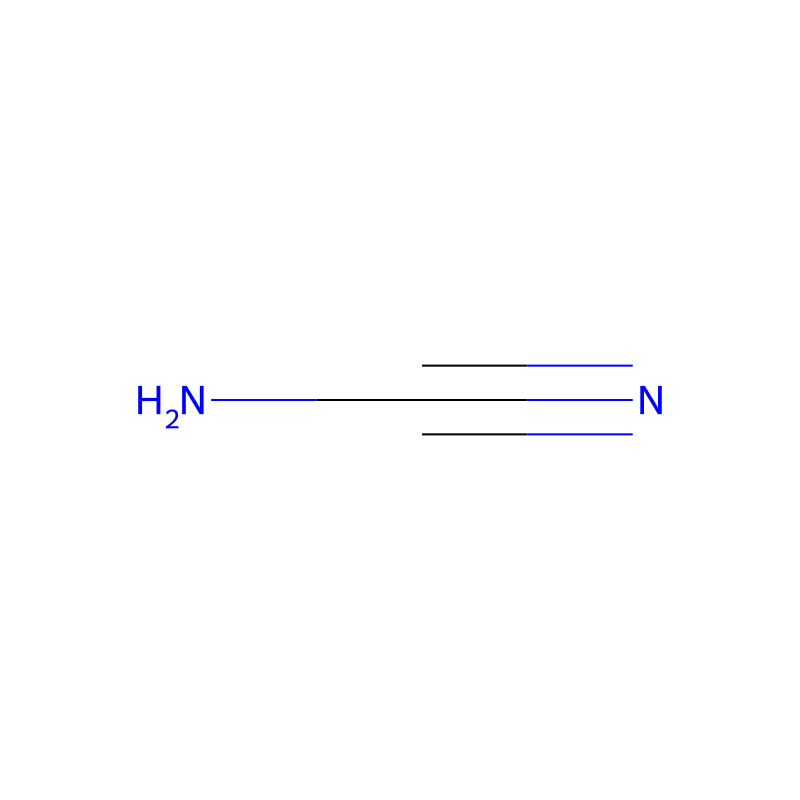
식별자 및 물리적 특성
| CAS No. | 20890-10-2 |
|---|---|
| 분자식 | CH2N2 |
| 평균 분자량 | 42.04 g/mol |
| 단동위원소 질량 | 42.02179806 g/mol |
| SMILES | N#CN |
| InChIKey | XZMCDFZZKTWFGF-UHFFFAOYSA-N |
| PubChem CID | 9864 |
| ChEMBL | CHEMBL56279 |
| ChEBI | CHEBI:16698 |
| EC No. | 206-992-3 |
| DTXSID | DTXSID9034490 |
| 현지명 | 시안아미드 |
화학 및 물리적 성질
| XLogP | -0.3 |
|---|---|
| 극성 표면적 | 49.8 |
| 수소 결합 공여자 수 | 1 |
| 수소 결합 수용자 수 | 2 |
| 회전 가능 결합 수 | 0 |
| 무거운 원자 수 | 3 |
| 형식 전하 | 0 |
| 복잡도 | 29.3 |
| 물질 분류 | Nitrogen Compounds -> CyanamidesFlammable agents - 3rd degree |
| SpringerMaterials Properties | 15N nuclear magnetic resonance spectrum |
| 농약 | Herbicides, Plant Growth RegulatorsActive substance -> EU Pesticides database: Not approvedEnvironmental transformation -> Pesticides (parent, predecessor) |
| LogP(분배 계수) | log Kow = -0.82 (20 °C) |
| 밀도 | 1.28 (NIOSH, 2024) - Denser than waterwill sink1.282 g/cu cm at 20 °CRelative density (water = 1): 1.281.282 @ 20°C1,282 g/cm3 |
| Color/Form | Orthorhombic, elongated, six-sided tablets from dimethyl phthalateCrystallizes from a variety of solvents as somewhat unstable, colorless, orthorhombic, deliquescent crystals.Deliquescent crystalsCyanamide forms colorless, orthorhombic crystals or long transparent needles (from water), large platelike crystals when allowed to crystallize spontaneously from water, and crystals from dimethyl phthalate solution. |
| 용해도 | 78 % at 59 °F (NIOSH, 2024)In butanol 28.8ethyl acetate 42.4, methyl ethyl ketone 50.5 (all g/100 g at 20 °C)sol in phenols, amines, ethers, ketonesvery sparingly soluble in benzene, halogenated hydrocarbonspractically insoluble in cyclohexane.Slightly soluble in carbon disulfideCyanamide is completely soluble in water at 43 °C and has a minimum solubility at -15 °Chighly soluble in polar organic solvents, such as alcohols, ethers, esters, nitriles and amides, but less soluble in nonpolar solvents like saturated, halogenated, or aromatic hydrocarbons. Ketones are not recommended as solvents for cyanamide, because they tend to react under certain circumstances.In chloroform 2.4 g/kg, 20 °C에탄올: 용해성 10%, 투명~흐릿함, 무색~미황색 |
| Corrosivity | Non-corrosive, as far as known |
| 인화점 | 286 °F (NIOSH, 2024)141 °C (closed cup)>230 °F |
| Endocrine Disruptors | Potential endocrine disrupting compound |
| 끓는 점 | 500 °F at 760 mmHg (Decomposes) (NIOSH, 2024)140 °C at 19 mm HgBoiling point at 19 mm Hg is 140 °Cat 0.067kPa: 83 °C500 °F (decomposes)83 °C/0.5 mmHg (lit.) |
| Decomposition | When heated to decomposition ... it emits toxic fumes of cyanide and nitroxides.260 °C |
| 녹는점 | 45-46 °C (lit.) |
| 증기압 | 1Pa at 24.95℃ |
| 굴절률 | 1.405 |
| 저장 조건 | 2-8°C |
| pKa(산도 계수) | 1.1(at 29℃) |
| 물리적 상태 | 결정질 고체 |
| 비중 | 1.282 |
| 용해도 | 775g/L |
| Merck | 14,2684 |
| BRN | 1732569 |
| 헨리 상수 | 3.7×10⁴ mol/(m3Pa) at 25℃, HSDB (2015) |
| 안정성 | 불안정 - 열에 민감함. 강한 산화제, 강한 환원제, 염기, 산, 철 및 그 염, 강철, 황동, 납, 습기와 호환되지 않습니다. 산과 반응하여 매우 유독한 가스를 생성합니다. |
| InChI | 1S/CH2N2/c2-1-3/h2H2 |
| InChIKey | XZMCDFZZKTWFGF-UHFFFAOYSA-N |
| SMILES | NC#N |
| LogP(분배 계수) | -0.72 at 20℃ |
| NIST | Cyanamide(420-04-2) |
| EPA | Cyanamide (420-04-2) |
화학적 성질
Cyanamide is a combustible crystalline solid, but it is usually found as a 25% liquid solution.
안전 및 규제
| GHS 분류 | DangerH301: Toxic if swallowed [Danger Acute toxicity, oral]P203, P260, P261, P262, P264, P264+P265, P270, P272, P273, P280, P301+P316, P301+P330+P331, P302+P352, P302+P361+P354, P304+P340, P305+P354+P338, P316, P317, P318, P319, P321, P330, P333+P317, P361+P364, P362+P364, P363, P405, and P501 (click each P-code to see the statement)H301+H311 (53.2%): Toxic if swallowed or in contact with skin [Danger Acute toxicity, oralacute toxicity, dermal]P203, P260, P261, P262, P264, P264+P265, P270, P272, P273, P280, P301+P316, P301+P330+P331, P302+P352, P302+P361+P354, P304+P340, P305+P351+P338, P305+P354+P338, P316, P317, P318, P319, P321, P330, P332+P317, P333+P317, P337+P317, P361+P364, P362+P364, P363, P405, and P501 (click each P-code to see the statement) |
|---|---|
| 규제 정보 | Chemical: CyanamideCommission Regulation (EC) No 33/2008Cyanamide is listed on the EPA's Chemical Data Reporting (CDR) system. Manufacturers and importers of Cyanamide are required to report information about their production and use of this chemical to the EPA under the Toxic Substances Control Act (TSCA). (40 eCFR Part 711)Hydrogen cyanamide (Cyanamide) is listed in the dataset of EPA Human Health Benchmarks for Pesticides under the Safe Drinking Water Act (40 eCFR 141)2008/745Status: Active Update: 03-11-2022 https://echa.europa.eu/registration-dossier/-/registered-dossier/15823 |
| 운송 라벨(DOT) | Poison |
| 화재 위험 | Excerpt from ERG Guide 154 [Substances - Toxic and/or Corrosive (Non-Combustible)]:Combustible only at increased temperature. Gives off irritating or toxic fumes (or gases) in a fire. |
| 화재 가능성 | Cyanamide may burn, but does not readily ignite. |
| 건강 유해성 | Excerpt from NIOSH Pocket Guide for Cyanamide: |
| 유해성 요약 | The TLV basis for cyanamide is skin and eye irritationMay cause antabuse-like effect in exposed workers who ingest alcohol[ACGIH] Allergic contact dermatitis has been reported. [Allergic contact dermatitis from cyanamide: report of 3 cases. Goday Bujan JJ, et al. Contact Dermatitis. 1994 Nov31(5):331-2. No abstract available. Abstract in NIOSHTIC # 192164] Can cause liver injury after ingestion[HSDB] Danger of skin sensitization[MAK] |
| 반응성 그룹 | Amines, Phosphines, and Pyridines |
| EC 분류 | Symbol: TR: 21-25-36/38-43S: (1/2)-3-22-36/37-45 |
| UN 분류 | UN Hazard Class: 6.1UN Pack Group: III |
| FIFRA 요건 | New Active Ingredients ... includes chemicals not previously registered as pesticides, as well as pesticide active ingredients initially registered after November 1, 1984 and that currently have active product registrations. By law, these pesticides must meet new safety standards, such as those described in the Food Quality Protection Act of 1996 and, if new safety standards are met, will be reviewed again on a 15-year cycle. Hydrogen Cyanamide is designated by EPA as a New Pesticide Active Ingredient. Active Ingredient Number: 014002Type of Pesticide: Conventional: Plant growth regulatorUse Site: Food useYear: 1993.The USEPA has published the Hydrogen Cyanamide (Cyanamide) Final Work Plan Registration Review - May 2008 in Docket EPA-HQ-OPP-2007-1014-0008. This Work Plan announces EPA's intention to conduct a comprehensive ecological risk assessment, including an endangered species assessment for all cyanamide uses and to complete a drinking water assessment. To date, the assessments have not been posted. |
| Reactivity Alerts | Polymerizable |
| Reactivity Profile | CYANAMIDE is the amide of cyanic acid. Non-flammable but combustible (flash point: 140 °C). Decomposes on warming above 49 °C. Emits toxic fumes of CN- and NOx when heated to decomposition or on contact with acids or acid fumes (Hazardous Chemicals Desk Reference, p. 353 (1987)). Contact with moisture, acids or bases may cause a violent reaction at temperatures above about 40 °C. Dry solid may polymerize at temperatures above 122 °C. Rapid or explosive polymerization may occur during the evaporation of aqueous solutions. Reacts explosively with strong oxidizing agents and strong reducing agents. Attacks various metals (International Chemical Safety Card). |
| 소화 | Excerpt from ERG Guide 154 [Substances - Toxic and/or Corrosive (Non-Combustible)]:Use carbon dioxide, dry powder, dry sand, water spray. Combat fire from a sheltered position. |
| 응급 조치 | Fresh air, rest. Seek medical attention if you feel unwell.Remove contaminated clothes. Rinse skin with plenty of water or shower. Refer for medical attention .First rinse with plenty of water for several minutes (remove contact lenses if easily possible), then refer for medical attention.Rinse mouth. Give one or two glasses of water to drink. Do NOT induce vomiting. Refer for medical attention . |
| 응급 처치 | Excerpt from NIOSH Pocket Guide for Cyanamide:(General first aid procedures) |
| 안전 보관 | Separated from food and feedstuffs and incompatible materials. See Chemical Dangers. Cool. Store at maximum 20 °C, never exceed 30 °C. Dry. Well closed. Keep in a well-ventilated room. Store only if stabilized. Store in stainless steel, polyethylene or polypropylene. |
| 노출 관리 및 개인 보호 | 0.35 [mg/m3] (can also occur as vapor and aerosol)[German Research Foundation (DFG)] |
| 소화 절차 | Use dry chemical or CO2 extinguishers. Containers may explode in fire. If material or contaminated runoff enters waterways, notify downstream users or potentially contaminated waters. Notify local health and fire officials and pollution control agencies. From a secure, explosion-proof location, use water spray to cool exposed containers. If cooling streams are ineffective (venting sound increases in volume and pitch, tank discolors or shows any signs of deforming), withdraw immediately to a secure position ... The only respirators recommended for fire fighting are self-contained breathing apparatuses that have full facepieces and are operated in a pressure-demand or other positive-pressure mode. |
| 보관 조건 | The commercial 50% solution produced by Degussa AG is stabilized by a special buffer system to a pH between 4.0 and 4.6. Typically, it contains less than 1.5 % dicyandiamide, less than 0.5% urea, and less than 0.1 % thiourea. This solution is stable for at least 3 months if stored at a temperature below 20 °C. Prolonged storage leads to an increase in the pH and thus to instability of the solution. If a pH of 5.2 has been reached, the product should be used quickly, above pH 5.5 it should be discarded immediately by mixing it with at least the double volume of water. Otherwise, a thermal runaway reaction leading to temperatures above 100 °C and potential bursting of the container may occur.The commercial crystalline Cyanamide F1000 from Degussa AG contains a special stabilizer system to ensure safe handling and transportation. It can be stored at least for 3 months at or below 20 °C. Temperatures above 40 °C must be avoided in any case.Store in tightly closed containers in a cool well-ventilated area away from acids or acid fumes. Cyanamide can be stored in glass containers if it is stabilized with phosphoric, acetic, sulfuric, or boric acidit attacks iron and steel, copper and brass. Sources of ignition, such as smoking and open flames, are prohibited where cyanamide is used, handled, or stored in a manner that could create a potential fire or explosion hazard. Wherever cyanamide is used, handled, manufactured, or stored, use explosion-proof electrical equipment and fittings.Soln can be stored in glass, provided they are stabilized with phisphoric, acetic, sulfuric, or boric acid.Solid is stored in a cool, dry, place. Liquid is stored in pH4 added with phosphoric acid, sulfuric acid, or boric acid. |
| 정리 방법 | Spill handling: evacuate persons not wearing protective equipment from area of spill or leak until clean-up is complete. Remove all ignition sources. Ventilate area of spill or leak. Collect powdered material in the most convenient and safe manner and deposit in sealed containers. Absorb liquids in vermiculite, dry sand, earth, peat, carbon, or a similar material and deposit in sealed containers. It may be necessary to contain and dispose of this chemical as a hazardous waste. Keep cyanamide out of a confined space, such as a sewer, because of the possibility of an explosion, unless the sewer is designed to prevent the build-up of explosive concentrations. If material or contaminated runoff enters waterways, notify downstream users of potentially contaminated waters. Contact your Department of Environmental Protection or your regional office of the federal EPA for specific recommendations. |
| 비화재 누출 대응 | Excerpt from ERG Guide 154 [Substances - Toxic and/or Corrosive (Non-Combustible)]: |
| 처리 방법 | SRP: The most favorable course of action is to use an alternative chemical product with less inherent propensity for occupational harm/injury/toxicity or environmental contamination. Recycle any unused portion of the material for its approved use or return it to the manufacturer or supplier. Ultimate disposal of the chemical must consider: the material's impact on air qualitypotential migration in soil or watereffects on animal and plant lifeand conformance with environmental and public health regulations. |
| 누출 처리 | Personal protection: complete protective clothing including self-contained breathing apparatus. Do NOT let this chemical enter the environment. Vacuum spilled material with specialist equipment. Carefully collect remainder. Then store and dispose of according to local regulations. |
| Preventive Measures | The worker should immediately wash the skin when it becomes contaminated.Work clothing that becomes wet or significantly contaminated should be removed and replaced.Workers whose clothing may have become contaminated should change into uncontaminated clothing before leaving the work premises.Local exhaust or breathing protection.For more Preventive Measures (Complete) data for Cyanamide (8 total), please visit the HSDB record page. |
| 상호 작용 | Systemic absorption after taking alc causes nausea, headache, vertigo, fall in blood pressure, & transitory intense redness of face.Rats fed ethanol (150 mL/L) for 3 mo & diet contaminated with calcium cyanamide showed 2-fold higher activity of low km acetaldehyde dehydrogenase in liver, higher rate of alc elimination & 2-3 times lower acetaldehyde levels in blood during alc elimination.Blood pressure response after alc admin was studied in relation to blood acetaldehyde levels in rats pretreated with cyanamide. Cyanamide inhibited low-km aldehyde dehydrogenase in liver & caused & incr acetaldehyde level in blood.Cyanamide reacted with amino & thiol groups to form guanidino & isothiouronium cmpd respectively under physiological conditions. Possible mode of action of cyanamide on alcohol metabolism are discussed. |
| 표적 장기 | Eyes, skin, respiratory system, central nervous system |
| 생태독성 수치 | LD50 Colinus virginianus (Bobwhite quail) 173 mg/kgLD50 Honey bee oral > 36.2 ug a.i./beeLC50Species: Anas platyrhynchos (Mallard duck)Concentration: > 5000 ppm for 8 days /Conditions of bioassay not given/Species: Colinus virginianus (Bobwhite quail)For more Ecotoxicity Values (Complete) data for Cyanamide (17 total), please visit the HSDB record page. |
| 환경 거동 | TERRESTRIAL FATE: Based on a classification scheme(1), estimated Koc values of 4.7 and 7.3(SRC), determined from a structure estimation method(2) and a log Kow of -0.82(3) with a regression-derived equation(2), respectively, indicate that cyanamide is expected to have very high mobility in soil(SRC). Volatilization of cyanamide from moist soil surfaces is not expected to be an important fate process(SRC) given an estimated Henry's Law constant of 2.66X10⁻¹⁰ atm-cu m/mole(SRC), derived from its vapor pressure, 3.75X10⁻³ mm Hg(3), and water solubility, 7.8X10+5 mg/L(3). In soil, cyanamide is converted to nitrogenous compounds which are rapidly taken up(3). In aqueous conditions, cyanamide decomposes by hydrolysis to urea and by dimerization to dicyanamide(4,5). Cyanamide does not absorb at wavelengths >290 nm(4) and therefore is not expected to be susceptible to direct photolysis on sunlit soil or plant(SRC).AQUATIC FATE: Based on a classification scheme(1), estimated Koc values of 4.7 and 7.3(SRC), determined from a structure estimation method(2) and a log Kow of -0.82(3) with a regression-derived equation(2), respectively, indicate that cyanamide is not expected to adsorb to suspended solids and sediment(SRC). Volatilization of cyanamide from water surfaces is not expected(4) given an estimated Henry's Law constant of 2.66X10⁻¹⁰ atm-cu m/mole(SRC), derived from its vapor pressure, 3.75X10⁻³ mm Hg(3), and water solubility, 7.8X10+5 mg/L(3). Cyanamide decomposes in water by hydrolysis to urea in acidic conditions and by dimerization to dicyanamide in alkaline conditions(5,6). Cyanamide does not absorb at wavelengths >290 nm(5) and therefore is not expected to be susceptible to direct photolysis on sunlit water(SRC).ATMOSPHERIC FATE: According to a model of gas/particle partitioning of semivolatile organic compounds in the atmosphere(1), cyanamide, which has a vapor pressure of 3.75X10⁻³ mm Hg at 20 °C(2), will exist solely as a vapor in the ambient atmosphere. The rate constant for the vapor-phase reaction of cyanamide with photochemically-produced hydroxyl radicals can not be estimatedtherefore, the half-life for this reaction in the atmosphere can not be estimated(SRC). Cyanamide does not absorb at wavelengths >290 nm(4) and therefore is not expected to be susceptible to direct photolysis by sunlight(SRC). |
| 유해 작용 | Occupational hepatotoxin - Secondary hepatotoxins: the potential for toxic effect in the occupational setting is based on cases of poisoning by human ingestion or animal experimentation. |
| 노출 경로 | The substance can be absorbed into the body by inhalation of its aerosol, through the skin and by ingestion.inhalation, skin absorption, ingestion, skin and/or eye contact |
| 독성 요약 | Organic nitriles decompose into cyanide ions both in vivo and in vitro. Consequently the primary mechanism of toxicity for organic nitriles is their production of toxic cyanide ions or hydrogen cyanide. Cyanide is an inhibitor of cytochrome c oxidase in the fourth complex of the electron transport chain (found in the membrane of the mitochondria of eukaryotic cells). It complexes with the ferric iron atom in this enzyme. The binding of cyanide to this cytochrome prevents transport of electrons from cytochrome c oxidase to oxygen. As a result, the electron transport chain is disrupted and the cell can no longer aerobically produce ATP for energy. Tissues that mainly depend on aerobic respiration, such as the central nervous system and the heart, are particularly affected. Cyanide is also known produce some of its toxic effects by binding to catalase, glutathione peroxidase, methemoglobin, hydroxocobalamin, phosphatase, tyrosinase, ascorbic acid oxidase, xanthine oxidase, succinic dehydrogenase, and Cu/Zn superoxide dismutase. Cyanide binds to the ferric ion of methemoglobin to form inactive cyanmethemoglobin. (L97) |
| 생태독성 발췌 | /BIRDS and MAMMALS/ A reproductive study ... showed no adverse effects in bobwhite quail up to 300 ppm in the feed. |
| Signs and Symptoms | Cough. Shortness of breath.MAY BE ABSORBED! Redness. Pain.Burning sensation. Sore throat. Abdominal pain.irritation eyes, skin, respiratory systemeye, skin burnsmiosis, salivation, lacrimation (discharge of tears), twitchingAntabuse-like effects |
| Effluent Concentrations | Cyanamide was found to be present in the wastewater from nitroguanidine processes after 271 days of operation of a continuous-flow columns. Concentrations in continuous-flow soil column effluent columns ranged from 0 to 1.7 mg/L(1). |
| ICSC Environmental Data | The substance is toxic to aquatic organisms. It is strongly advised not to let the chemical enter into the environment. |
| Soil Adsorption/Mobility | Using a structure estimation method based on molecular connectivity indices(1), the Koc of cyanamide can be estimated to be 4.7(SRC). The Koc of cyanamide can also be estimated as 7.3(SRC), using a log Kow of -0.82(2) and a regression-derived equation(1). According to a classification scheme(3), these estimated Koc values suggest that cyanamide is expected to have very high mobility in soil. |
| 직업 노출 등급(OEB) | B |
| 직업 노출 한계(OEL) | TWA: 2 mg/m3 |
| 수질 위해 등급(WGK) | 2 |
| TSCA 등재 상태 | TSCA listed |
| RTECS 번호 | GS5950000 |
| 운송 번호(UN) | UN 2811 6.1/PG 3 |
| 독성 | LD50 i.p. in male mice: 200-300 mg/kg (Doull) |
| 관세 코드 | 29269090 |
| 위험 문구(R) | 21-25-36/38-43 |
| 위험 표시 | T |
| 안전 문구(S) | 3-22-36/37-45-26 |
| 포장분류 | III |
| 위험 등급 | 8Acute Tox. 3 DermalAquatic Chronic 3Carc. 2Eye Dam. 1Repr. 2Skin Corr. 1BSkin Sens. 1STOT RE 2 |
| 기존화학 물질 | KE-09027 |
| 저장 분류 | 6.1C - Combustible acute toxic Cat.3toxic compounds or compounds which causing chronic effects |
| 유해 물질 데이터 | 420-04-2(Hazardous Substances Data) |
| 함량 및 규제정보 | 물질구분: 유독물질혼합물(제품)함량정보: 시안아미드 및 이를 25% 이상 함유한 혼합물 |
| 유해화학물질 필터링 | 97-1-145 |
용도
개요
Cyanamide and its salts are used on various occasions, such as in chemistry, in anti-rust solutions or in drugs for treating alcoholism (Come).
용도
In Europe, cyanamide is used as a fertilizer, weed killer, and defoliant. In North America, these applications have been practically discontinued. It is also used to produce cationic starch and calcium cyanide, dicyandiamide, and melamine. New uses include intermediates for pesticides; detergents; medicines such as antihistamines, hypertension, sedatives, and contraceptives; photography industry; additive for fuels and lubricants; paper preservative; and cement additive. Dormex is a common rest-breaking agent applied in spring to stimulate uniform opening of buds. Cyanamide has been tested as an effective and welltolerated pharmacological adjunct to treat alcohol-dependent patients. It is a potent aldehyde dehydrogenase inhibitor, and alters cholinergic function in the frontal cortex and hippocampus of rats exposed to ethanol.
일반 설명
Colorless deliquescent crystals. Mp: 45°C; bp: 260°C. Density: 1.282 g cm-3. Quite soluble in water (77 g / 100 g solution at 15°C). Soluble in butanol, methyl ethyl ketone, ethyl acetate, alcohols, phenols, amines, ethers. Note: The term "Cyanamide" is also used to refer to the important compound calcium Cyanamide, which is a different chemical.
제조 및 합성 방법
생산 방법
The basic process for the manufacture of cyanamide comprises four steps. The first three steps produce calcium cyanamide: lime is made from high grade limestone; (2) calcium carbide is manufactured from lime and coal or coke; calcium cyanamide is produced by passing gaseous nitrogen through a bed of calcium carbide with 1% calcium fluorspar, which is heated to 1000–1100°C to start the reaction—the heat source is then removed and the reaction continues because of its strong exothermic character; and cyanamide is manufactured from calcium cyanamide by continuous carbonation in an aqueous medium.