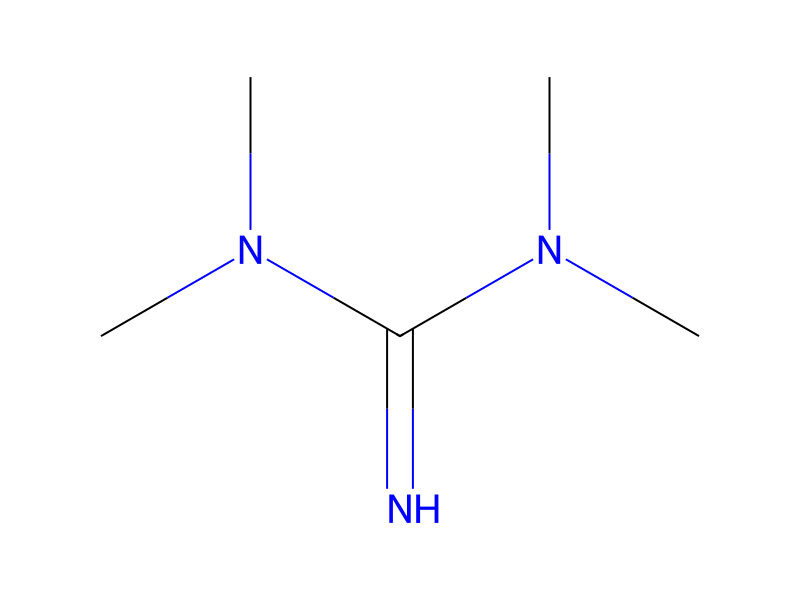
A procedure similar to Examples 1 and 2 was carried out using a ˜1:˜2.1 mixture of 1,5-bis(methylamino)-3-oxapentane (BMAOP) with pKa ˜9.87 and 1,1,3,3-tetramethylguanidine (˜1:1.05 mixture on the basis of amine sites) for ˜2 hours. Only one product, a mixed dicarbamate (monocarbamate at each amine site), appeared to form. The 1H NMR spectrum after carboxylation showed movement of the guanidinium protons (in relatively fast equilibrium with any remaining guanidine protons) downfield to ˜9.92 ppm, plus movement of the amine —NCH2— backbone resonance from ˜2.6 to ˜3.2-3.4 ppm. That most of BMAOP molecules reacted was confirmed by the absence of free peaks. Based on integration of the product peak at ˜161.6 ppm compared to the sharp C—O peak of DMAOP at ˜69.89 ppm, ˜99.7 mol % of BMAOP molecules were calculated to have reacted with CO2 to form a mixed carbamate with tetramethylguanidine. The difunctional BMAOP molecules appeared to react with two pairs of tetramethylguanidine and CO2 to form two mixed carbamate moieties per molecule at room temperature (˜199.4 mol % of CO2 per DMAOP molecule).