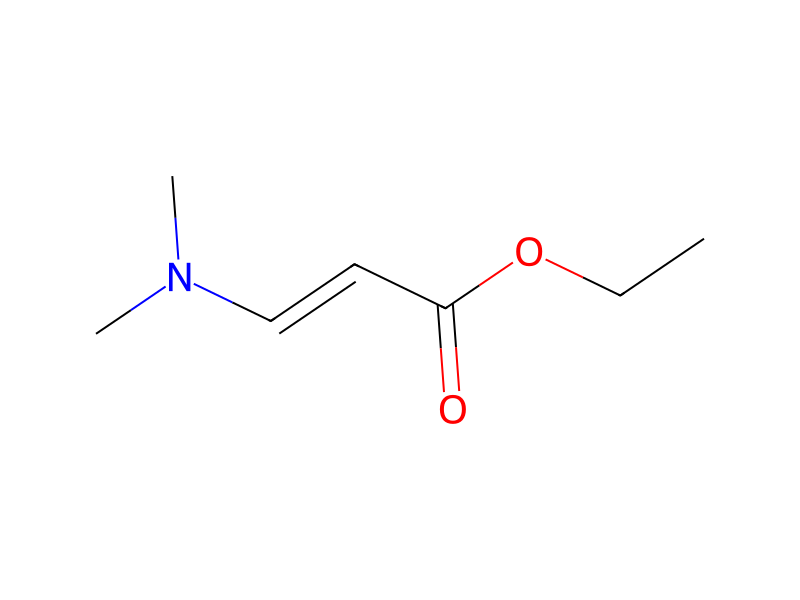
To a solution of 5-bromo-2-fluoronicotinic acid (3 g, 13.64 mmol) in toluene (30 mL) was added thionyl chloride (5 mL, 68.18 mmol, 5 equiv.) followed by DMF (0.5 mL). This was stirred at 110° C. for 2 h then concentrated in vacuo. The residue was resuspended in THF (15 mL) and added dropwise to a solution of ethyl 3-(dimethylamino)acrylate (2 mL, 13.64 mmol) and triethylamine (2.85 mL, 20.45 mmol) in THF (15 mL). The reaction was stirred at 70° C. for 18 h, cooled down to room temperature, and quenched with water. The reaction was partitioned between water (70 mL) and ethyl acetate (70 mL) and the layers were separated. The aqueous layer was extracted with ethyl acetate (2×70 mL). The combined organic layers were washed with 1 N HCl (100 mL) and brine (100 mL), dried over sodium sulftate, and concentrated. The concentrate was purified via silica gel chromotography to provide ethyl 2-(5-bromo-2-fluoronicotinoyl)-3-(dimethylamino)acrylate as an orange solid (3.64 g, 77%).