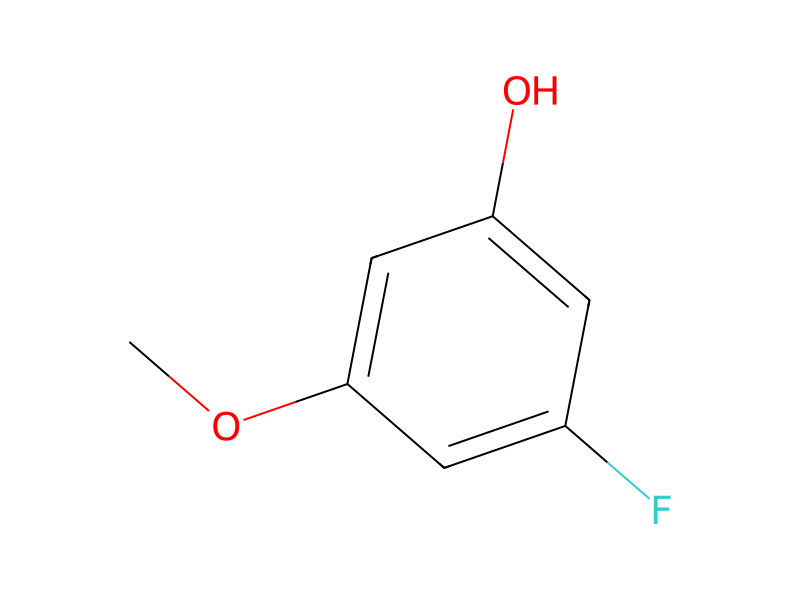
[F:1][C:2]1[CH:3]=[C:4]([OH:10])[CH:5]=[C:6]([O:8][CH3:9])[CH:7]=1.C1C(=O)N([Cl:18])C(=O)C1>ClCCCl>[Cl:18][C:3]1[C:2]([F:1])=[CH:7][C:6]([O:8][CH3:9])=[CH:5][C:4]=1[OH:10].[Cl:18][C:7]1[C:6]([O:8][CH3:9])=[CH:5][C:4]([OH:10])=[CH:3][C:2]=1[F:1]Under a nitrogen atmosphere, 3-fluoro-5-methoxyphenol (50-1) (15 g, 106 mmol) was diluted in DCE (150 mL, 0.7 M). To this solution NCS (15.5 g, 116 mmol) was added, and the reaction mixture was heated to reflux for 4 hours. The reaction was then cooled to room temperature and quenched with water (100 mL). The aqueous layer was then extracted with methylene chloride (3×50 mL). The organic extracts were dried over sodium sulfate and concentrated. Silica gel chromatography (1%-30% EtOAc/Hexanes) gave 2-chloro-3-fluoro-5-methoxyphenol (50-2) (6.7 g, 36%) and 4-chloro-3-fluoro-5-methoxyphenol (50-3) (2.8 g, 15%). LCMS (ES) m/z 177.2 (M)+. The starting material, 3-fluoro-5-methoxyphenol (50-1), was also recovered (4.3 g).