반응식

[NH+:1]1[CH:5]=[CH:4][NH:3][CH:2]=1.[NH+:6]1[NH:7][N:8]=[CH:9][CH:10]=1.[NH+]1C=CC=CC=1.CN(C)C1C=C[NH+]=CC=1>>[NH:3]1[CH2:4][CH2:5][N:1]=[CH:2]1.[NH:1]1[CH:5]=[CH:4][N:3]=[CH:2]1.[NH:6]1[CH:10]=[CH:9][N:8]=[N:7]1참가 물질


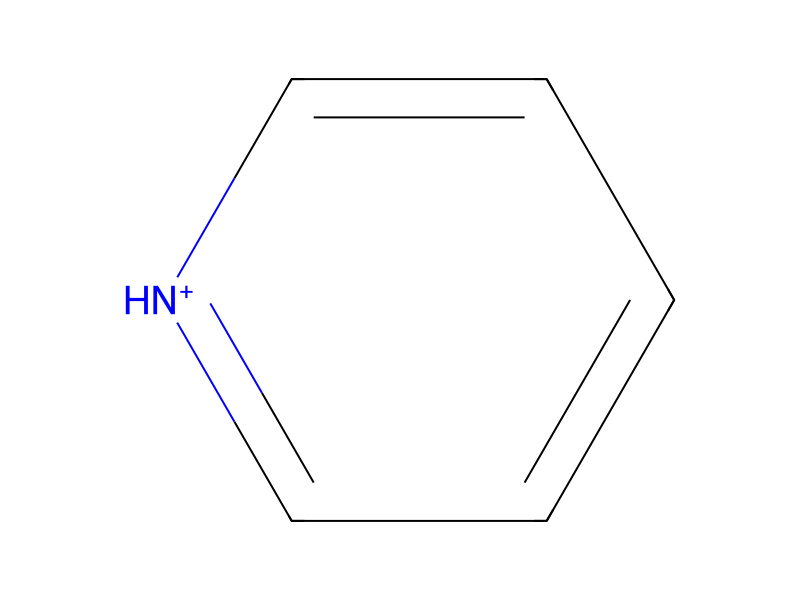




실험 절차
The onium cation can be chosen so as to introduce, into the salt, substituents which make it possible to confer specific properties on the said salt. For example, the M+ cation can be a cationic heterocycle of aromatic nature comprising at least one quaternized nitrogen atom in the ring. Mention may be made, by way of example, of the imidazolium, triazolium, pyridinium and 4-(dimethylamino)pyridinium ions, the said cations optionally carrying a substituent on the carbon atoms of the ring. Among these cations, those which give a salt with a melting point of less than 150° C. are advantageous, because they give ionic compositions which have a protonic conduction. A particularly preferred composition with protonic conduction comprises a salt in which the cation is formed by addition of a proton to the nitrogen of an imidazoline, of an imidazole or of a triazole, as well as the corresponding nitrogenous base, in a proportion of 0.5 to 10 by molar ratio.
후처리
- additionto introduce, into the salt, substituents which
- customAmong these cations, those which give a salt with a melting point of less than 150° C.
- customgive ionic compositions which
출처 및 근거
- ORD 기록
- ord-5fe258ed618e4371b7026cf42af2a2ff
- 출처 데이터셋
- uspto-grants-2003_09
- 특허 번호
- US06620546B1
연결된 노트
불러오는 중…