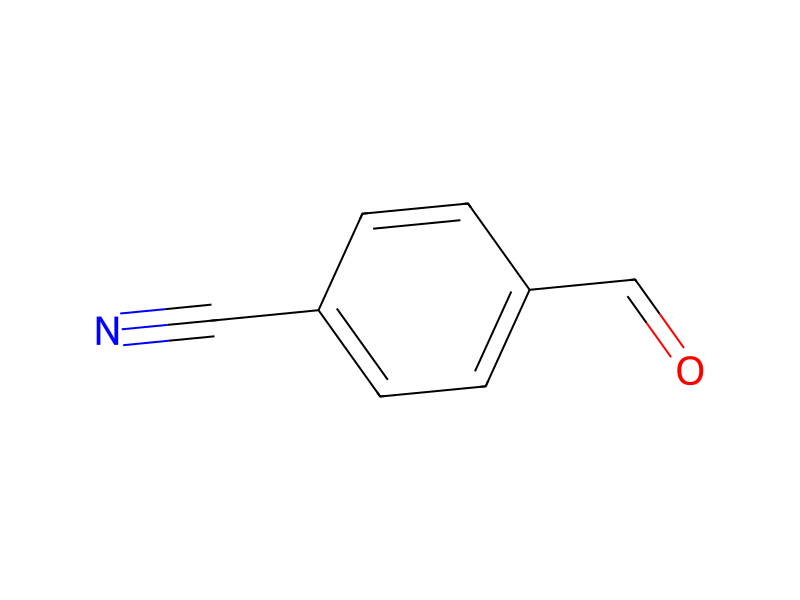
C(OC(CO)CO)CCCCCCC.C(C1C=CC(C=O)=CC=1)#N.O.C1(C)C=CC(S(O)(=O)=O)=CC=1.[CH2:37]([O:45][CH2:46][CH:47]1[CH2:51][O:50][CH:49]([C:52]2[CH:59]=[CH:58][C:55]([C:56]#[N:57])=[CH:54][CH:53]=2)[O:48]1)[CH2:38][CH2:39][CH2:40][CH2:41][CH2:42][CH2:43][CH3:44]>C1C=CC=CC=1>[CH2:37]([O:45][CH:46]1[CH2:47][O:48][CH:49]([C:52]2[CH:53]=[CH:54][C:55]([C:56]#[N:57])=[CH:58][CH:59]=2)[O:50][CH2:51]1)[CH2:38][CH2:39][CH2:40][CH2:41][CH2:42][CH2:43][CH3:44]To 10.2 g of the diol mixture obtained in (1) were added 100 ml of benzene, 6.6 g of p-cyanobenzaldehyde and p-toluenesulfonic acid monohydrate, and the mixture was heated. The generated water was removed by azeotropy with benzene. Then, the remaining benzene was distilled away, 200 ml of aqueous saturated sodium bicarbonate solution was added to the residue, and the mixture was extracted with dichloromethane. The extract was washed twice with water and dried over anhydrous sodium sulfate, and the solvent was distilled away to give 15.5 g of a crude product containing a by-product 4-(4-octyloxymethyl-1,3-dioxolan-2-yl)benzonitrile. This crude product was treated by column chromatography using silica gel to give 1.4 g of the desired product.