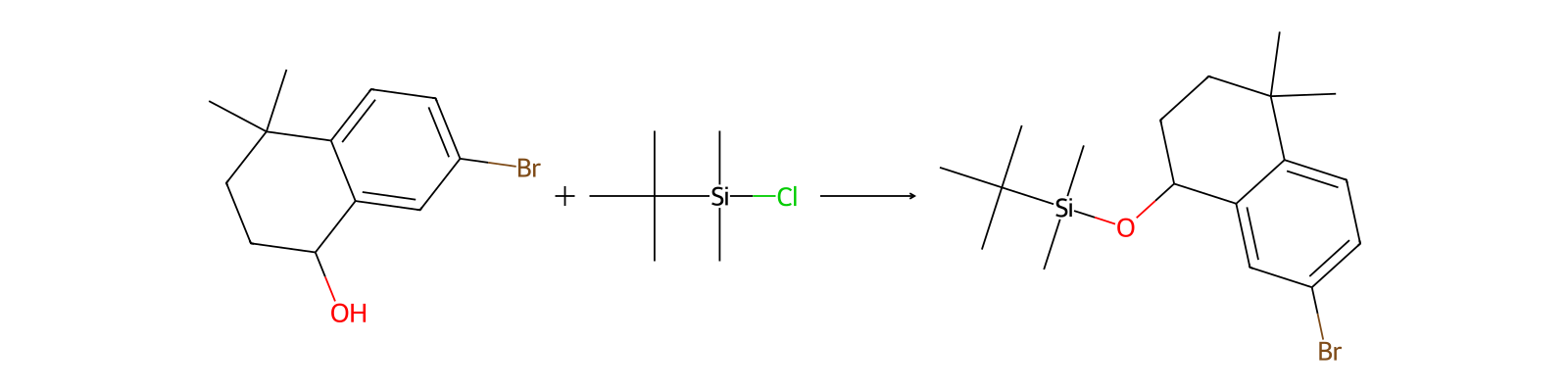
tert-Butyldimethylsilyl chloride → 6-Bromo-1,2,3,4-tetrahydro-1,1-dimethyl-4-(t-butyldimethylsilyloxy)naphthalene
반응식
[Br:1][C:2]1[CH:3]=[C:4]2[C:9](=[CH:10][CH:11]=1)[C:8]([CH3:13])([CH3:12])[CH2:7][CH2:6][CH:5]2[OH:14].[Si:15](Cl)([C:18]([CH3:21])([CH3:20])[CH3:19])([CH3:17])[CH3:16]>>[Br:1][C:2]1[CH:3]=[C:4]2[C:9](=[CH:10][CH:11]=1)[C:8]([CH3:12])([CH3:13])[CH2:7][CH2:6][CH:5]2[O:14][Si:15]([C:18]([CH3:21])([CH3:20])[CH3:19])([CH3:17])[CH3:16]참가 물질
3


실험 절차
Continuing on with the description of Reaction Scheme 6, 6-bromo-1,2,3,4-tetrahydro-1,1-dimethyl-4-hydroxynaphthalene is reacted in the presence of base with t-butyldimethylsilyl chloride to provide 6-bromo-1,2,3,4-tetrahydro-1,1-dimethyl-4-(t-butyldimethylsilyloxy)naphthalene (Compound B15). The starting 6-bromo-1,2,3,4-tetrahydro-1,1-dimethyl-4-hydroxynaphthalene can be obtained by reduction of 7-bromo-3,4-dihydro-4,4-dimethylnaphthalen-1(2H)-one (Compound G). Under conditions similar to the ones described above Compound B15 is converted to the boronic acid derivative (5,5-dimethyl-8-(t-butyldimethylsilyloxy)-5,6,7,8-tetrahydro-naphth-2-yl)boronic acid (Compound B14). Compound B14 is then coupled with ethyl 6-bromo-naphthalene-2-carboxylate to yield ethyl 6-[5,6,7,8-tetrahydro-5,5-dimethyl-8-(t-butyldimethylsilyloxy)-naphth-2-yl]naphth-2-oate (Compound B3). Compound B3 is then reacted with tetrabutylammonium fluoride to remove the t-butyldimethylsilyl blocking group and to give ethyl 6-[5,6,7,8-tetrahydro-5,5-dimethyl-8-hydroxy-naphth-2-yl]naphth-2-oate (Compound B4). Compound B4 can be acylated to give ethyl 6-[5,6,7,8-tetrahydro-5,5-dimethyl-8-(O-acetyl)-naphth-2-yl]naphth-2-oate (Compound B10), or methoxymethylated with methoxymethyl chloride in the presence of base (preferably ethyl N,N-diisopropylamine, Hunig's base) to give ethyl 6-[5,6,7,8-tetrahydro-5,5-dimethyl-8-(methoxymethyloxy)-naphth-2-yl]naphth-2-oate (Compound B8), and oxidized with N-methyl morpholine N-oxide to provide ethyl -6-[5,5-dimethyl-5,6-dihydro-naphthlen-8(7H)-one-2-yl]-naphthalen-2-oate (Compound B6). Compounds B8 and B10 of the invention are within the scope of Formula 1, whereas Compound B6 is within the scope of Formula 2. Compound B6 can be converted into the O-methyloxime (ethyl 6-[5,5-dimethyl-5,6-dihydro-naphthlen-8(7H)-anti-(O-methyl-oxime)-2-yl]-naphthalen-2-oate (Compound B11) not shown in the scheme) and into other derivatives such as oximes, imines, hydrazones and the like, as is described above in connection with Reaction Scheme 2. Further derivatives of Compound B6 (and of analogous compounds) wherein the 8-oxo function of the molecule is modified can be obtained in accordance with the general synthetic methodology described in this specification. For example the trifluoromethylsulfonyl (triflate) derivative can be obtained in analogy to the reaction leading to Compound A9 as described in Reaction Scheme 2, and the trifluoromethylsulfonyl (triflate) derivative is reacted with the reagents R14Me to provide compounds of Formula 6. ##STR21##