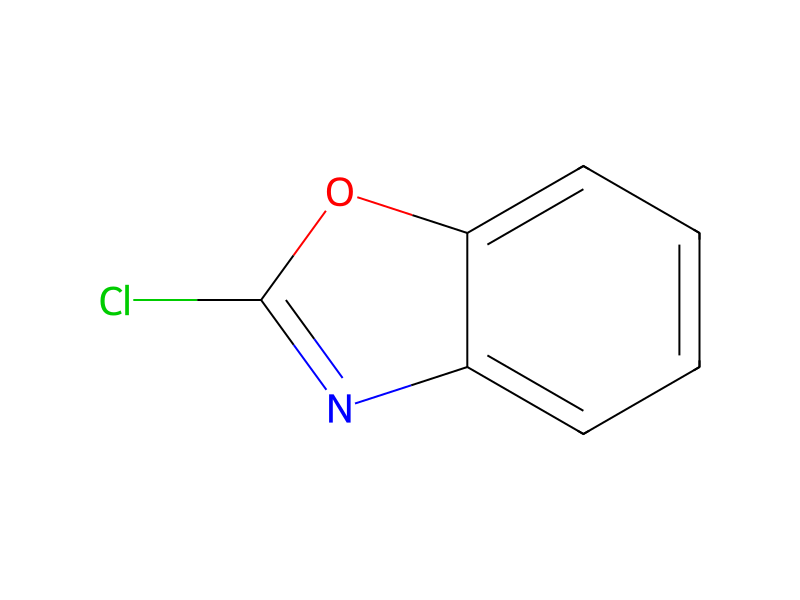
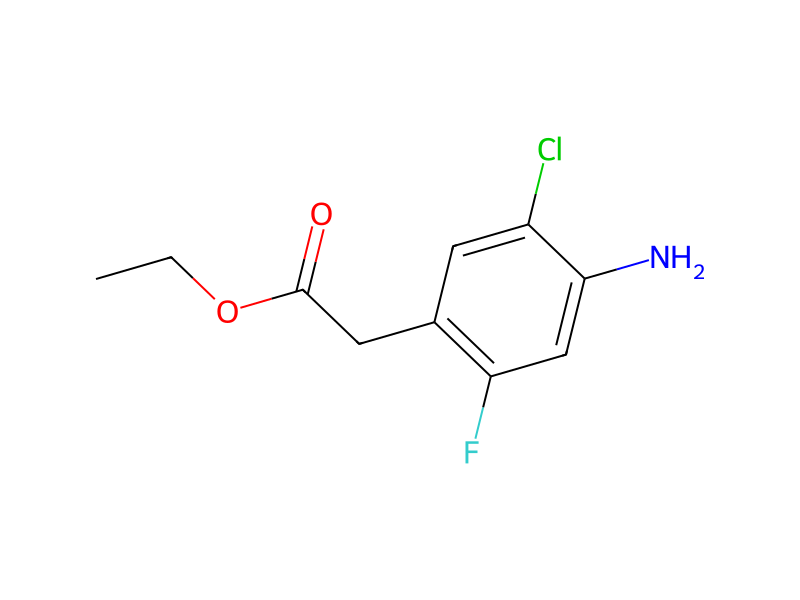
2-Chlorobenzoxazole → Ethyl (4-(2-benzoxazolyl)amino-5-chloro-2-fluorophenyl)acetate
반응식

Cl[C:2]1[O:3][C:4]2[CH:10]=[CH:9][CH:8]=[CH:7][C:5]=2[N:6]=1.[NH2:11][C:12]1[C:17]([Cl:18])=[CH:16][C:15]([CH2:19][C:20]([O:22][CH2:23][CH3:24])=[O:21])=[C:14]([F:25])[CH:13]=1>C1(C)C(C)=CC=CC=1>[O:3]1[C:4]2[CH:10]=[CH:9][CH:8]=[CH:7][C:5]=2[N:6]=[C:2]1[NH:11][C:12]1[C:17]([Cl:18])=[CH:16][C:15]([CH2:19][C:20]([O:22][CH2:23][CH3:24])=[O:21])=[C:14]([F:25])[CH:13]=1참가 물질
4


실험 절차
In xylene (4 ml), 2-chlorobenzoxazole (278 μl, 2.43 mmol) and ethyl (4-amino-5-chloro-2-fluorophenyl)acetate (512 mg, 2.21 mmol) were heated under reflux for 2 hours. After the reaction mixture was cooled to room temperature, the solvent was distilled off under reduced pressure. The residue was dissolved in ethyl acetate. The resulting solution was washed with a saturated aqueous solution of sodium bicarbonate, dried over anhydrous sodium sulfate, and distilled under reduced pressure to remove the solvent. The residue was purified by chromatography on a silica gel column, whereby from n-hexane/ethyl acetate (7:1, v/v) eluate fractions, ethyl (4-(2-benzoxazolyl)amino-5-chloro-2-fluorophenyl)acetate (570 mg, 74%) was obtained as a pale yellow solid.