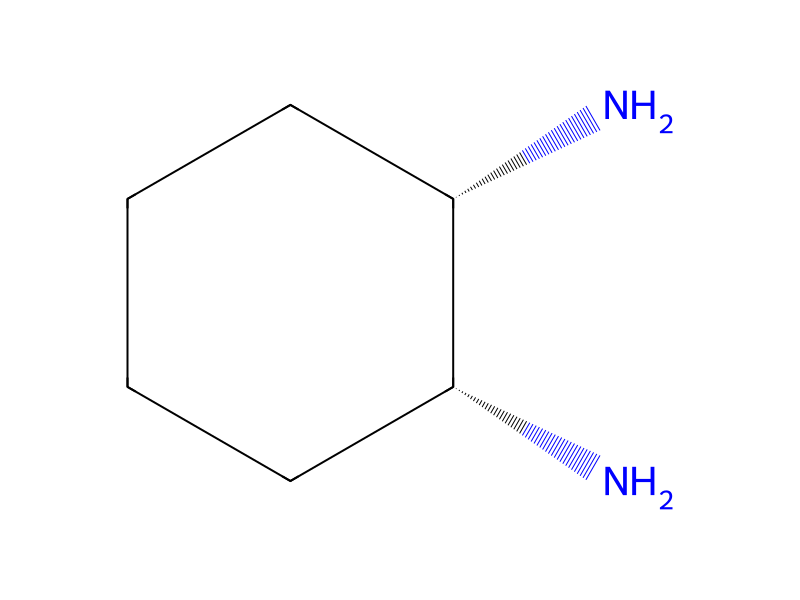
A mixture of 6-chloro-4-(5-(methylsulfonyl)pyridin-2-ylamino)pyridazine-3-carboxamide (60 mg, 0.183 mmol), cis-cyclohexane-1,2-diamine (125 mg, 1.1 mmol) and N-methyl-2-pyrrolidinone (2 mL) was heated to 150° C. After 18 h, the reaction mixture was cooled and concentrated in vacuo. Purification by chromatography (spherical silica 20-45 uM, 23 g, Versaflash Supelco, 0 to 5% MeOH containing 10% NH4OH in CH2Cl2, 20 min) gave a solid residue. This residue was dissolved in MeOH and CH2Cl2, then precipitated by addition of cyclohexane. The solid formed was obtained by decantation of the mother liquor, then dried to give 6-(cis-2-aminocyclohexylamino)-4-(5-(methylsulfonyl)pyridin-2-ylamino)pyridazine-3-carboxamide (19 mg, 45.6 μmol, 25%) as a beige solid. 1H NMR (300 MHz, DMSO-d6) δ ppm 12.21 (s, 1H) 8.73 (d, J=2.27 Hz, 1H) 8.48 (br. s., 1H) 8.16 (s, 1H) 8.12 (dd, J=8.69, 2.64 Hz, 1H) 7.75 (br. s., 1H) 7.14 (d, J=8.69 Hz, 1H) 7.03 (d, J=7.93 Hz, 1H) 4.06 (br. s., 1H) 3.26 (s, 3H) 3.09 (br. s., 1H) 1.24-1.78 (m, 10H). LCMS (EI/CI) m/z: 406 [M+H].