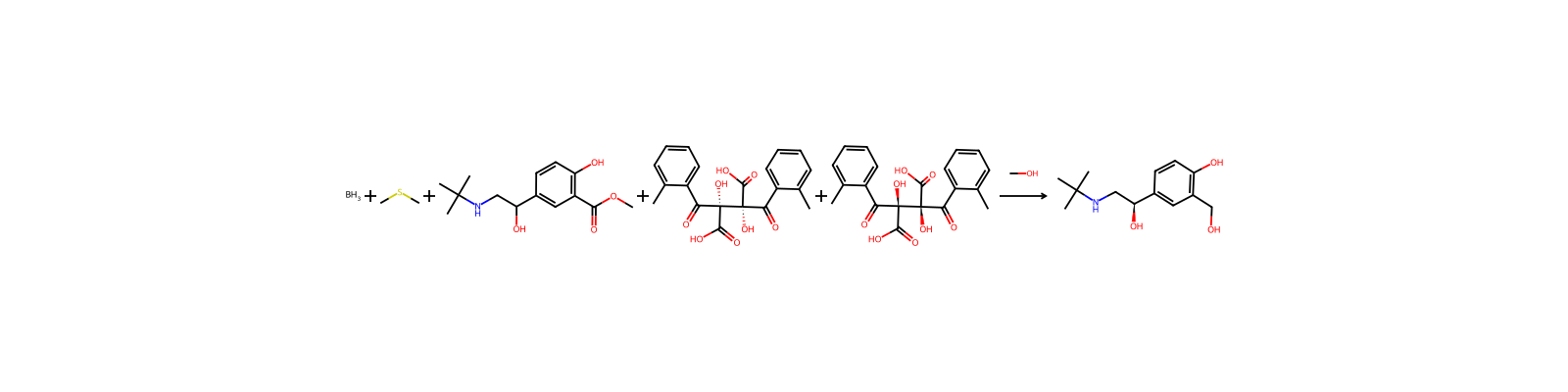
참여 물질
| 역할 | 이름 | HCID | 투입량 |
|---|
| 반응물 | Methyl 5-[2-[(1,1-dimethylethyl)amino]-1-hydroxyethyl]-2-hydroxybenzoate | HCID 11086725 | — |
| 반응물 | (Dimethyl sulfide)trihydroboron | HCID 12423031 | — |
| 반응물 | Ditoluoyl-l-tartaric acid | HCID 129746773 | — |
| 반응물 | (+)-di-toluoyl-D-tartaric acid | HCID 129858806 | — |
| 용매 | Methanol | HCID 887 | — |
| 생성물 | (-)-Salbutamol | HCID 123600 | — |
반응 단계
Several patents report synthetic routes using enantiomeric separation, however, the synthetic routes result in low yields of the enantiomerically pure product. Optically pure levalbuterol was synthesized by the borane-methylsulfide reduction of the enantiomerically pure precursor (Formula 2) as described in U.S. Pat. No. 5,399,765. The reaction dissolved a mixture of enantiomers of methyl 5-[2-[(1,1-dimethylethyl)amino]-1-hydroxyethyl]-2-hydroxybenzoate and a chiral acid selected from (−)-di-toluoyl-L-tartaric acid and (+)-di-toluoyl-D-tartaric acid in methanol, upon cooling one stereoisomer crystallized, which was separated, and recrystallized as a diastereomer from methanol, the diastereomer was separated, treated with base, and upon reduction formed optically active levalbuterol.
출처 및 근거
| DOI | 10.6084/m9.figshare.5104873.v1 |
|---|
| 특허 번호 | US07482489B2 |
|---|
| 출처 데이터셋 | uspto-grants-2009_01 |
|---|
| ORD ID | ord-c07eb2839d6b4c14a590a0ea09564163 |
|---|
| 출처 메모 | uspto-grants-2009_01 |
|---|