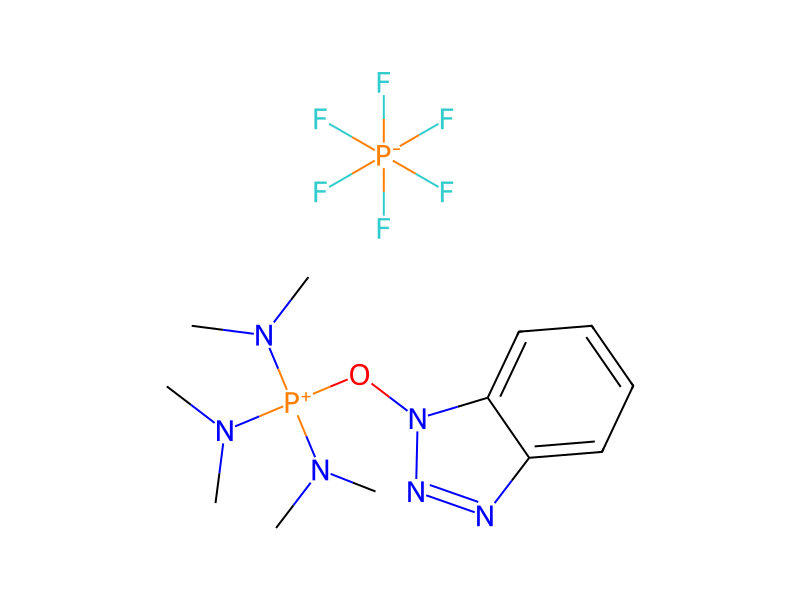
[Br:1][C:2]1[C:11]2[C:6](=[CH:7][CH:8]=[CH:9][CH:10]=2)[N:5]=[C:4]([C:12]([OH:14])=O)[CH:3]=1.Cl.[NH2:16][C@H:17]1[CH2:22][CH2:21][O:20][CH2:19][C@@H:18]1[OH:23].CN([P+](ON1N=NC2C=CC=CC1=2)(N(C)C)N(C)C)C.F[P-](F)(F)(F)(F)F.C(N(CC)CC)C>C(Cl)Cl>[Br:1][C:2]1[C:11]2[C:6](=[CH:7][CH:8]=[CH:9][CH:10]=2)[N:5]=[C:4]([C:12]([NH:16][C@H:17]2[CH2:22][CH2:21][O:20][CH2:19][C@@H:18]2[OH:23])=[O:14])[CH:3]=1To a solution of 4-bromoquinoline-2-carboxylic acid (A3) (0.5 g, 2.0 mmol) in 10 mL CH2Cl2 was added (3R,4S)-4-aminotetrahydro-2H-pyran-3-ol hydrogen chloride (0.37 g, 2.4 mmol), BOP reagent (1.1 g, 2.6 mmol), and triethylamine (0.83 mL, 6.0 mmol). The reaction was stirred at room temperature for 4.5 h, diluted with CH2Cl2, washed twice with water, dried over sodium sulfate, filtered, and concentrated. The resultant residue was subjected to silica gel chromatography eluting with 30-100% ethyl acetate in hexanes to afford 4-bromo-N-[(3R,4S)-3-hydroxytetrahydro-2H-pyran-4-yl]quinoline-2-carboxamide (O1) that gave a mass ion (ES+) of 353.2 (81Br) for M+H+.
불러오는 중…